
 Worksheets
Cell Organelle Quiz
Total questions: 22
Worksheet time: 17mins
Name
Class
Date
1.
All of the following are part of both a prokaryotic and eukaryotic cell except ____.
a)
a cell wall
b)
ribosomes
c)
an endoplasmic reticulum
d)
DNA
2.
You are told that the cells on a microscope slide are either plant, animal or bacterial. You look at them through a microscope and see cell walls and membrane-bound organelles. You conclude that the cells ____.
a)
are plant cells
b)
could be either plant cells or bacterial cells
c)
could be plant, animal or bacterial cells
d)
a bacterial cells
3.
Muscle cells are responsible for obtaining energy so the body can perform voluntary and involuntary movement. Using your knowledge about organelles and muscles, how would a muscle cell differ from other types of animal cells?
a)
The muscle cells would have larger centrioles than other types of animal cells.
b)
The muscle cells would have a larger Golgi apparatus than other types of animal cells.
c)
The muscle cells would have more mitochondria than other types of animal cells.
d)
The muscle cells would have more endoplasmic reticulum than other types of animals cells.
4.
Which of the following pairs is correctly matched?
a)
chloroplasts--storage of enzymes
b)
lysosome- cell division
c)
mitochondria - Produces energy (ATP)
d)
Golgi apparatus - production of energy
5.
____ endoplasmic reticulum has ribosomes attached to its outer membrane.
a)
Smooth
b)
Spiked
c)
Rough
d)
Cytoskeletal
6.
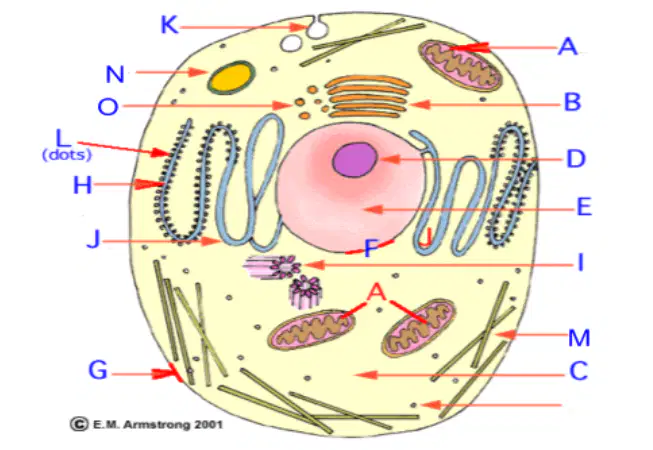
Which letter is pointing to the structure that is needed by animal cells to carry out cell division?
a)
Letter A
b)
Letter C
c)
Letter E
d)
Letter I
7.
Janae took the following notes will learning about cells:
1. Forms boundary between a cell and the outside environment
2. Controls the movement of materials into and out of the cell.
3. Consists of a double layer of phospholipids.
She forgot to write the name of the cell structure that her class was studying that day. What structure is described in her notes?
a)
endoplasmic reticulum
b)
cell membrane
c)
cell wall
d)
nucleus
8.
What features do plant cells have that animal cells lack?
a)
nucleus & cell membrane
b)
cell membrane & chloroplasts
c)
cytoplasm & cell wall
d)
cell wall & chloroplasts
9.

What structure do all of these cells have?
a)
cell membrane
b)
cell wall
c)
chloroplasts
d)
nucleus
10.
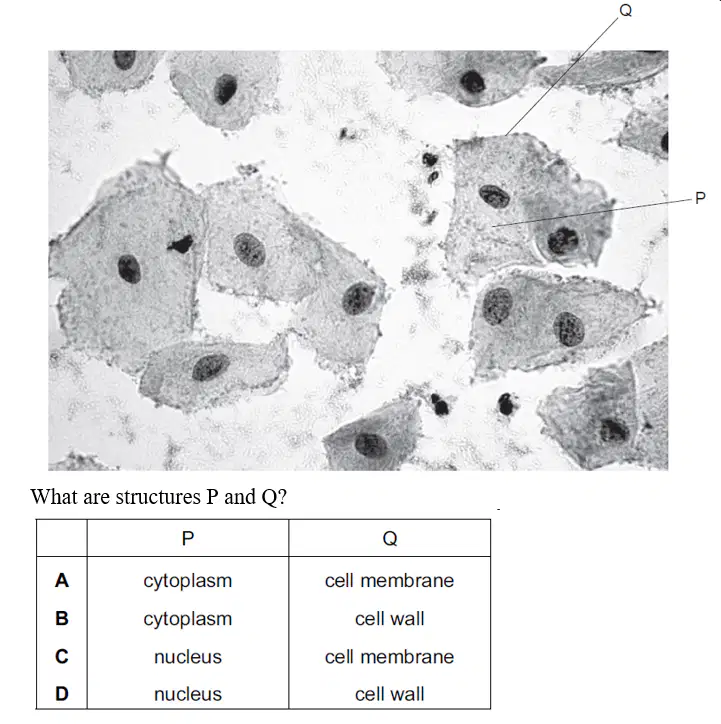
a)
A
b)
B
c)
C
d)
D
11.
Where protein synthesis occurs
a)
mitochondria
b)
chloroplast
c)
cell membrane
d)
ribosomes
12.
holds food and waste for the plant cell
a)
cell membrane
b)
cell wall
c)
chloroplast
d)
central vacuole
13.
A phospholipid has 2 parts. What are they called?
a)
Hydrophilic Head, Hydrophobic Tail
b)
Hydrophobic Head, Hydrophilic Tail
14.
Another term for maintaining an internal balance is...
a)
Equality
b)
Equential
c)
Homeostasis
d)
Balance
15.
Which of the following macromolecules is NOT part of the cell membrane?
a)
Lipids
b)
Carbohydrates
c)
Proteins
d)
Nucleic Acids
16.
How many layers thick is the lipid bilayer?
a)
1
b)
2
c)
3
d)
4
17.
Something is ___________ ____________
when some molecules can cross the membrane while others cannot.
when some molecules can cross the membrane while others cannot.
a)
Selectively (or Semi) Permeable
b)
Totally Transparent
c)
Liquid Licorice
d)
Heavily Patrolled
18.

Which organelle is only found in a plant cell?
a)
nucleus
b)
chloroplast
c)
mitochondria
d)
cell membrane
19.

Using this image, what organelle is N?
a)
Centrioles
b)
Cell Membrane
c)
Golgi Apparatus
d)
Ribosome
20.

Which part of an onion root cell gives it a brick-like structure?
a)
Cell membrane
b)
Cell wall
c)
Vacuole
d)
Chloroplast
21.

What does letter h point to
a)
mitochondria
b)
nucleus
c)
vacuole
d)
cytoplasm
22.

ALL cells (prokaryotic and eukaryotic) have DNA, ribosomes, cytoplasm, and __________________________.
a)
a cell wall
b)
mitochondria
c)
a cell membrane
d)
chloroplast
100 %

