
 Worksheets
IBC #1 Practice Quiz
Total questions: 10
Worksheet time: 5mins
Name
Class
Date
1.
What does the term "Bias" refer to in the context of professional communications?
a)
A) The ability to write persuasively and convincingly.
b)
B) A personal inclination or prejudice that influences judgment.
c)
C) The use of formal language and tone in written communication.
d)
D) The process of gathering information from multiple sources.
2.
What are two personal presentation choices that will best prepare you for an interview?
a)
A) Wearing casual attire to appear approachable.
b)
B) Dressing professionally and grooming well.
c)
C) Avoiding eye contact to seem more focused.
d)
D) Speaking softly to convey confidence.
3.
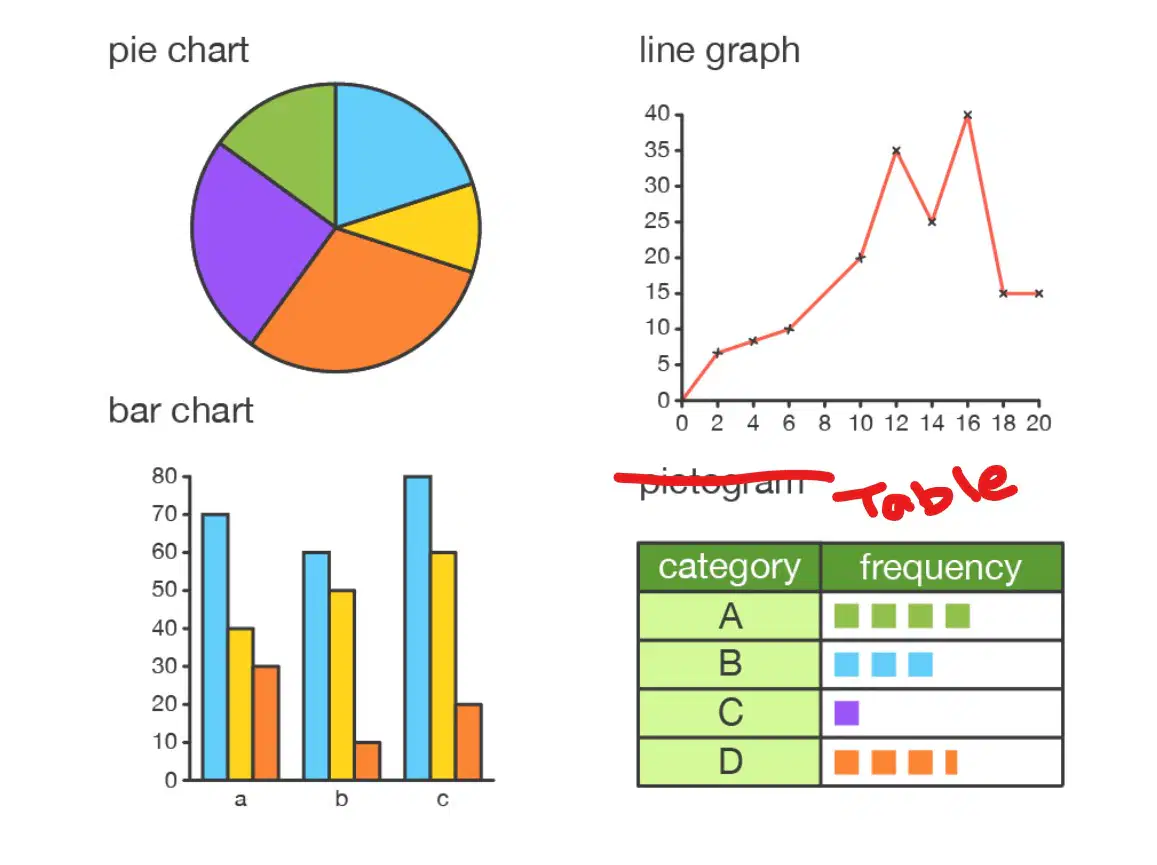
What is the primary difference between a line graph, pie graph, bar graph, and table graph in professional communications?
a)
A) Line graphs display data trends over time, pie graphs represent proportions of a whole, bar graphs compare different categories, while table graphs present data in a structured format.
b)
B) Line graphs emphasize categorical comparisons, pie graphs highlight sequential changes, bar graphs depict proportional relationships, while table graphs organize data in a linear fashion.
c)
C) Line graphs illustrate frequency distributions, pie graphs demonstrate rank order, bar graphs showcase correlation coefficients, while table graphs summarize descriptive statistics.
d)
D) Line graphs present qualitative data, pie graphs analyze quantitative relationships, bar graphs visualize continuous variables, while table graphs interpret inferential statistics.
4.
If you want to create a record of a conversation, calling someone on the phone is a great way to do so.
a)
True
b)
False
5.
To help understand a person's message better, you can clarify their statement by paraphrasing what they've said.
a)
True
b)
False
6.
Which of the following sections are essential components of a professional resume?
a)
A) Personal interests, hobbies, and favorite activities.
b)
B) References from past employers or colleagues.
c)
C) Work experience, education, skills, and contact information.
d)
D) A detailed autobiography highlighting personal achievements.
7.
Which of the following statements accurately reflects the role of letters of recommendation on a resume?
a)
A) Letters of recommendation are mandatory for all resumes to be considered complete.
b)
B) Including letters of recommendation can substitute for listing work experience.
c)
C) Letters of recommendation provide additional validation of an applicant's qualifications and character. They are optional depending on the position.
d)
D) Letters of recommendation are irrelevant and should not be included on a resume.
8.
What is the most effective form of communication for informing your office about changed work safety rules?
a)
A) Email
b)
B) Phone call
c)
C) Text message
d)
D) In-person meeting
9.
What is the primary characteristic of a 'persuasive message' in professional communication?
a)
A) A message intended to entertain the recipient.
b)
B) A message conveying factual information or updates.
c)
C) A message designed to influence the recipient's beliefs or actions.
d)
D) A message primarily focused on providing instructions or guidance.
10.
Your personal online accounts for email and social media should be kept separate from professional business accounts.
a)
True
b)
False
100 %

