
Font size
 Worksheets
Chapter 6 Practice
Total questions: 66
Worksheet time: 33mins
How many valence electrons does Lithium (Li) have?
1
2
3
0
How many valence electrons does Magnesium (Mg) have? (Electron configuration: 3s²)
2
4
6
8
How many valence electrons does Sulfur (S) have? (Electron configuration: 3s²3p⁴)
6
4
2
8
How many valence electrons does Bromine (Br) have?
5
6
7
8
What are chemical bonds formed by?
Atoms losing, gaining, or sharing valence electrons
Atoms splitting into smaller atoms
Atoms changing color
Atoms evaporating
Eight valence electrons is called a _________.
noble gas configuration
octet rule
covalent bond
isotope
In the example given, Argon (Ar) has the electron configuration 3s²3p⁶. Is this a very stable element?
True
False
What type of compound is formed by ionic bonds?
Molecular compound
Ionic compound
Metallic compound
Covalent compound
What type of compound is formed by covalent bonds?
Ionic compound
Molecular compound
Metallic compound
Noble gas
What is a cation?
A) A positively charged ion
B) A negatively charged ion
C) A neutral atom
D) An atom that gains electrons
What is an anion?
A) A positively charged ion
B) A negatively charged ion
C) A neutral atom
D) An atom that loses electrons
Fill in the blank: Atoms form positively charged ions when they ______ electrons and negatively charged ions when they ______ electrons.
lose; gain
gain; lose
share; lose
lose; share
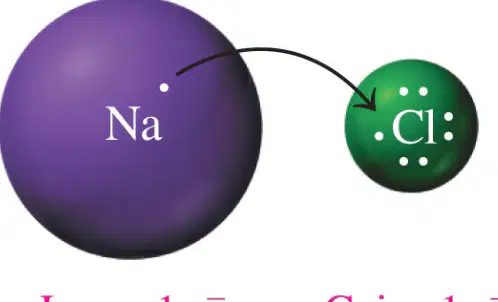
Refer to the diagram showing the transfer of electrons between Na and Cl. Which atom loses an electron and which atom gains an electron?
Na loses an electron; Cl gains an electron.
Cl loses an electron; Na gains an electron.
Both Na and Cl lose electrons.
Both Na and Cl gain electrons.
Ionic bonds are formed by the strong attractive forces between ______ and ______ ions.
positive; negative
neutral; positive
negative; neutral
positive; positive
In ionic bonding, ions form when atoms gain or lose their valence electrons to form a stable electron configuration. Metals in Group 1A (1), Group 2A (2), and Group 3A (13) have low ________ energies.
ionization
electronegativity
atomic
melting
In ionic bonding, ions form when atoms gain or lose their valence electrons to form a stable electron configuration. Metals in Group 1A (1), Group 2A (2), and Group 3A (13) readily lose one or more of their valence electrons to form ions with a ________ charge. Fill in the blank.
positive
negative
neutral
zero
In ionic bonding, ions form when atoms gain or lose their valence electrons to form a stable electron configuration. Metals in Group 1A (1), Group 2A (2), and Group 3A (13) lose electrons until they have the same number of valence electrons as the nearest noble gas, usually ______ valence electrons. What is the correct number of valence electrons?
eight
two
four
six
What is the electron configuration of sodium?
1s² 2s² 2p⁶ 3s¹
1s² 2s² 2p⁶ 3p¹
1s² 2s² 2p⁵ 3s²
1s² 2s² 2p⁶ 3s²
True or False: Metals have high ionization energies.
True
False
Nonmetals in Group 5A (15), Group 6A (16), and Group 7A (17) have high ionization energies.
True
False
Nonmetals gain electrons until they have the same number of valence electrons as the nearest noble gas, usually eight valence electrons.
True
False
Fill in the blank: The electron configuration for chlorine (Cl) is _____
1s2 2s2 2p6 3s2 3p5
1s2 2s2 2p6 3s2 3p6
1s2 2s2 2p6 3s2 3p4
1s2 2s2 2p6 3s2 3p3
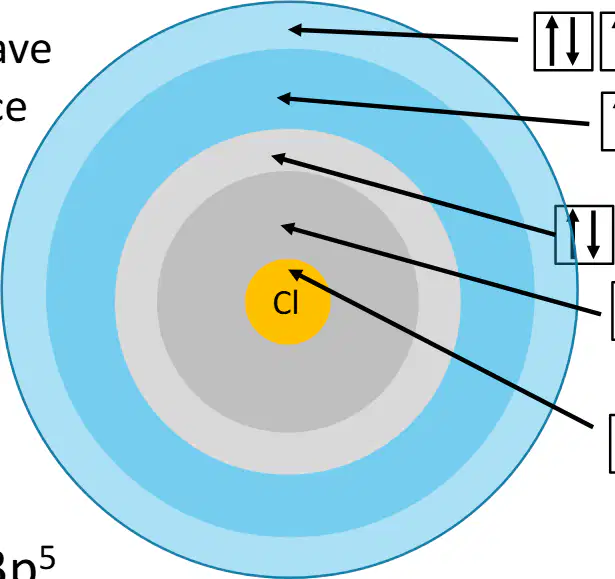
Refer to the diagram of the chlorine atom. The orbital that contains 5 electrons in the outermost shell is:
3p orbital
2p orbital
3s orbital
1s orbital
What is the nearest noble gas to the Li+ ion?
He
Ne
Ar
Kr
What is the nearest noble gas to the Na+ ion?
Ne
He
Ar
Kr
What is the nearest noble gas to the K+ ion?
Ar
Ne
He
Kr
What is the nearest noble gas to the Rb+ ion?
Kr
Ne
Ar
Xe
What is the nearest noble gas to the Cs+ ion?
Xe
Ne
Ar
Kr
What is the nearest noble gas to the N3- ion?
Ne
He
Ar
Kr
What is the nearest noble gas to the O2- ion?
Ne
He
Ar
Kr
What is the nearest noble gas to the F- ion?
Ne
He
Ar
Kr
What is the nearest noble gas to the S2- ion?
Ar
Ne
Kr
Xe
What is the nearest noble gas to the Cl- ion?
Ar
Ne
Kr
Xe
What is the nearest noble gas to the Br- ion?
Kr
Ne
Ar
Xe
What is the nearest noble gas to the I- ion?
Xe
Ne
Ar
Kr
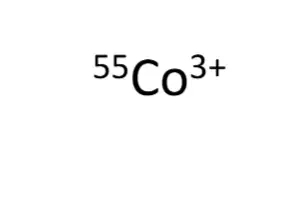
Given the atomic symbol, determine the number of protons, neutrons, and electrons in the following ion: 55Co3+.
Protons: 27, Neutrons: 28, Electrons: 24
Protons: 27, Neutrons: 30, Electrons: 27
Protons: 28, Neutrons: 27, Electrons: 24
Protons: 27, Neutrons: 28, Electrons: 27
Write the formula and the symbol of an ion with 16 protons and 18 electrons.
S²⁺
Ar
Ar²⁺
S²⁻
P²⁻
What are ionic compounds?
Compounds made of only positive charges
Compounds made of only negative charges
Compounds consisting of positive and negative charges held together by strong electrical attractions between oppositely charged ions
Compounds that are always liquids at room temperature
Fill in the blank: The strong electrical attractions between oppositely charged ions in ionic compounds are called _________.
ionic bonds
covalent bonds
metallic bonds
hydrogen bonds
Which of the following are properties of ionic compounds? Choose all that apply.
Low melting points
High melting points
Liquids at room temperature
Solids at room temperature
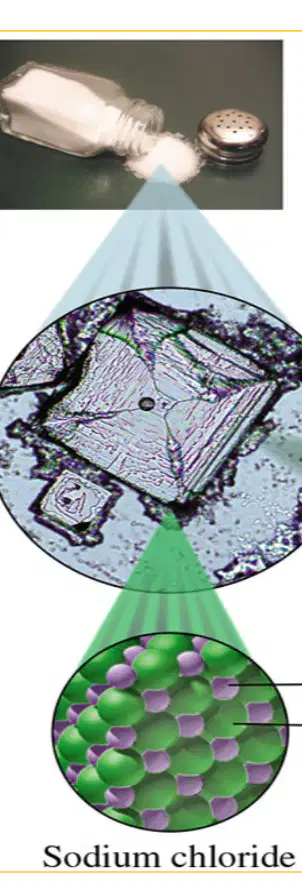
The diagram shows the structure of sodium chloride. Which ions are present in sodium chloride?
Na+ and Cl-
K+ and Br-
Ca2+ and O2-
H+ and OH-
In a chemical formula, the symbols and subscripts are written in the lowest whole-number ratio of the atoms or ions.
True
False
In a chemical formula, the sum of ion charges equals ____.
zero
one
two
ten
What is the lowest whole number combination for a compound called?
Molecule
Formula unit
Isotope
Ion
In the formation of NaCl, which atom loses an electron and which atom gains an electron?
Na loses an electron, Cl gains an electron.
Cl loses an electron, Na gains an electron.
Both Na and Cl lose electrons.
Both Na and Cl gain electrons.
To balance ionic charge in an ionic compound, what must be true?
Total positive charge > total negative charge
Total positive charge < total negative charge
Total positive charge = total negative charge
Total positive charge is ignored
In the formation of MgCl2, how many electrons does magnesium lose?
2 electrons
1 electron
3 electrons
0 electrons
In the formation of MgCl2, each chlorine atom gains ____.
1 electron
2 electrons
3 electrons
0 electrons
What is the chemical formula for magnesium chloride?
MgCl
MgCl2
Mg2Cl
Mg2Cl2
According to the image, what must be true to balance ionic charge in an ionic compound?
Total positive charge must be greater than total negative charge
Total positive charge must be less than total negative charge
Total positive charge must equal total negative charge
Total negative charge must be zero
In the formation of Na2S, how many electrons does each sodium atom lose?
1 electron
2 electrons
3 electrons
0 electrons
Fill in the blank: The formula for sodium sulfide is _____
Na2S
NaS
Na2SO4
NaSO3
What is the name of the compound with the formula Na2S?
Sodium sulfate
Sodium sulfide
Sodium sulfite
Sodium sulfur
What is the ionic formula of the compound formed between Al³⁺ and Cl⁻ ions?
AlCl₃
AlCl
Al₂Cl₃
Al₃Cl₂
What is the ionic formula of the compound formed between Mg²⁺ and N³⁻ ions?
Mg₃N₂
MgN
Mg₂N₃
MgN₂
What is the ionic formula of the compound formed between calcium and bromine?
Ca₂Br₂
Ca₂Br
CaBr
Ca₇Br₂
CaBr₂
According to the instructions for naming ionic compounds: 1. The name of the metal is written first and is the same as the name of the element. 2. The name of the nonmetal is the first syllable of the nonmetal name + ide ending and is written second. 3. A space is placed between the name of the metal and nonmetal ion. What is the name of the compound KI?
Potassium iodide
Potassium oxide
Potassium chloride
Potassium fluoride
What is the name of the compound MgBr2?
Magnesium bromide
Magnesium bromate
Manganese bromide
Magnesium dibromide
According to the instructions for naming ionic compounds: 1. The name of the metal is written first and is the same as the name of the element. 2. The name of the nonmetal is the first syllable of the nonmetal name + ide ending and is written second. 3. A space is placed between the name of the metal and nonmetal ion. What is the name of the compound Al2O3?
Aluminum oxide
Aluminum trioxide
Aluminum oxygen
Alumina
Identify the cation and anion in the compound K2O. The cation, K+, is from which group?
Group 1A (1)
Group 2A (2)
Group 3A (13)
Group 7A (17)
Identify the cation and anion in the compound K2O. The anion, O2-, is from which group?
Group 6A (16)
Group 1A (1)
Group 2A (2)
Group 7A (17)
STEP 2: Name the cation in K2O by its element name. The cation, K+, is ________.
potassium
sodium
calcium
magnesium
Name the anion in K2O by using the first syllable of its element name followed by 'ide'. The name of the anion O2- is ________.
oxide
oxalate
oxygenide
oxonate
What is the name of K2O?
potassium oxide
potassium peroxide
potassium hydroxide
potassium carbonate
What is the name of the ionic compound Ca3N2?
calcium nitride
calcium nitrate
calcium nitrite
calcium nitride oxide
What is the formula for the ionic compound formed with Na+ and PO43− ?
Na2PO4
NaPO4
Na3PO4
Na(PO4)3
Na2(PO4)3

