
 Worksheets
L7-L10 Assessment
Total questions: 11
Worksheet time: 6mins
Name
Class
Date
1.
Period
a)
1
b)
2
c)
3
d)
4
e)
6
2.
First and LAST NAME
4 lines
3.

Did a chemical reaction occur when magnesium was burned? Select the best explanation.
a)
A chemical reaction occurred when the teacher burned magnesium. While the two solids have the same solubility, the magnesium (the solid before burning) has a different color, hardness, density, and melting point than the solid after burning. The products of a chemical reaction are different substances from the reactants. The properties of the solids are different, so a chemical reaction occurred.
b)
A chemical reaction occurred when the magnesium was burned. Because the properties are different we know that a chemical reaction has taken place.
c)
The magnesium has the same solubility in water before and after the burning but all of the other properties have changed so a chemical reaction happened.
d)
A chemical reaction occurred when a strip of magnesium was burned. The strip of magnesium was a silver solid before the burning and now is a white powder with a different density and melting point.
4.
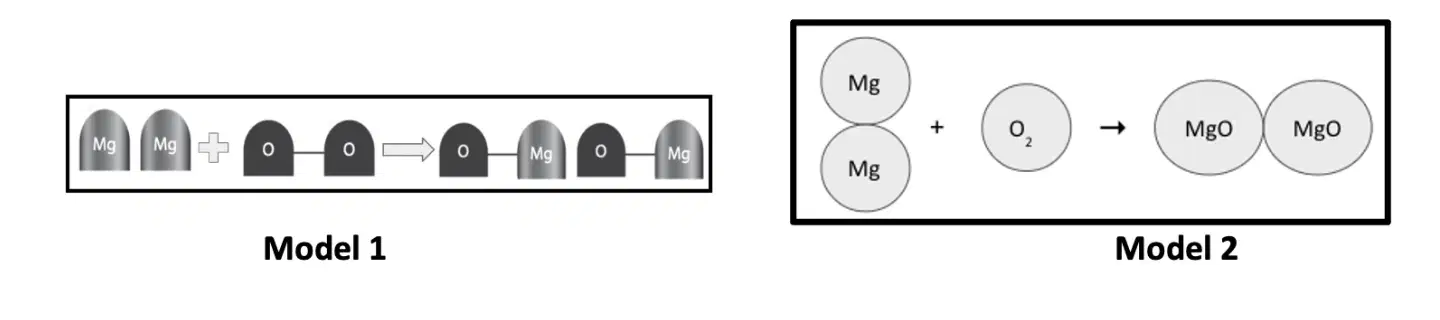
Look at the symbols for magnesium, oxygen, and magnesium oxide. Which model best represents the chemical reaction of the burning of magnesium?
Magnesium: Mg
Oxygen: O2,
Magnesium oxide: 2MgO
a)
Model 1 is the most accurate.
b)
Model 2 is the most accurate.
c)
Both models are the same.
d)
Neither model represents the chemical reaction.
5.
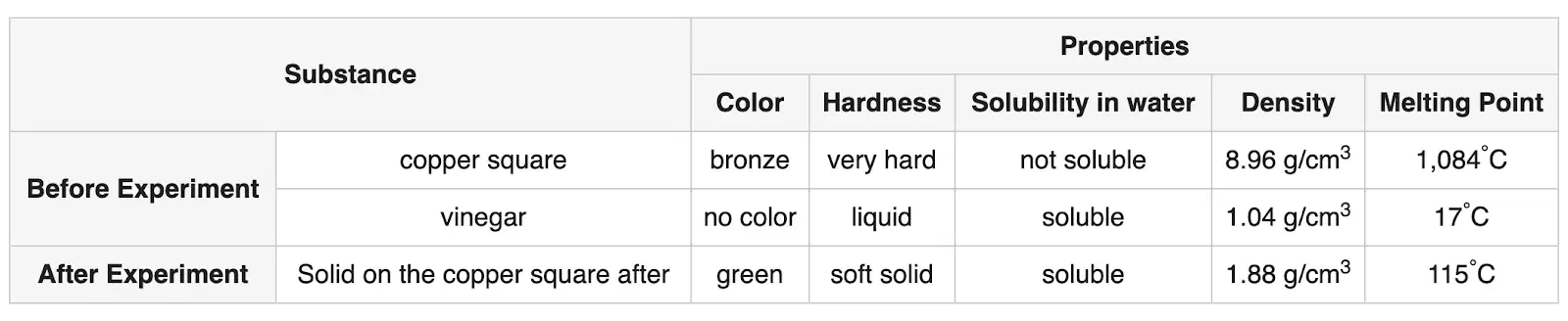
Does acid rain make new substances? Construct an argument that uses data from this investigation as evidence for your claim.
a)
A chemical reaction occurred when I combined the copper square and vinegar. I know this because a new green substance formed. A chemical reaction always results in a new substance.
b)
Acid rain and copper do not make for a chemical reaction. The copper was mostly the same with only a little green solid on it which came from the vinegar as it went from a liquid to a solid in the closed system.
c)
A chemical reaction occurred when I combined the copper square and vinegar. The copper square before the experiment had a different color, hardness, solubility in water, density, and melting point from the solid on the copper square after the experiment. The properties of the solids before and after the experiment are different, so the solids are different substances. A chemical reaction always results in different substances.
d)
A chemical reaction occurred when the copper square was dipped in vinegar. Before the copper was placed in the vinegar, it was bronze, very hard, and not soluble in water. After the experiment, the copper string was soft and bendable, and soluble in water. The copper strip became a new substance so it was a chemical reaction.
6.
Use your principle for this Lesson
Our current definition of a chemical reaction is a process where substances interact to form new substances. Which new definition of a chemical reaction best
explains what we now know occurs with the atoms and molecules?
a)
A chemical reaction is a process when two or more substances interact and their atoms combine in new ways to form new substances with different properties than the old substances. The new substances are made of the same atoms as the old substances, but the atoms are arranged in new ways.
b)
Sometimes in a chemical reaction, a new substance is formed and energy is released.
c)
A chemical reaction is a process in which substances interact to form new substances with properties different from the old substances.
d)
A chemical reaction is a process when two or more substances interact and new substances are made with new atoms and molecules. The old atoms and molecules are absorbed into the surroundings.
7.
In this activity, you investigated what happens when an electric current is sent through the water. You determined that the electrolysis of water results in a chemical reaction. What were the reactants? What were the products?
a)
The reactant was the battery acid and the products are hydrogen and oxygen.
b)
The reactant was hydrogen and the product is oxygen.
c)
The reactant was water and the products were hydrogen gas and oxygen gas.
d)
The investigation broke apart a water molecule so there was no reactant and product.
8.
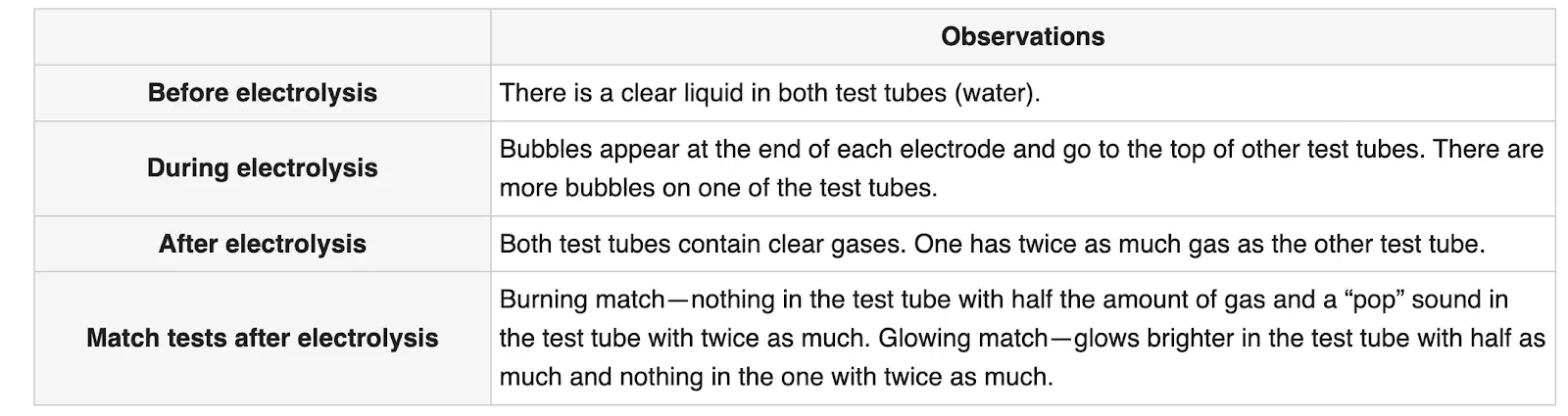
you are the teacher choose the best CERT
Which argument could convince someone else that electrolysis is a chemical reaction.
a)
A chemical reaction occurred during electrolysis. We started with water and we ended up with water in a gas state. During the reaction, we saw bubbles at the ends of the electrodes in the beaker of water as gas entered the test tubes. The oxygen and the hydrogen in the water vapor reacted differently with a match than water would react. Because they reacted differently, it was a chemical reaction.
b)
A chemical reaction occurred during electrolysis. We started with just liquid water, and after electrolysis, we had hydrogen gas and oxygen gas. We saw bubbles during the experiment that was an indication gas was being formed. We saw that one test tube had twice as much gas as the other test tube. During a flame test, one gas popped and the other caused a match flame to glow more brightly. The molecules of the water were split apart during electrolysis and the atoms rearranged to form hydrogen and oxygen gas. These two gases are new substances that have different properties than water.
c)
During a chemical reaction, at least two or more substances are combined. When they come together, there is often a release of heat and gases which causes bubbles to form. A new substance with new properties and new molecules is formed during a chemical reaction.
d)
Electrolysis is not a chemical reaction. In a chemical reaction, a new substance is formed with new atoms and molecules. Water has two hydrogen atoms and one oxygen atom. During electrolysis, the atoms were simply separated but not rearranged to form a new substance.
9.
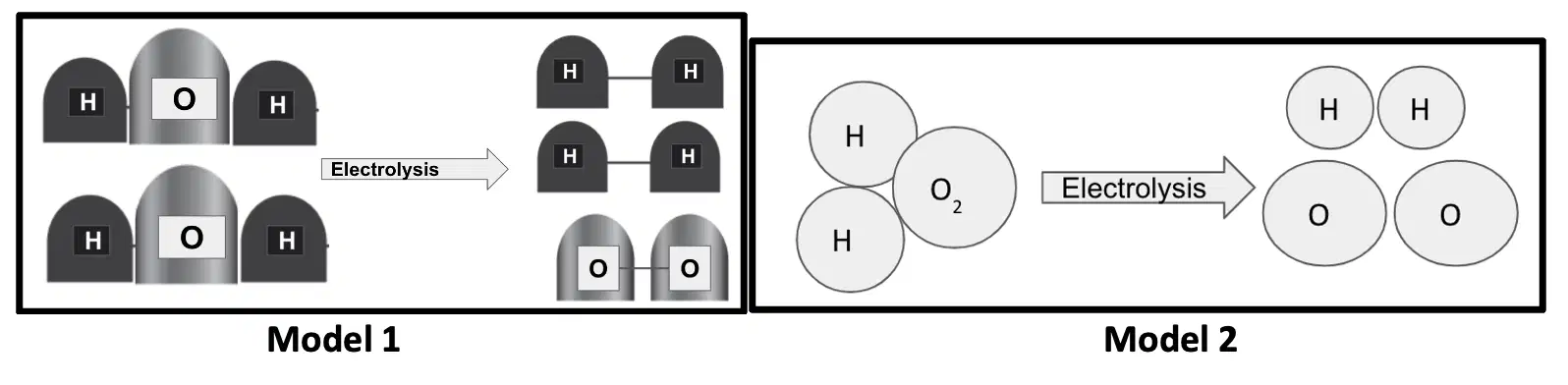
Which ball and stick model represents the process of the electrolysis of water as a chemical reaction?
a)
Neither model represents what happened during the electrolysis of water.
b)
Model 1because two water molecules broke down into two hydrogen molecules each with two hydrogen atoms and one oxygen molecule with two oxygen atoms.
c)
Both models accurately represent how the electrolysis of water is a chemical reaction.
d)
Model 2 because each time a water molecule was broken down into two hydrogen gas atoms and two oxygen gas molecules.
10.
What must happen to the atoms and molecules of the drink solution for this to be a chemical reaction?
a)
a. The atoms must combine with each other to form larger molecules.
b)
b. The atoms must separate and move farther apart making it less dense.
c)
c. The atoms in the water and powder must rearrange in new and different ways to form a new substance.
d)
d. The H O must separate into H and O in order to be a chemical reaction.
11.
Which of the following is an example of a phase change? Select all that apply.
a)
a. Freezing water
b)
b. Melting fat
c)
c. Making hot chocolate
d)
d. Baking Bread
100 %

