
Font size
 Worksheets
Introduction to Marketing Quiz
Total questions: 100
Worksheet time: 50mins
Which of the following is NOT listed as a lesson in the "Introduction to Marketing" module?
The Basics of Marketing
Consumer Buying Behavior
Financial Accounting
Market Research
Which lesson in the module would most likely cover understanding why people choose certain products over others?
The 4 Ps
Consumer Buying Behavior
Market Research
Marketing Strategy
If you wanted to learn about the elements of product, price, place, and promotion, which lesson from the module should you study?
The Basics of Marketing
The 4 Ps
Market Research
Marketing Strategy
A company wants to understand its customers better before launching a new product. Which lesson from the module would be most helpful for this purpose?
Market Research
The 4 Ps
The Basics of Marketing
Marketing Strategy
Which lesson in the module is most likely to focus on planning and setting goals to reach customers effectively?
Marketing Strategy
Consumer Buying Behavior
The 4 Ps
Market Research
Which of the following best describes one way marketing adds value to an organization?
By increasing the number of employees
By adding value to an organization’s goods and services
By reducing the quality of products
By eliminating competition
Which of the following should you be able to differentiate after learning the basics of marketing?
Employees and managers
Products, product lines, and product mixes
Profits and losses
Customers and suppliers
Suppose a company offers three types of beverages, five types of snacks, and two types of desserts. How would you categorize these offerings using marketing concepts?
As a single product
As a product mix
As a marketing strategy
As a service line
What is the main purpose of marketing according to the text?
To increase the number of products a company sells
To help businesses understand and meet the needs, wants, and desires of customers
To reduce the cost of production
To focus only on advertising
According to the American Marketing Association, what does marketing involve?
Only advertising and selling products
Creating, communicating, delivering, and exchanging offerings that have value for customers and society
Manufacturing products in large quantities
Reducing prices to attract customers
Which of the following best describes the marketing concept?
Focusing on increasing total sales regardless of customer needs
Concentrating on customer satisfaction, service, and profitability
Only promoting products through advertisements
Ignoring customer feedback
How do for-profit and not-for-profit organizations differ in their use of marketing?
Only for-profit organizations use marketing
Not-for-profit organizations use marketing only for advertising
For-profit organizations use marketing to deliver goods, while not-for-profits use it for public or private sector goals
Both use marketing only to increase sales
Why is customer satisfaction important in marketing?
It helps companies reduce their costs
It ensures that products are always the cheapest
It helps companies meet or exceed customer expectations, leading to loyalty
It focuses only on increasing the number of products sold
What is the main focus of customer relationship management (CRM)?
Increasing the number of advertisements
Finding out everything possible about customers to satisfy and exceed their expectations
Reducing the number of employees
Focusing only on short-term sales
A company wants to improve its profitability by focusing on the most profitable products rather than total sales. Which marketing principle are they applying?
Emphasis on total sales
Emphasis on profitability, not sales
Emphasis on advertising
Emphasis on product variety
If a company integrates the marketing concept throughout all levels of its organization, what is the likely outcome?
Only the top management will focus on customers
All employees will focus on satisfying the customer
Only the sales team will be responsible for customer service
The company will ignore customer feedback
What is the main focus of companies when utilizing marketing, according to the text?
To increase production speed
To produce and deliver offerings that have value
To reduce the number of employees
To expand internationally only
How is "value" defined in the context of marketing?
The lowest price available in the market
A customer's perception that a product offers a better relationship between costs and benefits than competitors' products
The number of features a product has
The popularity of a product on social media
Why is it important for companies to deliver value to customers, clients, partners, and society at large?
It helps companies avoid paying taxes
It ensures that products are always the cheapest
It builds better relationships and competitive advantage
It allows companies to ignore customer feedback
Suppose a company wants to improve its value proposition. What should it focus on, based on the definition of value provided?
Increasing the price of its products
Reducing the quality to save costs
Enhancing the relationship between costs and benefits for customers
Limiting the availability of its products
Which of the following best defines a product in marketing?
A good or service that can satisfy buyers' needs
A collection of products designed for a similar market
The combination of all product lines a firm offers
A service that cannot satisfy customer needs
What is a product line?
A group of products designed for a similar market
A single product offered by a company
A service that is intangible
The combination of all product lines a firm offers
Which statement best describes a product mix?
The combination of all product lines that a firm offers
A single product that satisfies customer needs
A group of unrelated products
A service that is only intangible
A company that offers a variety of products to survive wide swings in demand is most likely using which marketing strategy?
Offering a product mix
Selling only one product
Focusing on intangible services only
Ignoring customer needs
If a company has several collections of products, each designed for a different market, what does this indicate about the company's marketing approach?
They have multiple product lines
They only offer one product
They do not consider customer needs
They only offer intangible services
What is the main focus of the lesson titled "Consumer Buying Behavior"?
How to increase sales in a business
How consumers make decisions and what influences their buying behavior
The history of consumer rights
The process of product manufacturing
By the end of the lesson, what will students be able to do regarding customer behaviors?
Memorize product prices
Categorize customer behaviors into the steps of the consumer buying process
List popular brands
Describe advertising techniques
Which of the following is a learning objective of the lesson on Consumer Buying Behavior?
Differentiate among the factors that influence buying behavior
Explain the history of marketing
Identify types of retail stores
Calculate profit margins
Why is it important to categorize customer behaviors into the steps of the consumer buying process?
To understand how consumers make decisions and what influences their buying behavior
To increase the number of products in a store
To reduce advertising costs
To create new products
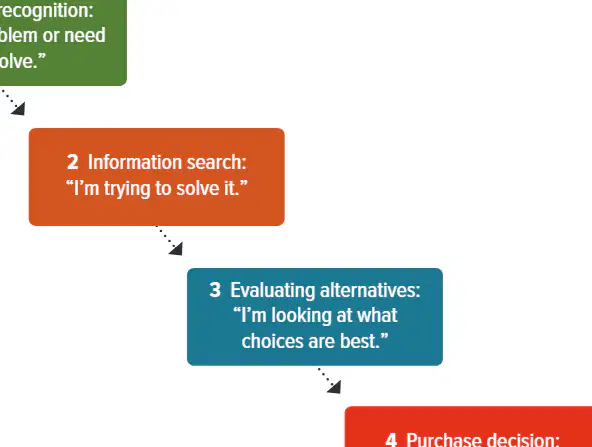
Which of the following is the first step in the consumer buying process?
Problem recognition
Information search
Purchase decision
Postpurchase evaluation
What is the main purpose of the information search step in the consumer buying process?
To identify a problem that needs to be solved
To look for solutions to the identified problem
To decide which product to buy
To evaluate satisfaction after purchase
During which step of the consumer buying process does a consumer compare different options to determine which is best?
Problem recognition
Information search
Evaluating alternatives
Purchase decision
A consumer has just bought a product and is now thinking about whether they liked or disliked it. Which step of the consumer buying process are they in?
Problem recognition
Purchase decision
Information search
Postpurchase evaluation
Understanding the consumer buying process is important for marketers because:
It helps marketers communicate and assist consumers in making decisions.
It allows marketers to ignore consumer needs.
It makes the buying process more confusing for consumers.
It prevents consumers from making purchases.
Which of the following is an example of a factor that influences consumer buying behavior?
Culture and subculture
Weather patterns
Government policies
Internet speed
What does the term "reference groups" refer to in the context of buying behavior?
The groups of people we belong to or identify with, such as family and friends
The brands we prefer to buy
The stores we visit most often
The advertisements we see on TV
How does social class influence consumer choices?
It affects the types of cars and houses people buy, reflecting their income levels
It determines the color of products people prefer
It influences the weather in a region
It sets the legal age for purchasing products
Which of the following best describes "personal image" as a factor in buying behavior?
The desire to project a certain image based on the products we buy
The need to save money on every purchase
The influence of government regulations
The effect of climate on shopping habits
Situational matters can affect buying decisions. Which of the following is NOT an example of a situational matter?
Timing
Moods
Product color
Advertising
A marketer wants to understand why a consumer chooses a particular brand. Which combination of factors should they consider according to the material?
Culture, social class, reference groups, personal image, and situational matters
Only the price and quality of the product
The weather and the consumer's age
The store's location and parking availability
Reference groups can influence a student's decision to buy a particular type of clothing because:
students may want to fit in or be accepted by these groups, as the material states we are affected by groups we belong to or identify with.
reference groups have no impact on clothing choices.
reference groups only influence what food a student eats.
reference groups determine the price of clothing.
What is the main focus of the lesson on Marketing Strategy?
Learning about financial accounting
Understanding how markets are classified and segmented
Studying the history of marketing
Exploring international trade laws
Which of the following will you be able to do by the end of the lesson?
Differentiate among the three approaches to market strategy
Memorize the periodic table
Solve algebraic equations
Write a business plan
By the end of the lesson, students should be able to differentiate among which of the following?
Types of consumer segmentation
Types of government policies
Types of advertising media
Types of financial statements
Which type of segmentation will students learn to differentiate among in business contexts?
Business segmentation
Geographic segmentation
Demographic segmentation
Psychographic segmentation
Why is it important to differentiate among the three approaches to market strategy?
To better understand how to target different market segments effectively
To memorize marketing terms
To increase the number of advertisements
To reduce the cost of production
Which of the following best describes a marketing strategy?
A plan for identifying the target market, creating the right marketing mix, and dealing with the external environment.
A method for producing goods in large quantities.
A way to reduce company expenses.
A process for hiring new employees.
Which of the following is NOT one of the three types of marketing mentioned in the text?
For-profit marketing to consumers
For-profit marketing of businesses to other businesses
Not-for-profit marketing
For-profit marketing to government agencies
What is the first step in developing a marketing strategy according to the text?
Identifying the target market among market segments
Setting the product price
Hiring marketing professionals
Launching an advertising campaign
What does market segmentation involve?
Dividing a market into groups whose members have similar characteristics or wants and needs
Setting the price for a product
Designing a company logo
Choosing a location for a business
Why do marketers need a target marketing strategy?
Because marketers don’t have endless resources and need to direct their efforts toward people most likely to buy their products
Because it is required by law
Because it increases production speed
Because it helps in hiring more employees
Which of the following is a key focus of a well-defined target market strategy?
Defining consumer attributes
Increasing the number of employees
Reducing the cost of raw materials
Expanding the company’s office space
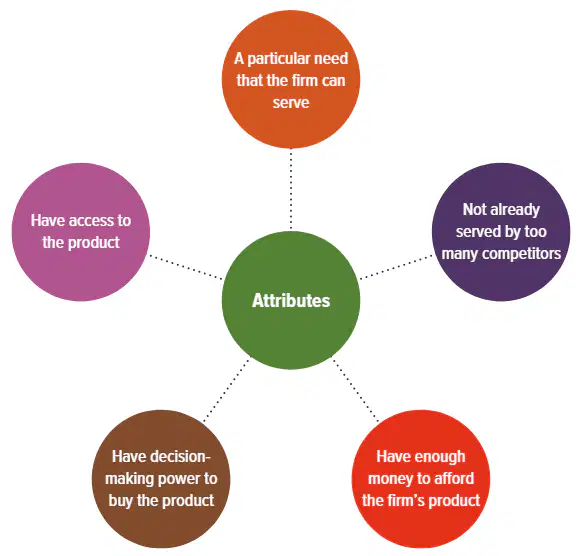
Which of the following is an attribute that a firm should consider when targeting a market?
The product's color options
A particular need that the firm can serve
The number of employees in the firm
The location of the firm's headquarters
Which attribute ensures that customers are able to actually purchase the product?
Have access to the product
Not already served by too many competitors
A particular need that the firm can serve
The product is environmentally friendly
Why is it important for a firm to target customers who are not already served by too many competitors?
It increases the cost of production
It reduces the need for advertising
It allows the firm to face less competition and potentially gain more market share
It ensures the product is more expensive
Which of the following is NOT listed as an attribute for targeting a market in the diagram?
Have enough money to afford the firm's product
Have decision-making power to buy the product
The product is made from recycled materials
Have access to the product
A company wants to introduce a new product. According to the attributes shown, what should the company ensure about its target customers? (Select the best answer.)
Customers have a need the company can serve and are not already served by too many competitors
Customers are interested in the company's logo
Customers live in the same city as the company
Customers have visited the company's website
Which of the following best describes the consumer market?
All businesses that sell goods or services to other businesses
All individuals or households that want goods or services for their personal use
All government agencies that purchase goods for public use
All organizations that manufacture products
What is the main focus of geographic segmentation?
Categorizing customers by their income level
Categorizing customers according to geographic location
Categorizing customers by their psychological characteristics
Categorizing customers by the benefits they seek in a product
Which segmentation type involves categorizing consumers by statistical characteristics such as age, gender, and income?
Psychographic segmentation
Benefit segmentation
Demographic segmentation
User-rate segmentation
Psychographic segmentation categorizes people according to which of the following?
Geographic location
Lifestyle, values, and psychological characteristics
Frequency of product usage
Statistical characteristics of a population
Benefit segmentation is based on:
The benefits or attributes people seek in a product
The frequency of product usage
The geographic location of customers
The age and gender of customers
What does user-rate segmentation focus on?
The psychological traits of customers
The benefits customers seek in a product
The volume or frequency of product usage
The geographic location of customers
Which of the following best describes niche marketing?
Dividing market segments into microsegments for profitable sales
Reducing market segmentation to individual customers
Categorizing customers by their geographic location
Grouping customers by their psychological characteristics
What is the main goal of one-to-one marketing?
To group customers by age and gender
To reduce market segmentation to the smallest part—individual customers
To divide markets into geographic regions
To focus on the benefits customers seek in a product
A marketer wants to understand a customer’s preferences in detail and keep detailed records of their interactions. Which marketing approach are they using?
Geographic segmentation
Niche marketing
One-to-one marketing
Benefit segmentation
Why might a company use niche marketing?
To reach the largest possible audience
To divide market segments into smaller, more profitable microsegments
To focus only on geographic location
To categorize customers by frequency of usage
What is the business market, also known as the business-to-business (B2B) market?
A market where businesses sell goods and services to individual consumers
A market where businesses and organizations buy goods and services to help produce or supply their own goods and services
A market focused only on online sales
A market for government procurement only
Which of the following is NOT one of the three main market segments that businesses may target in marketing to other businesses?
Geographic
Customer-based
Product-use-based
Price-based
How does geographic segmentation work in the business market?
By categorizing customers according to their age
By categorizing customers according to their geographic location
By categorizing customers according to their income
By categorizing customers according to their product preferences
Customer-based segmentation in the business market is similar to demographic segmentation for consumers because both segment customers according to specific characteristics.
Both segment customers by their product usage
Both segment customers by their geographic location
Both segment customers according to specific characteristics
Both segment customers by their purchase history
A company wants to segment its business customers based on how they will use its product. Which type of segmentation should it use?
Geographic segmentation
Customer-based segmentation
Product-use-based segmentation
Demographic segmentation
Which of the following is a key strategy consideration in the marketing mix, often referred to as one of the "4 Ps"?
Product
Profit
Partnership
Performance
Why might a firm develop a new product?
To recall the 4 Ps
To increase market share or meet customer needs
To reduce the number of employees
To eliminate competition entirely
What are students expected to recall by the end of the lesson on "The 4 Ps"?
The history of marketing
The reasons a firm may develop a new product and the four key strategy considerations of a marketing mix
The process of manufacturing
The types of business ownership
Which of the following is NOT one of the four key strategy considerations in the marketing mix, also known as the "4 Ps"?
Product
Price
Promotion
Production
What is a new product defined as in the context of marketing?
A product that is cheaper than competitors
A product that is a significant improvement over existing products or performs a new function for the consumer
A product that is only available online
A product that is made from recycled materials
Why do companies need to develop new products to stay ahead or match the competition?
To reduce production costs
To avoid being left behind by competitors who innovate
To increase employee satisfaction
To improve customer service
Which of the following best explains why businesses introduce new products to expand revenues and profits?
To reduce the number of employees
To maintain the same earnings every year
To grow and continue rewarding shareholders
To decrease their market share
A company that creates a new product as a natural extension of what they already offer is most likely trying to:
Fill out a product line
Lower their prices
Increase advertising
Enter a new industry
Suppose a company notices a sudden trend in the market and quickly develops a new product to meet this demand. Which reason for developing new products does this illustrate?
To stay ahead of the competition
To fill out a product line
To take advantage of an opportunity
To expand into international markets
Which of the following is NOT one of the 4 Ps in the marketing mix?
Product
Price
Place
Production
What is the first step in the process of building a marketing mix?
Promoting the product
Pricing the product
Developing a product that will fill consumer wants
Distributing the product
What is the main purpose of conducting research in the marketing process?
To determine the price of the product
To establish the target market for the product
To design the product packaging
To promote the product
Which of the following best describes "concept testing" in marketing?
Setting the price for a new product
Distributing the product to stores
Soliciting initial consumer reaction to new product ideas
Promoting the product through advertising
A company is trying out a sample of a potential product among the target population to see what they think. What is this process called?
Concept testing
Test marketing
Pricing strategy
Promotion strategy
Why is pricing an important part of the marketing mix?
It determines the color and brand name of the product
It helps to identify the target market
It figures out how much to charge for a product and can affect customer attraction
It is used to test consumer likes and dislikes
Suppose a company wants to know if their new product idea is appealing to their target market before launching it. Which marketing activity should they perform?
Promotion
Concept testing
Pricing
Distribution

What is the main focus of the place strategy in marketing?
Setting the price of products
Moving goods or services from the seller to prospective buyers
Designing the product packaging
Creating advertisements for products

Which of the following is an example of a promotion strategy used by companies?
Deciding the color of the product
Determining the location of the store
Advertising and public relations
Setting the product price

A retailer wants to improve their ability to serve customers who want products delivered directly to them. Which strategy should they focus on enhancing?
Product strategy
Price strategy
Place strategy
Promotion strategy

Which of the following techniques are commonly used in promotion strategies to influence a consumer’s decision to buy a product?
Offering discounts and changing product color
Advertising and personal selling
Moving products closer to consumers and increasing price
Changing product size and reducing advertising
Which of the following is a key objective of learning about market research in this lesson?
To memorize historical marketing campaigns
To differentiate among the steps of the marketing research process
To design a new product from scratch
To learn about financial accounting
What does the lesson aim to help students differentiate among in the external marketing environment?
Internal company policies
Forces that can affect marketing strategy
Employee training programs
Product manufacturing steps
According to the lesson overview, what is one way customer relations and marketing automation technology are relevant to marketing?
They are only used in product development
They are utilized within the marketing function
They are unrelated to marketing
They are only important for sales teams
Suppose a company wants to improve its marketing strategy. Based on the lesson objectives, what should the company analyze?
The color of its logo
Forces in the external marketing environment
The number of employees in the HR department
The location of its headquarters
If a business wants to use technology to enhance its marketing, which area should it focus on according to the lesson?
Customer relations and marketing automation technology
Office decoration
Employee dress code
Warehouse management
Which of the following is the first step in the marketing research process?
Define the problem
Collect facts
Analyze the data
Take action
What is the main purpose of marketing research?
To gather and analyze data about problems relating to marketing products
To create advertisements for products
To design new products
To increase the price of products
Which of the following is NOT one of the four basic steps in the marketing research process?
Develop a marketing mix
Define the problem
Collect facts
Take action

