
 Worksheets
Adaptations and Natural Selection Concepts
Total questions: 67
Worksheet time: 1hrs 13mins
What is natural selection?
The process by which certain traits or characteristics become more or less common in a population over time, based on their ability to survive and reproduce in a given environment.
The process by which organisms intentionally change their traits to better survive in their environment.
The process by which species evolve into new species.
The process by which individuals adapt to their environment over time.
What is adaptation?
The process of ignoring new conditions or changes in the environment.
The process of avoiding new conditions or changes in the environment.
The process of adjusting to new conditions or changes in the environment.
The process of staying the same despite changes in the environment.
Which of the following best explains how adaptations are related to natural selection?
Adaptations are traits or characteristics that are determined by chance. Natural selection is the process by which individuals with the most offspring survive.
Adaptations are traits or characteristics that help an organism survive and reproduce in its environment. Natural selection is the process by which individuals with advantageous adaptations are more likely to survive and pass on their genes to the next generation.
Adaptations are traits or characteristics that are acquired during an organism's lifetime. Natural selection is the process by which individuals with the most offspring survive.
Adaptations are traits or characteristics that are only found in humans. Natural selection is the process by which individuals with the most offspring survive.
How does gene flow affect population genetics?
Gene flow only introduces new genetic variations in small populations.
Gene flow has no effect on genetic variations in populations.
Gene flow increases genetic differentiation between populations.
Gene flow introduces new genetic variations and reduces genetic differentiation between populations.
Define Hardy-Weinberg equilibrium.
Genetic equilibrium in a population where allele frequencies remain constant from generation to generation in the absence of other evolutionary influences.
Genetic equilibrium in a population where allele frequencies are influenced by genetic drift.
Genetic equilibrium in a population where allele frequencies are determined by natural selection.
Genetic equilibrium in a population where allele frequencies change from generation to generation in the absence of other evolutionary influences.
What are the five conditions required for Hardy-Weinberg equilibrium?
Small population size, No migration, No mutation, Random mating, No natural selection
Large population size, High migration rate, High mutation rate, Random mating, No natural selection
Large population size, No migration, High mutation rate, Random mating, No natural selection
Large population size, No migration, No mutation, Random mating, No natural selection
What is gene flow?
Mutation of genetic material in a population
Movement of genes within a single population
Exchange of genetic information between individuals
Transfer of genetic material between populations through emigration or immigration
How does gene flow impact genetic diversity in a population?
Gene flow only impacts genetic diversity in small populations.
Gene flow decreases genetic diversity in a population.
Gene flow increases genetic diversity in a population.
Gene flow has no impact on genetic diversity in a population.

homologous structures
A current challenge for doctors involves the bacterial strain Clostridioides difficile, which no longer responds to traditional antibiotic treatments.
Which of the following best explains why this particular strain of bacteria is resistant to antibiotic treatment?
Mutations creating new alleles occur more frequently in this species of bacteria than in other species.
The bacteria have high genetic variability and high reproductive rates.
Crossing over during meiosis increased genetic variability in the bacteria.
The bacteria are able to recognize and destroy the antibiotics by breaking them down extracellularly.
The differences in sparrow songs among different species of sparrows are examples of
geographic isolation, allopatric speciation
behavioral isolation, sympatric speciation
The Tasmanian devil is a marsupial that resembles the North America wolf, which is a placental mammal. They are not closely related, but have developed similar traits due to selective pressures in their environments. Which pattern of evolution is this an example of?


Natural selection is based on all of the following except
genetic variation exists within populations.
the best-adapted individuals tend to leave the most offspring.
individuals who survive longer tend to leave more offspring than those who die young.
populations tend to produce more individuals than the environment can support.
individuals adapt to their environments and, thereby, evolve.
Over time, the movement of people on Earth has steadily increased. This has altered the course of human evolution by increasing
non-random mating.
geographic isolation.
genetic drift.
mutations.
gene flow.
When we say that an individual organism has a greater fitness than another individual, we specifically mean that the organism
lives longer than others of its species.
competes for resources more successfully than others of its species.
mates more frequently than others of its species.
utilizes resources more efficiently than other species occupying similar niches.
leaves more viable offspring than others of its species.
Which describes an African butterfly species that exists in two strikingly different color patterns?
artificial selection
directional selection
stabilizing selection
disruptive selection
sexual selection
Males of different species of the fruit fly Drosophila that live in the same parts of the Hawaiian islands have different elaborate courtship rituals that involve fighting other males and stylized movements that attract females. What type of reproductive isolation does this represent?
habitat isolation
temporal isolation
behavioral isolation
gametic isolation
postzygotic barriers
The allele frequency of p=.20 What is the percentage of Heterozygous Dominant genotype?
.80
.04
.32
.64
The allele frequency of p=.20 What is the percentage of recessive genotype?
.80
.04
.32
.64
The allele frequency of p=.20 What is q?
.80
.04
.32
.64
The frequency of two alleles in a gene pool is 0.19 (A) and 0.81 (a). Assume the population is in Hardy-Weinberg equilibrium. What is the percent of heterozygous individuals in the population?
31%
4%
66%
15%
In a population that is in Hardy-Weinberg equilibrium, the frequency of the recessive homozygote genotype of a certain trait is 0.09. Calculate the % of individuals homozygous for the dominant allele.
49%
30%
70%
9%
Which of the following is the best/most valid source of evidence to use when creating a phylogenetic tree?
anatomical similarities
comparative embryology
location where an organism lives
DNA/molecular evidence
All desert mice have adaptations that allow them to conserve water and stay cool in the desert heat. Which of the following best explains this phenomenon?
All desert mice around the world share a recent common ancestor.
Mice in deserts are exposed to similar selective pressures and these traits help mice to survive and reproduce.
If you put an individual mouse in a desert, it will develop these traits.
Which term refers to a group of organisms that can mate and produce fertile offspring?
ecomorph
species
community
organism
Which term refers to the place an organism lives?
habitat
community
niche
home
Which term refers to an organisms job/role in their environment?
habitat
niche
community
home

Which organisms pictured on the diagram have hair?
prosimians only
prosimians and humans
humans only
prosimians and birds


Which species is the least closely related to humans based on the comparisons of amino acids in cytochrome c?
rhesus monkey
chimpanzee
yeast
fruit fly


How many differences exist in the sequence of amino acids that codes for hemoglobin proteins in horses and zebras?
1
2
3
4

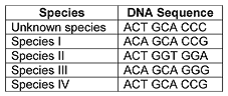

Who is most closely related to Taxidea taxus?
Lutra lutra
Panthera pardus
Canis latrans
Canis lupus

Label the natural selection graphs correctly...
1 Stabilizing, 2 Directional, 3 Disruptive
1 Disruptive, 2 Stabilizing, 3 Directional
1 Directional, 2 Stabilizing, 3 Disruptive

Starlings produce an average of five eggs. If there are more than five the parents cannot adequately feed the young. Fewer than five and predators may destroy them. As a result, five eggs becomes the most common number.
Stabilizing
Directional
Disruptive

Seed cracker birds have either large beaks or small beaks. They do not have medium sized beaks because medium sized beaks do not allow for adequate cracking of seeds.
Stabilizing
Directional
Disruptive

A scientist measures the circumference of acorns in a population of oak trees and discovers that the most common circumference is 2 cm. There are very few acorns with circumferences of 3 cm or circumferences of 1 cm. Only the 2 cm circumference acorns survive.
Stabilizing
Directional
Disruptive

A population of Madagascar hissing cockroaches lives in a woodpile. The cockroaches are eaten by lizards. Because the lizards have small heads, the lizards are unable to eat the very largest adult cockroaches, and instead prey upon small and medium sized adults. Over time, only the large headed lizards survive.
Stabilizing
Directional
Disruptive

Women often have complications during labor while giving birth to very large babies, whereas very small babies tend to be underdeveloped. As a result, medium sized babies are the ones that end up surviving to adulthood.
Stabilizing
Directional
Disruptive
Hummingbirds have a beak just the right length to reach the nectar in a cardinal flower and as they feed their foreheads bump into the pollen structure. Cardinal flowers are red which hummingbirds can see but bees can’t. Cardinal flower’s pollen structure is just the right length for the hummingbird to pick up pollen as it feeds
Convergent
Divergent
Coevolution
In the ocean surrounding Antarctica, there are fish that survive the cold water by using a molecule made of glycoproteins that circulates the blood and keeps it from freezing. Certain kinds of worms that live in the Arctic ocean also make antifreeze proteins that help them live in icy water.
Convergent Evolution
Divergent Evolution
Coevolution
The beaver in North America and the capybara in South America share a common ancestor, but have evolved over time to look different
Convergent Evolution
Divergent
Coevolution
The Galápagos tortoises share a common ancestor, but have necks of different lengths to best reach the food they need in their environment.
Convergent
Divergent
Coevolution
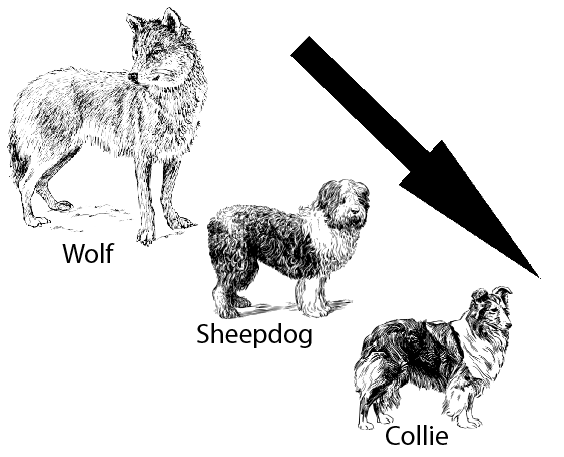
Gradualism means Natural Selection would normally happen over many generations and very
slowly
quickly
in space
beyond time
Describes a patter of long, stable periods interrupted by brief periods of more rapid change
convergent evolution
coevolution
punctuated equilibrium
adaptive radiation
The evolution of an ancestral species into an array of species that occupy different niches
convergent evolution
coevolution
speciation
adaptive radiation
What is the standard error of the sampling distribution?


