
 Worksheets
T1 Exam Review 2025
Total questions: 54
Worksheet time: 35mins
The supercontinent that broke up during the Mesozoic Era
Pangaea
North America
Eurasia
Antarctica
The theory proposed by Alfred Wegener that the continents have moved over time
Plate Tectonics
Continental Drift
Seafloor Spreading
The reason why other scientists rejected Alfred Wegener's ideas
He was not a geologist
He had too much evidence to support his theory
He could not prove how the continents moved
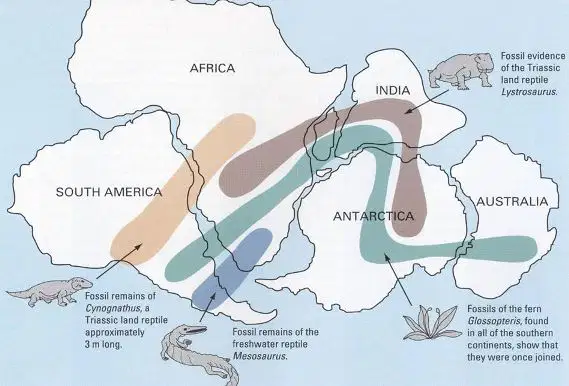
The reason why there are the same fossils found on different continents in the same rock layers.
The continents were once connected
The continents have always been separated
What evidence did Alfred Wegener used to support his theory of continental drift (choose all that apply)
fossil evidence
glacier scratches
coal deposits
rock layers in mountain ranges
The top layer of the earth that floats above the mantle
Crust or Lithosphere
Mantle or Asthenosphere
The layer below the crust where convection currents cause magma to flow
Crust or Lithosphere
Mantle or Asthenosphere
Causes the tectonic plates to move
Energy from the sun
Convection currents in the mantle
Harry Hess discovered rocks at the mid-ocean ridge are younger or older
older
younger
Harry Hess discovered the Atlantic Ocean was separating by analyzing sonar. What was the name of Harry Hess' theory?
Contiental Drift
Seafloor Spreading
A boundary where two plates collide and make mountains
convergent
divergent
transform
When two plates collide and the denser plate sinks, causing volcanoes and mountains.
divergent
transform
subduction
A mid-ocean ridge or a rift valley is where plates separate. This is a ______ boundary
convergent
divergent
transform
A plate boundary where two plates slide past each other like the San Andreas fault in California
convergent
divergent
transform
If oceanic crust and continental crust collided, which plate would subduct and why?
continental, it is less dense
oceanic, it is more dense
Most volcanoes and earthquakes are located where in the world?
Around the Atlantic Ocean
Around the Pacific Ocean (Ring of Fire)
Around the Indian Ocean
"The process of breaking rocks down into small pieces of rocks or fragments"
Erosion
Weathering
Deposition
Soil
A rock that forms from magma or lava cooling
igneous
sedimentary
metamorphic
A rock that forms from heat and pressure
igneous
sedimentary
metamorphic
A rock that forms from sediments compacting and cementing together. The most common type of rock to have fossils.
igneous
sedimentary
metamorphic
To move sediments from one place to another...
weathering
erosion
The laying down of sediments carried by wind, water, and erosion.
erosion
deposition
Fossils are most common in...
igneous rock
metamorphic rock
sedimentary rock
Watersheds, tributaries, rivers, lakes, would be examples of...
surface water
groundwater
What does permeable/infiltrate mean?
The space between soil particles
The ability for water to flow through sediments
What would happen to the water table during a drought?
It was raise up above the ground
It would lower below the ground
Mountains pushing up, sediments depositing in layers, a volcano making a new island would be...
constructive
destructive
A river weathering and eroding into a deep canyon would be...
constructive
destructive
Forces that build up earth's surface are...
constructive
destructive
Forces that break down Earth's surface are...
constructive
destructive
Water that moves flows on top of Earth's surface.
infiltrate
run off
The preserved remains or evidence of ancient living things...
clay
fossils
igneous rocks
silt
How do fossils form?
An organisms is rapidly buried. The sediments and minerals replace the tissues.
An organism is buried slowly. Only bones can become fossils
What can we learn about by looking at fossils? (Choose 2)
They're really cool.
They are evidence of ancient environments.
They can show how sea level rise could happen.
We can't learn anything by studying fossils.
Fossils could provide evidence for....
relationships between past organisms and current organisms
past organisms only
current organisms only
The Law of Superposition states...
older rocks are below younger rock
younger rocks are below older rocks

Organize from oldest to youngest...
BCDAE
BACDE
EDCBA
EDCAB
What are qualities of an index fossil? (Choose multiple)
long lived
short lived
abundant
scarce
How is the geologic timeline organized?
all eras are the same
all eons are the same
depends when extinction events happened
there is no organization
What is a mass extinction event?
when many species die out
when biodiversity increases
What are causes of mass extinction? (Select all)
climate change
volcanoes
meteor impacts
hurricanes
What is the current geologic era?
Cenozoic
Mesozoic
Paleozoic
Which geologic era had dinosaurs?
Cenozoic
Mesozoic
Paleozoic
Which geologic era had ancient, very simple multicellular life?
Cenozoic
Mesozoic
Paleozoic
We cannot predict the exact moment a natural disaster will occur, but we do know...
how big the natural disaster will be
where the natural disaster is likely to occur
Natural disasters like tornadoes and floods are caused by weather. But natural disasters like volcanoes and earthquakes are caused by...
the Sun
movement of tectonic plates
Where are volcanoes, earthquakes, and mountains formed?
In the middle of tectonic plates
On the edges of tectonic plates
A certain school is beside a river that will overflow during heavy rains. The water from the river will sometimes come through the lunchroom doors and form small puddles. What is the best option to protect the lunchroom floors?
use sandbags or flood barriers outside doors to keep water from entering
stop the rain so the river cannnot flood
Mrs. Nancy's class is building a design for a home. The home is built on a rubber base and is low to the ground. The students are most likely trying to built a home that will be safe during...
an earthquake
a flood
What is a constraint?
Something that holds you back or limits what you can do to solve the problem
The first draft of your design
You are designing a home that will be safe from a volcanic eruption. Which of the following would NOT be a sucess critera of your home?
the home made out of a material that will not melt if touched by lava
the windows boarded to protect from heavy rainfall or winds
Scientists have tools that monitor volcanic activity. However, there are too many volcanoes and not enough time or tools to monitor them all. What would be the best way to improve monitoring of volcanoes?
keep track of patterns of when volcanoes erupt, and only monitor the ones that may be close to erupting
because volcanic eruptions are not dangerous to people, we do not need to monitor them
Which of the following would be an engineering criteria in an area with wildfires?
How do natural disasters impact society?

