
Font size
 Worksheets
(6) U2 C1 Test Practice
Total questions: 34
Worksheet time: 42mins
By 1750, how many English colonies were there on the East Coast of what would become the United States?
Ten
Thirteen
Seven
Twenty
Which group made up most of the American colonists in the thirteen colonies?
Kings and queens
Ordinary people such as farmers and people from small towns
Soldiers
Scientists and inventors
About what fraction of the population in the English colonies was enslaved by 1750?
One in ten
One in five
One in two
One in twenty
What is a charter colony?
A colony where a monarch granted a charter to a joint-stock company
A colony ruled by a governor on behalf of a monarch
A colony gifted as a reward or payment
A colony that was independent from any monarch
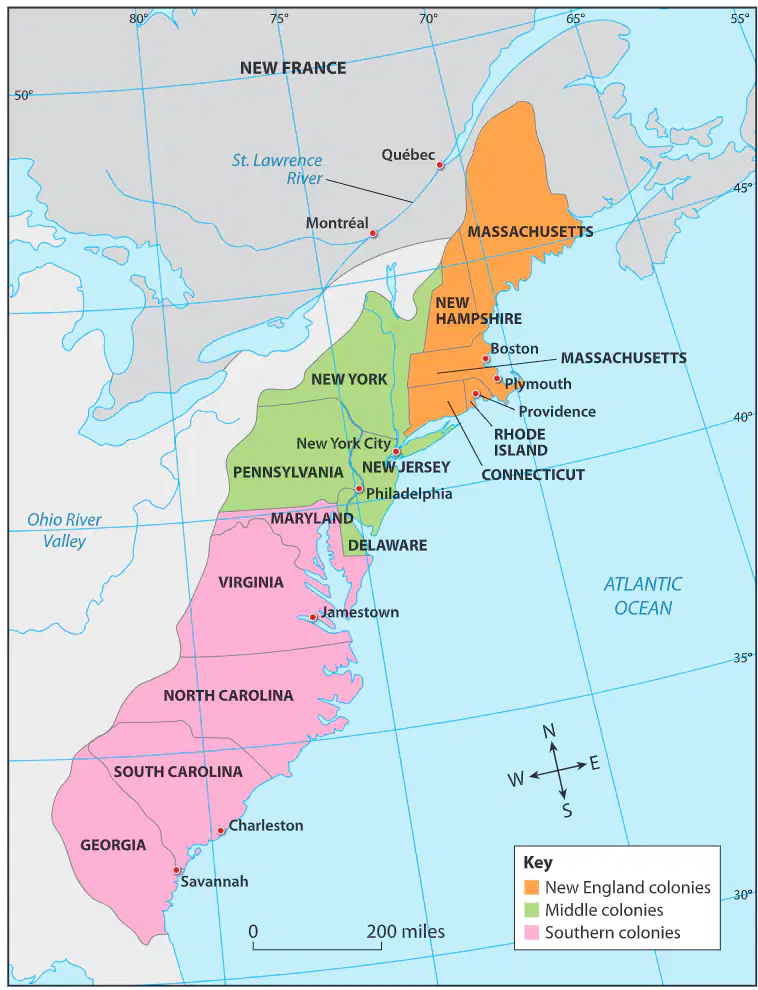
According to the map, which of the following is a New England colony?
Massachusetts
Georgia
Pennsylvania
Maryland
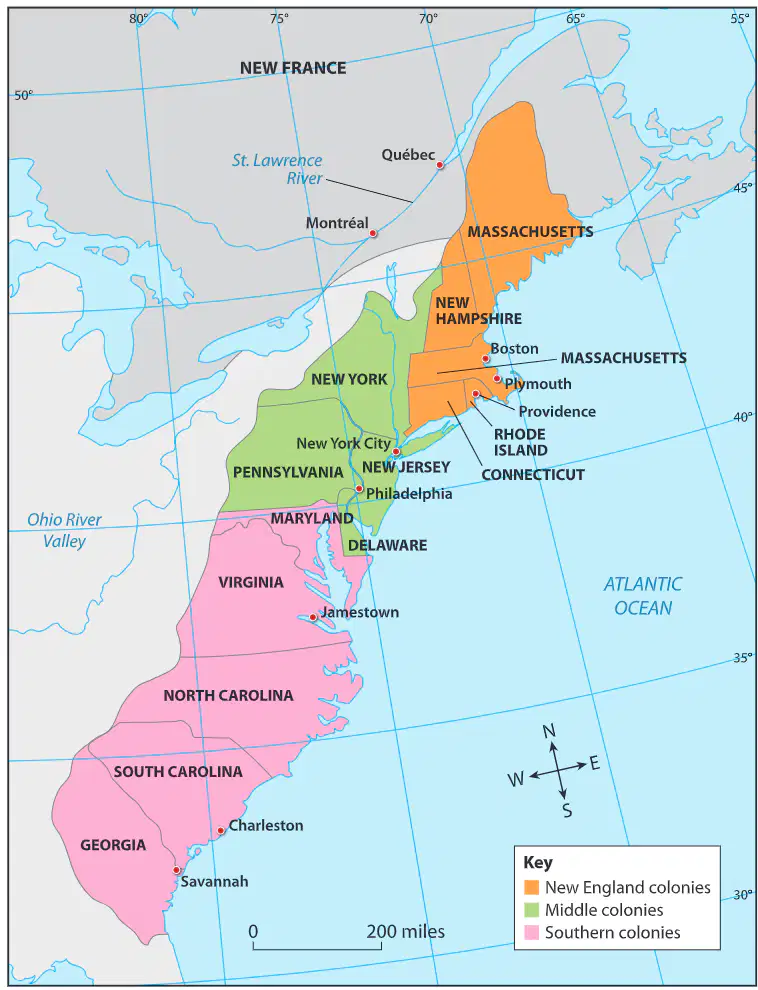
Based on the map, which region does Virginia belong to?
Southern colonies
New England colonies
Middle colonies
Western colonies
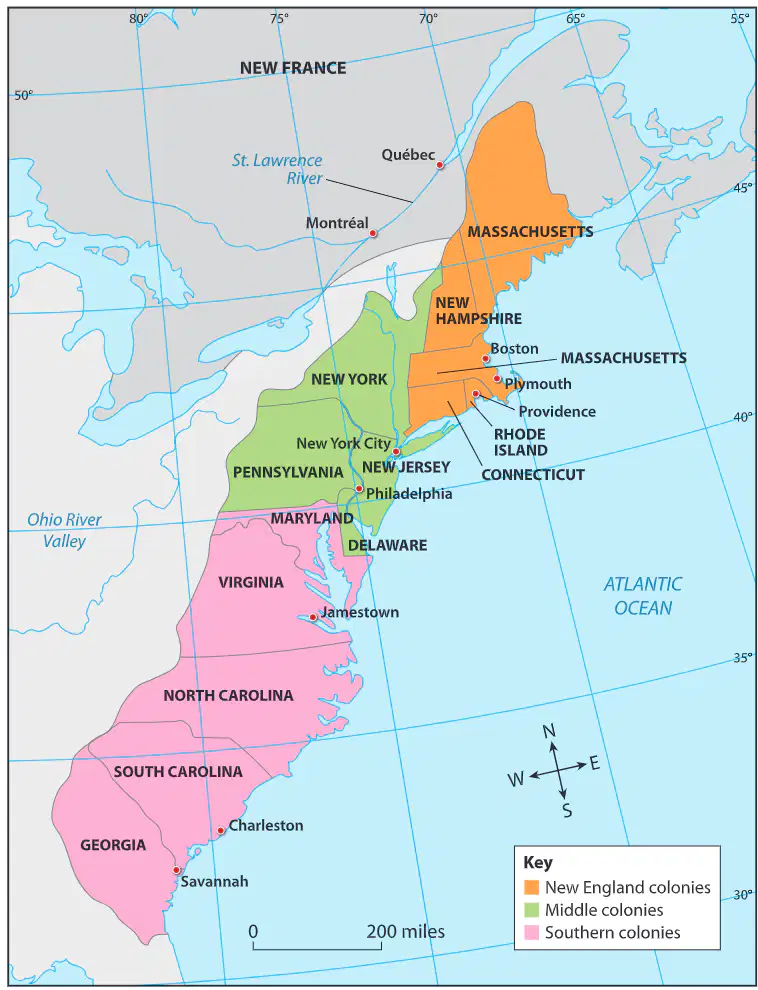
How were the English colonies divided according to the map?
Into three distinct regions
By language spoken
By size of population
By climate zones
Which of the following best describes a "buffer zone" as used in the text?
A neutral area that separates rival nations or factions
A place where crops are stored
A region with the best farmland
A city with many factories
What was the name of the first schoolbook for children in America, written by the Puritans?
The New England Primer
The American Reader
The Colonial Handbook
The Pilgrim’s Guide
Why were enslaved workers in New England more likely to learn to read and write compared to those in the South?
It was encouraged by law in New England.
There were fewer enslaved people and different types of work.
They had more free time.
They were not allowed to work on farms.
What was one result of King Philip’s War (1675–76) in New England?
The Native American population increased.
The Native American population greatly diminished.
English colonists left New England.
Slavery was abolished.
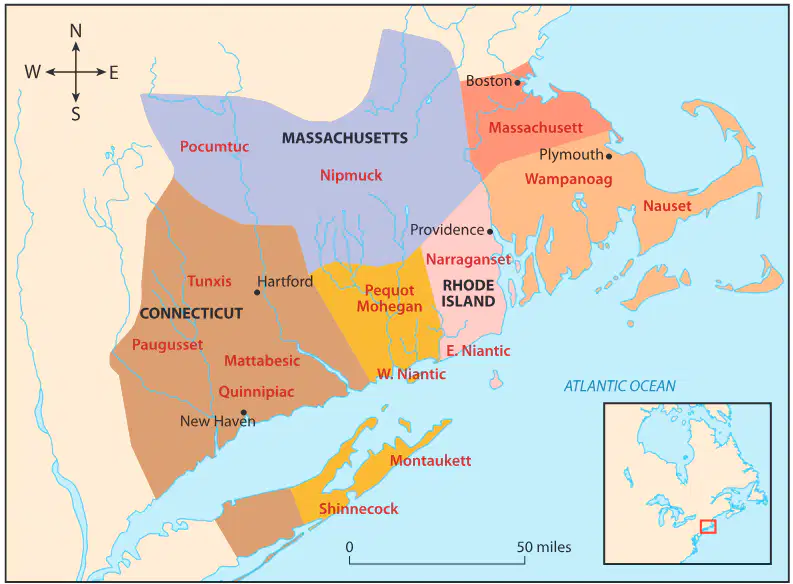
Which Native American group lived in the area that is now Connecticut in 1675?
Wampanoag
Tunxis
Narragansett
Nauset
Which colonies were known as the Middle Colonies in colonial America?
New York, New Jersey, Delaware, and Pennsylvania
Massachusetts, Connecticut, Rhode Island, and New Hampshire
Virginia, North Carolina, South Carolina, and Georgia
Maine, Vermont, New Hampshire, and Massachusetts
What reputation had the Middle Colonies established by 1750?
Military strength
Religious toleration
Economic power
Agricultural innovation
Why did immigrants in the Middle Colonies often settle near people from the same country or religion?
To avoid learning new languages
To feel more comfortable in a strange new land
To form political alliances
To compete for resources
What was the significance of the first synagogue established in North America?
It was the largest building in New York City
It showed that the Middle Colonies were a center for Jewish colonists
It was the first church in the colonies
It was built by the Quakers
How did different immigrant groups in the Middle Colonies influence each other over time?
They avoided each other completely
They borrowed and shared ideas with each other
They all spoke the same language
They built identical houses
Which group of colonists was known for being skilled farmers in the Middle colonies?
People from Germany
People from England
People from France
People from Spain
What was one way the colonists in the Middle colonies shared their skills?
They taught each other skills from their home countries
They kept their skills secret
They only used skills from England
They refused to learn new skills
How did rivers help the Middle colonies prosper?
By helping produce and transport grains
By providing drinking water only
By being used for swimming
By separating the colonies
What was a major reason immigrants were attracted to the Middle colonies?
Fertile soil and business opportunities
Cold climate and rocky soil
Lack of forests
Expensive land
Explain how land distribution and ownership differed between New England and the Southern colonies.
Both regions gave land only to the wealthiest families
New England divided land among townspeople, while the South developed large tracts for cash crops
The South had no land ownership
New England had only plantations
Which of the following was NOT a responsibility of colonial artisans?
Shipbuilding
Carpentry
Farming large plantations
Silversmithing
Why was life often challenging for colonial women?
They had too much free time
They were prevented from voting and had limited property rights
They were required to travel frequently
They had no household responsibilities
How did most colonial children receive their education?
At home instead of in a formal school
In large public schools
By traveling to Europe
Through online classes
Which skill was more commonly taught to boys than girls in colonial times?
How to run a household
How to sew clothing
How to run a business or learn a trade
How to cook and bake
What was the main job of Parliament in relation to the British colonies?
To oversee the British Empire and regulate trade
To elect representatives in the colonies
To write the Mayflower Compact
To hold town meetings in New England
How did self-government in the colonies differ from colony to colony?
Each colony had its own way of organizing self-government, such as town meetings in New England and the House of Burgesses in Virginia
All colonies had the exact same government structure
Only the southern colonies practiced self-government
Self-government was not allowed in any colony
What type of work were most people in Germantown involved in, according to Pastorius?
Linen weaving
Shipbuilding
Mining
Teaching
Based on the excerpts, how did the laws and punishments in Connecticut differ from modern times?
Laws were stricter, and punishments like whipping were common for minor offenses.
Laws were more relaxed, and there were no punishments for crimes.
Laws were only enforced by the church, not by judges.
Laws were the same as today, with no physical punishments.
Label the colonial regions.
New England
Middle
Southern
Which areas were the New England Colonies?
Correctly label the South Colonies.
Georgia
Virginia
Maryland
North Carolina
South Carolina
Correctly label the New England Colonies.
New Hampshire
Rhode Island
Massachusetts
Connecticut

