
 Worksheets
Plant Parts
Total questions: 94
Worksheet time: 47mins
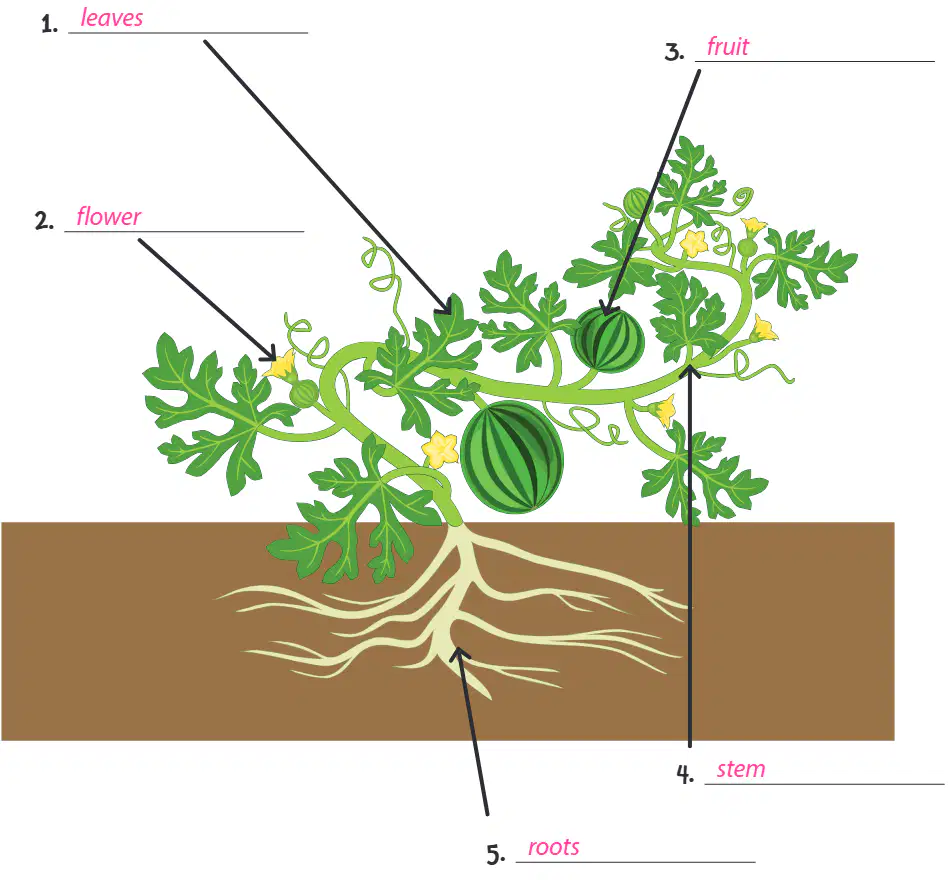
Label the external structures of the plant. 1. ________
leaves
roots
stem
flower
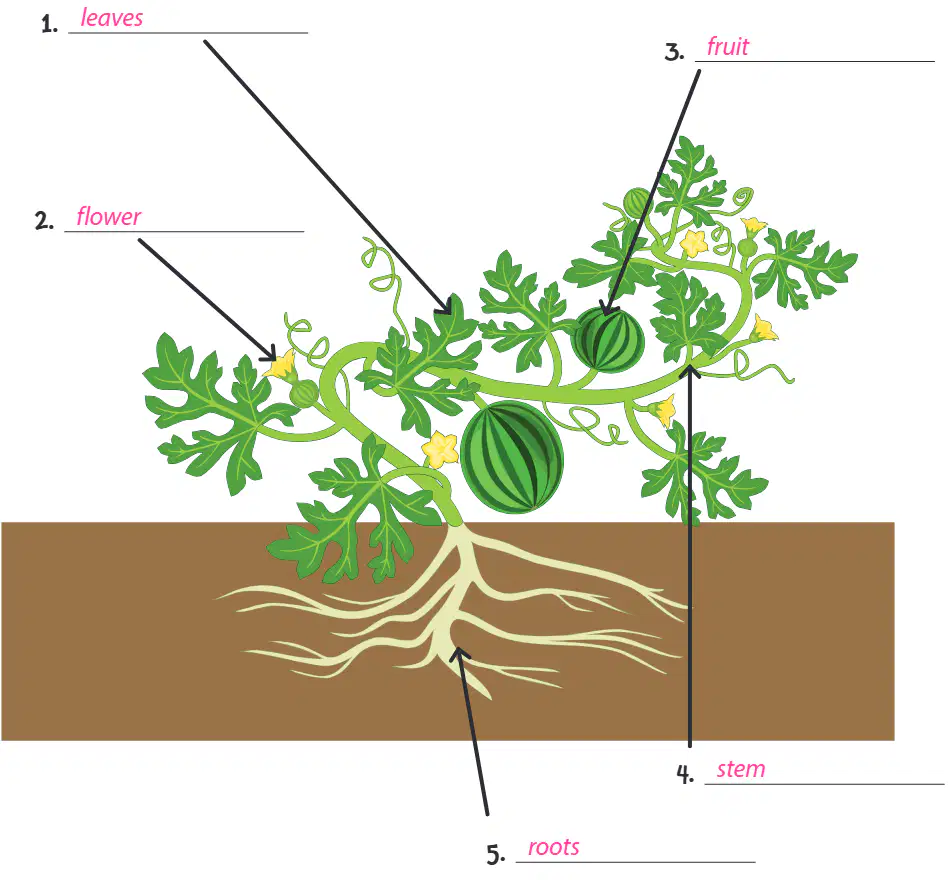
Label the external structures of the plant. 2. ________
flower
root
stem
leaf
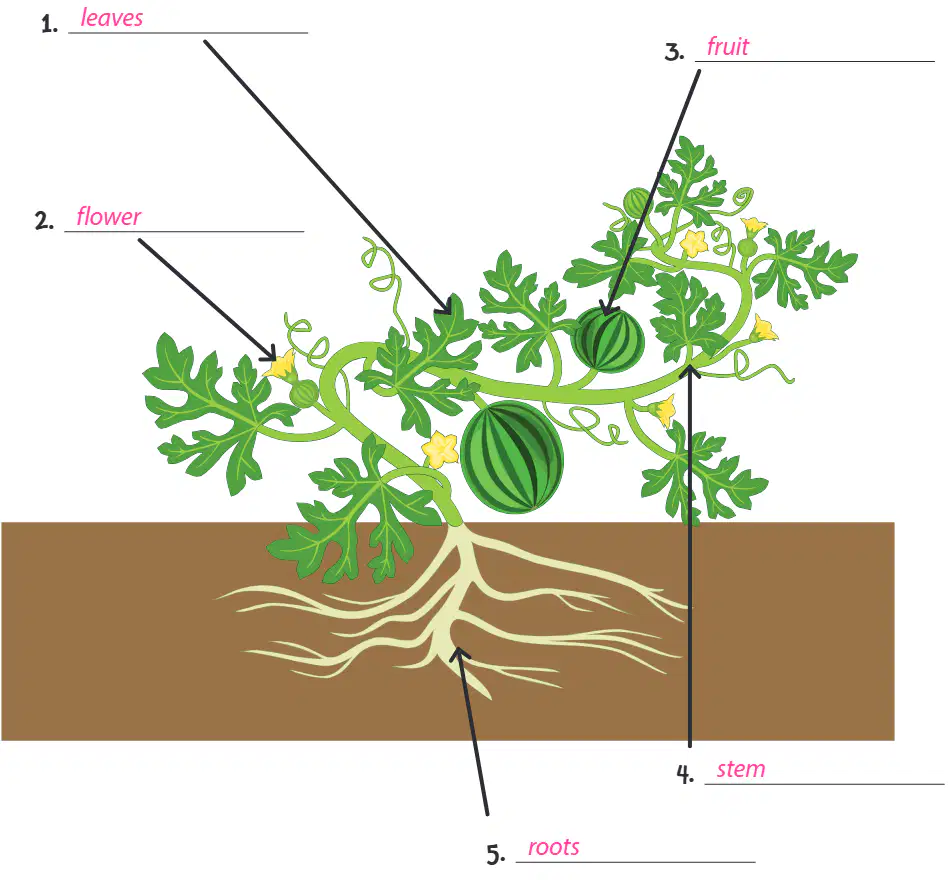
Label the external structures of the plant. 3. ________
fruit
root
stem
leaf
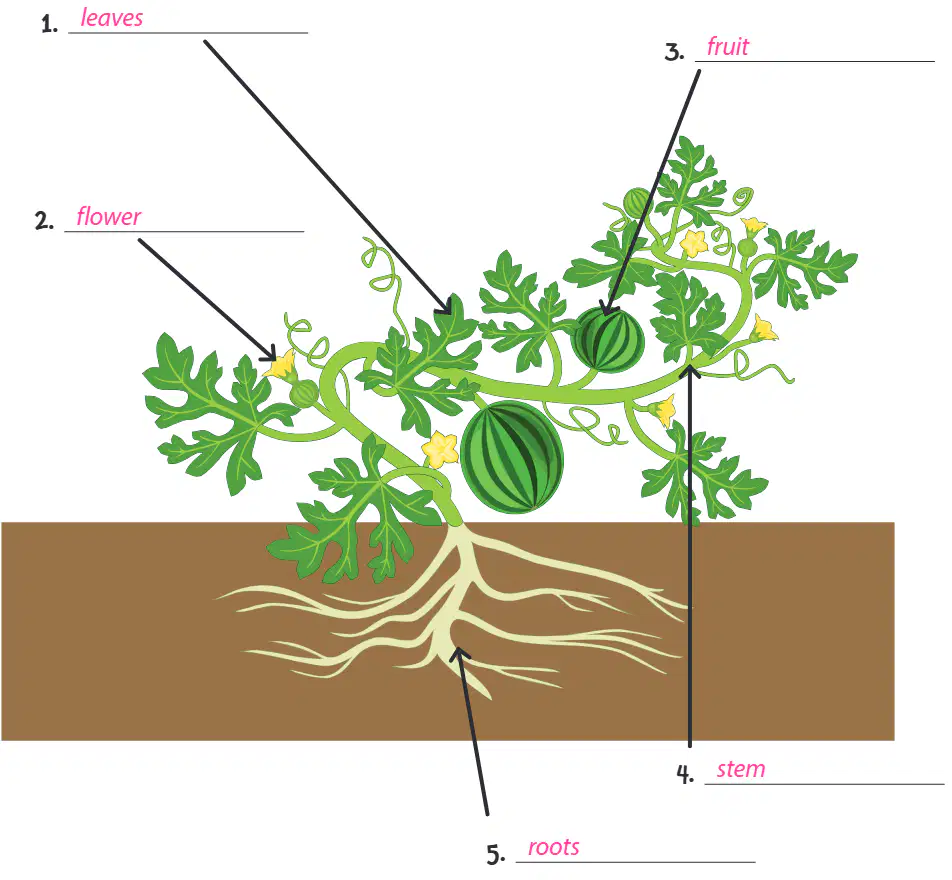
Label the external structures of the plant. 4. ________
stem
root
leaf
flower
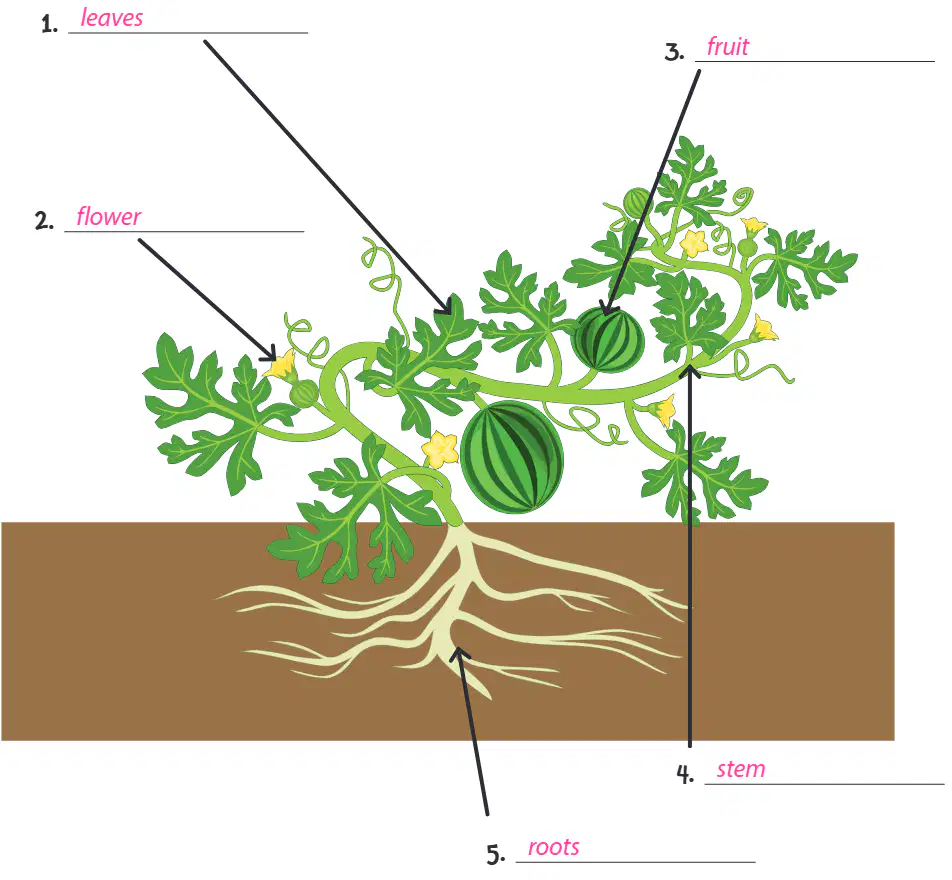
Label the external structures of the plant. 5. ________
roots
stem
leaf
flower
The parts that an organism is made of are called ________.
structures
cells
functions
organs
Internal structures are on the ________ of an organism.
inside
outside
surface
top
External structures are on the ________ of an organism.
outside
inside
top
bottom
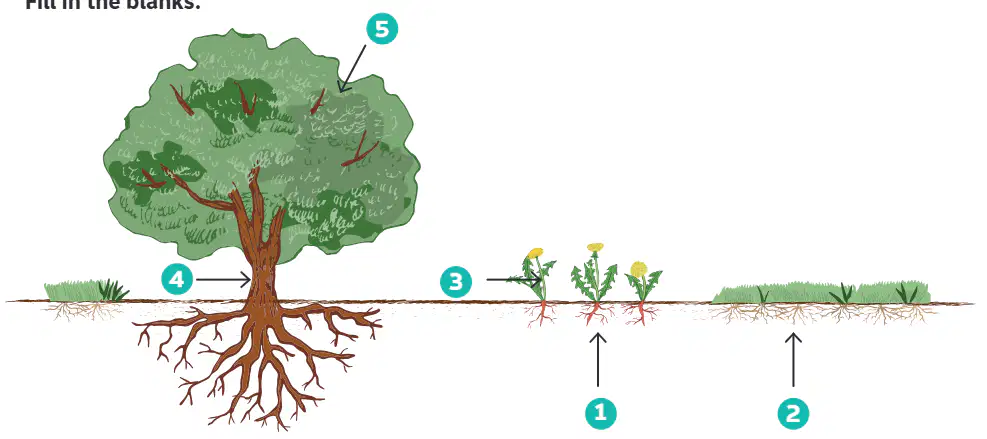
1. Taproots are long and __________. They grow straight down from the __________ of the plant.
thick, stem
thin, leaf
short, root
bushy, flower
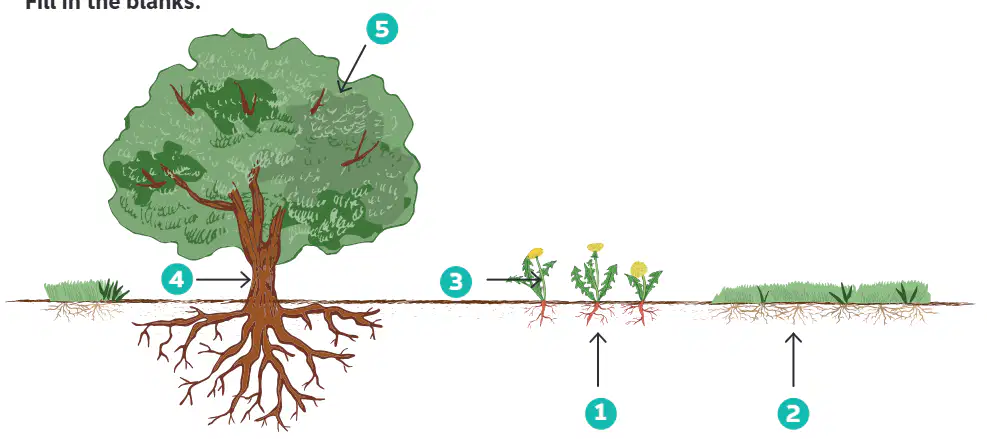
2. Fibrous roots are __________, but there are many of them. They spread out in all __________ from the plant. Together they are very __________.
thin, directions, thick
thick, places, thin
short, ways, long
long, sides, soft
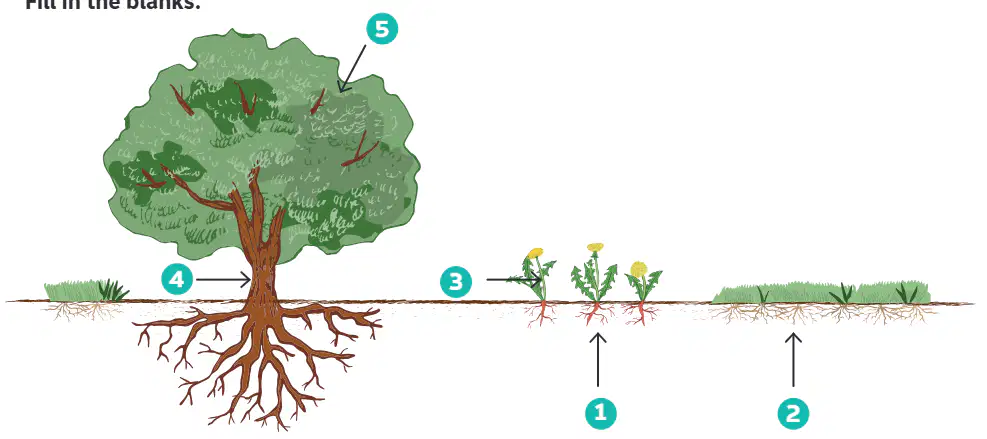
3. Soft, green __________ are usually __________. They live through only __________ growing season.
stems, thin, one
roots, thick, two
leaves, broad, many
flowers, hard, several
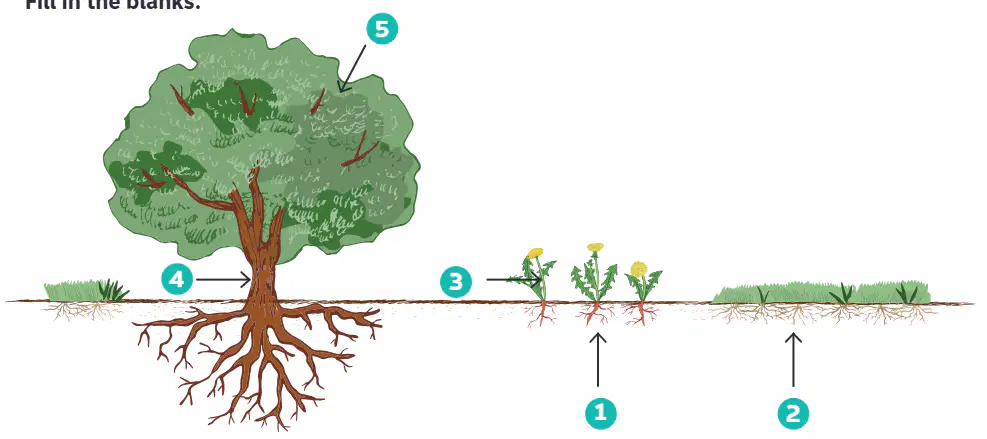
4. Woody stems of trees grow __________, thicker, and __________ than soft, green stems. The woody stem of a tree is called a __________. __________ is the hard, outer covering of a tree that __________ it.
taller, harder, trunk, Bark, protects
shorter, softer, branch, Leaf, covers
wider, greener, root, Stem, supports
smaller, thinner, leaf, Wood, breaks
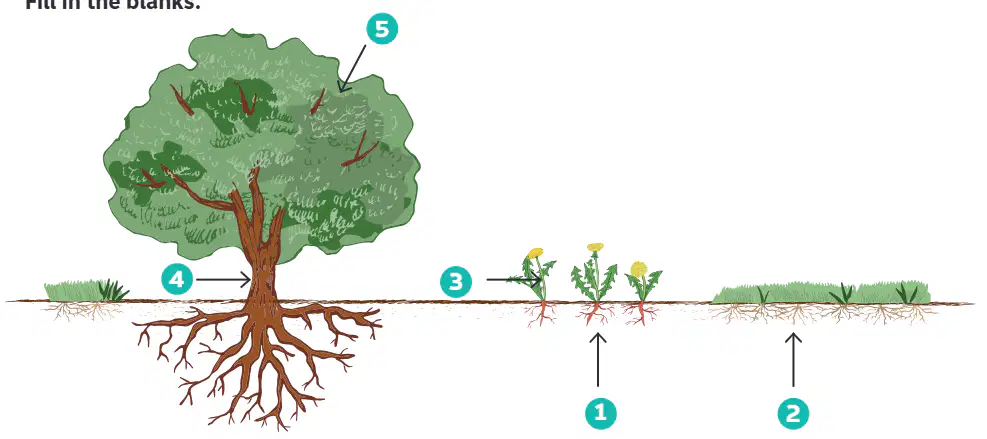
5. The branches and leaves of a tree are called the __________.
crown
root
bark
trunk
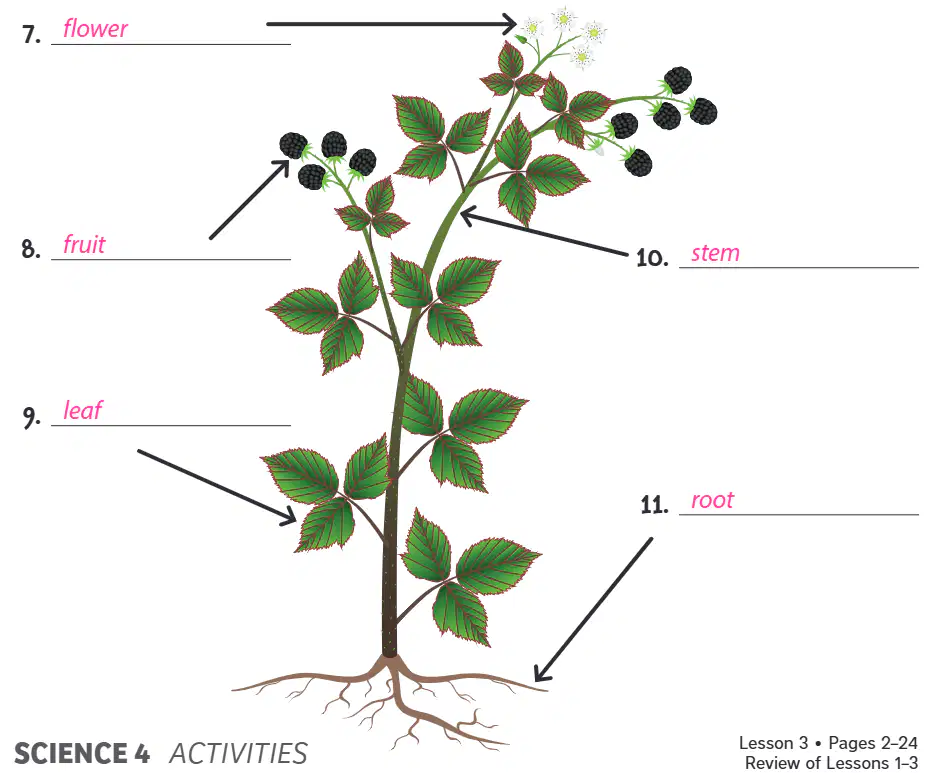
What is labeled as number 7 in the diagram?
flower
leaf
stem
root
Label the external structures of the plant. What is labeled as number 8 in the diagram?
fruit
leaf
stem
root
What is labeled as number 9 in the diagram?
leaf
root
stem
flower
Label the external structures of the plant. What is labeled as number 10 in the diagram?
stem
leaf
root
flower
What is labeled as number 11 in the diagram?
root
stem
leaf
flower
The part of the plant that transports water and nutrients to the plant and supports the plant is the ____.
fruit
stem
roots
The part of the plant that takes in water and nutrients from the soil is the ____.
flower
stem
root
A long, thick root that grows straight down from the stem of the plant is ____.
an edible root
a fibrous root
a taproot
What is the hard, outer covering that protects the woody stem of a plant?
bark
taproot
stomata
The internal structure that moves water and nutrients from the roots to the leaves is the ____.
phloem
roots
xylem
The internal structure that carries food from the leaves to other parts of the plant is the ____.
phloem
roots
xylem
A stem that is usually thin and lives through one growing season is a ____.
fibrous root
soft, green stem
woody stem
The process of plants making food using energy from the sun, carbon dioxide, and water is called ____.
energy
nutrients
photosynthesis
The tiny, internal structures in leaves where photosynthesis happens are called ____.
chlorophyll
chloroplasts
stomata
The tiny openings on the underside of plant leaves that take in carbon dioxide from the air are called ____.
chlorophyll
chloroplasts
stomata
During photosynthesis, the plant produces ____.
carbon dioxide and water
sugar and oxygen
water and sugar
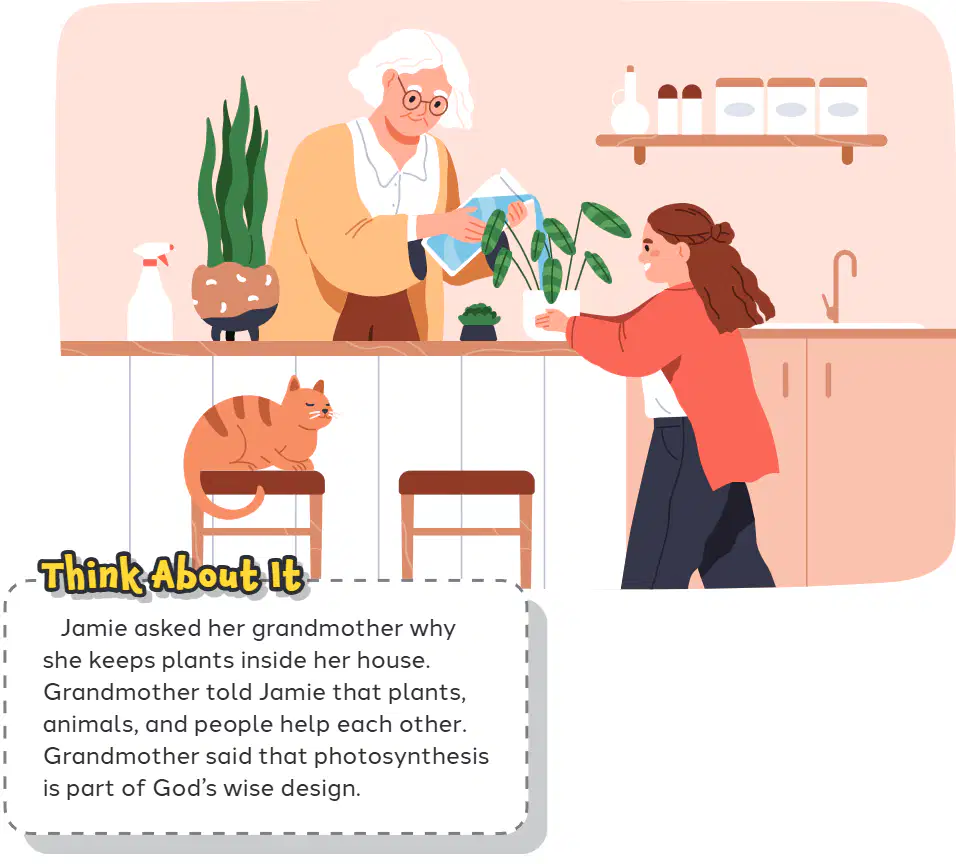
Explain how God’s design of photosynthesis benefits plants, animals, and people.
Plants use carbon dioxide during photosynthesis. People breathe out carbon dioxide. Plants give off oxygen for people and animals to breathe in. Without photosynthesis, people, animals, and plants would not be able to live.
Photosynthesis only benefits plants by making them green and does not affect animals or people.
Photosynthesis is a process that only happens at night and does not involve oxygen or carbon dioxide.
Photosynthesis causes plants to use oxygen and release carbon dioxide, which is harmful to animals and people.
What science inquiry skill involves using your senses to gather information about objects and events?
Observe
Predict
Classify
Infer
What science inquiry skill involves using devices to find the size, weight, volume, or quantity of something?
Measure
Predict
Classify
Infer
What science inquiry skill involves drawing conclusions based on what is already known?
Infer
Observe
Measure
Predict
What science inquiry skill involves grouping or ordering objects based on what is similar or what is different?
Classify
Predict
Measure
Observe
What science inquiry skill involves forming an idea about what may happen based on what you know or have experienced?
Predict
Observe
Measure
Classify
What science inquiry skill involves sharing information with others by writing, speaking, or using pictures or graphs?
Communicate
Predict
Measure
Classify
What science inquiry skill involves writing a hypothesis, or statement, that can be tested by using a controlled investigation?
Hypothesize
Observe
Classify
Measure
What science inquiry skill involves recognizing the changing and unchanging parts of a controlled investigation?
Identify and Control Variables
Formulate Hypotheses
Measure and Record Data
Draw Conclusions
What science inquiry skill involves correctly communicating scientific terms using observations and experience?
Define Operationally
Predicting
Classifying
Measuring
What science inquiry skill involves setting up and following a procedure to test a hypothesis?
Experiment
Observation
Prediction
Classification
What science inquiry skill involves gathering and organizing information about objects or events?
Collect, Record, and Interpret Data
Make Predictions
Formulate Hypotheses
Design Experiments
What science inquiry skill involves creating an object to represent or explain something that cannot be easily observed?
Make and Use Models
Measure and Record Data
Ask Questions
Form Hypotheses
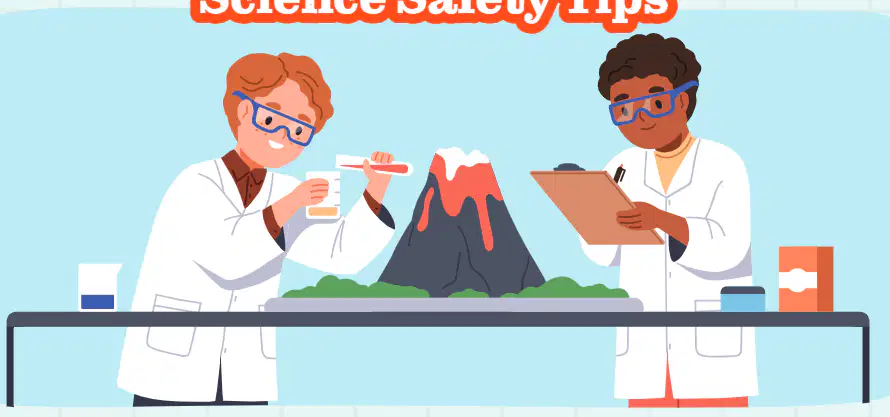
When doing a science experiment, always ______ your teacher’s directions.
follow
ignore
rewrite
question
It is important to follow the ______ carefully during a science experiment.
procedure
weather
music
holiday
Handle supplies with ______ during science activities.
care
anger
neglect
speed
Use tools and chemicals the way they were ______ to be used.
designed
forgotten
ignored
misplaced
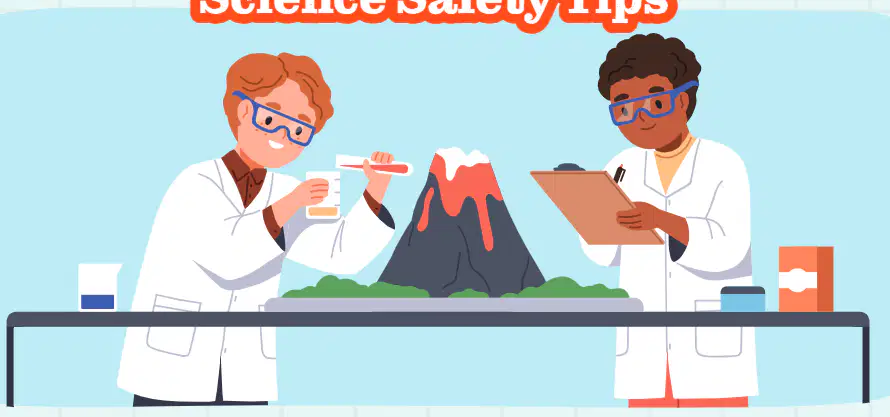
Wear safety ______ when needed during science experiments.
goggles
hats
scarves
gloves
Tell your teacher about ______ if they happen during a science experiment.
accidents
successes
instructions
results
Always ______ your turn when working in a science lab.
wait
skip
rush
ignore
After finishing a science experiment, always ______ up.
clean
mess
break
hide
Which of the following is NOT listed as an inquiry skill in the 'Leaf Detective' activity?
Observe
Classify
Communicate
Calculate
Which material is needed to measure the length and width of a leaf in the 'Leaf Detective' activity?
Hand lens
Black marker
Centimeter ruler
Observation chart
The first step in the 'Leaf Detective' procedure is to label each leaf with a ________, beginning with number 1, for identification.
number
color
shape
letter
What is the purpose of the 'Leaf Detective' activity?
To classify different types of leaves and compare my classified leaves with another group of leaves.
To collect insects from different plants and observe their behavior.
To measure the height of trees in the school garden.
To draw pictures of flowers found in the park.
Select two details you are asked to record about each leaf in the Observation Chart during the 'Leaf Detective' activity.
Color and size of the leaf
Type of tree and weather conditions
Shape and number of leaves on the tree
Time of day and location of the tree
What is the color of Leaf 1?
(Student's observation of Leaf 1 color)
Red
Blue
Yellow
What is the shape of Leaf 1?
(Student's observation of Leaf 1 shape)
Round
Oval
Pointed
What is the length (cm) of Leaf 1?
(Student's observation of Leaf 1 length)
2 cm
10 cm
20 cm
What is the width (cm) of Leaf 1?
(Student's observation of Leaf 1 width)
2 cm
5 cm
10 cm
What are other details of Leaf 1?
(Student's observation of Leaf 1 other details)
It is a coniferous leaf with needle-like structure.
It is a succulent leaf with thick, fleshy texture.
It is a compound leaf with multiple leaflets.
Another way that you could classify your leaves is:
By their shape
By their color only
By their size only
By the number of veins only
A Leaf Web can be compared to another Leaf Web by looking at their similarities and differences. Which of the following best describes how two Leaf Webs can be the same or different?
They may have similar or different patterns and connections between leaves.
All Leaf Webs are exactly the same in every way.
Leaf Webs cannot be compared to each other at all.
Only the color of the leaves can be different in Leaf Webs.
Choose two leaves from your collection. Use a field guide or internet search to identify the types of plants the leaves are from. Write the names of the plants below. Leaf Number _____: name of plant Leaf Number _____: name of plant
Answers will vary.
You must only use one leaf for identification.
Do not use any field guide or internet search.
Write only the color of the leaves.
Evolution is the belief that living things _ _ change into new kinds of living things over _ _ of years.
gradually, millions
suddenly, hundreds
rarely, thousands
never, billions
An _adaptation_ is a characteristic of a living thing that helps it to _survive_ in its environment.
adaptation, survive
mutation, reproduce
migration, grow
variation, move
The characteristic can result in one kind of organism _evolving_, or changing, over _millions_ of years into another kind of _organism_.
evolving, millions, organism
growing, thousands, animal
adapting, centuries, plant
mutating, decades, bacteria
An _evolutionist_ believes that a plant with thorns _adapted_.
evolutionist, adapted
botanist, mutated
creationist, evolved
geneticist, transformed
Evolutionary View: Some parts of the plant slowly _evolved_ into _thorns_.
evolved, thorns
grew, leaves
changed, flowers
developed, roots
Biblical View: An _adaptation_ is a characteristic that helps a living thing to _survive_ in its environment. This characteristic is passed down from _parents_ to _offspring_.
adaptation, survive, parents, offspring
mutation, thrive, friends, neighbors
variation, grow, teachers, classmates
instinct, migrate, predators, prey
Biblical View: Thorns began as part of God's _judgment_. Adam and Eve _sinned_.
judgment, sinned
creation, obeyed
mercy, repented
promise, worshipped
Biblical View: The sin of man brought _death_ into the world. God cursed the earth. This is called the _Fall_.
death, Fall
life, Creation
joy, Redemption
peace, Salvation
Biblical View: After the Fall, _thorns_ grew on plants. _Thorns_ are passed down from _parents_ to _offspring_.
thorns, Thorns, parents, offspring
leaves, Roots, children, ancestors
flowers, Fruits, siblings, cousins
branches, Seeds, elders, neighbors
An ________ is a scientific test to solve a problem.
investigation
observation
prediction
discussion
What are inquiry skills in a scientific investigation?
Each investigation will direct attention to three to five inquiry skills.
Inquiry skills are only used in mathematics.
Inquiry skills are not important in science.
Inquiry skills refer to memorizing facts only.
What is the problem in a scientific investigation?
An investigation begins with a problem. The problem comes from an observation you have made. The problem is a question you want answered.
The problem is always a mathematical equation to solve.
The problem is a list of materials needed for the experiment.
The problem is the conclusion drawn from the results.
What are materials in a scientific investigation?
The materials are the tools and supplies needed to do the investigation.
Materials are the results obtained from the investigation.
Materials are the steps followed during the investigation.
Materials are the questions asked in the investigation.
What are observations in a scientific investigation?
Scientists observe what happens using the five senses. Scientists record data from their observations in charts, lists, or graphs.
Observations are only made using specialized scientific equipment.
Observations are guesses scientists make before an experiment.
Observations are the conclusions scientists draw after analyzing data.
What is a hypothesis in a scientific investigation?
A hypothesis is a possible answer to the problem. The investigation tests the hypothesis to find out whether it is correct. The hypothesis is written as a statement.
A hypothesis is a summary of the results after the investigation is complete.
A hypothesis is a list of materials needed for the experiment.
A hypothesis is a set of instructions for conducting the experiment.
What is the procedure in a scientific investigation?
The procedure is the steps of an investigation. The procedure must be followed carefully to have correct results.
The procedure is the conclusion drawn from the experiment.
The procedure is the list of materials needed for the experiment.
The procedure is the hypothesis that is being tested.
What are conclusions in a scientific investigation?
The conclusions are the answers to the test. They tell what was learned from the investigation and whether the hypothesis was correct.
Conclusions are the materials used in the experiment.
Conclusions are the steps taken to perform the experiment.
Conclusions are the questions asked before starting the investigation.
What is a controlled investigation?
An investigation where all conditions are changed at once
An investigation that changes only one condition at a time
An investigation with no variables
An investigation that does not record observations
The variables are the parts, or conditions, of an investigation. It is important to control the variables so that only one condition is tested. There are ______ kinds of variables.
three
two
four
five
Which of the following best describes an independent variable?
The part that is observed and measured
The only part of the investigation that is changed
The part that does not change
The observations and measurements
Which of the following is the dependent variable?
The part that is observed and measured in the investigation
The only part of the investigation that is changed
The part that does not change
The variable that is controlled
Which of the following is true about the controlled variable?
It is the only part of the investigation that is changed
It is the part that is observed and measured
It is the part of the investigation that does not change
It is the variable that is dependent
What is the problem being investigated in this worksheet?
How does the temperature of water affect the movement of water through a plant?
How does the amount of sunlight affect the color of plant leaves?
How does the type of soil affect the height of a plant?
How does the amount of fertilizer affect the number of flowers produced by a plant?
What is the hypothesis stated in this investigation?
The colder/warmer the temperature of the water, the faster the water will move through a plant.
The amount of sunlight affects the color of the plant leaves.
The type of soil determines the height of the plant.
The size of the pot changes the number of leaves produced.
What should you use to measure 2.5 cm from the bottom of each celery stalk?
centimeter ruler
measuring cup
thermometer
stopwatch
Which tool is used to cut the bottom of each celery stalk off at the line?
serrated plastic knife
measuring cup
peeler
whisk
What should you use to label the jars A, B, and C?
masking tape and marker
glue and glitter
paint and brush
stickers with numbers
colored pencils
How much water should be poured into Jar A at room temperature?
300 mL
100 mL
500 mL
700 mL
How many drops of food coloring should be mixed into the water in each jar?
4–5 drops
1–2 drops
10–12 drops
7–8 drops
What should you use to heat the water for Jar B until it is steaming?
microwave or hot plate
refrigerator
freezer
fan
toaster
Which of the following is NOT listed as a material needed for this investigation?
Celery stalks
Beaker
Microscope
Stopwatch

