
 Worksheets
introduction to matter Test Bank - Chapter 1
Total questions: 53
Worksheet time: 28mins
1. Any sample of matter has mass and takes up space. The main reason for this is because:
All matter is heavy
Matter can be a gas
Matter is made up of tiny particles that have mass and take up space
The Earth is made of matter
Water drops stay together on wax paper and don’t break apart easily. This is mainly because:
Water molecules are small
Water molecules are in motion
Water molecules are attracted to each other
Water molecules are wet
When you bring two drops of water near each other and allow them to touch, they combine immediately and become one drop. This is mainly because:
Water molecules are made of atoms
Water molecules are attracted to each other
Water molecules are magnetic
Water is a liquid
If you put food coloring in room temperature water, the coloring spreads throughout the water. The water causes the color to spread mainly because:
Water molecules are warm
Water molecules are in motion
Water is more dense than food coloring
Food coloring molecules are small
Food coloring spreads out faster in hot water than in cold water. This is mainly because:
The water molecules in hot water move more quickly
The molecules in hot water are larger
The food coloring molecules are small
Hot water is less dense
When a thermometer is heated, the red liquid inside the thermometer moves up. This is mainly because:
The red liquid is thin
The molecules of the liquid move faster and get a little further apart
Hot liquid is lighter
The glass of the thermometer gets hot
When a thermometer is cooled, the red liquid inside the thermometer moves down. This is mainly because:
Cold liquids sink
The glass of the thermometer gets cold
The molecules of the liquid move slower and get a little closer together
The red liquid is thick
When you heat a sample of a solid, the particles that make up the solid:
Get bigger
Loose mass
Move faster
Slow down
When you heat a sample of a solid, the sample gets a little bigger. This is mainly because:
The particles move faster and get a little further apart
Heat helps the particles grow
Heating the sample makes it lighter
Heating helps the particles slide past each other
When you heat a sample of gas, what happens to the particles that make up the gas?
The particles move faster
The particles break apart
The particles get smaller
The particles become more dense
To describe a liquid, you could say:
The particles of a liquid are attracted to one another
The particles of a liquid are in motion
The particles of a liquid are able to move past one another
A liquid has mass and takes up space
To describe a solid, you could say:
The particles of a solid are attracted to each other
The particles of a solid can move past one another
The particles of a solid vibrate but do not move past one another
A solid has mass and takes up space
To describe a gas, you could say:
The particles are very attracted to each other
The particles are not very attracted to each other
The particles are close together like a liquid
The particles of a gas are further apart than the particles in a liquid or solid
The three common states of matter are _____, _____, and _______.
solid, liquid, gas
water, air, fire
earth, wind, fire
plasma, crystal, vapor
The particles of a liquid are attracted to one another, but can’t move past each other.
True
False
____________ is the study of matter.
Chemistry
Biology
Physics
Astronomy
An increase in temperature increases molecular motion and increases the distance between atoms and molecules in solids, liquids, and gases.
True
False
A __________ in the speed of the molecules allows the attractions between molecules to bring them a little closer together.
decrease
increase
fluctuation
constancy
Even when measuring the same temperature, the liquids in different thermometers can move to different heights depending on the liquid inside of them.
True
False
The molecules of the liquid inside the thermometer increase in speed when the thermometer is ___________.
heated
cooled
shaken
broken
The atoms of a solid are very far apart and vibrate in fixed positions.
True
False
Cooling a solid ______ the motion of the atoms.
slows
speeds up
stops completely
reverses
Heating a gas stops all of its molecular motion.
True
False
Air has mass.
True
False
The molecules of a gas are not very attracted to each other.
True
False
The particles of a liquid are always moving, but they don’t all come apart from each other and become a gas because:
there are forces of attraction between the particles that keep them together
the particles are too heavy to move apart
liquids do not have enough energy to become gases under normal conditions
the particles are fixed in place like in a solid
Water molecules can be inferred to have which of the following properties based on the observations you made in yout lab?
They are attracted to other.
They are not attracted to each other.
They do not like each other.
They are metallic.
Based on these observations, water molecules can be inferred to have which of the following properties?
They are polar molecules.
They are nonpolar molecules.
They have no charge distribution.
They are metallic in nature.
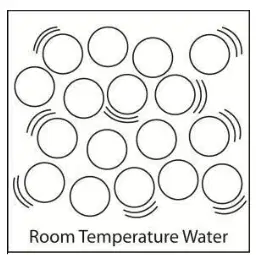
The circles and lines in the diagram show the arrangement, spacing, and speed of water molecules in room temperature water.
The molecules are close together but can move past each other, indicating moderate speed and spacing.
The molecules are far apart and move very quickly, indicating high speed and large spacing.
The molecules are tightly packed and do not move, indicating no speed and no spacing.
The molecules are arranged in a fixed pattern and vibrate in place, indicating low speed and fixed spacing.
This amazing fact tells you that water molecules are:
extremely small in size
larger than most molecules
visible to the naked eye
about the size of a grain of sand
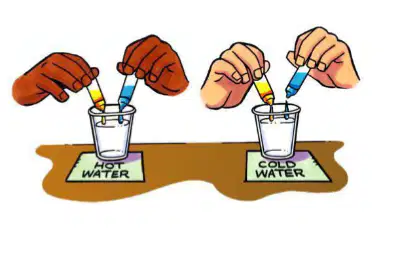
The differences you would expect if you place yellow and blue food coloring in both hot and cold water at the same time are:
The colors spread faster in hot water than in cold water.
The colors mix instantly in both hot and cold water.
The colors do not mix in either hot or cold water.
The colors spread faster in cold water than in hot water.
The speed of molecules in hot water compared to molecules in cold water is:
faster in hot water than in cold water
slower in hot water than in cold water
the same in both hot and cold water
zero in hot water
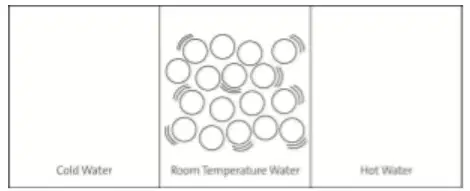
Which diagram best shows the differences in the movement and arrangement of water molecules in cold, room temperature, and hot water?
A diagram where molecules in hot water are spaced farther apart and have more motion lines than in cold water.
A diagram where molecules in cold water are spaced farther apart and have more motion lines than in hot water.
A diagram where all molecules are equally spaced and have the same number of motion lines in each box.
A diagram where molecules in room temperature water have the most motion lines and are spaced the farthest apart.
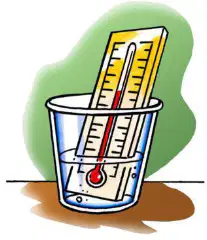
The red liquid moves up the tube when a thermometer is heated because:
the liquid expands when heated.
the liquid contracts when heated.
the tube gets longer when heated.
the liquid evaporates when heated.
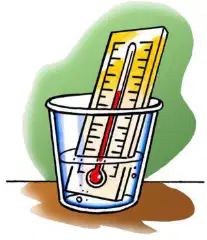
The red liquid moves down the tube when a thermometer is cooled because:
the liquid contracts when cooled
the liquid expands when cooled
the glass tube expands when cooled
the air pressure increases when cooled
If two thermometers have different liquids in them, the liquids can move to different heights in the thermometers even if they are measuring the same temperature. Why does that happen?
Because different liquids expand by different amounts when heated.
Because the thermometers are not accurate.
Because the liquids have different colors.
Because the thermometers are made of different materials.
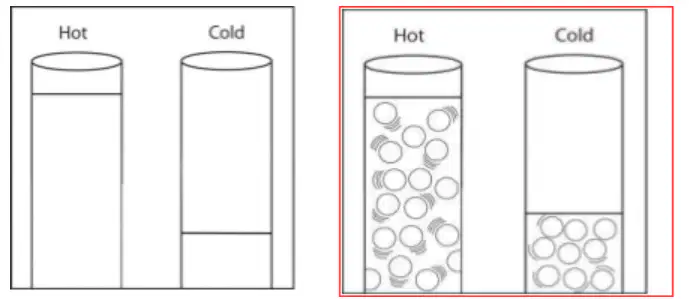
The difference between the speed and spacing of molecules in hot water and cold water is that:
Molecules in hot water move faster and are spaced farther apart than in cold water.
Molecules in hot water move slower and are closer together than in cold water.
Molecules in hot water move at the same speed and spacing as in cold water.
Molecules in cold water move faster and are spaced farther apart than in hot water.
The particles of which state of matter are more attracted to each other?
Solid
Liquid
Gas
Plasma
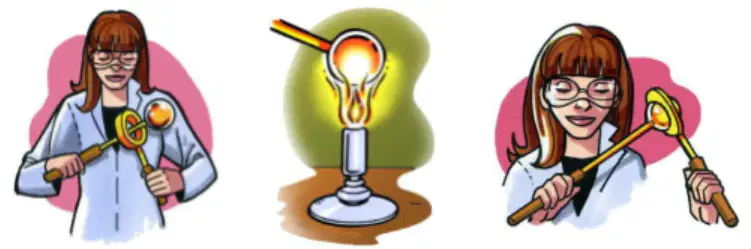
The motion and attractions of the atoms in the metal ball cause it to get slightly larger when heated because:
the atoms move faster and push each other farther apart
the atoms shrink and move closer together
the atoms stop moving completely
the attractions between atoms become much stronger
When a solid is heated, what happens on the molecular level?
The molecules vibrate faster and move further apart.
The molecules stop moving completely.
The molecules combine to form larger molecules.
The molecules shrink and move closer together.
In the demonstration with the metal ball and ring, the ball didn’t fit through the ring after being heated with a Bunsen burner because:
the ball expanded when heated and became too large to pass through the ring
the ring shrank when the ball was heated
the ball became lighter and floated above the ring
the ball changed its shape and became irregular
If the metal ring was cooled a lot, and the metal ball was at room temperature, would the ball still fit through the ring?
No, the ball would not fit through the ring.
Yes, the ball would fit through the ring.
The ball would melt and pass through the ring.
The ring would expand and the ball would fit easily.
Sometimes on especially hot days, a wooden door, that opens and closes just fine during cooler months, will be hard to open and close. Why is the door hard to open and close on hot days?
The wood expands when heated, making the door fit more tightly in the frame.
The wood contracts when heated, making the door smaller.
The metal hinges expand and break the door.
The paint on the door melts and sticks it shut.
Gas is considered matter because:
it has mass and takes up space.
it does not have mass or volume.
it is not made of particles.
it cannot change shape or volume.
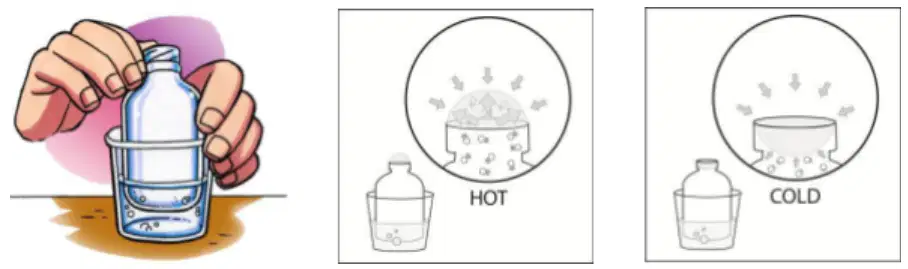
A bubble forms on the top of the bottle placed in hot water because:
the air inside the bottle expands when heated
the bottle melts in hot water
the water inside the bottle evaporates instantly
the bottle releases gas when heated
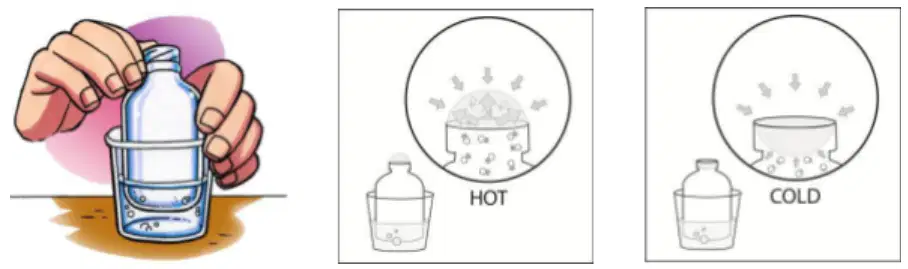
The bubble shrinks when the bottle is placed in cold water because:
the air inside the bubble contracts due to the decrease in temperature.
the air inside the bubble expands due to the increase in temperature.
the water enters the bubble and dissolves it.
the pressure inside the bottle decreases.
Classify each of the three states as gas, liquid, or solid by placing the word on top of the letter.
LIQUID
SOLID
GAS
What happens to the spacing between water molecules when water is heated?
The molecules disappear.
The spacing does not change.
The molecules move closer together.
The molecules move farther apart.
Which of the following best explains why a solid expands when it is heated?
The solid absorbs water from the air.
The particles stop moving completely.
The particles move faster and push each other farther apart.
The particles lose mass and shrink.
Why does the red liquid in a thermometer contract and move down when cooled?
The glass tube shrinks and pushes the liquid down.
The molecules slow down and get closer together.
The air pressure inside the thermometer increases.
The liquid evaporates quickly.
What happens to the volume of a gas when it is heated at constant pressure?
The volume decreases
The volume increases
The volume stays the same
The gas turns into a solid
Which of the following statements best describes the movement of particles in a solid compared to a liquid?
Particles in a solid move freely in all directions
Particles in both solids and liquids do not move
Particles in a solid vibrate in place, while particles in a liquid move past each other
Particles in a liquid are fixed in position
When a metal ring is cooled, what happens to its size and why?
The ring melts due to cooling
The ring stays the same size because temperature does not affect metals
The ring contracts because the particles move slower and get closer together
The ring expands because the particles move faster

