
 Worksheets
WH Unit 3A Test Review
Total questions: 60
Worksheet time: 32mins
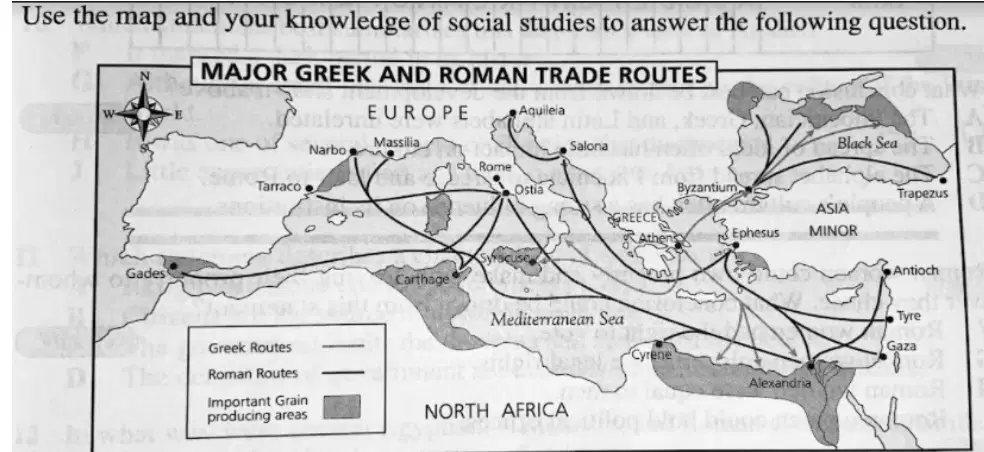
Which statement is most accurate based on the information in the map?
Spain was ancient Europe's largest grain producer.
Rome's main trading partner was Carthage.
Rome traded extensively throughout the Mediterranean region.
Greece limited its trade to Alexandria in North Africa.
Which statement describes a characteristic of democracy?
Religious leaders control government policy.
Citizens are the source of power in the government.
The government limits the thoughts and actions of the people.
The decisions of government are made by influential military officers.
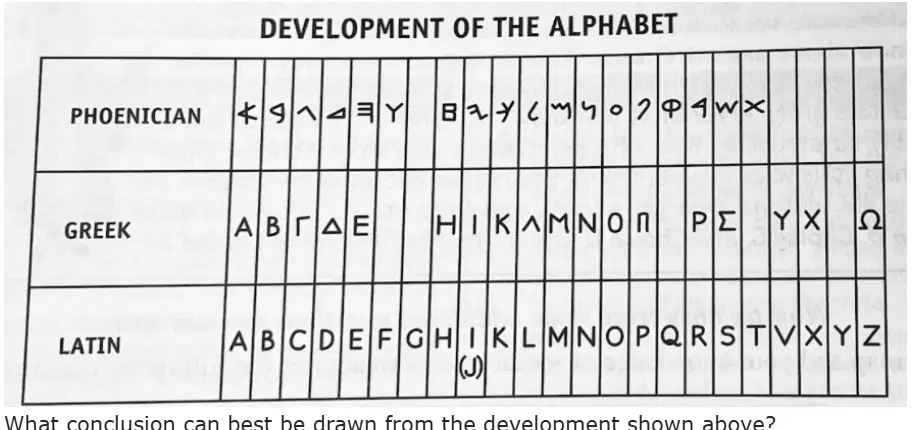
What conclusion can best be drawn from the development shown above?
The Phoenician, Greek and Latin alphabets were unrelated.
The spread of ideas often has little impact on culture.
The alphabet spread from Phoenicia to Greece and later Rome.
A people's culture often has a strong influence on its institutions.
Roman women could own property and make wills leaving their property to whomever they chose. What conclusion could be drawn from this statement?
Roman women had the right to vote.
Roman women had some legal rights.
Roman women were equal to men.
Roman women could hold political offices.
How did Italy's geography influence the development of the Roman Empire?
A harsh climate prevented sufficient agricultural production.
Unnavigable rivers in the northern part of the peninsula protected the Romans from their neighbors.
The lengthy, rugged seacoast encouraged frequent invasions by hostile foreigners.
The central location of the peninsula contributed to Roman control of the Mediterranean regions.
In what way were ancient Egyptian, Hellenistic, and Roman civilizations similar?
They failed to develop a system of writing.
They extended their control over other peoples.
They established advanced industrial economies.
They all had democratically elected governments.
The Roman system of justice is considered a milestone because it ____________.
served as a model for many later European legal systems
greatly limited the emperor's powers
provided the first democratic constitution
united Greco-Roman and Chinese ideas of justice
In what way were the Code of Hammurabi and the Twelve Tables of Rome similar?
They allowed for belief in one God.
They established written legal standards.
They provided records of economic activity.
They legalized democratic government.
Which ancient civilization is most closely associated with the "rule of law", an extensive road system, the invention of concrete, and the spread of Christianity?
Babylonian
Greek
Phoenician
Roman
One effect of rugged, mountainous geography on the civilization of ancient Greece was the development of ________________.
absolute monarchies
extensive trade
separate, independent city-states
belief in one God
Who were Socrates, Plato, and Aristotle?
Consuls of the Roman Republic
pharaohs of ancient Egypt
religious leaders of the ancient Hebrews
philosophers of ancient Greece
Which society was the first to practice direct democracy?
city-state of Athens
empire of Alexander the Great
city-state of Sparta
Persian Empire
Which statement would most likely represent the view of a citizen of ancient Athens visiting Sparta?
The government and society of Sparta are too strict. The people have little voice in the government.
I feel as though I have never left home. Everything here is the same as it is in Athens.
This society allows more freedom of expression than I have ever experienced in Athens.
I have never seen a society that so valued its citizens as here in Sparta.
Use the paragraph below and your knowledge of social studies to answer the following question. "We think and feel different today because of what a little Greek city-state did twenty-four hundred years ago. What was produced in art and thought has never been surpassed and rarely equaled. It has put the stamp of it upon all the art and thought of the Western world. And yet, this greatness came at a time when the mighty civilizations of the ancient world had disappeared and the shadow of barbarism was dark upon the Earth. In this dark and fierce world a little center of spiritual energy was at work. A new civilization arose in Athens - unlike all that had gone before." -Adapted from The Greek Way by Edith Hamilton Which statement best summarizes this historian's view of Athens?
It marked a dark period in its history.
Although a small city-state, it had a deep impact on the culture of the Western world.
It was on of several ancient civilizations that disappeared.
Little appreciation of art and thought existed in Athens.
What Roman legal concept is evident in legal proceedings in the United States today?
The burden of proof is on the accused.
The accused has a right to legal counsel.
The state uses religious leaders as judges.
The accused is innocent until proven guilty.
Which type of government of early Greece often consisted of a small group of wealthy people in power?
Oligarchy
Tyranny
Republic
Democracy
How does the government of a republic differ from that of a direct democracy?
In a direct democracy, power is given to political parties, yet in a republic power is given to a tyrant.
In a republic all power is in the hands of a committee of appointees, yet in a direct democracy the leader of the city-state has the concentration of power.
In a republic every citizen votes directly on all proposed laws, yet in a direct democracy only male citizens are eligible to vote.
In a republic each representative is elected to office by the citizens, yet in a direct democracy every citizen votes directly on proposed legislation.

Which characteristic of classical Greek civilization was Thomas Paine most likely referring to in the quote?
The life-long military service
The use of democratic elections
The creation of an oligarchy
The use of oracles for advice
How did Judaism differ from many other early religions prior to the classical period?
Judaism imposed strict dietary laws
Judaism emphasized a belief in one God.
Judaism relied on the interpretations of religious scholars.
Judaism encouraged missionaries to convert non-believers.
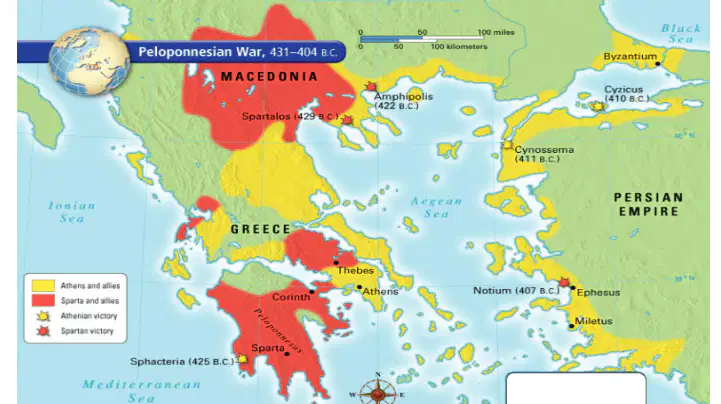
Analyzing the map of the Peloponnesian Wars, which body of water was central to most of the significant battles during this conflict?
Aegean Sea
Ionian Sea
Mediterranean Sea
Black Sea
Zoroastrianism is an early monotheistic religion emerging from which classical civilization?
Han China
Persia
Greece
Gupta India
Which innovation promoted trade and contributed to the unity of the Persian Empire?
Use of standardized metal coins
Creation of a universal code of laws
Division of the empire into administrative provinces
Construction of the remarkable gardens of the palace in Babylon
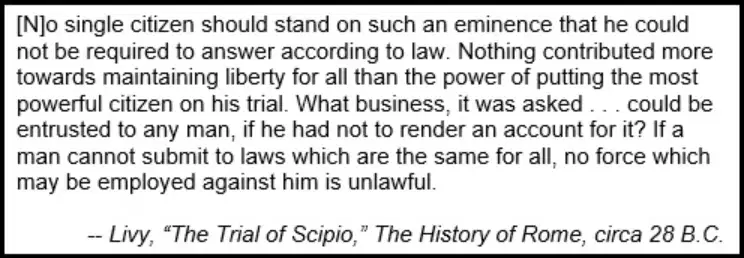
Based on the information in the excerpt, in what way is the trial of this war hero a step in the development of the rule of law?
It proved that a trial by a jury was common
It illustrated the idea that no citizen was above the law
It demonstrated the importance of having lawyers in trials
It showed a commitment to protecting the innocence of the accused
How did the construction of the Colosseum symbolize the power of the Roman Empire?
It demonstrated architectural innovation.
It provided a venue for public entertainment, showcasing the empire's wealth and resources.
It served as a religious site.
It was built using foreign labor only.
How did the Romans reflect their inheritance of Greek culture in their own society?
They rejected Greek mythology entirely.
They worshipped different gods and goddesses with no similarities to Greek deities.
They adopted Greek gods, studied Greek philosophy, and imitated Greek artistic achievements.
They isolated themselves from all foreign influences.
Which of the following was politically characteristic of many civilizations during the Classical Era (500 BC-600 AD)?
Voting rights were given to more and more people.
Representative governments evolved throughout the world.
Small feudal kingdoms spread across Eurasia.
Complex empires with bureaucracies developed.
Which of the following best explains how river valley civilizations influenced the development of Classical civilizations?
The belief in monotheism was advanced by the river valley civilizations.
The idea of religious freedom was promoted by the river valley civilizations.
The tradition of hunting and gathering was introduced by the river valley civilizations.
The foundations of political centralization were established by the river valley civilizations.

The characteristics listed in the box best reflect the efforts of the Roman Republic to —
reduce tension between plebeians and patricians
maintain effective borders against barbarian invasion
separate power among different government branches
divide power between provincial and central authorities
How did the Roman idea of citizenship facilitate political stability throughout Roman territories?
Romans granted citizenship to both men and women.
Romans extended citizenship to powerful landowners.
Romans allowed conquered peoples to become citizens.
Romans educated citizens about representative government.
Which innovation promoted trade and contributed to the unity of the Persian Empire?
Use of standardized metal coins
Creation of a universal code of laws
Division of the empire into administrative provinces
Construction of the remarkable gardens of the palace in Babylon
Zoroastrianism is an early monotheistic religion emerging from which classical civilization?
China
Greece
Persia
Rome
As a result of the collapse of Roman rule in 476, western Europe experienced —
a revolution in agriculture
a rebirth of art and learning
a shift to an urban population
a lack of political unity and stability
Which social change resulted from the adoption of the Edict of Milan?
Rome became the center of the Christian Church.
Roman social classes were divided resulting in a civil war.
Political rights were granted to the plebian social class in Rome.
Common culture developed between German invaders and Roman citizens.

Based on the information in the excerpt, how did the role of women in Roman society change during the classical period?
Roman women became landowners.
Roman women started voting in elections.
Roman women began serving in the army.
Roman women began serving in the legislatures.
Match the form of government to its correct description:
Citizens vote on laws and decisions
Democracy
Small group of people, usually from the wealthy class, makes most of the decisions
Oligarchy
Government guided by religious leaders or beliefs
Theocracy
Elected officials represent the people
Republic
Rule inherited from family
Monarchy
Use your knowledge to select the correct word to fill in each blank. In the Roman Republic, the ________ represented the aristocratic class, while the ________ represented the common people. Later, Rome transitioned from a republic to an ________, ruled by a single emperor with supreme power.
patricians, plebeians, empire
plebeians, patricians, democracy
senators, tribunes, monarchy
consuls, citizens, oligarchy
Use your knowledge to select the correct word to fill in each blank. Rome began as a ________, ruled by kings, but the Romans overthrew the last king and created a ________ in 509 BCE. In the Roman Republic, two ________ were elected each year to lead the government and the army, sharing power equally.
monarchy, republic, consuls
democracy, empire, senators
oligarchy, dictatorship, tribunes
city-state, monarchy, emperors
Match the achievements or cultural contributions to the correct civilization.
philosophers like Socrates and Plato; theater and drama
Athens
Code of laws created by Darius; royal road for trade
Persia
Engineering feats like aqueducts and roads; Twelve Tables
Rome
Strong military training; emphasis on discipline and obedience
Sparta
Match the government system to the correct civilization.
Athens
Democracy with citizen participation in government
Sparta
Militaristic oligarchy ruled by a few elite warriors
Persia
Empire ruled by a king with satraps for provinces
Rome
Republic with elected officials and a senate
The main social focus of Sparta and Athens and how they differed can be described as:
Sparta focused on military strength while Athens emphasized education and the arts.
Both Sparta and Athens focused mainly on trade and commerce.
Sparta and Athens both prioritized military training above all else.
Athens focused on agriculture while Sparta focused on philosophy.
Julius Caesar took which actions that led Rome to change from a republic to an empire?
He declared himself dictator for life and centralized power.
He expanded the Senate's authority and reduced his own power.
He restored the monarchy and abolished the Senate.
He isolated Rome from foreign influence and trade.
One cultural or religious difference between the Western and Eastern Roman Empires was:
The Western Empire was Roman Catholic, while the Eastern Empire was was Greek Orthodox.
The Western Empire practiced Buddhism, while the Eastern Empire practiced Christianity.
The Western Empire celebrated Ramadan, while the Eastern Empire celebrated Hanukkah.
The Western Empire followed Confucianism, while the Eastern Empire followed Hinduism.
One major contribution the Roman Empire had on modern day society is:
The development of a legal system
The invention of the printing press
The discovery of electricity
The creation of the internet
Constantine was a Roman emperor who is best known for which major change he brought to the Roman Empire?
He made Christianity a legal religion in the empire.
He expanded the empire into Asia.
He abolished the Senate.
He moved the capital to Carthage.
The main events and results of the Persian Wars included which of the following?
Greek city-states united to defeat the Persian Empire, leading to the rise of Athens as a major power.
Sparta conquered Athens and established an oligarchy.
The Persian Empire conquered all of Greece and imposed Persian culture.
The Greek city-states formed a permanent alliance with Persia.
One contributing factor that led to the fall of the Western Roman Empire was ________, and the immediate cause of its collapse was ________.
political instability; the invasion by Germanic tribes
economic prosperity; the rise of Christianity
military expansion; the construction of the Colosseum
strong leadership; the spread of democracy
The origins and main beliefs of Zoroastrianism are best described as:
Founded by Zoroaster in ancient Persia, emphasizing the battle between good and evil.
Originated in India, focusing on reincarnation and karma.
Started in ancient Egypt, centered around the worship of many gods.
Began in Greece, teaching about the afterlife in the Elysian Fields.
The main events and results of the Peloponnesian War can be described as
Which achievement is most closely associated with the government of ancient Athens?
Creation of a feudal system
Formation of a theocratic state
Development of a centralized monarchy
Establishment of a direct democracy
What was a major effect of the spread of Hellenistic culture throughout the Mediterranean region?
Rise of feudalism in the region
Increased isolation of local traditions
Blending of Greek, Egyptian, Persian, and Indian influences
Decline in trade and commerce
Which factor contributed most to the economic strength of the Roman Empire?
Dependence on a single crop for export
Frequent changes in currency
Strict isolation from neighboring civilizations
Extensive network of roads and trade routes
Which factor most contributed to the spread of Greek culture during the Hellenistic period?
Alexander the Great's conquests across Asia and Egypt
The isolation of Greek city-states
The decline of trade in the Mediterranean
The rise of the Roman Republic
What was a significant impact of Roman engineering on later civilizations?
Invention of the printing press
Development of aqueducts and roads that influenced modern infrastructure
Creation of the first steam engine
Discovery of electricity
The city-state of (a) was the birthplace of democracy.
This ancient civilization is the model that we use for the Olympic games today.
China
Greece
Rome
Egypt


What enabled Rome to engineer and build strong structures like the Colosseum efficiently; doors and windows could withstand very heavy weights because of these:
Roads and Bridges
Domes and vaults
Concrete and Arches
Hindu-Arabic Numbers
How were the Twelve Tables similar to the U.S. Constitution?
both were first written on bronze tablets
both were written to protect people's rights
both were written over 1,000 years ago
both were only written to protect the wealthy
Who developed the Law of Twelve Tables - a record of fundamentals of law that was set in stone?
The Greeks
The Romans
The Egyptians
The Americans
What was unusual about the religion of the Israelites?
they created the world’s first religion
they worshiped cows
they worshiped idols
they were the world’s first monotheistic religion

