
 Worksheets
Unit 1 Nature of Science Test Review
Total questions: 45
Worksheet time: 1hrs 8mins

Observation or Inference: I think the weather is cold.
Observation
Inference
Observation or Inference: I notice the tree by the pond has no leaves on it.
Observation
Inference

The cat looks mad. He must be hangry.
Observation
Inference
What is a test/independent variable?
The variable that is changed/manipulated in the experiment
The variable that is being observed/measured in the experiment
Elements that are kept constant/unchanged in the experiment
What is the dependent variable?
The variable that is changed/manipulated in the experiment
The variable that is being observed/measured in the experiment
Elements that are kept constant/unchanged in the experiment
What are the "constants" in an experiment?
The variable that is changed/manipulated in the experiment
The variable that is being observed/measured in the experiment
Elements that are kept constant/unchanged in the experiment

What is the test/independent variable in this experiment?
The height of the plants
The color of the lightbulbs

What is the outcome/dependent variable in this experiment?
The height of the plants
The color of the light bulbs
The variables in an experiment have a cause and effect relationship. Which variable is the "cause"?
independent variable
dependent variable
controlled variable
The variables in an experiment have a cause and effect relationship. Which variable is the "effect"?
independent variable
dependent variable
controlled variable
Which of the following is an example of quantitative data?
Observing
Measurements
Descriptions

What part of the experiment changes as a result of the independent variable?
The students
The study time
The grade on the quiz

HYPOTHESIS: Does study time affect the student's score on an test?
Use the table to answer questions 5 and 6.
Suppose you collected this data from students in your school. What is the independent variable in the study?
The Students
The Study Time
The Grade on the Quiz


The vertical axis of a line graph is called the __________.
slope
line of best fit
x-axis
y-axis

The horizontal axis of a line graph is called the __________.
slope
line of best fit
x-axis
y-axis
Which type of graph best represents data that shows a change over a period of time?
line
bar
table
circle


A meteorologist recorded high temperatures for five days at three locations on land. The data are shown in the table. Which statement correctly compares the beach temperature to the distance from the beach?
Areas at the beach have the coolest temperatures
Areas farther from the beach always have the warmest temperatures.
Areas at the beach have the most stable temperatures.
Areas farther from the beach always have the same weather as areas at the beach
Researchers are developing a new fertilizer designed to improve the growth of endangered Hawaiian plants. The fertilizer was applied to one hundred plants in a greenhouse. The temperature, humidity and amount of water were kept constant. Which is best for the researchers to do next?
A compare plants that received fertilizer plants that received none
B begin selling the fertilizer to gardeners living in hot, dry climates
C change the conditions in the greenhouse and retest the fertilizer
D test the fertilizer on plants that are adapted to cooler climates
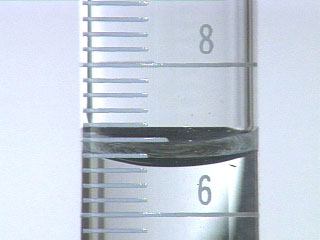
6.4 mL


Which object has the highest density in this picture?
A
B
C

Which object has the lowest density in this picture?
A
B
C
What is the density of an object if it has a mass of 6g and a volume of 3cm3? (Hint: Density = mass/volume)
6 g/cm3
3 g/cm3
2 g/cm3
1/3 g/cm3

You calculated the density of an unknown substance to be 7.8g/cm3. According to the chart, which of the substances doe you most likely have?
Zinc
Copper
Tin
Iron

You calculated the density of an unknown substance to be 5.7g/cm3. According to the chart, which of the substances do you most likely have?
Aluminum
Iron
Tin
Zinc

Which substance is the most dense in this picture?
Vegetable Oil
Dish Soap
Honey
Corn Syrup

Compared to material A, material B has different...
Density
Mass
Phase
Shape

Which of the following substances would float in water? (Hint: water has a density of 1g/cm3)
gold
rubber
water
cork
Find the density of a 2 cm x 2 cm x 2 cm cube with a mass of 64 g. Remember to first find the volume (Length x Width x Height) then use the density formula (mass / volume)


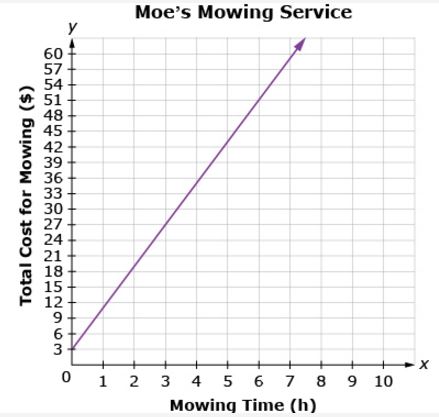
What is the general trend of this line graph?
The more you mow, the less money you make.
You make the same amount of money regardless of how long you mow.
The more you mow, the more money you make.
Mowing is dangerous.
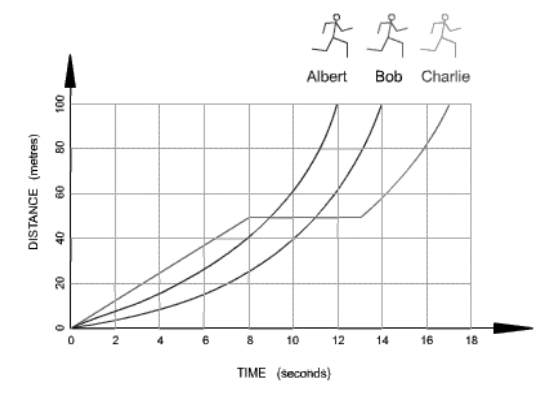
Which runner stopped for a rest?
Albert
Bob
Charlie

