
 Worksheets
SS Chapter 7: The U.S. Constitution
Total questions: 100
Worksheet time: 50mins
Decide if the following statement reflects a fact or an opinion. Write F for Fact and O for Opinion. 1. The Articles of Confederation got the new U.S. government off to a good start.
Fact
Opinion
Decide if the following statement reflects a fact or an opinion.
F
O
Decide if the following statement reflects a fact or an opinion. Write F for Fact and O for Opinion. 3. The U.S. Constitution was signed at the end of the Constitutional Convention.
F
O
What is the definition of the word 'constitution'?
a written plan for government
a type of government official
a set of laws for a state
a group of government leaders
How many of the 55 attendees at the Constitutional Convention signed the U.S. Constitution?
39
42
27
55
Where was the Constitutional Convention held?
Philadelphia
New York
Boston
Richmond
Which delegate arrived 2 weeks early to make plans?
James Madison
George Washington
Benjamin Franklin
Alexander Hamilton
Which statements best describe James Madison?
Madison was the president of the Constitutional Convention.
Madison is known as the 'Father of the Constitution.'
Madison was the oldest delegate at the Constitutional Convention.
Madison brought many ideas from his experience of writing Virginia’s constitution.
Which statements best describe George Washington?
George Washington attended the meetings of the Convention in his military uniform.
George Washington is known as the 'Father of the Constitution.'
George Washington was elected president of the Constitutional Convention.
George Washington was very unpopular with other delegates of the Convention.
Which statements best describe Benjamin Franklin? (Choose all that apply.)
Franklin was the oldest delegate at the Constitutional Convention.
Franklin was the youngest delegate at the Constitutional Convention.
Franklin was the most stubborn delegate at the Constitutional Convention.
Franklin encouraged delegates at the Constitutional Convention to compromise.
What is the definition of 'democracy'?
a country governed by elected representatives and by an elected leader (such as a president)
a form of government in which the people rule, either directly or through elected representatives
a person chosen to speak or make decisions for another person or group of people
freedoms that are protected by law
What is the definition of 'republic'?
a country governed by elected representatives and by an elected leader (such as a president)
a form of government in which the people rule, either directly or through elected representatives
a person chosen to speak or make decisions for another person or group of people
freedoms that are protected by law
What is the definition of 'representative'?
a country governed by elected representatives and by an elected leader (such as a president)
a form of government in which the people rule, either directly or through elected representatives
a person chosen to speak or make decisions for another person or group of people
freedoms that are protected by law
What is the definition of 'rights'?
a country governed by elected representatives and by an elected leader (such as a president)
a form of government in which the people rule, either directly or through elected representatives
a person chosen to speak or make decisions for another person or group of people
freedoms that are protected by law
Use the word bank to complete the sentence: A constitution is a ______ plan for government. It describes how the government is ______ and what ______ are divided. The U.S. Constitution establishes our government as a ______ and ______ the power of the government.
written, organized, powers, democracy, limits
oral, scattered, rights, monarchy, increases
verbal, disorganized, laws, dictatorship, expands
unwritten, chaotic, duties, oligarchy, ignores
Complete the graphic organizer: Whose problem is it?
Americans'
Canadians'
Europeans'
Asians'
Complete the graphic organizer: What is the problem?
Articles of Confederation
Bill of Rights
Declaration of Independence
Federalist Papers
Complete the graphic organizer: Why is it a problem?
it established a weak, ineffective central government
it created a powerful monarchy
it allowed for unlimited taxation
it banned all forms of trade
Complete the graphic organizer: What is the solution?
create a more effective government with a constitution
increase taxes without representation
abolish all forms of government
return to colonial rule
Write T for True and F for False. Correct any false statements to make them true. 1. After the Revolutionary War, Americans were worried a weak government would take away their rights.
True
False
The U.S. Constitution establishes a government with unlimited power.
True
False
The U.S. government gets its authority from the people.
True
False
The U.S. Constitution limits government’s power by describing what it may and may not do.
True
False
Write T for True and F for False. Correct any false statements to make them true. 5. The U.S. Constitution protects the rights of the government.
True
False
Voting is a way for people to exercise their power to participate in government.
True
False
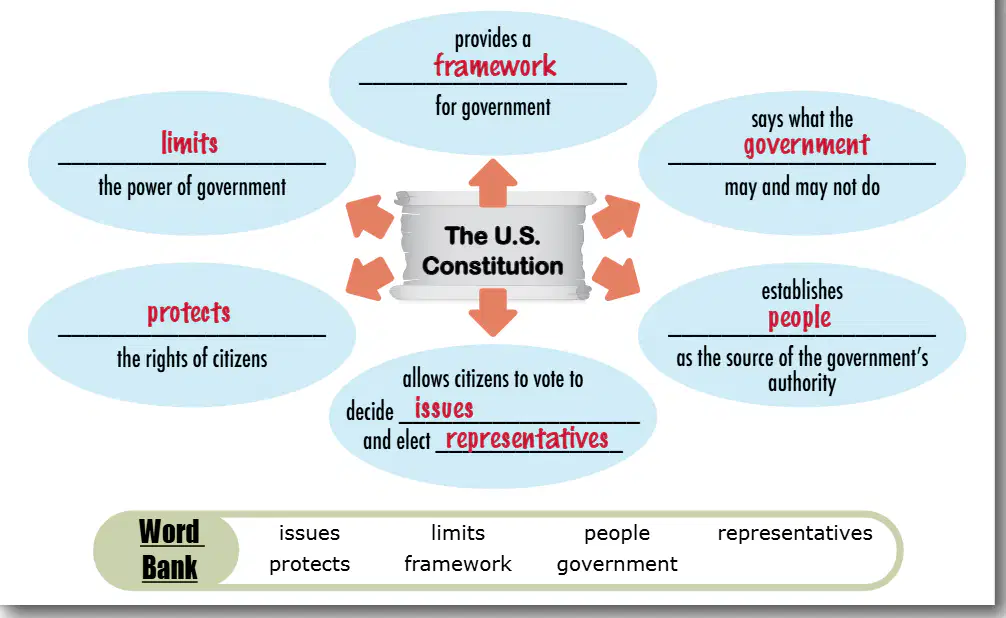
The U.S. Constitution provides a __________ for government.
framework
currency
holiday
anthem
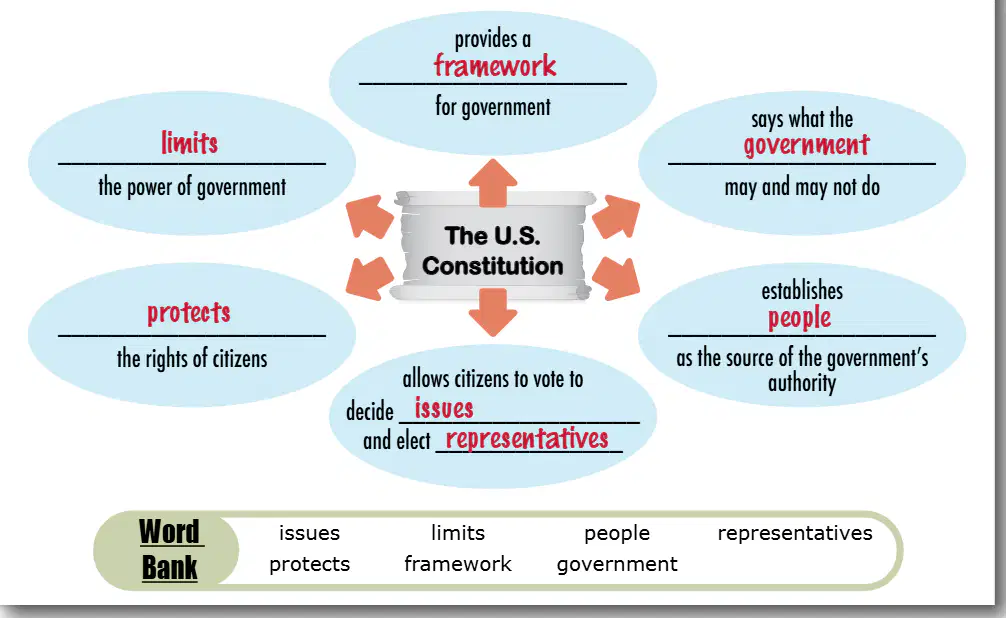
Use the word bank to correctly complete the phrases about the U.S. Constitution. The U.S. Constitution __________ the power of government.
limits
increases
ignores
removes
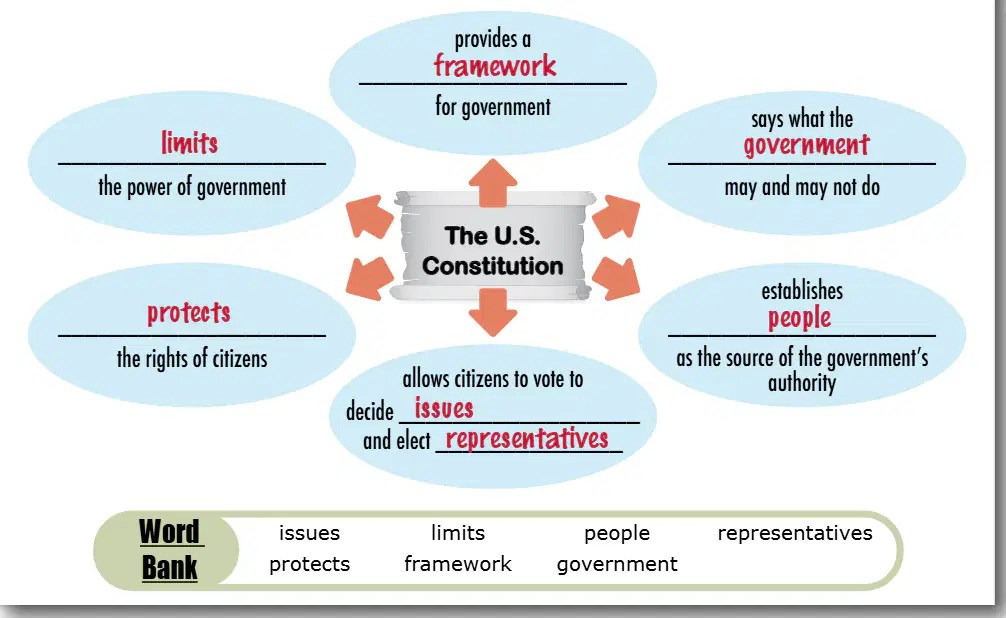
The U.S. Constitution says what the __________ may and may not do.
government
citizens
states
president
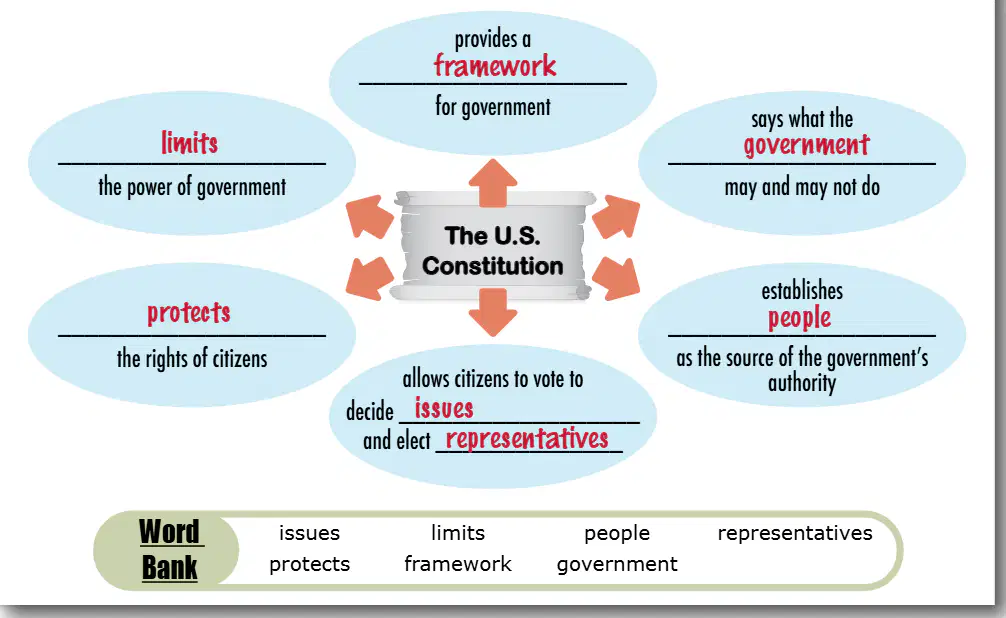
Use the word bank to correctly complete the phrases about the U.S. Constitution. The U.S. Constitution __________ the rights of citizens.
protects
removes
ignores
limits
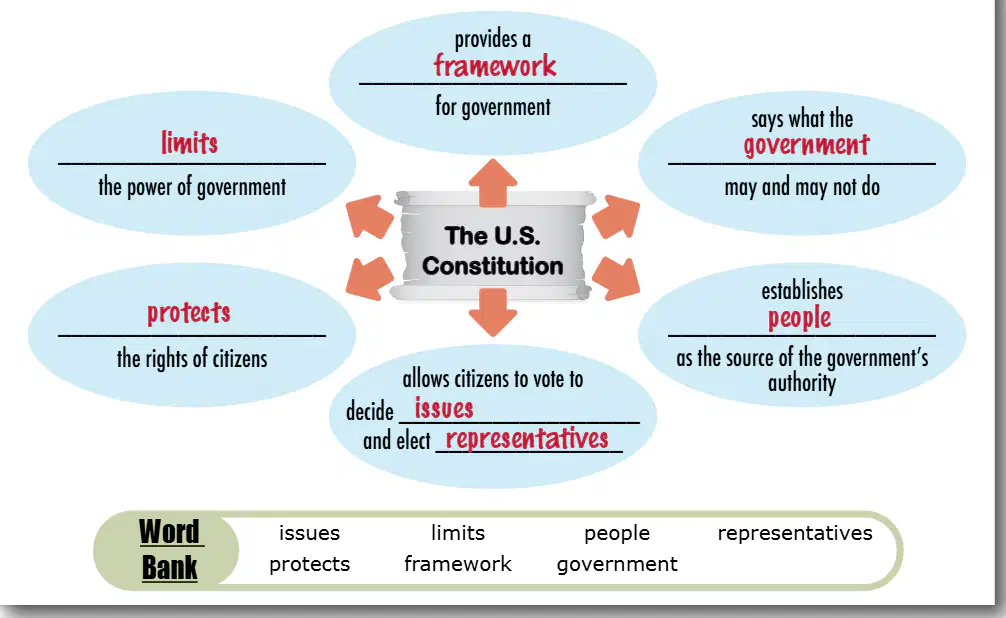
The U.S. Constitution establishes __________ as the source of the government’s authority.
people
Congress
the President
the Supreme Court
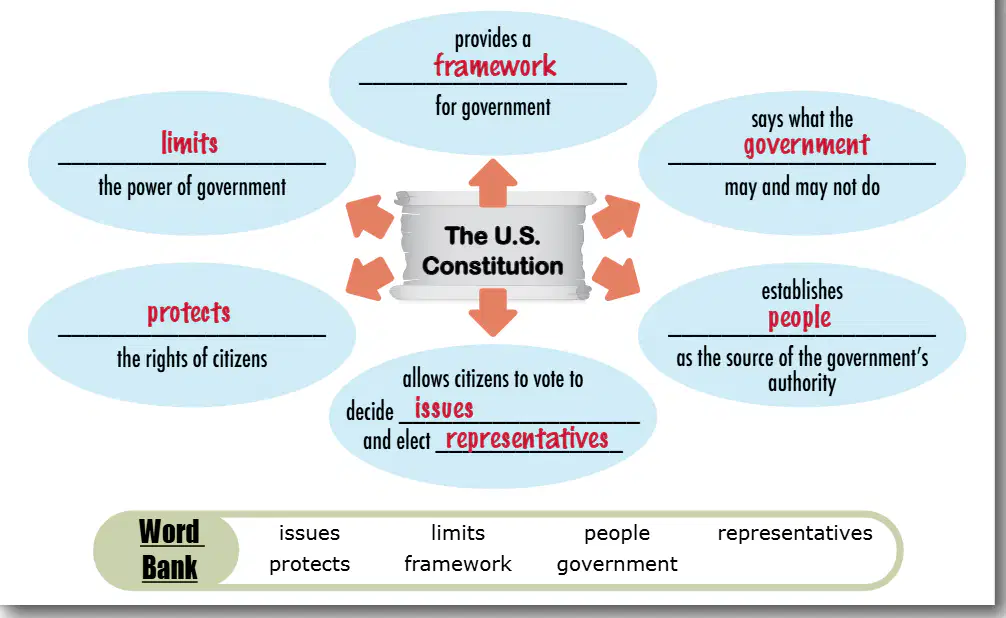
Use the word bank to correctly complete the phrases about the U.S. Constitution. The U.S. Constitution allows citizens to vote to decide __________ and elect __________.
issues, representatives
laws, presidents
judges, senators
amendments, governors
Look up each of these key words from the Preamble to the U.S. Constitution and define them here. Union: ____________________________
a whole country/ together as one
a type of government with a king
a group of separate states with no connection
a document that lists laws
Look up each of these key words from the Preamble to the U.S. Constitution and define them here. Justice: ____________________________
fairness
strength
wealth
happiness
Look up each of these key words from the Preamble to the U.S. Constitution and define them here. Tranquility: ____________________________
peaceful
angry
chaotic
unjust
Look up each of these key words from the Preamble to the U.S. Constitution and define them here. Defense: ____________________________
protection for everyone
freedom of speech
right to vote
equal taxation
Look up each of these key words from the Preamble to the U.S. Constitution and define them here. Welfare: ____________________________
care for those in need
a type of government
a form of transportation
a military strategy
Look up each of these key words from the Preamble to the U.S. Constitution and define them here. Liberty: ____________________________
freedom
law
government
justice
Look up each of these key words from the Preamble to the U.S. Constitution and define them here. Posterity: ____________________________
for generations to come
for the present government
for the founding fathers
for the people living now
Who would say this? (S=State Govt, N=National Govt)
N
S
Local Govt
Private Organization
Read each statement and write the correct letter in each column. 1. "States will never stop arguing if Congress can't regulate trade!" Is this a fact or opinion? (F=Fact, O=Opinion)
O
F
N
C
Who would say this? (S=State Govt, N=National Govt)
S
N
Both S and N
None of these
Read each statement and write the correct letter in each column. 2. "Each state is different and should be allowed to make its own laws." Is this a fact or opinion? (F=Fact, O=Opinion)
O
F
N
C
Read each statement and write the correct letter in each column. 3. "The Articles are weak—it's time to give Congress more authority." Who would say this? (S=State Govt, N=National Govt)
N
S
Both S and N
Neither S nor N
Read each statement and write the correct letter in each column. 3. "The Articles are weak—it's time to give Congress more authority." Is this a fact or opinion? (F=Fact, O=Opinion)
O
F
N
C
Read each statement and write the correct letter in each column. 4. "I don't want to fight another war to protect my rights and liberties." Who would say this?
S
A
B
C
Read each statement and write the correct letter in each column. 4. "I don't want to fight another war to protect my rights and liberties." Is this a fact or opinion? (F=Fact, O=Opinion)
O
F
N
C
What is a federal system?
A federal system is a system of government in which certain powers are given to the federal government and any powers not reserved for the federal government are given to the states. Some powers are shared powers.
A federal system is a government where all powers are held by a single central authority with no division of powers.
A federal system is a system where only the states have power and the federal government has no authority.
A federal system is a government in which the president has absolute power over all branches of government.
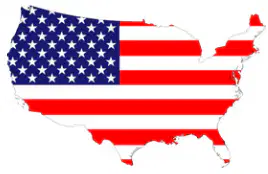
The national government is also known as the ______ government.
federal
state
local
municipal
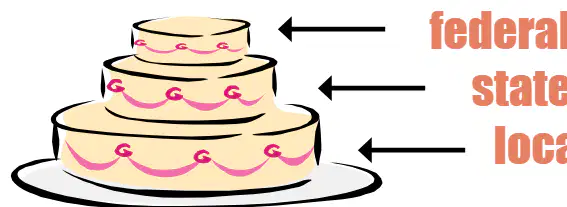
According to the passage, how many levels is the U.S. government organized into?
Two
Three
Four
Five
Which level of government is responsible for establishing and managing foreign policy?
Federal government
State government
Local government
None of the above
Which of the following is a responsibility of state governments?
Declare war
Conduct elections
Admit new states
Coin money
Local governments usually get their authority from the _________.
state constitution
federal government
city charter
county ordinance
The federal government is responsible for managing public health and welfare.
True
False
Which level of government is closest to the people and handles matters affecting just a city, county, or other local community?
Federal government
State government
Local government
None of the above
State governments are responsible for ratifying (approving) amendments to the U.S. Constitution.
True
False
Complete the sentences to describe our country’s system of government. 1. The U.S. Constitution describes how power is distributed to the federal and state governments.
The U.S. Constitution
The Declaration of Independence
The Bill of Rights
The Federalist Papers
Complete the sentences to describe our country’s system of government. 2. The U.S. government is structured as a ________ where certain powers are given to the federal government.
federal system
monarchy
unitary system
dictatorship
Complete the sentences to describe our country’s system of government. 3. The most powerful level of government is the _________.
federal government
state government
local government
municipal government
Complete the sentences to describe our country’s system of government. 4. States ________ make laws that violate or contradict federal laws.
cannot
always
should
might
Complete the sentences to describe our country’s system of government. 5. Shared powers are powers given to ________ levels of government.
both federal and state
only federal
only state
local
Write “state,” “local,” or “federal” to describe the power of each level of government. ________ government: laws that affect the entire country.
federal
state
local
municipal
Write “state,” “local,” or “federal” to describe the power of each level of government. ________ government: laws that only affect Tennessee.
state
local
federal
international
Write “state,” “local,” or “federal” to describe the power of each level of government. ________ government: laws that only affect your community.
local
state
federal
national
Determine which level of government has each of the following powers. Write federal or state if the power belongs to only one level of government, or write shared if the federal and state governments share the power. 1. Develop educational systems _________.
state
federal
shared
local
Determine which level of government has each of the following powers. Write federal or state if the power belongs to only one level of government, or write shared if the federal and state governments share the power.
2. Declare war _________.
federal
state
shared
local
Determine which level of government has each of the following powers. Write federal or state if the power belongs to only one level of government, or write shared if the federal and state governments share the power. 3. Tax citizens _________.
shared
federal
state
local
Determine which level of government has each of the following powers. Write federal or state if the power belongs to only one level of government, or write shared if the federal and state governments share the power.
4. Coin money _________.
federal
state
shared
local
Determine which level of government has each of the following powers. Write federal or state if the power belongs to only one level of government, or write shared if the federal and state governments share the power.
5. Manage public health and safety _________.
shared
federal
state
local
Determine which level of government has each of the following powers. Write federal or state if the power belongs to only one level of government, or write shared if the federal and state governments share the power. 6. Borrow money _________.
shared
federal
state
local
Determine which level of government has each of the following powers. Write federal or state if the power belongs to only one level of government, or write shared if the federal and state governments share the power. 7. Ratify amendments to the U.S. Constitution _________.
state
federal
shared
local
Determine which level of government has each of the following powers. Write federal or state if the power belongs to only one level of government, or write shared if the federal and state governments share the power. 8. Establish a court system _________.
shared
federal
state
local
What is the definition of the word 'branch' as used in the context of government?
A part that has a role within a larger organization.
A type of tree limb found in forests.
A financial institution that lends money.
A document used to pass laws.
Draw lines to match the branch with its responsibility: The legislative branch ________.
carries out laws
makes laws
interprets laws
Draw lines to match the branch with its responsibility: The executive branch ________.
carries out laws
makes laws
interprets laws
Draw lines to match the branch with its responsibility: The judicial branch ________.
carries out laws
makes laws
interprets laws
Match each person with the branch of government to which he or she belongs: President ________.
Legislative
Judicial
Executive
Match each person with the branch of government to which he or she belongs: Senator ________.
Legislative
Judicial
Executive
Match each person with the branch of government to which he or she belongs: Supreme Court Justice ________.
Legislative
Judicial
Executive
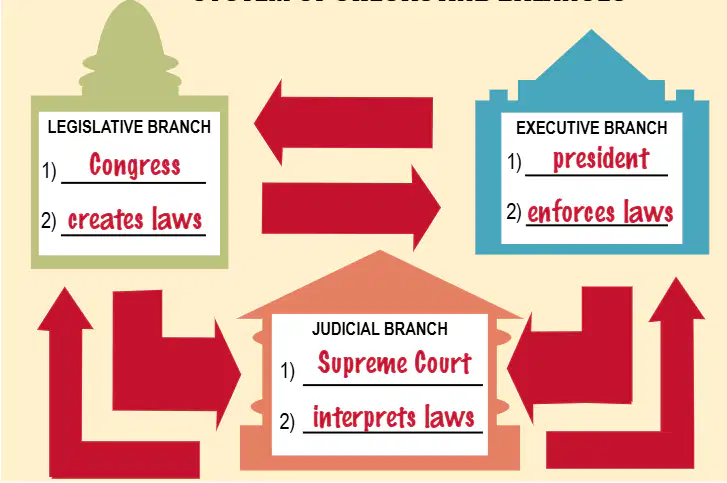
This chart shows the structure and powers of government at the national level. Use the words from the word bank to complete it. Write 1) the name of the person or group who serves in each branch and 2) one of the duties each branch has. LEGISLATIVE BRANCH 1) ________
Congress
President
Supreme Court
Cabinet
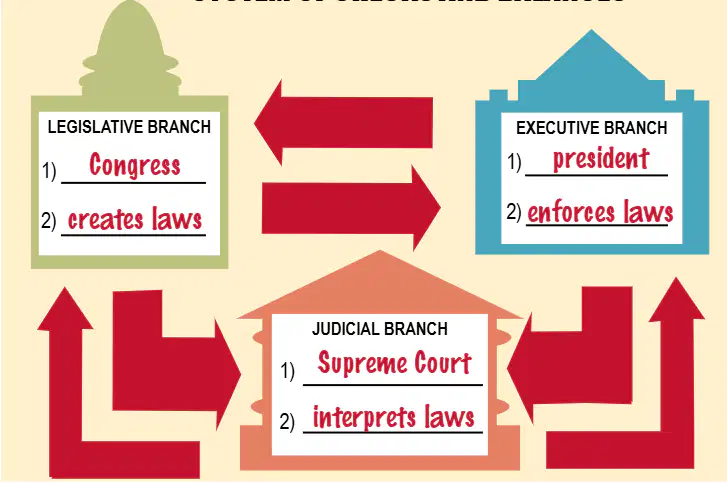
This chart shows the structure and powers of government at the national level. Use the words from the word bank to complete it. Write 1) the name of the person or group who serves in each branch and 2) one of the duties each branch has.
creates laws
enforces laws
interprets laws
collects taxes
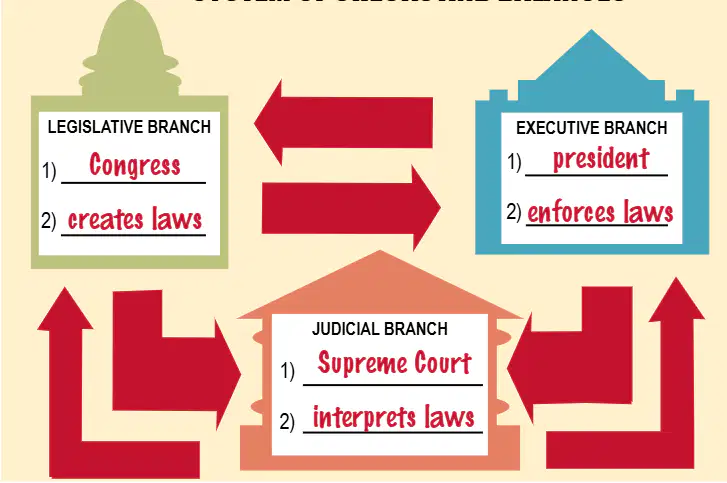
This chart shows the structure and powers of government at the national level. Use the words from the word bank to complete it. Write 1) the name of the person or group who serves in each branch and 2) one of the duties each branch has. Which of the following is the correct name of the person who serves in the executive branch at the national level?
president
governor
mayor
chief justice
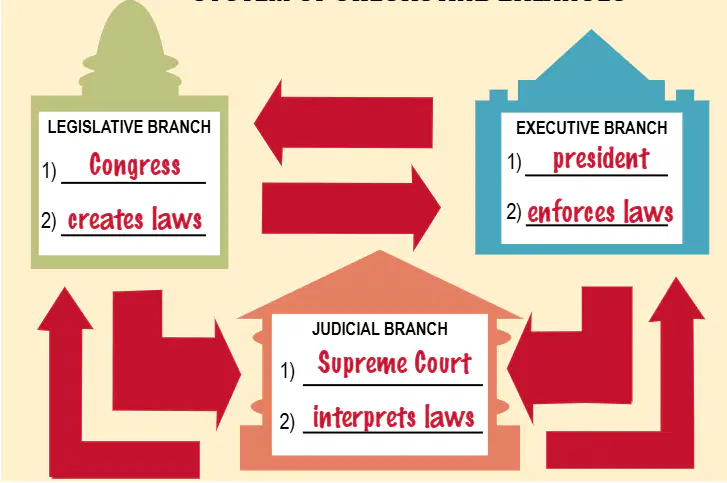
This chart shows the structure and powers of government at the national level. Use the words from the word bank to complete it. Write 1) the name of the person or group who serves in each branch and 2) one of the duties each branch has. EXECUTIVE BRANCH 2) ________
enforces laws
interprets laws
makes laws
settles disputes
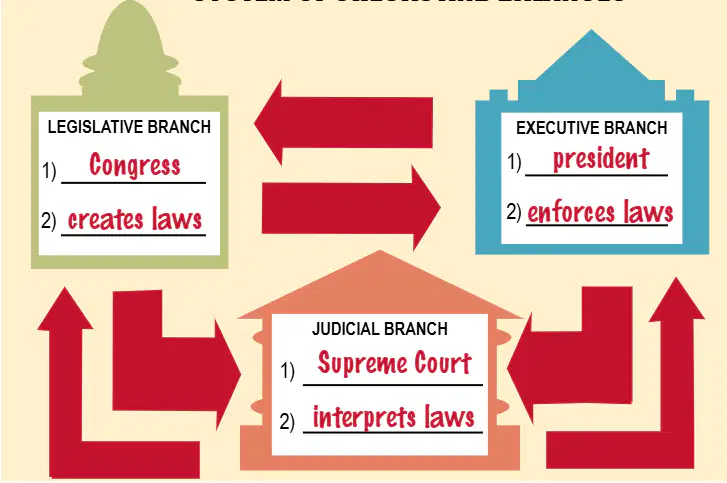
This chart shows the structure and powers of government at the national level. Use the words from the word bank to complete it. Write 1) the name of the person or group who serves in each branch and 2) one of the duties each branch has.
Supreme Court
House of Representatives
President
Senate

This chart shows the structure and powers of government at the national level. Use the words from the word bank to complete it. Write 1) the name of the person or group who serves in each branch and 2) one of the duties each branch has.
JUDICIAL BRANCH
2) ________
interprets laws
enforces laws
makes treaties
vetoes bills
If the Constitutional Convention delegates had not compromised on representation, the result would have been:
A lack of agreement, possibly leading to the failure of forming the Constitution
A stronger central government with no opposition
Immediate ratification by all states
A single house legislature with equal votes for all states
Who do you think 'won'? (This is kind of a trick question, but it’s not meant to be!)
Both sides won! The United States won! We all won!
Only the United States won!
Only the other side won!
No one won!
The war never ended!
A good compromise is characterized by:
Both sides making concessions and reaching a mutually acceptable solution.
One side getting everything they want.
Ignoring the needs of both parties.
Refusing to negotiate or communicate.
Compromise can be about each party winning, rather than each party losing, because:
it allows both parties to achieve some of their goals.
it means one party gets everything they want.
it always results in both parties being unhappy.
it requires both parties to give up all their interests.
How can it be about getting, rather than giving up?
It focuses on receiving benefits instead of making sacrifices.
It emphasizes letting go of desires.
It is about surrendering to circumstances.
It involves giving up personal goals.
It can be about innovative ideas, rather than a contest of wills, by focusing on:
collaborative problem-solving
personal competition
winning at all costs
dominating others
It can be about fairness, rather than selfish interests, when:
decisions are made with consideration for everyone involved
only personal gain is prioritized
rules are ignored for convenience
selfish motives drive every action
At first, states ________________ about representation in Congress.
disagreed
celebrated
ignored
united
Fill in the blanks with the correct words or phrases. 2. Small states wanted ________________.
equal representation
more land
higher taxes
a monarchy
Fill in the blanks with the correct words or phrases. 3. Large states wanted ________________.
representation based on population
equal representation for all states
no representation in Congress
a monarchy instead of a republic
Fill in the blanks with the correct words or phrases. 4. They solved the problem with the 'Great ________________.''
Compromise
Revolution
Treaty
Agreement
Fill in the blanks with the correct words or phrases. 5. Their solution was for Congress to have ________________ houses.
two
four
five
ten
In one house, the ________________, representation is based on population.
House of Representatives
Senate
Supreme Court
Cabinet
In the other house, the ________________, states have equal representation.
Senate
House of Representatives
Parliament
Assembly
How many representatives does Tennessee have in the U.S. Senate?
2
4
1
3
How does this compare to other states?
same as other states
completely different from other states
better than all other states
worse than most states

