
 Worksheets
Worksheet: Understanding Sounds and Listening Skills
Total questions: 100
Worksheet time: 50mins
The sound 'Duk! Duk!' is something you may have heard before.
Yes, I have heard it.
No, I have never heard it.
It is a type of music.
It is a famous movie dialogue.
Usually, the sound 'Duk! Duk!' is made by:
a woodpecker
a cat
a frog
a dog
Taking care of your sense of hearing involves:
Avoiding exposure to loud noises
Listening to music at maximum volume
Inserting objects into your ears
Ignoring ear infections
The questions discussed after reading the story together are:
Questions about the story's events and characters.
Questions about mathematical equations.
Questions about scientific experiments.
Questions about historical dates.
The color of the ball you have at home is:
Red
Blue
Green
Yellow
The ball makes a sound when it bounces. Is the sound slow or loud?
The sound is loud.
The sound is slow.
The sound is silent.
The sound is soft.
The teacher points to a letter on the alphabet poster in class or on a letter card. Ask the students if they can do it themselves. Can you point to the letter on the poster or card yourself?
Yes, I can point to the letter myself.
No, I cannot point to the letter myself.
The teacher asks students to sing the alphabet song together. Can you sing the alphabet song together?
Yes, I can sing the alphabet song together.
No, I cannot sing the alphabet song together.
The teacher introduces the sounds of each letter. Imitate the sound of the letter after the teacher. Can you imitate the sound of the letter?
Yes, I can imitate the sound of the letter.
No, I cannot imitate the sound of the letter.
The teacher shows a letter to the students. Can you mention the letter shown by the teacher?
A
B
C
D
The teacher asks students to differentiate between uppercase and lowercase letters. Can you differentiate between uppercase and lowercase letters?
Yes, I can differentiate between uppercase and lowercase letters.
No, I cannot differentiate between uppercase and lowercase letters.
The teacher asks students to identify the alphabet on word cards such as 'bola', 'biru', 'Boni', and 'batu'. Identify the letters in the word 'bola'.
b, o, l, a
b, o, n, a
b, a, l, o
b, o, l, u
Students should follow the instruction given in the image.
Follow the instruction in the image
Ignore the instruction in the image
Ask someone else about the instruction
Wait for further instructions

According to the instructions, the correct way to group words in the table with columns 'bo-' and 'bi-' is:
Place words starting with 'bo-' under the 'bo-' column and words starting with 'bi-' under the 'bi-' column.
Place all words randomly in either column.
Group words by their length in each column.
Put words ending with 'o' in 'bo-' and words ending with 'i' in 'bi-'.
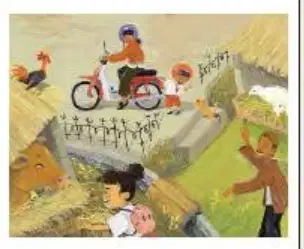
Apa arti dari judul gambar 'Pagi yang Sibuk'?
Pagi yang penuh aktivitas
Pagi yang tenang
Pagi yang cerah
Pagi yang santai
Ask the students to observe the picture. What should you do after the students observe the picture?
Ask questions from the Student Book.
Ignore the students' answers.
Move to the next lesson immediately.
Do not ask any questions.
Guess the first letter of each animal sound listed in the Student Book.
The first letter of each animal sound is the same as the animal's name.
The first letter of each animal sound is always 'A'.
The first letter of each animal sound is always 'S'.
The first letter of each animal sound is different from the animal's name.
Point to the animal that makes the sound you hear.
Point to the animal that makes the sound you hear.
Point to the animal that you see first.
Point to the animal that is the largest.
Point to the animal that is the smallest.
Identify the types of sounds you heard, including any new sounds and those that are the same as at home.
Sounds you heard, new sounds, and sounds that are the same as at home
Only the sounds you heard at home
Only the new sounds you heard
Only the loudest sounds you heard
Which of the following describes the sounds you might hear during the day and at night, as well as from the pictures in the Student Book?
Different sounds can be heard during the day and at night, and the pictures show various sounds too.
Only loud sounds are heard at night, and the pictures show silence.
The same sounds are heard both day and night, and the pictures show no sounds.
No sounds can be heard during the day, only at night.
Look at the image of the letters. Which letters are shown in the picture?
A and a
B and b
C and c
D and d
According to the instructions, which fingers should be used to hold a pencil correctly?
Thumb and index finger
Thumb and middle finger
Index and ring finger
Thumb and pinky finger
The correct way to hold a pencil is to grip it with the thumb and ______ finger, while the middle finger supports the pencil.
index
ring
little
palm
Which of the following is important for developing fine motor skills in students?
Holding the pencil with all fingers
Using three fingers to hold the pencil
Holding the pencil with only the thumb
Not using any fingers
Look at the two images of holding a pencil. Which image shows the correct way to hold a pencil?
Left image
Right image
What is the syllable at the beginning of the word 'batu'?
ba-
bu-
ta-
tu-
Identify the syllable in the word 'buku'
ba-
bu-
be-
From the following words, which one starts with the syllable 'be-'?
bola
biru
bebek
The scene in the picture is busier because there are more people and activities happening. The event in the picture takes place in the afternoon. Which of the following best describes the time of day shown in the picture?
Morning
Afternoon
Evening
Night
List five words you have learned that start with the letter 'b'.
bola, biru, buku, baju, batu
bola, biru, meja, baju, batu
bola, merah, buku, baju, batu
bola, biru, buku, meja, batu
Recall the story 'Duk! Duk!'. Did you like the story?
Yes, I liked the story because it was interesting.
No, I did not like the story because it was too long.
Yes, I liked the story because it was confusing.
No, I did not like the story because it was boring.
What should you do at home to practice the sound of the letter 'b'?
Ask your parents to help you listen to and identify sounds that start with 'b' at home.
Read a book without paying attention to any sounds.
Practice the sound of the letter 'z' instead.
Ignore the sounds and watch TV.
Which of the following is NOT a word that starts with the letter 'b'?
bola
biru
sapi
Jurnal Membaca: Pilih judul buku yang kamu baca.
Judul buku yang kamu baca
Nama penulis buku
Tahun terbit buku
Jumlah halaman buku
Jurnal Membaca: Pilih aktivitas yang sesuai dengan instruksi pada jurnal membaca dari buku.
Menggambar adegan yang paling disukai dari buku
Menulis ringkasan cerita buku
Mencari biografi penulis buku
Membuat daftar kosakata sulit dari buku
The word for 'ball' in Indonesian is _____
bola
meja
kursi
buku
The word for 'blue' in Indonesian is _____
biru
merah
kuning
hijau
The word for 'book' in Indonesian is _____
buku
meja
rumah
kursi
The word for 'shirt' in Indonesian is _____
baju
celana
sepatu
topi
The word for 'stone' in Indonesian is _____
batu
air
rumput
kayu
Have you prepared media and teaching aids before starting the lesson?
Sudah Saya Lakukan (I have done it)
Sudah Saya Lakukan, Tetapi Belum Efektif (I have done it, but it was not effective)
Masih Perlu Saya Tingkatkan Lagi (I still need to improve it)
Have you conducted introductory activities and invited students to discuss and make predictions about the topic to be discussed?
Sudah Saya Lakukan (I have done it)
Sudah Saya Lakukan, Tetapi Belum Efektif (I have done it, but it was not effective)
Masih Perlu Saya Tingkatkan Lagi (I still need to improve it)
Have you appreciated students' opinions and responses to motivate them to speak?
Sudah Saya Lakukan (I have done it)
Sudah Saya Lakukan, Tetapi Belum Efektif (I have done it, but it was not effective)
Masih Perlu Saya Tingkatkan Lagi (I still need to improve it)
Have you asked students to observe the cover illustration of the story before reading the content of the story?
Sudah Saya Lakukan (I have done it)
Sudah Saya Lakukan, Tetapi Belum Efektif (I have done it, but it was not effective)
Masih Perlu Saya Tingkatkan Lagi (I still need to improve it)
Have you elaborated on all students' responses during the discussion activity?
Sudah Saya Lakukan (I have done it)
Sudah Saya Lakukan, Tetapi Belum Efektif (I have done it, but it was not effective)
Masih Perlu Saya Tingkatkan Lagi (I still need to improve it)
Have you agreed on how to listen and speak well with students?
Sudah Saya Lakukan (I have done it)
Sudah Saya Lakukan, Tetapi Belum Efektif (I have done it, but it was not effective)
Masih Perlu Saya Tingkatkan Lagi (I still need to improve it)
Have you provided alternative enrichment and remedial activities according to students' competencies?
Sudah Saya Lakukan (I have done it)
Sudah Saya Lakukan, Tetapi Belum Efektif (I have done it, but it was not effective)
Masih Perlu Saya Tingkatkan Lagi (I still need to improve it)
Have you paid attention to students' reactions during the lesson?
Sudah Saya Lakukan (I have done it)
Sudah Saya Lakukan, Tetapi Belum Efektif (I have done it, but it was not effective)
Masih Perlu Saya Tingkatkan Lagi (I still need to improve it)
Keberhasilan yang saya rasakan dalam mengajarkan Bab 1 ini adalah:
Meningkatnya pemahaman siswa terhadap materi
Berkurangnya minat siswa belajar
Tidak ada perubahan pada hasil belajar siswa
Siswa menjadi kurang aktif di kelas
Kesulitan apa yang akan saya perbaiki untuk bab berikutnya?
Kesulitan yang saya alami pada bab sebelumnya
Materi yang sudah saya kuasai
Topik yang tidak relevan
Hal yang tidak berkaitan dengan pelajaran
Kegiatan yang paling disukai peserta didik adalah:
Belajar bersama teman
Membaca buku di perpustakaan
Mengikuti upacara bendera
Membersihkan kelas
Kegiatan yang paling sulit dilakukan peserta didik adalah:
Mengatur waktu belajar secara mandiri
Mengikuti pelajaran di kelas
Berpartisipasi dalam kegiatan ekstrakurikuler
Mengerjakan tugas kelompok
Sumber yang dapat digunakan untuk mengajar bab ini adalah:
Buku
Majalah gosip
Iklan televisi
Surat pribadi
Berdasarkan Tabel 1.2 Contoh Rubrik Penilaian Pengenalan Huruf, berapa nilai yang didapatkan jika seorang peserta didik dapat menyebutkan lebih dari 12 huruf?
1
2
3
4
According to the rubric in Table 1.4, what score should a student receive if they can write their name completely and independently?
1
2
3
4
Identify words that start with the prefix 'bo-' and 'bi-' as shown in Table 1.5.
'bo-' = bola; 'bi-' = bintang
'bo-' = bintang; 'bi-' = bola
'bo-' = bunga; 'bi-' = bola
'bo-' = bintang; 'bi-' = bunga
A score of 2 in Table 1.4 indicates what about a student's ability to write their name?
The student writes their name with some assistance.
The student writes their name independently and correctly.
The student cannot write their name at all.
The student writes only the first letter of their name.
According to the rubric, what does a student achieve if, with guidance, they can recognize one of the forms and sounds of the letters 'b', 'o', or 'i'?
With guidance, the student recognizes one of the forms and sounds of the letters 'b', 'o', or 'i'.
With guidance, the student recognizes the forms and sounds of the letters 'b', 'o', and 'i'.
The student can recognize and read the syllable 'bo-' or 'bi-' in a word.
The student can recognize and read words containing the syllables 'bo-' and 'bi-'.
According to the rubric, what does a student achieve if, with guidance, they can recognize the forms and sounds of the letters 'b', 'o', and 'i'?
Score 1: With guidance, the student recognizes one of the forms and sounds of the letters 'b', 'o', or 'i'.
Score 2: With guidance, the student recognizes the forms and sounds of the letters 'b', 'o', and 'i'.
Score 3: The student can recognize and read the syllable 'bo-' or 'bi-' in a word.
Score 4: The student can recognize and read words containing the syllables 'bo-' and 'bi-'.
According to the rubric, what does a student achieve if they can recognize and read the syllable 'bo-' or 'bi-' in a word?
With guidance, the student recognizes one of the forms and sounds of the letters 'b', 'o', or 'i'.
With guidance, the student recognizes the forms and sounds of the letters 'b', 'o', and 'i'.
The student can recognize and read the syllable 'bo-' or 'bi-' in a word.
The student can recognize and read words containing the syllables 'bo-' and 'bi-'.
According to the rubric, what does a student achieve if they can recognize and read words containing the syllables 'bo-' and 'bi-'?
Score 1: With guidance, the student recognizes one of the forms and sounds of the letters 'b', 'o', or 'i'.
Score 2: With guidance, the student recognizes the forms and sounds of the letters 'b', 'o', and 'i'.
Score 3: The student can recognize and read the syllable 'bo-' or 'bi-' in a word.
Score 4: The student can recognize and read words containing the syllables 'bo-' and 'bi-'.
According to the rubric, what does a student achieve if, with guidance, they can recognize one of the forms and sounds of the letters 'b', 'a', 'u', or 'e'?
Score 1: With guidance, the student recognizes one of the forms and sounds of the letters 'b', 'a', 'u', or 'e'.
Score 2: With guidance, the student recognizes the forms and sounds of the letters 'b', 'a', 'u', and 'e'.
Score 3: The student can recognize and read the syllable 'ba-', 'bu-', or 'be-' in a word.
Score 4: The student can recognize and read words containing the syllables 'ba-', 'bu-', and 'be-'.
According to the rubric, what does a student achieve if, with guidance, they can recognize the forms and sounds of the letters 'b', 'a', 'u', and 'e'?
With guidance, the student recognizes one of the forms and sounds of the letters 'b', 'a', 'u', or 'e'.
With guidance, the student recognizes the forms and sounds of the letters 'b', 'a', 'u', and 'e'.
The student can recognize and read the syllable 'ba-', 'bu-', or 'be-' in a word.
The student can recognize and read words containing the syllables 'ba-', 'bu-', and 'be-'.
According to the rubric, what does a student achieve if they can recognize and read the syllable 'ba-', 'bu-', or 'be-' in a word?
With guidance, the student recognizes one of the forms and sounds of the letters 'b', 'a', 'u', or 'e'.
With guidance, the student recognizes the forms and sounds of the letters 'b', 'a', 'u', and 'e'.
The student can recognize and read the syllable 'ba-', 'bu-', or 'be-' in a word.
The student can recognize and read words containing the syllables 'ba-', 'bu-', and 'be-'.
According to the rubric, what does a student achieve if they can recognize and read words containing the syllables 'ba-', 'bu-', and 'be-'?
Score 1: With guidance, the student recognizes one of the forms and sounds of the letters 'b', 'a', 'u', or 'e'.
Score 2: With guidance, the student recognizes the forms and sounds of the letters 'b', 'a', 'u', and 'e'.
Score 3: The student can recognize and read the syllable 'ba-', 'bu-', or 'be-' in a word.
Score 4: The student can recognize and read words containing the syllables 'ba-', 'bu-', and 'be-'.
Students can touch and smell various objects brought by the teacher. What can students do with their eyes closed?
Guess the names of the objects
See the colors of the objects
Draw pictures of the objects
Hear the sounds of the objects
Which of the following is the correct way to complete the patterns by tracing the dotted lines as shown in the image?
By carefully following the dotted lines to complete each pattern
By ignoring the dotted lines and drawing freely
By tracing only the solid lines
By connecting random points in the image
Which letters are you asked to trace and write by following the dotted lines as shown in the image?
Uppercase and lowercase B (B and b)
Uppercase and lowercase D (D and d)
Uppercase and lowercase A (A and a)
Uppercase and lowercase C (C and c)
________ is an element derived from learning achievement content that describes the achievement of competencies in stages.
alur konten capaian pembelajaran
indikator penilaian akhir
metode pembelajaran aktif
tujuan pembelajaran khusus
________ is a tool used by teachers in learning so that the material taught is easily understood by students.
alat peraga
buku tulis
meja
papan pengumuman
________ is an effort to obtain data from the process and learning outcomes to find out the achievement of students in class on certain learning materials.
asesmen
pengajaran
kurikulum
evaluasi
________ is an assessment conducted at the beginning of the school year to map students' competencies so that they receive appropriate handling.
asesmen diagnosis
asesmen sumatif
asesmen formatif
asesmen akhir
________ is the collection of learning progress data that can be done by teachers or students during the learning process.
asesmen formatif
asesmen sumatif
remedial teaching
kurikulum
________ is the assessment of learning outcomes comprehensively, covering all aspects of competence that are assessed and usually conducted at the end of the learning period.
asesmen sumatif
asesmen formatif
asesmen diagnostik
asesmen awal
________ means expressing the thinking process aloud so that others can learn and obtain information from the process.
berpikir lantang
berpikir diam-diam
berpikir cepat
berpikir lambat
________ is a book used as a supplement or complement to the main textbook.
buku pengayaan
buku utama
buku harian
buku pelajaran
________ is the ability at the end of the learning period obtained through a series of learning processes.
capaian pembelajaran
metode pembelajaran
tujuan pembelajaran
media pembelajaran
________ is a three-dimensional view of nature by placing objects in front of a background to depict the actual state of nature.
diorama
painting
photograph
sketch
________ is the smallest sound unit that can show a contrast in meaning, for example, /h/ is a phoneme because it distinguishes the meaning of the words 'harus' and 'arus'.
fonem
morfem
suku kata
kata
________ is a fact (state, event) that is a reality; something that really exists or happens.
fakta
opini
teori
hipotesis
________ is a fictional story (novel, romance, etc.).
fiksi
biografi
esai
artikel
________ is the accuracy of pronunciation and rhythm in a sentence so that listeners understand the meaning of the sentence correctly.
intonasi
aksara
tanda baca
huruf kapital
________ is a term for polite expressions that must be known and used by students in their daily lives.
kata ajaib
kata kasar
kata benda
kata kerja
________ is a person's ability to communicate effectively and interact with others verbally and nonverbally according to social norms and culture.
keterampilan sosial
keterampilan teknis
keterampilan fisik
keterampilan akademik
Kemampuan atau kecakapan seseorang untuk mengerjakan pekerjaan tertentu disebut ________.
kompetensi
motivasi
pengalaman
kreativitas
Kecakapan membaca dan menulis permulaan yang harus dikuasai di jenjang awal pendidikan formal disebut ________.
literasi dasar
numerasi lanjut
keterampilan vokasional
kompetensi digital
Pengetahuan dan kecakapan untuk mengaplikasikan pemahaman tentang konsep dan risiko, keterampilan agar dapat membuat keputusan finansial untuk meningkatkan kesejahteraan disebut ________.
literasi finansial
ekonomi makro
manajemen risiko
investasi saham
Catatan yang berisi sikap dan/atau keterampilan peserta didik untuk diamati guru disebut ________.
lembar amatan
daftar hadir
nilai rapor
surat izin
Format konten yang dapat diakses oleh perangkat-perangkat digital disebut ________.
media digital
media cetak
media analog
media tradisional
Membacakan buku atau kutipan dari buku kepada orang lain secara nyaring dengan tujuan untuk menarik minat membaca disebut ________.
membaca nyaring
membaca dalam hati
menulis ringkasan
mendengarkan cerita
Kemampuan untuk menggerakkan anggota tubuh yang melibatkan saraf, tulang, dan otot untuk melakukan aktivitas tertentu disebut ________.
motorik halus
pernapasan
pencernaan
penglihatan
Teks yang berdasarkan kenyataan atau fakta disebut ________.
nonfiksi
fiksi
puisi
dongeng
Proses menyajikan sebuah perilaku atau proses melakukan sesuatu agar orang lain dapat meniru atau mengadaptasi perilaku atau proses yang diperagakan tersebut disebut ________.
peragaan
diskusi
ceramah
tanya jawab
Teknik pemberian dukungan belajar secara terstruktur dan bertahap agar peserta didik dapat belajar secara mandiri disebut ________.
perancah
diskusi kelompok
ceramah
simulasi
Bagian dari kelas yang dilengkapi dengan rak buku berisikan buku-buku pengayaan sesuai jenjang untuk dibaca peserta didik selama berada di kelas disebut ________.
pojok baca kelas
meja guru
lemari alat tulis
papan tulis
Tugas pembelajaran yang kompleks dan melibatkan beberapa kegiatan untuk dilakukan peserta didik secara kolaboratif dengan serangkaian proses mulai dari perencanaan, pelaksanaan, hingga evaluasi kegiatan disebut ________.
proyek kelas
diskusi kelompok
presentasi individu
tugas rumah
Prakiraan tentang sesuatu disebut ________.
prediksi
analisis
observasi
teori
Teks yang melukiskan sesuatu sesuai dengan keadaan sebenarnya sehingga pembaca dapat melihat, mendengar, mencium, dan merasakan apa yang dilukiskan itu sesuai dengan citra penulisnya disebut ________.
teks deskripsi
teks eksposisi
teks narasi
teks argumentasi
Teks yang bertujuan untuk memberikan informasi tertentu, misalnya maksud dan tujuan sesuatu disebut ________.
teks eksposisi
teks narasi
teks deskripsi
teks prosedur
Teks yang berisi penilaian, ulasan, atau resensi terhadap suatu karya (film, buku, novel, drama, dll) sehingga orang lain mengetahui kelebihan dan kekurangan karya tersebut disebut ________.
teks tanggapan
teks prosedur
teks eksposisi
teks narasi

