
 Worksheets
Sourcing Decision Cycle Quiz
Total questions: 78
Worksheet time: 39mins
Which of the following best describes the Sourcing Decision Cycle Framework?
A structured approach to making decisions about sourcing activities
A method for calculating company profits
A framework for employee training programs
A guideline for marketing strategies
What is the primary difference between insourcing and outsourcing?
Insourcing uses internal resources, while outsourcing uses external providers
Insourcing is only for manufacturing, outsourcing is only for services
Insourcing is more expensive than outsourcing in all cases
Insourcing always involves international partners
Which pair correctly matches the concepts of in-shoring and offshoring?
In-shoring: Domestic sourcing; Offshoring: International sourcing
In-shoring: International sourcing; Offshoring: Domestic sourcing
In-shoring: Outsourcing to a third party; Offshoring: Insourcing
In-shoring: Sourcing from competitors; Offshoring: Sourcing from customers
What is the main distinction between near-shoring and far-shoring?
Near-shoring involves sourcing from nearby countries, while far-shoring involves sourcing from distant countries
Near-shoring is always cheaper than far-shoring
Near-shoring is only used in the technology sector
Far-shoring is only used for customer service
Which of the following is a major driver for outsourcing?
Cost reduction
Increasing product prices
Decreasing employee satisfaction
Reducing market share
At a strategic level, what should organizations consider when managing offshoring?
Risks, communication, and cultural differences
Only the cost of labor
The color of office furniture
The number of employees in the home country
What was the main goal of JP Morgan outsourcing its IT to IBM in 2002?
To improve the company's technology infrastructure.
To reduce the number of employees.
To expand into new markets.
To increase physical office space.
How long after signing the outsourcing contract did JP Morgan terminate it?
21 months
7 years
12 months
36 months
Which of the following was NOT a reason for JP Morgan terminating the outsourcing contract with IBM?
Expansion into Asia
Stagnation of IT at the company
Merger with Bank One in 2004
The global outsourcing market grew from $9 billion in 1990 to $256 billion in 2008. What does this suggest about the trend in outsourcing during this period?
The market grew from $9 billion to $256 billion, suggesting a significant increase in the adoption of outsourcing globally.
The market shrank from $256 billion to $9 billion, suggesting outsourcing became less popular.
The market remained the same, indicating no change in outsourcing trends.
The market fluctuated without a clear trend.

Which of the following terms refers to the practice of obtaining goods or services from an external provider, either domestically or internationally?
Insourcing
Outsourcing
Nearshoring
Captive Center

In the Sourcing Decision Cycle Framework, what is the primary question that leads to choosing between insourcing and outsourcing?
Where to locate operations?
Make or Buy?
How to reduce costs?
What technology to use?
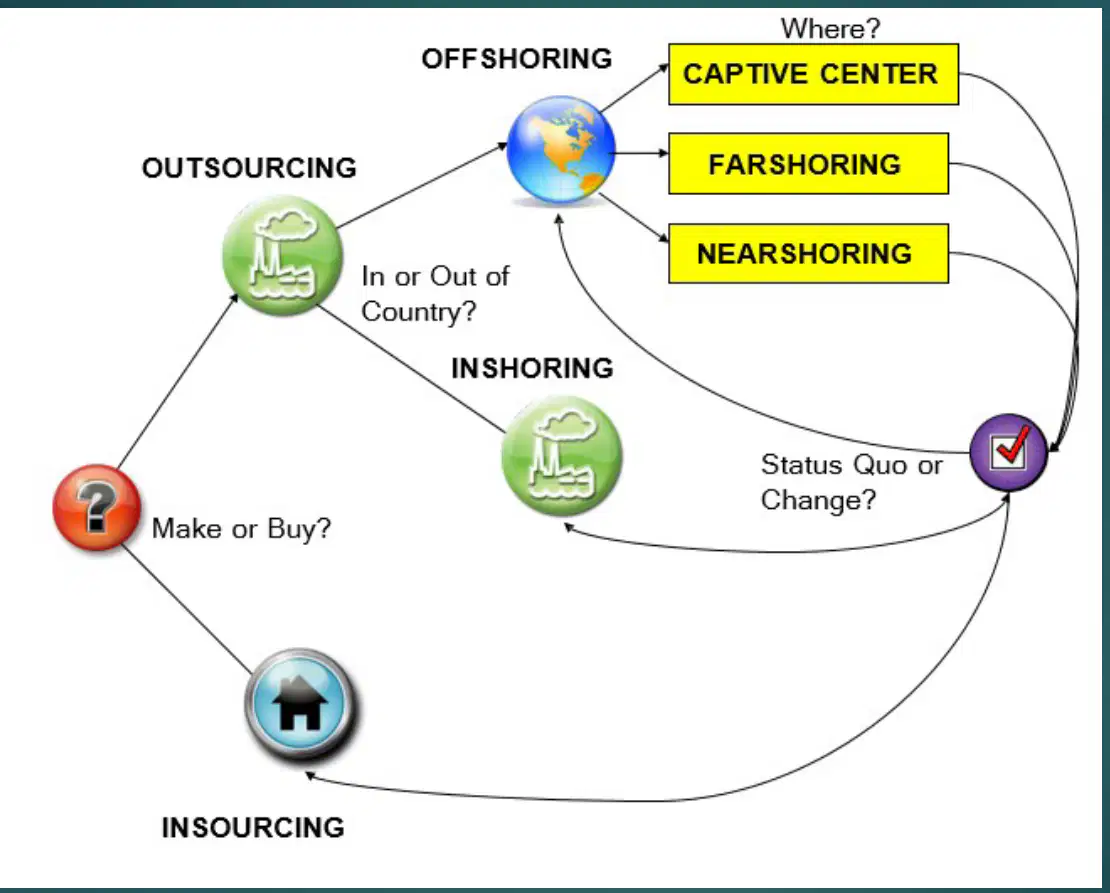
Which of the following best describes 'offshoring' as shown in the Sourcing Decision Cycle Framework?
Moving operations to another city within the same country
Moving operations to another country
Hiring temporary staff locally
Automating internal processes

According to the Sourcing Decision Cycle Framework, what are the three options for the location of offshored operations?
Captive Center, Farshoring, Nearshoring
Outsourcing, Insourcing, Inshoring
Domestic, International, Regional
Buy, Make, Lease
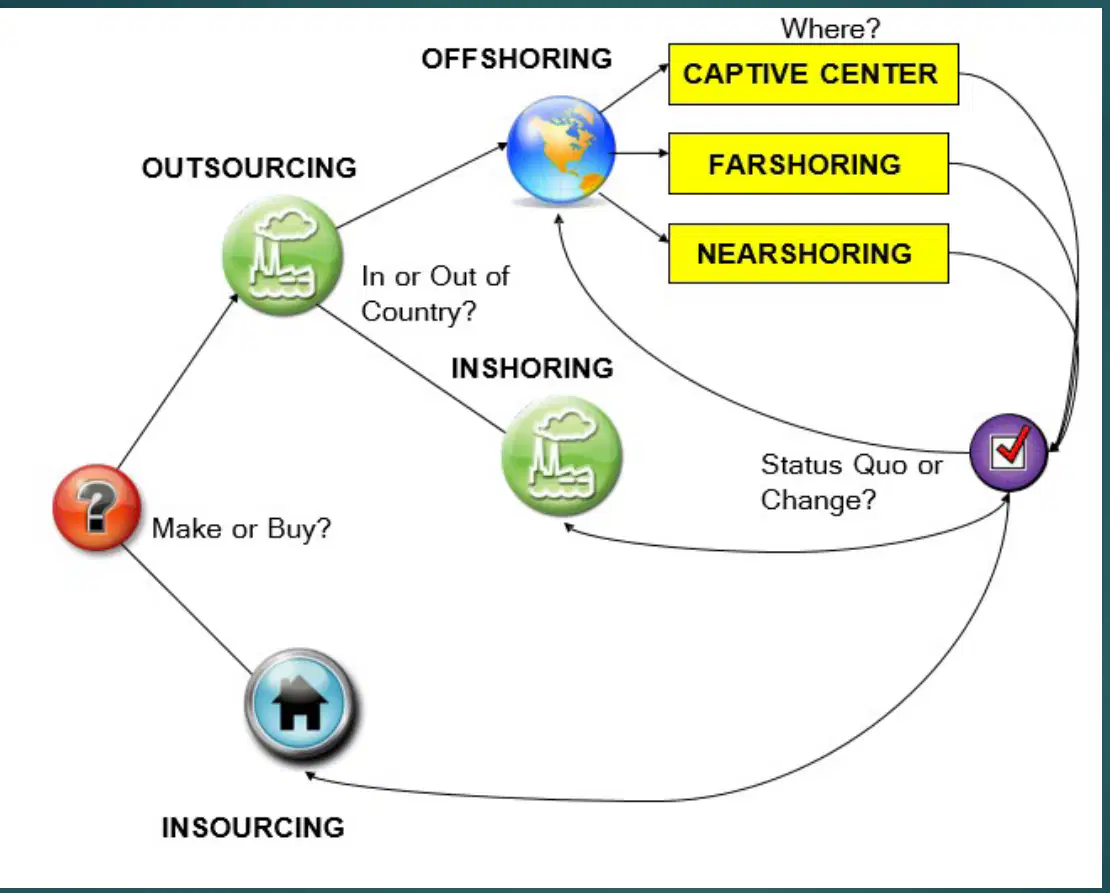
If a company decides to keep its operations within the same country but outside its own facilities, which sourcing strategy is it using according to the framework?
Offshoring
Inshoring
Nearshoring
Captive Center
What is the first step in the Sourcing Decision Cycle Framework?
Deciding if the offshore company is near or far
Periodic evaluation
The make or buy decision
Continual evaluation
If a company chooses to buy rather than make, what must it decide next?
How to evaluate the arrangement
Where to buy from
Whether to outsource or insource
The cost of production
When a company decides to go offshore, what additional decision must it make?
Whether to make or buy
If the offshore company is near or far
The cost of the product
The type of product to source
Why is continual evaluation important in the sourcing decision cycle?
To determine if the arrangement is satisfactory or not
To reduce costs
To increase production speed
To hire more employees
Which of the following best describes the purpose of periodic evaluation in the sourcing decision cycle?
To decide between making or buying
To ensure ongoing effectiveness of the sourcing arrangement
To select a supplier
To determine the location of the company
A company is considering outsourcing production to another country. What strategic factor should it consider according to the Sourcing Decision Cycle Framework?
The color of the company logo
Whether the offshore company is near or far
The number of employees in the company
The type of packaging used
What does insourcing mean in the context of IS (Information Systems) services?
A firm provides IS services or develops IS in its own in-house IS organization.
A firm outsources all IS services to a third-party provider.
A firm purchases IS products from external vendors only.
A firm does not use IS services at all.
Which of the following is a driver that favors the decision to insource IS services?
Keeping core competencies in-house.
Reducing the number of in-house IT personnel.
Increasing dependency on external vendors.
Lowering security requirements.
Why might a firm choose to insource an IS service or product?
The service or product requires considerable security or confidentiality.
The service or product is widely available as a commercial off-the-shelf solution.
The firm wants to reduce its in-house IT staff.
The firm has no time to complete IS projects in-house.
Which of the following is a challenge to insourcing mentioned in the material?
Getting needed IT resources from management.
Reducing the cost of external vendors.
Increasing the number of outsourced projects.
Decreasing in-house IT personnel.
A company is considering insourcing its IS projects. What strategic factor should it consider to ensure success?
Whether it has enough in-house time and IT personnel to complete the projects.
Whether it can find the cheapest external vendor.
Whether it can eliminate all in-house IT staff.
Whether it can avoid all management involvement.
Which of the following is considered a driver for insourcing in an organization?
Dealing with inadequate support from top management
Good for core competencies
Finding a reliable outsourcing provider
Lack of in-house IT professionals
What is a challenge associated with insourcing, according to the provided material?
Time available in-house to complete projects
Good for confidential IS services
Dealing with inadequate support from top management to acquire needed resources
In-house IT professionals have adequate training
Which of the following best explains why insourcing is suitable for confidential or sensitive IS services?
It is less expensive than outsourcing
It allows for more control over sensitive information
It requires less training for IT professionals
It eliminates the need for software development
A company is considering insourcing for a new software development project. Which factor should they consider as a potential advantage?
Difficulty in finding a competent outsourcing provider
In-house IT professionals have adequate training and experience
Inadequate support from top management
Lack of time to complete projects in-house
Suppose a company faces challenges in acquiring needed resources due to lack of support from top management. What is the most likely impact on their insourcing efforts?
Increased efficiency in project completion
Enhanced confidentiality of services
Difficulty in successfully implementing insourcing
Improved training for IT professionals
Which of the following best defines outsourcing?
The purchase of a good or service that was previously provided internally, or that could be provided internally.
The process of hiring only internal staff for all company needs.
The act of selling company assets to external vendors.
The development of new products within the company.
Which of the following is a primary driver for outsourcing according to the provided material?
Increasing the number of internal employees
Cost reduction achieved through economies of scale
Decreasing access to IT talent pools
Focusing more on IT issues than core activities
How can outsourcing help a company transition to new technologies?
By limiting access to IT talent pools
By providing access to larger IT talent pools
By reducing the need for technology upgrades
By focusing only on existing technologies
Why might management choose to bring in outside expertise through outsourcing?
To focus more on IT issues
To focus more attention on core activities rather than IT issues
To reduce the number of core activities
To avoid hiring new staff
Which of the following is NOT listed as a driver for outsourcing in the material?
Greater capacity on demand
Overcoming inertia to consolidate data centers
Increasing the number of internal IT staff
Outsourcing companies know how to hire, manage, and retain IT staff
A company is struggling to consolidate its data centers due to internal resistance. According to the material, how can outsourcing help in this situation?
By increasing internal resistance
By overcoming inertia to consolidate data centers
By reducing the need for data centers
By hiring more internal staff
The strategic benefit of outsourcing IT staff management for a company aiming to improve its talent retention is that:
Outsourcing companies know how to hire, manage, and retain IT staff, which can improve talent retention.
Outsourcing companies only provide temporary staff, which does not help with retention.
Outsourcing companies focus solely on cost reduction, not talent retention.
Outsourcing companies do not manage IT staff at all.
Which of the following is a primary driver for organizations to consider outsourcing?
Maintaining an adequate level of control
Offers cost savings
Avoiding overreliance on outsourcing provider
Mitigating outsourcing risks
What is one of the main challenges organizations face when outsourcing?
Provides a cash-infusion
Offers opportunity for better strategic focus
Maintaining ability to respond to technological innovation
Makes it easier to consolidate data centers
Which of the following is NOT listed as an outsourcing driver?
Provides better management of IS
Avoiding a loss of strategic advantage
Eases transition to new technologies
Provides a cash-infusion
Why might an organization want to outsource in order to handle staff peaks?
To avoid overreliance on outsourcing provider
To offer better ability to handle fluctuating workloads
To ensure cost savings while protecting quality
To mitigate outsourcing risks
Which of the following best describes a strategic challenge of outsourcing?
Offers cost savings
Avoiding a loss of strategic advantage
Provides a cash-infusion
Makes it easier to consolidate data centers
What is a potential risk if an organization becomes too dependent on its outsourcing provider?
Offers opportunity for better strategic focus
Avoiding overreliance on outsourcing provider
Provides better management of IS
Eases transition to new technologies
Which of the following is a benefit of outsourcing related to data management?
Makes it easier to consolidate data centers
Mitigating outsourcing risks
Ensuring cost savings while protecting quality
Maintaining an adequate level of control
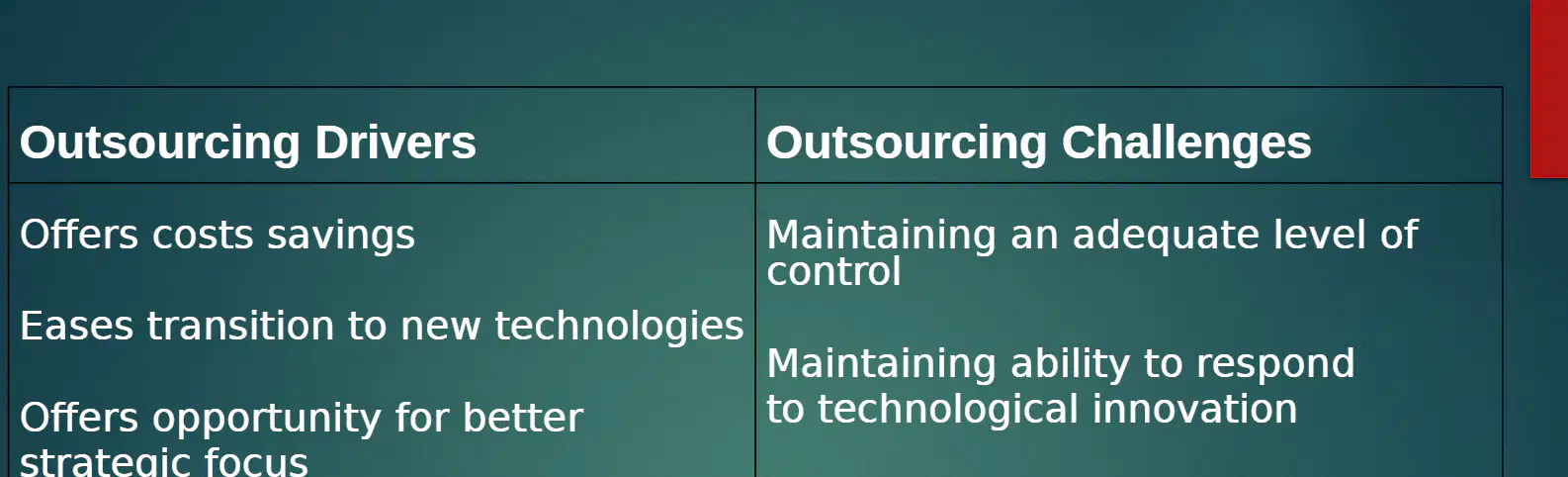
What does the diagram primarily illustrate?
The financial statements of a company
The differences between insourcing and outsourcing
The key drivers and challenges associated with outsourcing
The process of technological innovation
Which of the following is a challenge commonly associated with outsourcing?
A degree of control is surrendered.
Increased internal innovation.
Guaranteed cost savings.
Enhanced competitive secrets.
What is a potential risk when a company does not adequately anticipate new technological capabilities during outsourcing contract negotiations?
They may fall behind in technology advancements.
They will always save money.
They will gain more control over processes.
They will become less dependent on providers.
Why might contract terms in outsourcing make clients highly dependent on their providers?
Because the terms can limit flexibility and tie clients to specific providers.
Because clients gain more control over the provider.
Because providers always offer better technology.
Because clients can easily switch providers.
Which of the following best explains why competitive secrets may be harder to keep when outsourcing?
Outsourcing involves sharing sensitive information with external parties.
Outsourcing always increases internal security.
Outsourcing eliminates the need for contracts.
Outsourcing guarantees confidentiality.
A company outsources a key function but does not realize the expected cost savings. Which outsourcing challenge does this scenario illustrate?
Savings may never be realized.
Competitive advantage is increased.
Control is enhanced.
Technological capabilities are always anticipated.
(DoK Level 3) A company is considering outsourcing its IT department. Analyze two major risks they should consider before making this decision.
Loss of control and difficulty keeping competitive secrets.
Guaranteed cost savings and increased innovation.
Enhanced internal development and reduced dependency.
Automatic technological advancement and flexibility.
Which of the following is recommended to avoid outsourcing pitfalls?
Do not negotiate solely on price.
Negotiate only on price.
Ignore contract management skills.
Choose a single supplier for all needs.
What is the purpose of crafting full life-cycle service contracts that occur in stages?
To allow flexibility and manage risks over time.
To lock in a supplier for the longest period possible.
To avoid evaluating supplier capabilities.
To reduce the number of suppliers.
Why is it important to thoroughly evaluate outsourcing providers' capabilities?
To ensure the provider can meet your company's needs.
To reduce the number of contracts.
To avoid developing internal skills.
To focus only on price.
Which factor should be considered in addition to technical expertise when choosing an outsourcing provider?
Cultural fit
Lowest price
Shortest contract duration
Number of suppliers
How can using SOAs (Service-Oriented Architectures) benefit a company in outsourcing?
By increasing agility
By reducing the need for contracts
By eliminating the need for evaluation
By focusing only on price
A company is planning to offshore some of its operations. What should it do to avoid common outsourcing pitfalls?
Plan the transition to offshoring
Ignore the transition process
Choose the cheapest provider
Avoid evaluating its own capabilities
Why is it important to determine whether a particular outsourcing relationship produces a net benefit for your company?
To ensure the outsourcing decision adds value to the company
To avoid using multiple suppliers
To focus only on contract length
To ignore cultural fit
What is a recommended approach when selecting suppliers for outsourcing?
Use multiple, best-of-breed suppliers
Use only one supplier for all needs
Ignore supplier capabilities
Base decisions solely on price
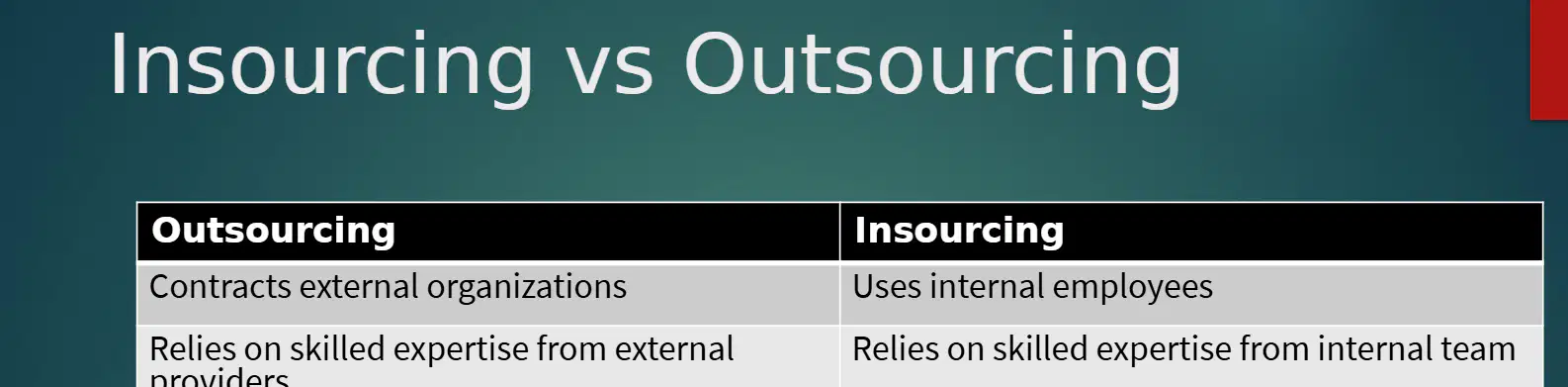
Which of the following best describes outsourcing?
Uses internal employees
Contracts external organizations
Involves only internal team expertise
Is always more costly than insourcing
What is a primary advantage of outsourcing for businesses?
Provides flexibility and ability to focus on core aspects of the business
Ensures strict quality control
Always uses internal employees
Is less flexible than insourcing
Which statement is true about insourcing compared to outsourcing?
Insourcing always saves more money than outsourcing
Insourcing relies on skilled expertise from internal team members
Insourcing contracts external organizations
Insourcing is always more flexible than outsourcing
For a task involving sensitive customer data and requiring strict quality control, which approach is more suitable for a company?
Outsourcing, because it is always cheaper
Insourcing, because it is beneficial for tasks requiring strict quality control and sensitive information
Outsourcing, because it provides more flexibility
Insourcing, because it contracts external organizations
Which of the following is a potential disadvantage of outsourcing?
May pose challenges regarding quality control and data security
Always uses internal employees
Is always more expensive than insourcing
Involves only internal team expertise
Why might outsourcing result in significant cost savings for a company?
Because it always uses internal employees
Because it can involve countries with lower labor costs
Because it is less flexible than insourcing
Because it requires strict quality control
Which of the following factors should a company consider when deciding between insourcing and outsourcing?
The company's specific needs, resources, and goals
The popularity of outsourcing in the industry
The number of employees in the company
The location of the company's headquarters
What is the main advantage of using a hybrid model that combines insourcing and outsourcing?
It eliminates the need for any internal staff
It achieves a balance between control and cost savings
It increases the complexity of business operations
It focuses only on cost reduction
Why should the decision between insourcing and outsourcing be based on a thorough analysis of an organization’s needs?
To ensure the decision is based on trends
To optimize business operations by leveraging strengths of both approaches
To follow what competitors are doing
To reduce the number of employees
A company is considering whether to insource or outsource a business function. What is a recommended first step according to the summary?
Analyze the organization’s needs thoroughly
Immediately choose outsourcing for cost savings
Hire more employees before deciding
Ignore the company’s goals and resources
Which of the following is a factor that makes a country attractive for offshoring software services?
High English language proficiency
High population density
Low internet usage
Expensive labor costs
Why is it important to assess which city in a selected country is suitable for offshoring?
Because different cities may have varying levels of technical infrastructure and other relevant factors
Because all cities in a country are identical in terms of resources
Because only the capital city can be used for offshoring
Because cities do not affect offshoring decisions
Which of the following is NOT mentioned as a factor that makes a country attractive for offshoring?
Politically stable environment
Lower crime rates
High levels of pollution
Friendly international relationships
A company is considering two countries for offshoring. Country A has high English proficiency and strong technical infrastructure, but frequent political unrest. Country B has moderate English proficiency, stable politics, and low crime rates. Based on the factors listed, which country is likely to be more attractive for offshoring, and why?
Country B, because political stability and low crime rates are important for offshoring
Country A, because English proficiency is the only important factor
Country A, because political unrest is not a concern
Country B, because moderate English proficiency is better than high proficiency
Which country is mentioned as making an entire industry out of offshoring?
Brazil
India
China
Germany
What does Level 1 in the Capability Maturity Model (CMM) indicate about software development processes?
Processes are highly efficient and reliable
Processes are immature and bordering on chaotic
Processes are automated and optimized
Processes are partially documented and repeatable
Why is India considered a desirable vendor for software development according to the CMM?
India has the lowest labor costs
India is known for CMM Level 5 software development processes, which are extremely reliable
India has the largest number of software engineers
India is the only country using the CMM model
Suppose a company is looking for a reliable offshoring destination for software development. Based on the CMM levels discussed, what should they look for in a vendor?
Vendors with CMM Level 1 processes
Vendors with no CMM certification
Vendors with CMM Level 5 processes
Vendors with only hardware expertise

