
 Worksheets
CHEM CHAPTER 6
Total questions: 149
Worksheet time: 2hrs 28mins
Atoms form positively charged ions when they lose electrons and negatively charged ions when they gain electrons.
True
False
Ionic bonds are formed by the strong attractive forces between positive and negative ions.
True
False
Select the correct symbols for the simple ions of the representative elements.
Na+, Cl-, Mg2+, O2-
Na2+, Cl+, Mg+, O-
Na-, Cl+, Mg-, O+
Na2-, Cl2+, Mg2-, O2+
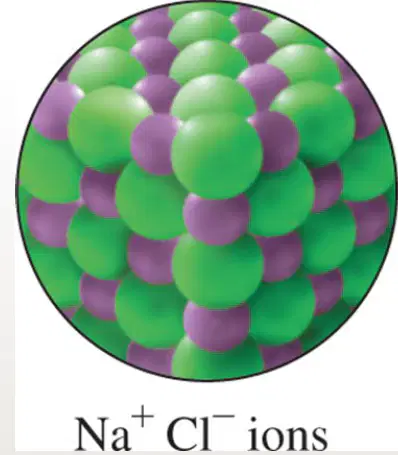
Refer to the diagram of Na+ and Cl- ions. Which type of bond is formed between these ions?
Covalent bond
Ionic bond
Metallic bond
Hydrogen bond
According to Table 6.1 Types of Particles and Bonds in Compounds, what type of particles are found in Ionic Compounds?
Ions
Atoms
Molecules
Electrons
According to Table 6.1 Types of Particles and Bonds in Compounds, what type of particles are found in Molecular Compounds?
Molecules
Ions
Atoms
Electrons
According to Table 6.1 Types of Particles and Bonds in Compounds, what type of bond is present in Ionic Compounds?
Ionic
Covalent
Metallic
Hydrogen
According to Table 6.1 Types of Particles and Bonds in Compounds, what type of bond is present in Molecular Compounds?
Covalent
Ionic
Metallic
Hydrogen
According to Table 6.1 Types of Particles and Bonds in Compounds, which of the following is an example of an Ionic Compound?
A) Na+ Cl- ions
B) H2O molecules
C) C3H8 molecules
According to Table 6.1 Types of Particles and Bonds in Compounds, which of the following is an example of a Molecular Compound?
Na+ Cl- ions
H2O molecules
Both B and C
What is the octet rule in chemistry?
Atoms gain, lose, or share valence electrons to acquire eight valence electrons
Atoms always have six valence electrons
Atoms do not share electrons
Atoms only lose electrons
Ionic bonds occur when the valence electrons of atoms of a metal are ________ to atoms of a nonmetal.
transferred
shared
absorbed
repelled
Covalent bonds form when atoms of nonmetals ________ valence electrons.
share
lose
gain
transfer

Based on the diagram, what is the main difference between an ionic bond and a covalent bond?
A) Ionic bonds involve sharing electrons, covalent bonds involve transfer of electrons
B) Ionic bonds involve transfer of electrons, covalent bonds involve sharing electrons
C) Both involve sharing electrons
D) Both involve transfer of electrons
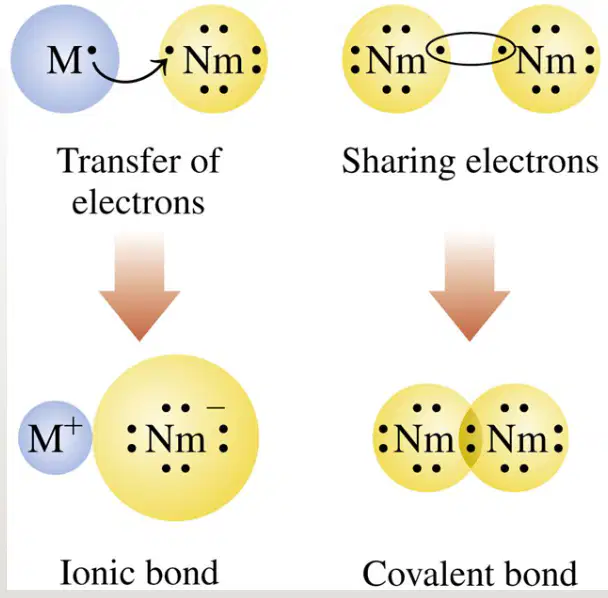
Fill in the blank: In an ionic bond, electrons are ______ from a metal to a nonmetal.
transferred
shared
created
destroyed
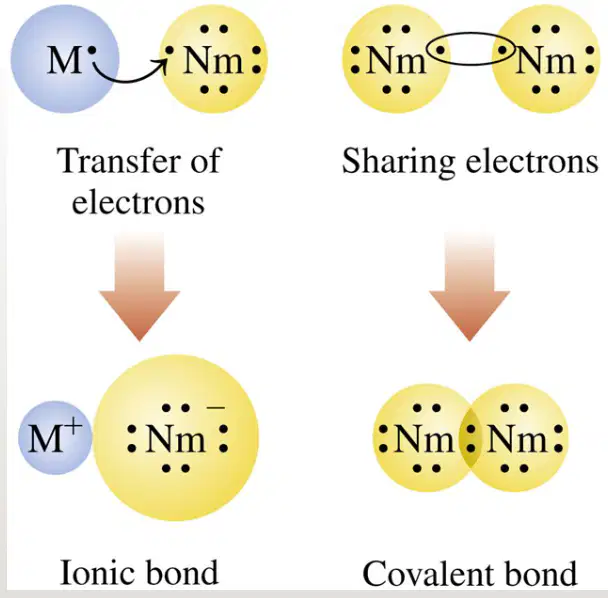
Fill in the blank: In a covalent bond, electrons are ______ between two nonmetals.
shared
transferred
lost
gained
In ionic bonding, ions form when atoms gain or lose their valence electrons to form a stable electron arrangement.
True
False
Metals in Group 1A (1), Group 2A (2), and Group 3A (13) have ______ ionization energies.
low
high
moderate
variable
Which of the following statements is true about metals in Group 1A, 2A, and 3A?
They have high ionization energies
They readily lose one or more of their valence electrons to form ions with a positive charge
They gain electrons to form negative ions
They do not form ions
Metals lose electrons until they have the same number of valence electrons as the nearest noble gas, usually ______ valence electrons.
eight
two
four
six
Sodium atoms in Group 1A (1) are neutral, with how many electrons and protons?
10 electrons and 10 protons
11 electrons and 11 protons
12 electrons and 12 protons
1 electron and 1 proton
What happens when a sodium atom loses one electron?
It becomes neutral
It has the same number of valence electrons as neon and a filled energy level
It gains a proton
It loses a proton
After losing one electron, a sodium ion will have ___ electrons and ___ protons.
10 electrons and 11 protons
11 electrons and 11 protons
10 electrons and 10 protons
9 electrons and 11 protons
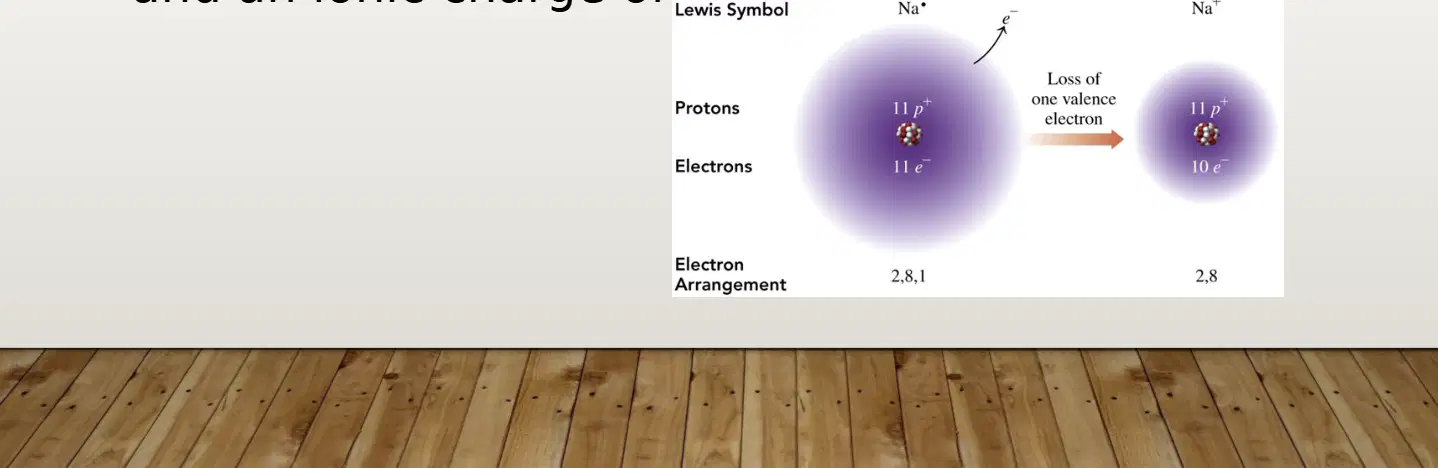
What is the electron arrangement of a sodium atom before it loses an electron?
2,8,1
2,7,2
2,8,2
2,6,3
Magnesium atoms in Group 2A (2) are neutral, with how many electrons and how many protons?
10 electrons and 10 protons
12 electrons and 12 protons
14 electrons and 14 protons
2 electrons and 2 protons
Magnesium atoms will lose how many electrons to have the same number of valence electrons as neon and a filled energy level?
One
Two
Three
Four
When a magnesium atom forms an ion, it has ____ electrons and an ionic charge of _____
10 electrons, 2+
12 electrons, 2-
8 electrons, 2+
10 electrons, 1-
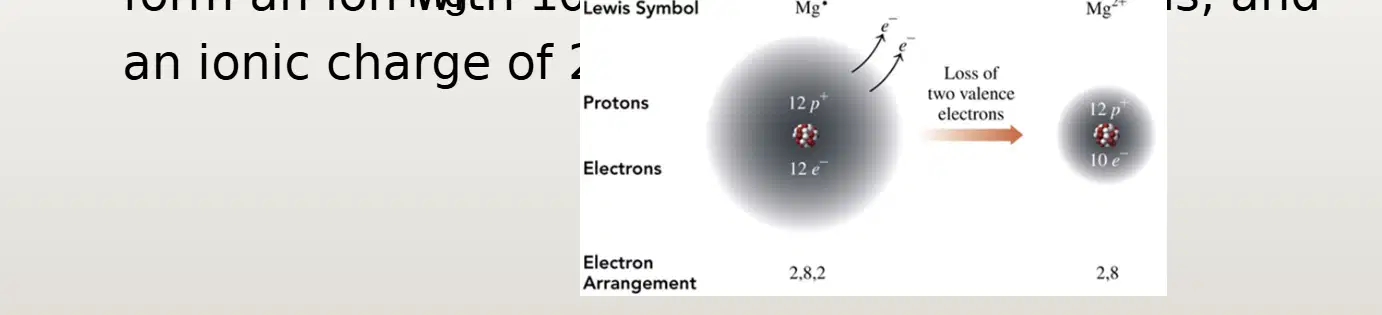
What happens to the number of electrons when a magnesium atom (Mg) becomes a magnesium ion (Mg2+)?
The magnesium atom loses two electrons to become a magnesium ion (Mg2+).
The magnesium atom gains two electrons to become a magnesium ion (Mg2+).
The magnesium atom loses one electron to become a magnesium ion (Mg2+).
The magnesium atom gains one electron to become a magnesium ion (Mg2+).
Nonmetals—Group 5A (15), Group 6A (16), and Group 7A (17)— have ________ ionization energies.
high
low
moderate
variable
Nonmetals—Group 5A (15), Group 6A (16), and Group 7A (17)— readily gain one or more ________ electrons to form ions with a negative charge.
valence
core
nuclear
inner
Nonmetals—Group 5A (15), Group 6A (16), and Group 7A (17)— gain electrons until they have the same number of valence electrons as the nearest noble gas, usually ________ valence electrons.
eight
six
ten
four
Chlorine atoms in Group 7A (17) are neutral, with how many electrons and protons?
17 electrons and 17 protons
18 electrons and 17 protons
17 electrons and 18 protons
16 electrons and 17 protons
What happens to a chlorine atom when it gains one electron?
It forms an ion with 18 electrons and an ionic charge of 1−.
It forms an ion with 17 electrons and an ionic charge of 1+.
It forms an ion with 18 electrons and an ionic charge of 1+.
It forms an ion with 17 electrons and an ionic charge of 1−.
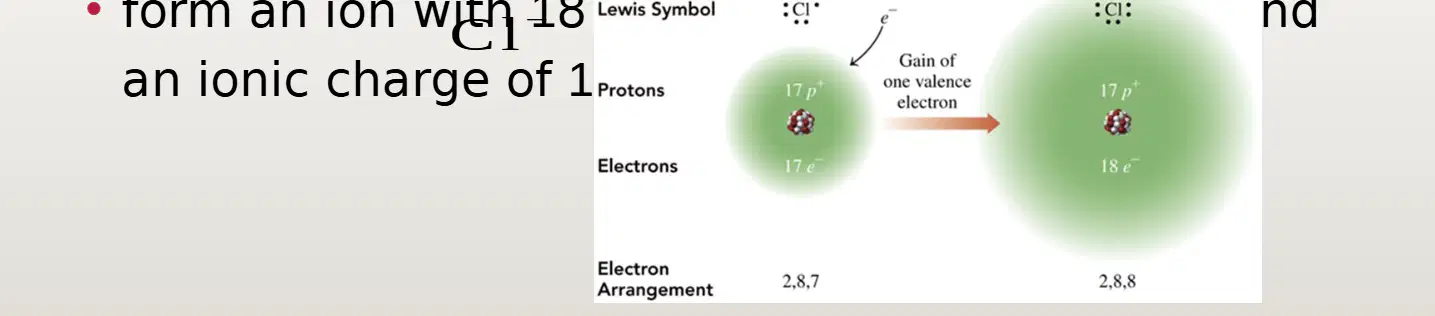
How many protons and electrons does the chloride ion have?
17 protons and 18 electrons
18 protons and 17 electrons
17 protons and 17 electrons
18 protons and 18 electrons
A chloride ion has the same number of valence electrons as argon.
True
False
What is the formula for the cation Lithium?
Li⁺
Li²⁺
Li⁻
LiO
What is the name of the cation with the formula Na⁺?
Sodium
Potassium
Calcium
Magnesium
Which group number does Potassium (K⁺) belong to?
1A (1)
2A (2)
3A (13)
7A (17)
What is the formula for the cation Magnesium?
Mg²⁺
Mg⁺
Mg²⁻
MgO
What is the name of the cation with the formula Ca²⁺?
Calcium
Sodium
Potassium
Magnesium
Which group number does Barium (Ba²⁺) belong to?
2A (2)
1A (1)
3A (13)
7A (17)
What is the formula for the cation Aluminum?
Al³⁺
Al⁺
Al²⁺
AlO₃⁻
What is the name of the anion with the formula N³⁻?
Nitride
Nitrate
Nitrite
Amide
Which group number does Phosphide (P³⁻) belong to?
5A (15)
6A (16)
3A (13)
7A (17)
What is the formula for the anion Oxide?
O²⁻
O₂⁻
O⁻
O₂²⁻
What is the name of the anion with the formula S²⁻?
Sulfide
Sulfate
Sulfurous
Sulfonate
Which group number does Fluoride (F⁻) belong to?
7A (17)
1A (1)
2A (2)
6A (16)
What is the formula for the anion Chloride?
Cl⁻
ClO₃⁻
Cl₂
ClO₂⁻
What is the name of the anion with the formula Br⁻?
Bromide
Bromate
Bromite
Bromine
Which group number does Iodide (I⁻) belong to?
7A (17)
1A (1)
2A (2)
6A (16)
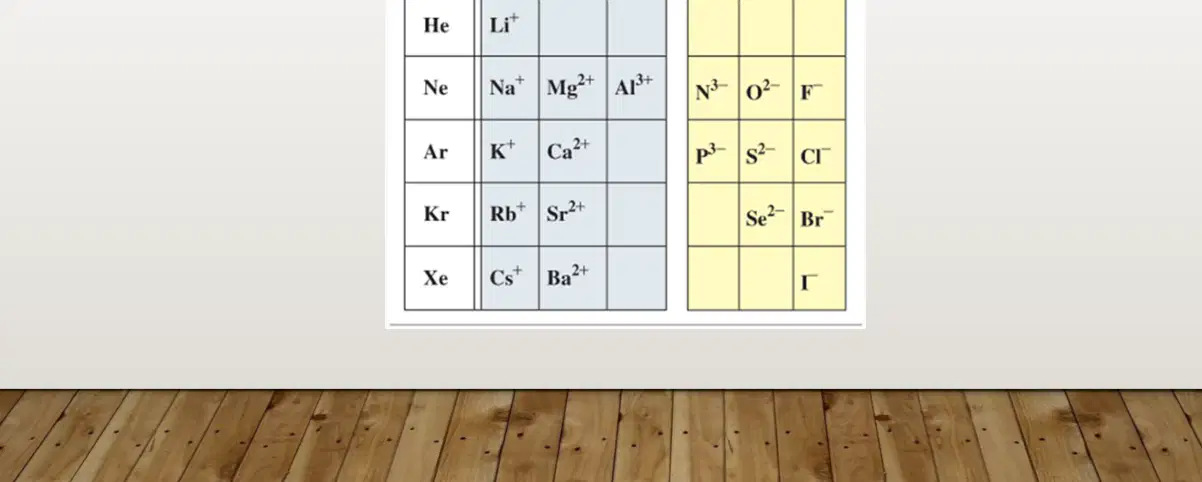
According to the table, what is the ion formed by lithium (Li) when it loses its valence electron?
Li⁺
Li²⁺
Li⁻
LiO⁺
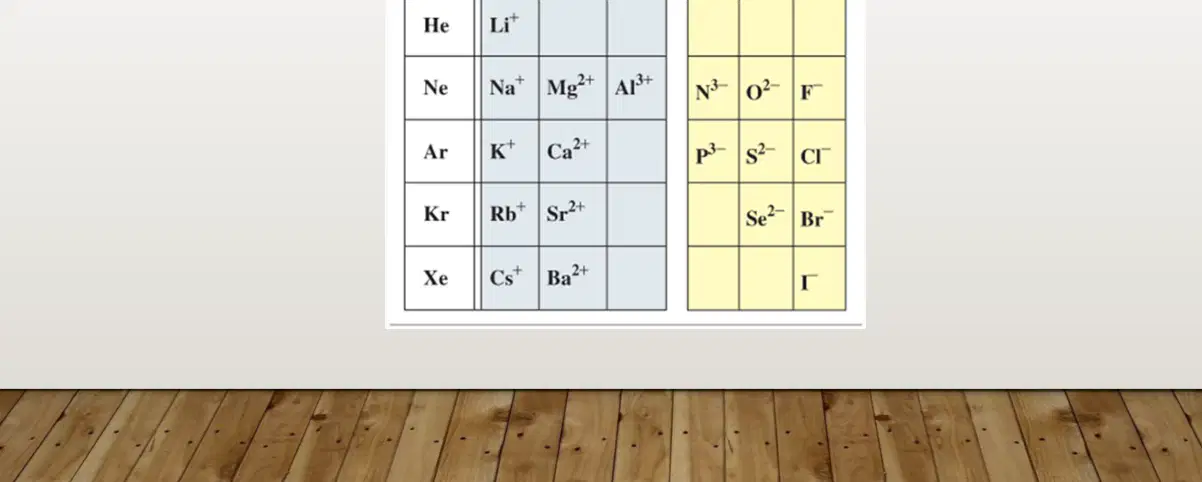
According to the table, what is the ion formed by sodium (Na) when it loses its valence electron?
Na⁺
Na²⁺
Na⁻
Na²⁻
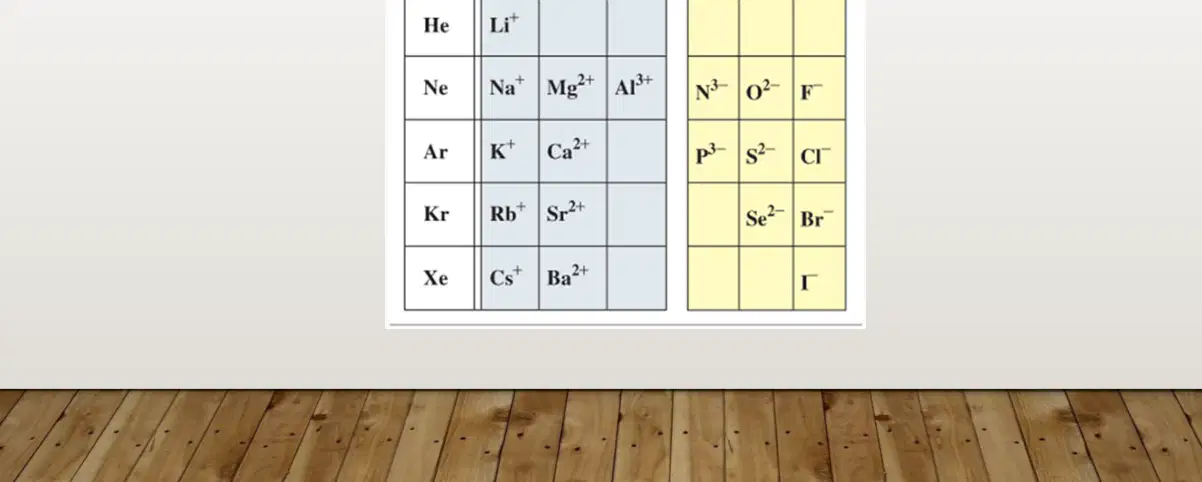
According to the table, what is the ion formed by magnesium (Mg) when it loses its valence electrons?
Mg²⁺
Mg⁺
Mg²⁻
MgO
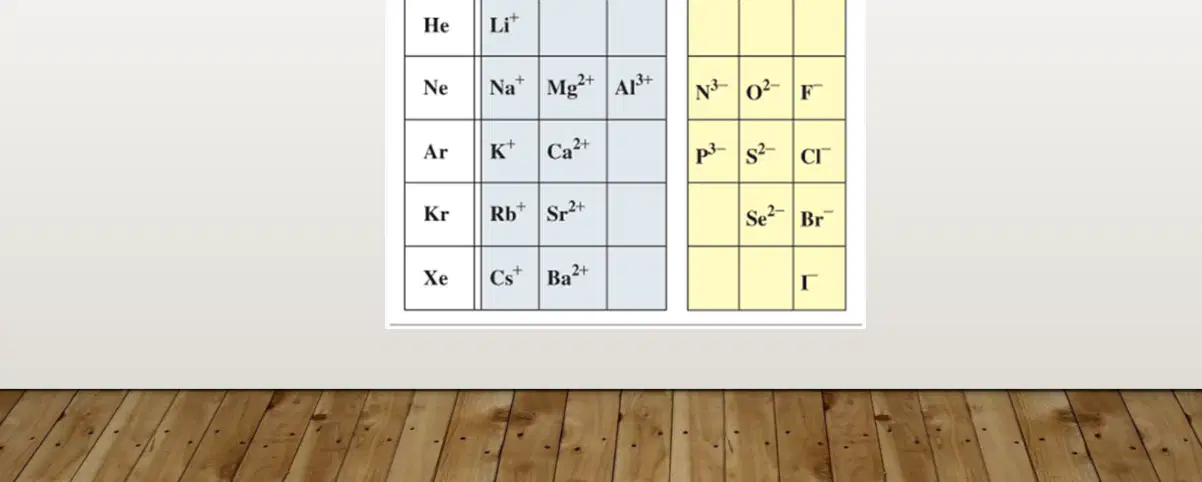
According to the table, what is the ion formed by aluminum (Al) when it loses its valence electrons?
Al³⁺
Al⁺
Al²⁺
Al³⁻
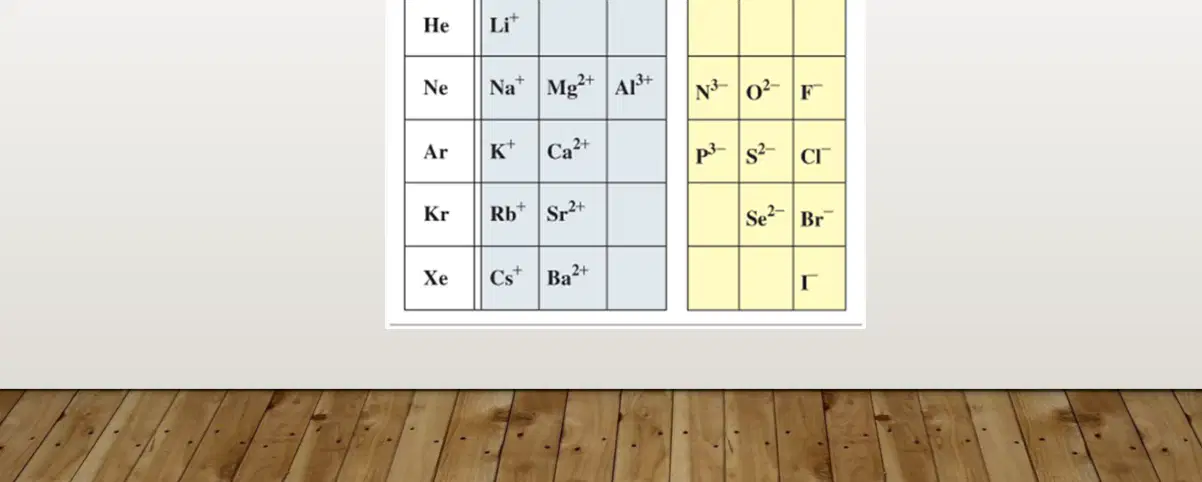
According to the table, what is the ion formed by potassium (K) when it loses its valence electron?
K⁺
K²⁺
K⁻
K²⁻
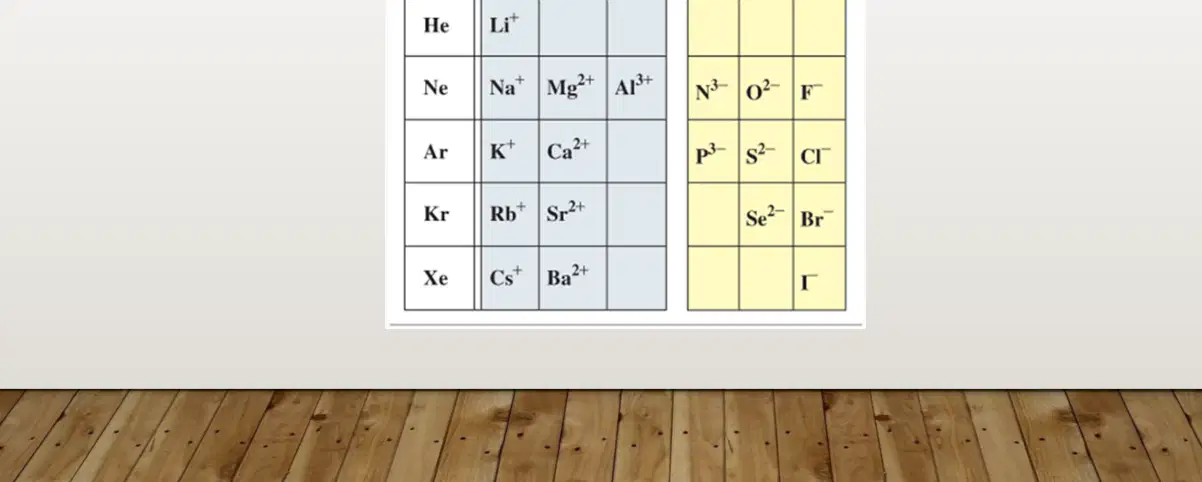
According to the table, what is the ion formed by calcium (Ca) when it loses its valence electrons?
Ca²⁺
Ca⁻
Ca⁺
Ca²⁻

According to the table, what is the ion formed by rubidium (Rb) when it loses its valence electron?
Rb⁺
Rb²⁺
Rb⁻
Rb²⁻
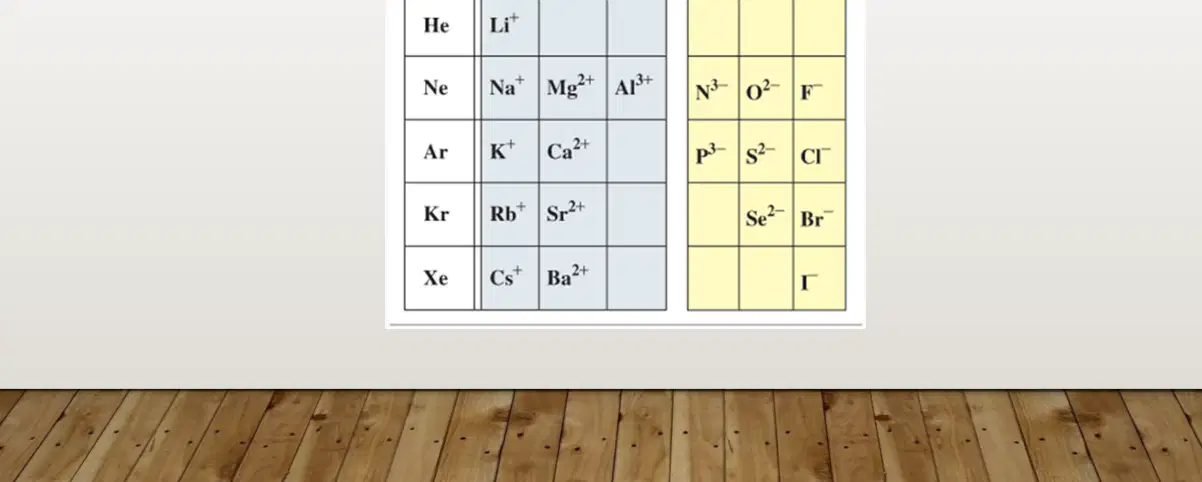
According to the table, what is the ion formed by strontium (Sr) when it loses its valence electrons?
Sr²⁺
Sr⁺
Sr³⁺
Sr²⁻
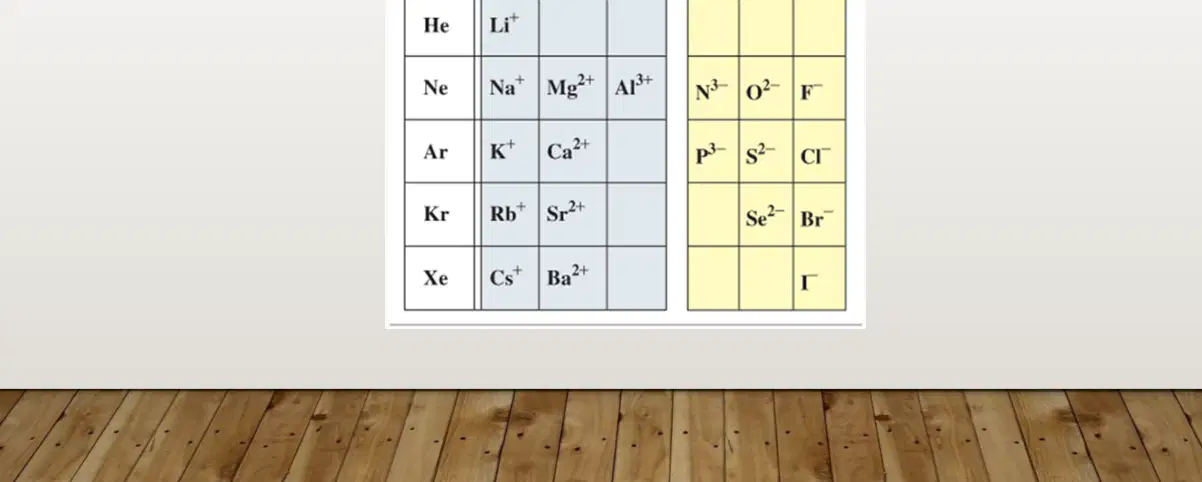
According to the table, what is the ion formed by cesium (Cs) when it loses its valence electron?
Cs⁺
Cs²⁺
Cs⁻
CsO
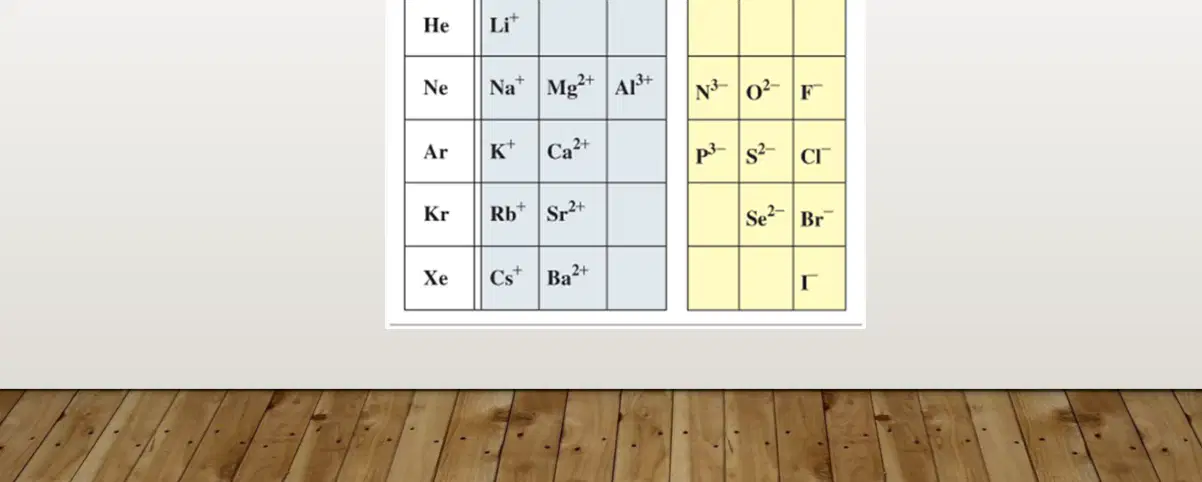
According to the table, what is the ion formed by barium (Ba) when it loses its valence electrons?
Ba²⁺
Ba⁺
Ba²⁻
BaO
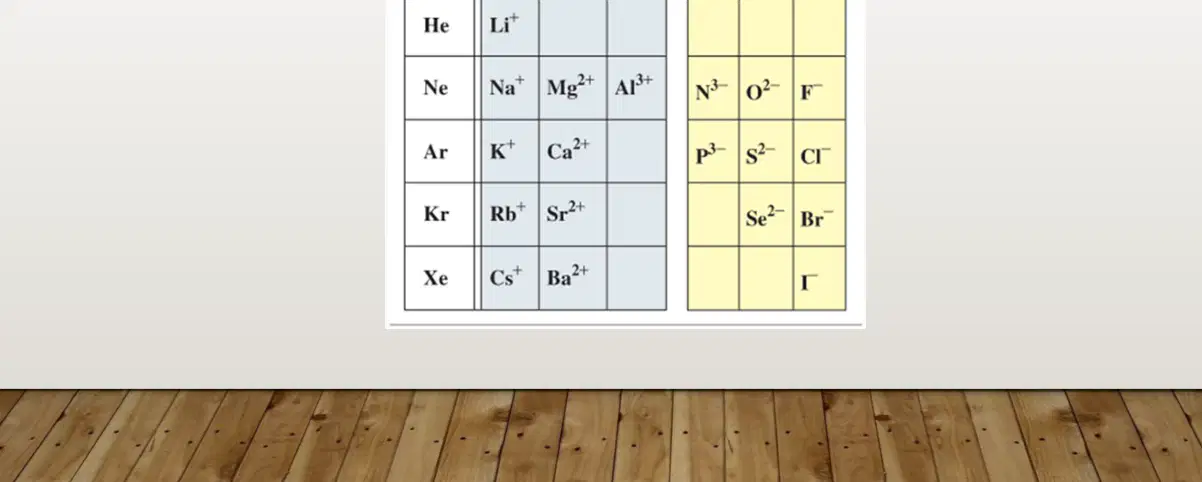
According to the table, what is the ion formed by nitrogen (N) when it gains valence electrons?
N³⁻
N³⁺
N²⁻
N⁻
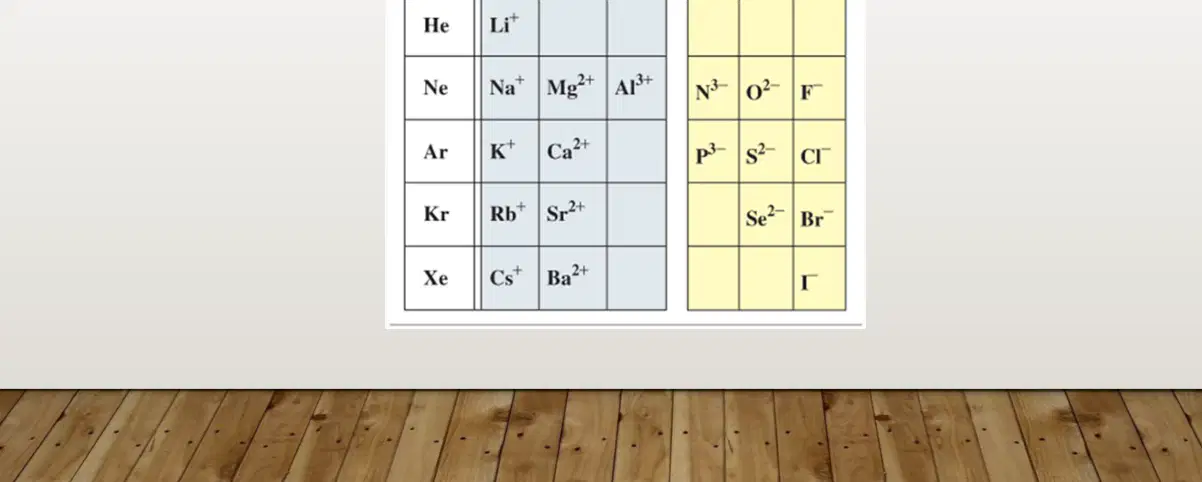
According to the table, what is the ion formed by oxygen (O) when it gains valence electrons?
O²⁻
O²⁺
O⁻
O⁺
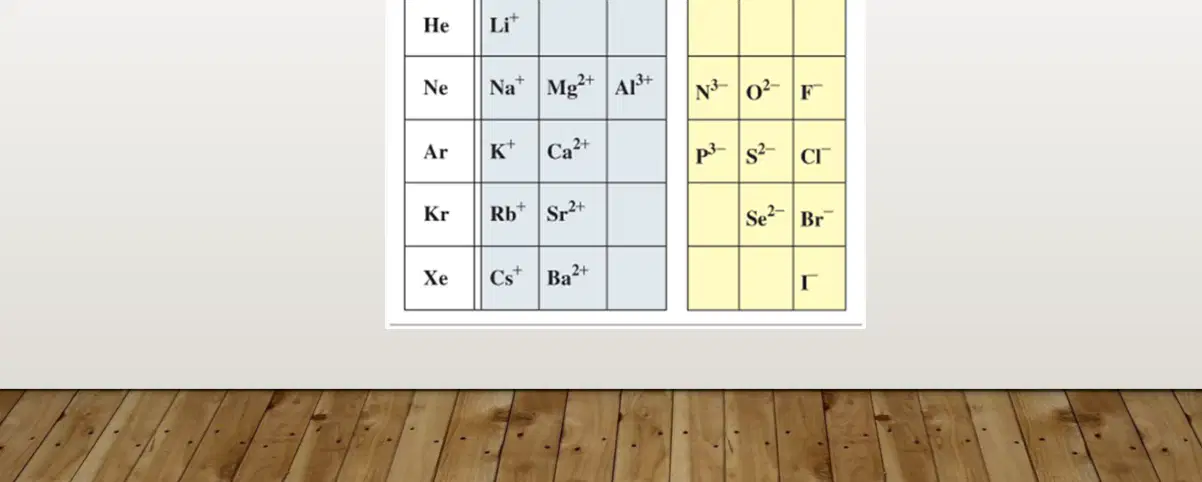
According to the table, what is the ion formed by fluorine (F) when it gains a valence electron?
F⁻
F²⁺
F⁺
F²⁻

According to the table, what is the ion formed by chlorine (Cl) when it gains a valence electron?
Cl⁻
Cl²⁻
Cl⁺
ClO⁻
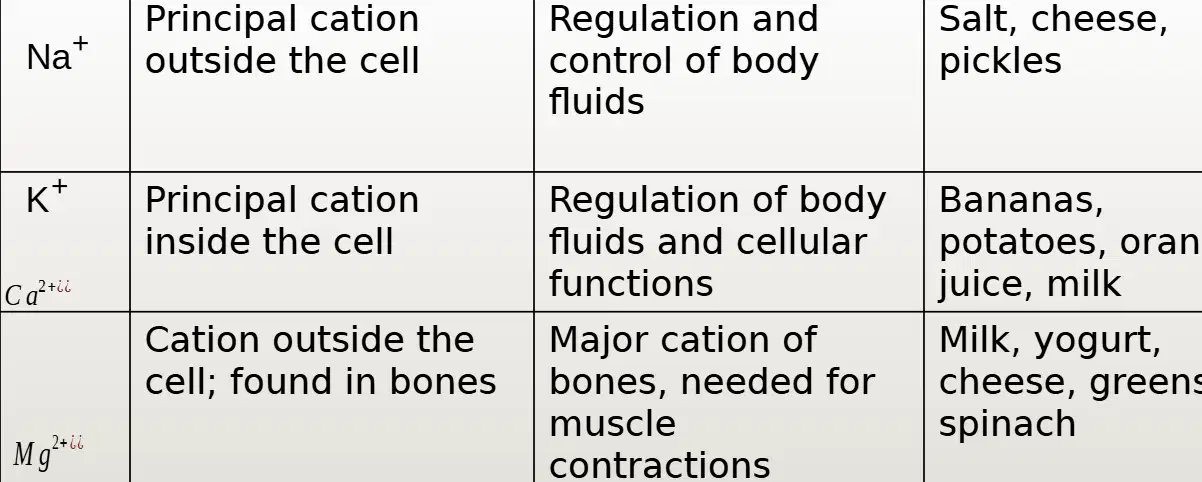
According to the table 'Some Important Ions in the Body', what is the principal cation outside the cell?
Na+ (Sodium)
K+ (Potassium)
Ca2+ (Calcium)
Mg2+ (Magnesium)
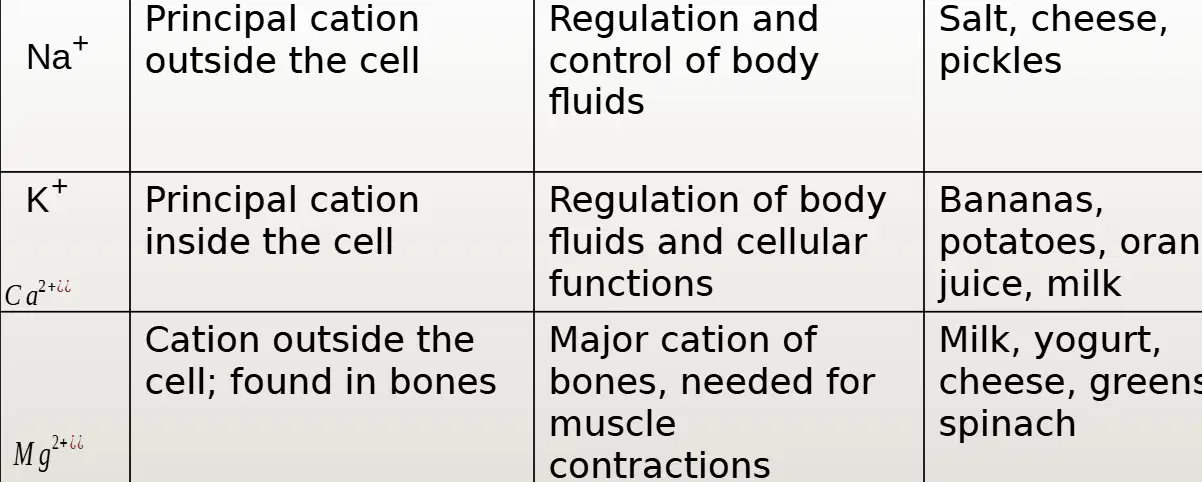
According to the table 'Some Important Ions in the Body', which ion is the principal cation inside the cell?
K+ (Potassium)
Na+ (Sodium)
Ca2+ (Calcium)
Mg2+ (Magnesium)
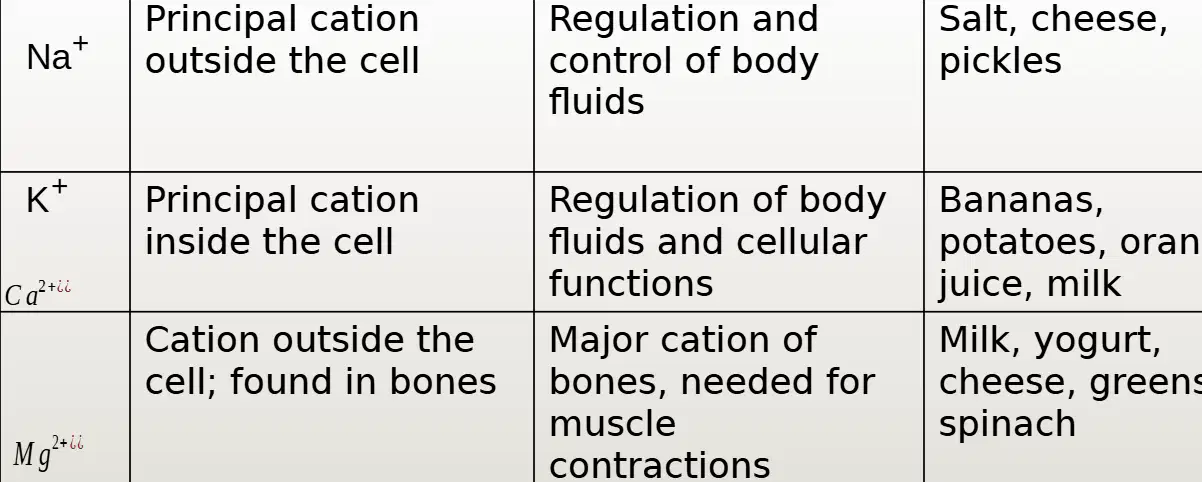
According to the table 'Some Important Ions in the Body', which ion is a major cation of bones and is needed for muscle contractions?
Ca2+ (Calcium)
Na+ (Sodium)
K+ (Potassium)
Cl- (Chloride)
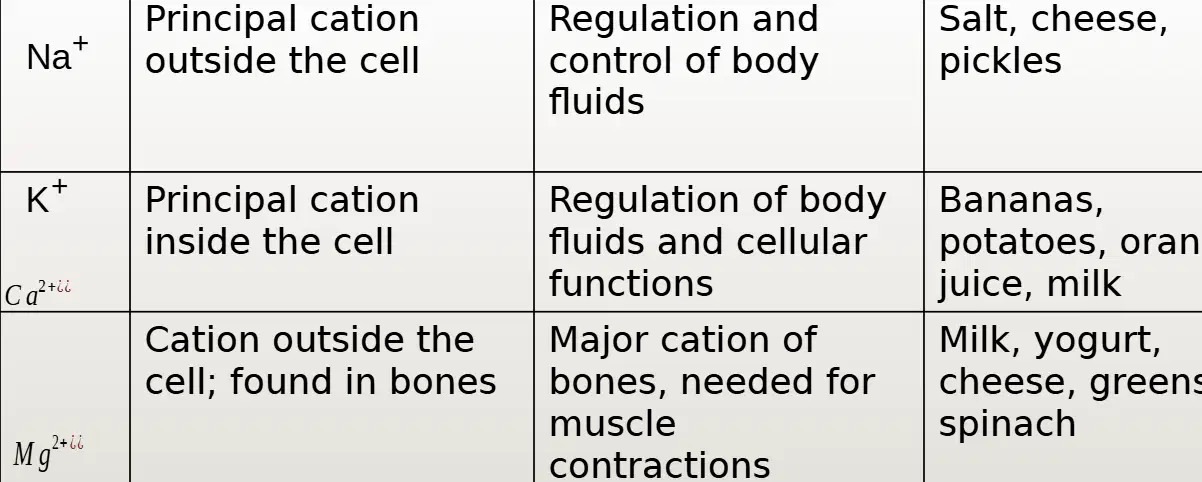
According to the table 'Some Important Ions in the Body', which ion is essential for certain enzymes, muscles, and nerve control?
Mg2+ (Magnesium)
Na+ (Sodium)
Cl- (Chloride)
K+ (Potassium)
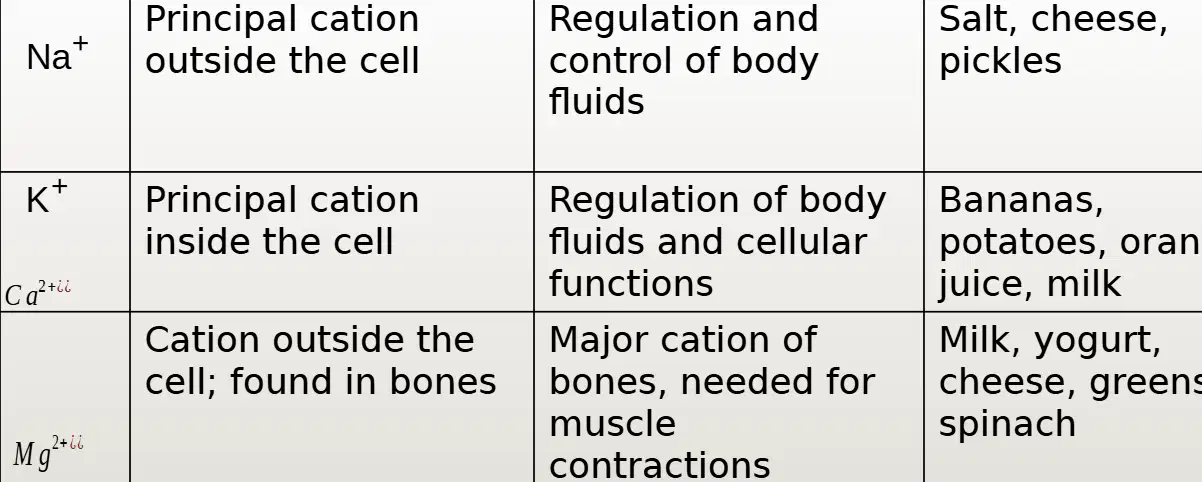
According to the table 'Some Important Ions in the Body', which of the following is a source of Na+?
A) Bananas
B) Salt
C) Milk
D) Chlorophyll
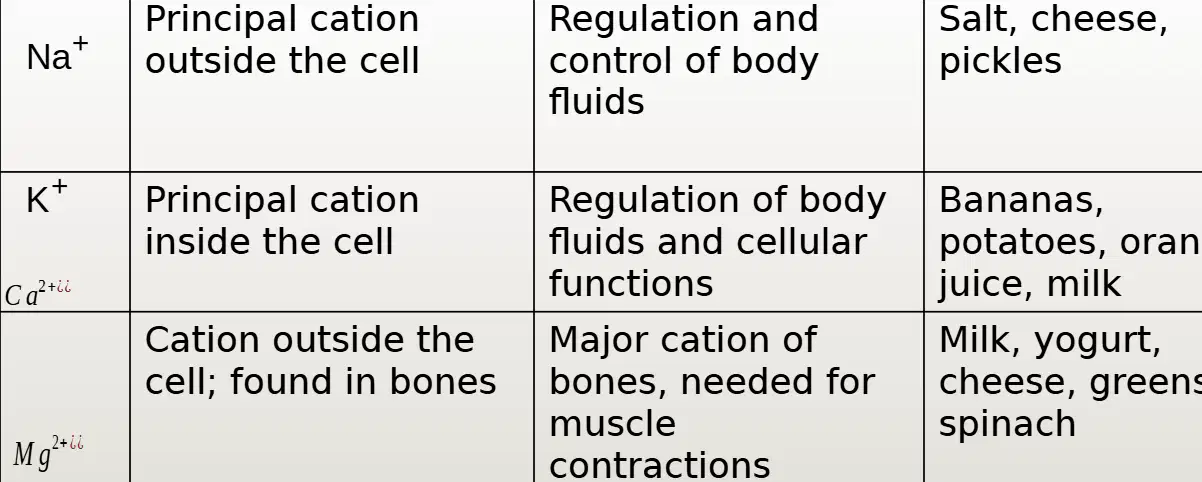
According to the table 'Some Important Ions in the Body', which of the following is a source of K+?
Cheese
Orange juice
Yogurt
Nuts
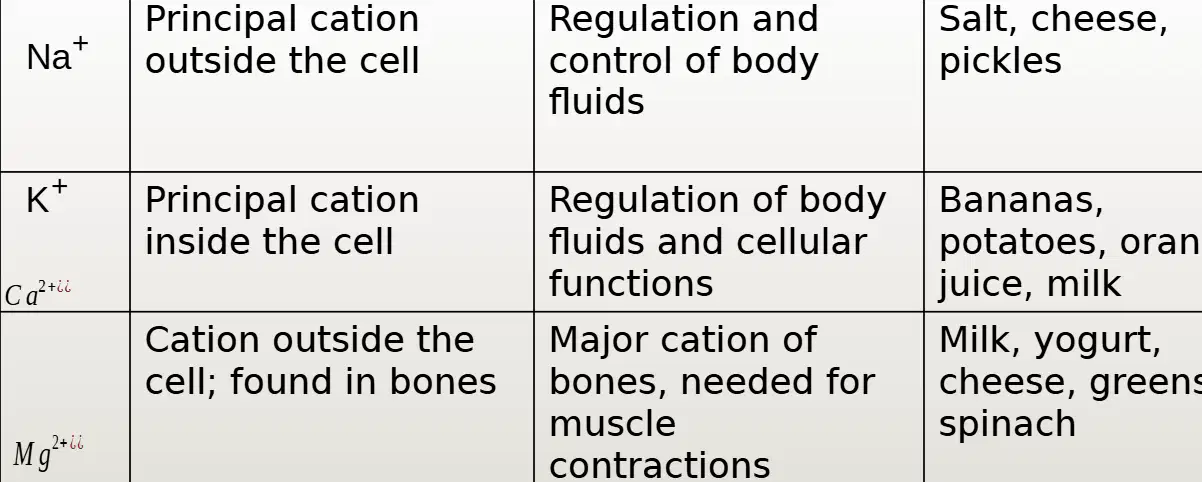
Match the following ions with their primary function according to the table 'Some Important Ions in the Body':
Regulation and control of body fluids
Na+
Regulation of body fluids and cellular functions
K+
Major cation of bones, needed for muscle contractions
Ca2+
Essential for certain enzymes, muscles, nerve control
Mg2+
Write the formula and symbol of an ion with 16 protons and 18 electrons.
S²⁻
O²⁻
Cl⁻
S²⁺
Write the formula and symbol of an ion with 16 protons and 18 electrons. The element with 16 protons is sulfur, with the symbol S. An ion of sulfur with 18 electrons gives sulfur a charge of ___. The sulfide ion is ___.
2- ; S²-
1- ; S-
2+ ; S²+
1+ ; S+
Calcium and chlorine can be identified as which of the following:
Calcium is a metal, chlorine is a nonmetal.
Calcium is a nonmetal, chlorine is a metal.
Both calcium and chlorine are metals.
Both calcium and chlorine are nonmetals.
State the number of valence electrons for calcium and chlorine.
Calcium: 2, Chlorine: 7
Calcium: 4, Chlorine: 6
Calcium: 8, Chlorine: 1
Calcium: 6, Chlorine: 2
State the number of electrons that must be lost or gained by calcium and chlorine to acquire an octet.
Calcium loses 2 electrons, chlorine gains 1 electron.
Calcium gains 2 electrons, chlorine loses 1 electron.
Calcium loses 1 electron, chlorine gains 2 electrons.
Calcium gains 1 electron, chlorine loses 2 electrons.
Which of the following correctly shows the symbol, ionic charge, and name of the ions formed by calcium and chlorine?
Ca2+ (calcium ion), Cl- (chloride ion)
Ca+ (calcium ion), Cl2- (chloride ion)
Ca2- (calcium ion), Cl+ (chloride ion)
Ca- (calcium ion), Cl2+ (chloride ion)
Consider the elements calcium and chlorine. A. Identify each as a metal or a nonmetal. Fill in the blank: Calcium is a ________ and chlorine is a ________.
Calcium is a metal and chlorine is a nonmetal.
Calcium is a nonmetal and chlorine is a metal.
Calcium is a nonmetal and chlorine is a nonmetal.
Calcium is a metal and chlorine is a metal.
Consider the elements calcium and chlorine. B. State the number of valence electrons for each. Fill in the blank: Calcium in Group 2A (2) has ________ valence electrons. Chlorine in Group 7A (17) has ________ valence electrons.
Calcium in Group 2A (2) has two valence electrons. Chlorine in Group 7A (17) has seven valence electrons.
Calcium in Group 2A (2) has seven valence electrons. Chlorine in Group 7A (17) has two valence electrons.
Calcium in Group 2A (2) has eight valence electrons. Chlorine in Group 7A (17) has one valence electron.
Calcium in Group 2A (2) has one valence electron. Chlorine in Group 7A (17) has eight valence electrons.
Consider the elements calcium and chlorine. State the number of electrons that must be lost or gained for each to acquire an octet. Fill in the blank: Calcium will ______ two electrons to acquire an octet. Chlorine will ______ one electron to acquire an octet.
Calcium will lose two electrons to acquire an octet. Chlorine will gain one electron to acquire an octet.
Calcium will gain two electrons to acquire an octet. Chlorine will lose one electron to acquire an octet.
Calcium will gain one electron to acquire an octet. Chlorine will lose two electrons to acquire an octet.
Calcium will lose one electron to acquire an octet. Chlorine will gain two electrons to acquire an octet.
Consider the elements calcium and chlorine. Write the symbol, including its ionic charge, and name for each resulting ion. Fill in the blank: The symbol and name for the calcium ion is ______. The symbol and name for the chloride ion is ______.
The symbol and name for the calcium ion is Ca²⁺ (calcium ion). The symbol and name for the chloride ion is Cl⁻ (chloride ion).
The symbol and name for the calcium ion is Ca⁻ (calcium ion). The symbol and name for the chloride ion is Cl²⁺ (chloride ion).
The symbol and name for the calcium ion is Ca⁺ (calcium ion). The symbol and name for the chloride ion is Cl²⁻ (chloride ion).
The symbol and name for the calcium ion is Ca²⁻ (calcium ion). The symbol and name for the chloride ion is Cl⁺ (chloride ion).
The elements sodium and chlorine react to form the ionic compound ________, the compound that makes up table salt. (Fill in the blank)
sodium chloride
potassium chloride
magnesium oxide
calcium carbonate
Learning Goal: Using charge balance, write the correct formula for an ionic compound. What is the correct formula for sodium chloride?
NaCl
Na2Cl
NaCl2
Na2Cl2
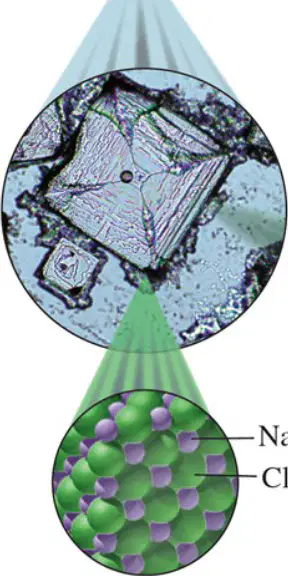
Which ions are present in sodium chloride?
Na+ and Cl-
K+ and Br-
Ca2+ and O2-
H+ and OH-
What is ionic bonding?
Bonding that is the result of two elements sharing electrons
Bonding involving only one atom
Bonding that is the result of an exchange of electrons between a metal and a nonmetal
Bonding between two metals
What is Covalent Bonding?
Bonding that is the result of two nonmetals sharing electrons
Bonding between two metals
Bonding that is the result of a nonmetal and a metal exchanging electrons
Bonding between more than two elements
Which particle is responsible for bonding?
Protons
Electrons
Neutrons
Nucleus

This Lewis Dot Structure for water is correct
True
False

Is this picture of the lewis dot stucture of Potassium Iodide correct?
Yes
No
Which of the following is true about Ionic Bonds? (select ALL TRUE options)
High melting point
Low melting point
Can dissolve in water
Cannot dissolve in water
Can conduct electricity
Which of the following is true about Covalent (non-polar) bonds? (select ALL true options)
High melting point
Low melting point
Can dissolve in water
Cannot dissolve in water
Can conduct electricity
Potassium Chloride is...
Ionic
Covalent
Water (H2O) is...
Ionic
Covalent
Potassium Sulfate (K2SO4) is...
Ionic
Covalent
Ammonium (NH4) is...
Ionic
Covalent
The name for K2S is
Dipotassium Sulfur
Dipotassium Sulfide
Potassium Sulfide
Potassium Sulfur
The correct name for CH4 is...
Carbon Hydrogen
Carbon Tetrahydride
Monocarbon hydride
Carbon Hydride
What is the correct formula for Calcium Oxide?
CaO
Ca2O
CaO2
CaO3
What is the correct formula for Carbon Dioxide?
C2O2
CO2
C2O
CO3
Which of the following is TRUE about ionic compounds?
They have low melting and boiling points.
They can conduct electricity in the solid state.
They are stronger than covalent bonds.
They are usually formed from 2 metals.
Which type of bond is formed from the sharing of electrons?
ionic bond
covalent bond
Ionic compounds are usually formed from _____.
two nonmetals.
a metal and a nonmetal.
two metals.
Which of the following is NOT TRUE about covalent compounds?
They have low melting and boiling points.
They are formed from 2 nonmetals.
They can conduct electricity when dissolved in water (aqueous).
True or False: The chemical formula for a covalently bonded group of atoms is called the molecular formula and it indicates the exact makeup of one molecule of a substance.
True
False
A single covalent bond is made up of _____ electrons.
one
two
three
four
True or False: Ionic compounds are usually liquids at room temperature.
True
False
What happens to electrons in a covalent bond?
they are shared
they are transferred
they are negative
What two types of atoms make a covalent bond?
2 nonmetals
2 metals
1 metal and 1 nonmetal`

What type of bonding does this picture show?
Ionic
Covalent

What type of bonding does this picture show?
Ionic
Covalent
Generally low melting and boiling points
Ionic compounds
Covalent compounds
Poor electrical conductivity
Ionic compounds
Covalent compounds
Conducts electricity well when melted or dissolved
Ionic compounds
Covalent compounds
Carbon and Oxygen will make a ___________ bond.
ionic
covalent
metallic
Sodium and Bromine will make a _____ bond.
ionic
covalent
metallic
A cation is an ion with a positive charge.
true
false
An anion is an ion with a negative charge.
true
false
What is the correct formula for the polyatomic ion called ammonium?
NH3+
NH3
CN+
NH4+
What is the correct name for this polyatomic ion: NO3–
carbonate
hydroxide
nitrite
nitrate

What is the name of this polyatomic Ion?
Ammonia
Nitrogen tetrahydride
Ammonium
Pneumonia
What is the formula for ammonium?
NH₄⁺
NH₃
N₂H₄
NH₄O
acetate
AsO4-3
C2H3O2-
CN-
NH4+
What is the correct name for this polyatomic ion: CN–
carbonate
cyanide
chromate
chromite
What is the correct formula for the polyatomic ion called sulphate?
SO32–
HSO4–
SO42–
CH3COO–
HCO3-
Hydrogen Carbonate
Carbonate
Dihydrogen Carbonate
Carbonate
What is the formula for hydroxide?
OH-
H2O
NaOH
HCl
What is the name of the ion with the formula ClO4-?
perchlorate
chlorate
hypochlorite
chloride
What is the name of the ion with the formula PO43-?
phosphate
nitrate
sulfate
carbonate
Hydrogen sulfate
HCO3-
HSO4-
HSO3-
HS-
dihydrogen phosphate
HPO4-3
H2PO4-3
H2PO3-2
H2PO4-
hydrogen phosphate
HPO4-3
HPO4-2
HPO4-
HPO3-2
hypochlorite
CO3-2
ClO3-2
ClO-
CrO4-
ClO2-
chlorate
chlorite
hypochlorite
perchlorate
Hypochlorite choose 2
CIO-
OCl-
CI-
HCL-
When naming ionic compounds with transition metals you need to include roman numerals to show the _____ of the metal..
atomic number
mass number
charge
ionization energy

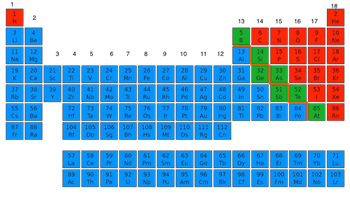
Where are nonmetals typically located on the periodic table?
In the middle of the periodic table
To the left of the transition metals
Staircase of the periodic table
To the right of the staircase
When naming covalent compounds: Penta is the prefix for....
1
2
3
4
5
When naming covalent compounds: Tri is the prefix for....
1
2
3
4
5
When naming covalent compounds: Di is the prefix for....
1
2
3
4
5
Match

sulfur trioxidedown

barium chloride

ammonium phosphite

Copper Carbonate

dinitrogen tetroxide

