
 Worksheets
DFT-SURGERY DAY 2-04/10/2025
Total questions: 10
Worksheet time: 8mins
An 18-year-old male presents with a 24-hour history of anorexia, low-grade fever, and a dull, migrating pain now localized to the right flank. On examination, there is minimal tenderness over McBurney's point and no abdominal rigidity. However, the patient experiences sharp pain in the right lower quadrant upon passive extension of his right hip. Which anatomical position of the appendix is most likely responsible for this presentation?
Retrocecal
Pelvic
Pre-ileal
Subhepatic
A 19-year-old female is evaluated for recurrent episodes of colicky abdominal pain. Her medical history is significant for an intussusception requiring surgical reduction two years ago. Physical examination is notable for several 1-3 mm dark brown macules on her lips and buccal mucosa. In addition to colorectal and small bowel cancer, this patient requires routine surveillance for which extraintestinal malignancy?
Pancreatic adenocarcinoma
Medullary thyroid carcinoma
Hepatocellular carcinoma
Glioblastoma multiforme
A 67-year-old male with a 20-year history of ulcerative colitis, type 2 diabetes mellitus, and coronary artery disease undergoes routine surveillance colonoscopy. He has been managed with mesalamine, metformin, and low-dose aspirin. Biopsies from a flat, velvety lesion in the rectum confirm adenocarcinoma. Which of his chronic medications has a well-established role in reducing the risk of colorectal carcinoma development?
Aspirin and Metformin
Mesalamine and Aspirin
Metformin and Mesalamine
Mesalamine only
A 70-year-old male is diagnosed with a cT3N1M0 adenocarcinoma of the mid-rectum, located 8 cm from the anal verge. He has no evidence of distant metastases on staging scans. He is otherwise fit with good performance status. What is the most appropriate initial step in management?
Neoadjuvant chemoradiation followed by total mesorectal excision
Neoadjuvant chemotherapy followed by surgical resection
Upfront low anterior resection with diverting loop ileostomy
Palliative colonic stenting for impending obstruction
The accumulation of gas proximal to a mechanical bowel obstruction, which contributes to the characteristic air-fluid levels seen on an erect abdominal radiograph, is primarily composed of which two substances?
Swallowed atmospheric nitrogen and bacterially-produced hydrogen sulfide.
Methane and carbon dioxide from the fermentation of luminal contents.
Oxygen and carbon monoxide released from ischemic bowel tissue.
Ammonia and hydrogen peroxide from intraluminal protein degradation.
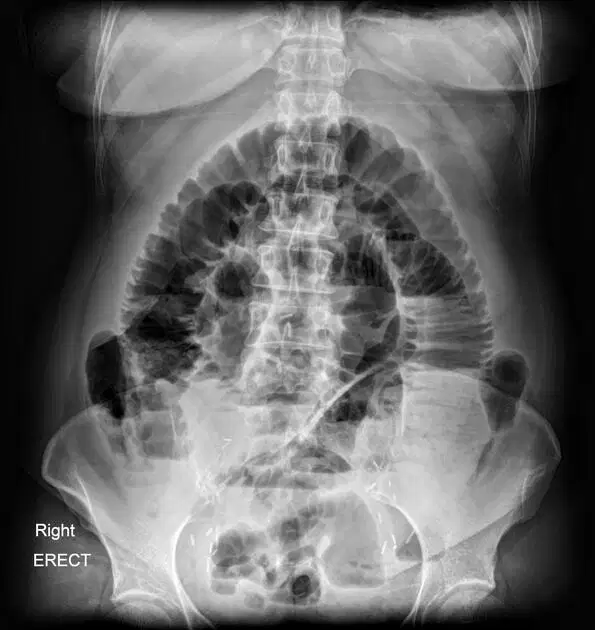
A 68-year-old male is on postoperative day three following an elective open sigmoid colectomy for diverticular disease. He reports nausea and generalized abdominal bloating but denies any cramping or colicky pain. On examination, his abdomen is distended and tympanitic, with absent bowel sounds. An abdominal radiograph reveals diffusely dilated loops of both the small and large bowel, with air visualized in the rectal vault. Which of the following is the most likely diagnosis?
Paralytic ileus
Early postoperative small bowel obstruction
Ogilvie's syndrome
Anastomotic leak with localized peritonitis
Which of the following electrolyte abnormalities is most commonly implicated as a precipitating or exacerbating factor for the development of paralytic ileus in a hospitalized patient?
Hypokalemia
Hypernatremia
Hypercalcemia
Hypophosphatemia
A 72-year-old male is on postoperative day 4 following a laparotomy for a perforated duodenal ulcer. He has persistent abdominal distension, has not passed flatus, and has hypoactive bowel sounds on auscultation. An abdominal X-ray is performed to differentiate between prolonged paralytic ileus and mechanical obstruction. Which of the following radiographic findings would be most consistent with paralytic ileus?
Diffuse and uniform gaseous distension of small and large bowel, including the rectum
Multiple, short air-fluid levels at varying heights, creating a "step-ladder" appearance
Disproportionate cecal dilation (>10 cm) with a relative paucity of distal colonic gas
A sentinel loop of dilated small bowel localized to the left upper quadrant
The twisting of the sigmoid colon on its mesentery not only causes luminal obstruction but also compromises its vascular supply. The occluded vessels within the twisted mesentery lead to a rapid progression toward ischemia. The arterial supply most directly compromised by the mesenteric torsion in a sigmoid volvulus originates from which of the following parent vessels?
Inferior mesenteric artery
Superior mesenteric artery
Celiac trunk
Internal iliac artery
A 45-year-old male with a history of Crohn's disease presents with a 4-day history of severe, deep-seated pelvic pain and fever. Examination of the perianal region reveals only mild erythema with no discernible fluctuance or swelling. However, a digital rectal examination is met with exquisite tenderness and reveals a boggy, indurated mass high on the left lateral aspect of the rectum. What is the most probable diagnosis?
Supralevator abscess
Ischioanal abscess
Perianal abscess
Submucosal abscess

