
NEW
Font size
 Worksheets
ar week 1
Total questions: 53
Worksheet time: 27mins
What is the basic architecture of a computer?
The physical components of a computer
The software applications installed
The network connections
The user interface design
What is the difference between computer organization and computer architecture?
Organization refers to the software, architecture to the hardware
Organization is about the hardware, architecture is about the software
Organization is about the operational units, architecture is about the structure
Organization is about the user interface, architecture is about the network
Which of the following is a type of programming language?
HTML
Python
CSS
SQL
What is a characteristic of high-level programming languages?
They are machine-dependent
They use binary code
They are easy to read and write
They require no compilers
What are the three main components of a computer system as shown in the diagram?
Input, Output, Storage
Control, Storage, Processing
Hardware, Software, User
CPU, Memory, Storage
Which component is responsible for the movement of data in a computer system?
Control
Storage
Processing
Movement
In the context of computer architecture, what does the 'Control' component manage?
Data input and output
Data storage
Data processing
Data movement and coordination
What is a digital computer?
A device that processes analog signals
A fast electronic calculating machine that accepts digitized input information
A machine that only stores data without processing
A tool for manual calculations
How does a digital computer process information?
By using external instructions only
By converting output into input
By processing digitized information according to internally stored instructions
By storing information without processing
Which type of computer is most commonly found in homes, schools, and offices?
Workstations
Mainframes
Personal Computers
Supercomputers
What type of computer is often used in engineering applications like CAD/CAM for interactive design work?
Supercomputers
Workstations
Mainframes
Personal Computers
Which type of computer is used for large-scale numerical computations in applications like weather forecasting?
Mainframes
Workstations
Supercomputers
Personal Computers
Mainframes are typically used in which type of organizations?
Small businesses
Medium to large corporations
Home offices
Educational institutions

Which of the following is a functional unit of a computer responsible for performing calculations and logical operations?
Input
Output
Arithmetic and Logic
Memory
What is the role of the 'Control' unit in a computer's functional units?
To perform arithmetic operations
To manage the execution of instructions
To store data temporarily
To provide input and output
What is the primary function of an input unit in computer architecture?
Processes data from the CPU
Accepts coded information from human operators or other computers
Stores data for future use
Outputs data to a display
Which of the following is an example of an input device?
Monitor
Printer
Keyboard
Speaker
Which device is NOT typically considered an input device?
Joystick
Scanner
Microphone
Magnetic disk
What is the primary function of the Main Memory in a computer?
To store programs during their execution
To process data at mechanical speeds
To manage input and output devices
To provide power to the computer
How is information in the Main Memory typically processed?
In random sizes
In groups of fixed size called WORDS
In variable sizes called BYTES
In sequential order only
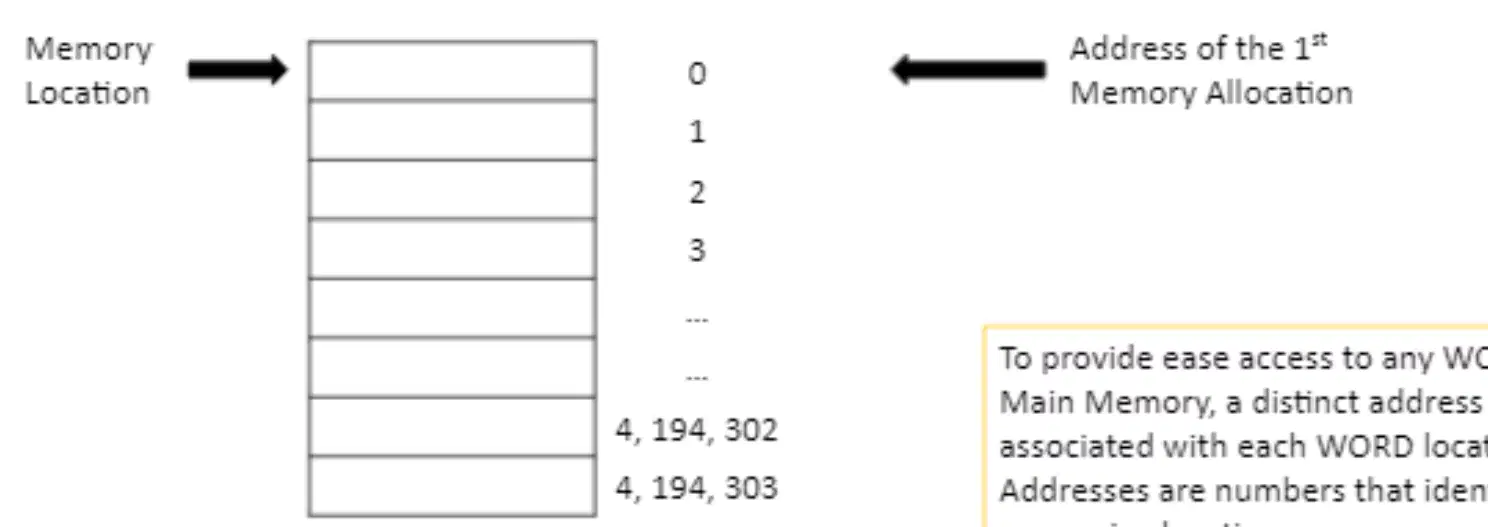
What is the purpose of assigning a distinct address to each WORD location in main memory?
To increase the speed of the processor
To provide ease of access to any WORD in main memory
To reduce the size of the memory
To enhance the security of the data
What does the address of the 1st memory allocation represent?
The total size of the memory
The starting point of memory storage
The end point of memory storage
The speed of memory access
Which area of main memory is responsible for accepting and storing input data to be processed?
Input Storage Area
Working Storage Space
Output Storage Area
Program Storage Area
What is the function of the Working Storage Space in main memory?
Holds the program instructions
Maintains the final outputs
Holds the data being processed and intermediary results
Accepts input data
Which main memory division maintains the final outputs or processed results of operations?
Input Storage Area
Working Storage Space
Output Storage Area
Program Storage Area
What does the Program Storage Area in main memory store?
Input data
Final outputs
Data being processed
Program or processed instructions
What is the primary use of auxiliary storage in computer systems?
To store data temporarily during processing
To store large amounts of data on a permanent basis
To increase the speed of data processing
To enhance the graphics capabilities of a computer
Why might auxiliary storage be particularly useful?
It is faster than primary storage
It is used for temporary data storage
It allows frequent access to large amounts of data
It is cheaper than primary storage
What is another name for the Processing Unit?
Main Memory
Central Processing Unit (CPU)
Arithmetic and Logic Unit (ALU)
Control Unit (CU)
How much faster is the Processing Unit compared to Main Memory?
5 times faster
10 times faster
15 times faster
20 times faster
What are the high-speed storage elements in the Processing Unit called?
Buffers
Caches
Registers
Disks
What components make up the Processing Unit?
ALU and CU
RAM and ROM
Hard Drive and SSD
GPU and CPU
What is the primary function of the output unit in computer architecture?
To process data
To store data
To send processed results to the outside world
To input data
Which of the following is an example of an output device?
Keyboard
Display Screen
Scanner
Mouse
Which device is not considered an output device?
Printer
Plotter
Modem
Microphone
Which unit in a computer is responsible for processing information?
Control Unit
Output Unit
Arithmetic and Logic Unit
Memory Unit
What is the role of the Control Unit in a computer?
Processes information
Directs all activities inside the machine
Stores information
Outputs information
Through which unit does processed information leave the computer?
Control Unit
Arithmetic and Logic Unit
Output Unit
Memory Unit
What is the first step in the basic operations of a computer?
Information is processed
Information is stored
Information is accepted
Information is outputted
What does the design of computers include according to the basic concepts of computer architecture?
Instruction Sets, Hardware Components, and System Organization
Software Applications and User Interfaces
Network Protocols and Internet Connectivity
Data Encryption and Security Measures
Which architecture do most computers follow, as mentioned in the basic concepts of computer architecture?
Von-Neumann Architecture
Harvard Architecture
RISC Architecture
CISC Architecture
What is another name for the Von-Neumann Architecture?
Store Program Architecture
Harvard Architecture
Parallel Processing Architecture
Distributed Computing Architecture
In the Von-Neumann Architecture, where are programs stored during execution?
In the memory
On the hard drive
In the CPU cache
On external storage devices
What is the primary characteristic of machine language?
It uses mnemonics to simplify programming.
It is an English-like language with complex instructions.
It consists of 1's and 0's, making programming difficult.
It is designed for developing commercial business software.
Which type of programming language uses mnemonics to replace binary patterns?
Machine Language
Assembly Language
High-Level Language
4GL Language
What is a characteristic of high-level languages?
They are primitive languages understood by computers.
They use mnemonics for easier programming.
They are English-like and easy to use.
They are designed for specific purposes like business software.
What is the purpose of 4GL languages?
To make programming easier with mnemonics.
To provide a natural language for computers.
To develop commercial business software.
To offer English-like commands and instructions.
Which of the following is an advantage of high-level languages over low-level languages?
Complex syntax
Easy to learn
Machine dependency
Limited portability
What feature of high-level languages allows them to be used on different types of computer systems?
Predefined functions
Portability
Complex algorithms
Machine code
High-level languages often come with which of the following to simplify programming tasks?
Predefined functions
Manual memory management
Direct hardware access
Binary code
What is one advantage of low-level languages over high-level languages?
User-friendly syntax
Compact code
Easier debugging
Platform independence
Which of the following is a benefit of using low-level languages?
Speed
Portability
Readability
Abstraction
Low-level languages are considered more flexible than high-level languages. What does this flexibility refer to?
Ability to run on any operating system
Direct manipulation of hardware
Easier to learn
Automatic memory management

