
 Worksheets
AMSA - Certification Practice
Total questions: 105
Worksheet time: 53mins
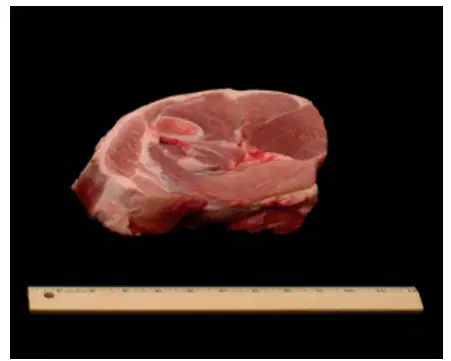
Identify the retail cut.
Pork Ham/Leg Pork Fresh Ham Center Slice
Pork Ham/Leg Smoked Ham, Center Slice
Pork Shoulder Arm Steak
Pork Shoulder Arm Roast

Identify the retail cut.
Beef Variety Meats Tripe
Beef Variety Meats Oxtail
Pork Variety Meats Oxtail
Lamb Variety Meats Tripe
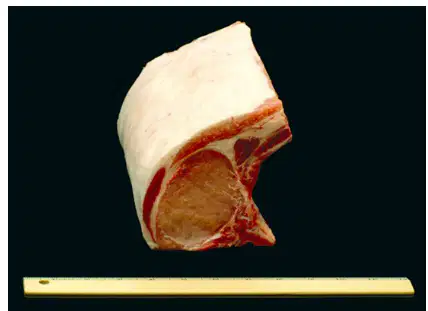
Identify the retail cut.
Pork Back Center Back Roast
Pork Loin Sirloin Roast
Pork Side Center Back Roast
Pork Loin Center Rib Roast
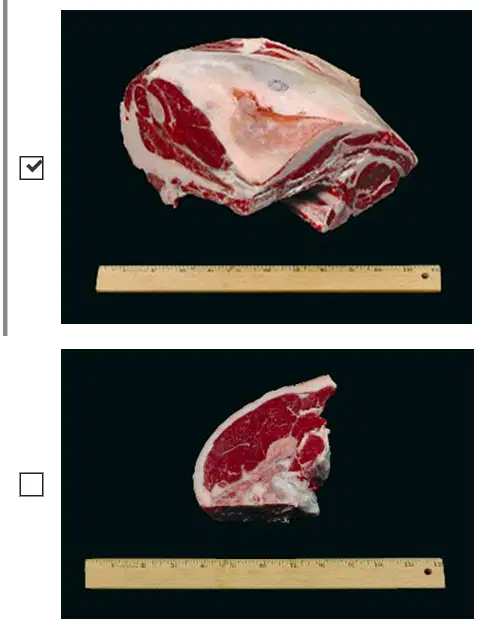
Which of the retail cuts came from the shoulder of a lamb carcass?
Top image
Bottom image
Both images
Neither image
If you need to leave your work area, you should do which of the following with your knife?
Leave the knife on the top of the work area
Place the knife beneath the corner of the cutting board
Place the knife in the sink to be washed at a later time
Place the knife in the sanitation bucket
You are responsible for purchasing steak for a five-star, high-end restaurant which serves only the best. Which of the following quality grades of beef would you purchase for the restaurant?
USDA Prime
USDA Choice
USDA Select
USDA Good
Which of the following is present in a poultry leg quarter, but NOT present in a leg?
Drumstick
Tendons
Backbone
Wings
Which wholesale cut of beef has the most value?
Chuck
Loin
Round
Brisket
Which of the following retail cuts of beef does NOT come from the loin?
T-bone steak
Porterhouse steak
Tri-tip roast
7-bone pot roast
Which of the following is located underneath the large breast muscle of a chicken carcass?
Split breast
Tenderloin
Wing
Drumette
Which of the following is a cooking technique which involves food being completely immersed in hot fat and fried until it is done?
Stir-frying
Pan-frying
Deep-frying
Sautéing
Where is quality evaluated in lamb carcasses?
Primary and secondary flank
Only the primary flank
Only the secondary flank
In the loin eye
Which of the following is NOT a meat tenderizer?
Papain
Bromelain
Ficin
Potassium nitrate
Ground beef should be cooked to which of the following internal temperatures to ensure food safety?
150°F (66°C)
160°F (71°C)
170°F (77°C)
180°F (82°C)
Which of the following is the perception of a food’s taste and aroma?
Palatability
Texture
Flavor
Acceptability
Whole chicken, whole turkey, poultry parts, duck and goose should reach which of the following internal temperatures to be considered done?
145°F (63°C)
155°F (68°C)
165°F (74°C)
175°F (80°C)
Which of the following involves inserting long, thin strips of fat into a large, naturally lean piece of meat with a special needle before cooking to baste the meat from the inside?
Barding
Larding
Marinating
Roasting
Which of the following is NOT a dry cooking method?
Broiling
Steaming
Deep frying
Roasting
When cutting bones out of the meat, which direction should you cut to ensure you have as little waste as possible?
Toward the meat
Toward the bone
Always away from the bone
Always away from the fat
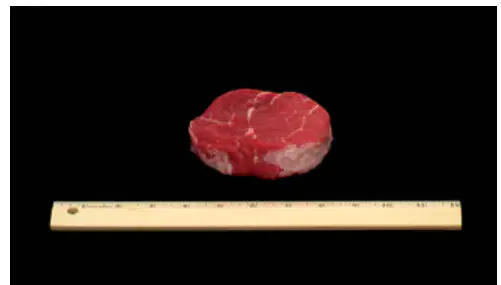
Identify the retail cut.
Beef Chuck Eye Steak, Bnls.
Beef Chuck Mock Tender Steak
Beef Loin Mock Tender Steak
Beef Loin Tenderloin Roast
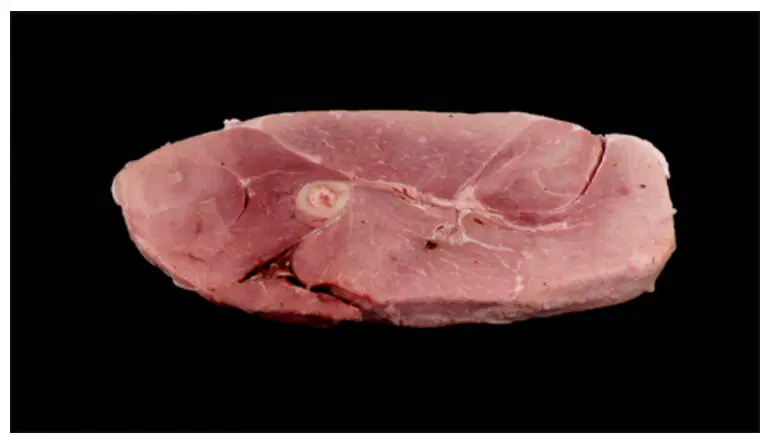
Identify the retail cut.
Pork Ham/Leg Pork Fresh Ham Center Slice
Pork Ham/Leg Smoked Ham, Center Slice
Pork Shoulder Arm Steak
Pork Shoulder Arm Roast
Which of the following is NOT true of duck meat?
All dark meat
All white meat
Higher in fat content
Tougher than chicken
Which of the following is NOT an appropriate method for defrosting meat?
In a bowl on the kitchen counter
In a refrigerator
In cold water
In a microwave oven
A honing steel can be used to do which of the following?
Sharpening the knife by shaving off fragments of the blade
Straightening the knife’s blade
Cleaning the knife
Lengthening the blade of the knife
Which of the following is a moist-heat cooking technique which involves food being submerged in liquid which is between 185°F (85°C) and 205°F (96°C) with small bubbles breaking through the liquid’s surface?
Simmering
Poaching
Boiling
Blanching
Which of the following is the proper storage temperature for hot products?
Below 140°F (60°C)
Above 140°F (60°C)
Below 40°F (4°C)
Above 40°F (4°C)
Which of the following correctly defines the statement “Best if Used By”?
Food product should be sold by this date
Food product should be used by this date for the best taste and texture
Food product should be used by this date to be considered safe
Food product is spoiled if not used by this date
One ounce of meat or poultry contains an average of how many grams of protein?
5 grams
6 grams
7 grams
8 grams
Fresh beef, pork, veal and lamb should reach which of the following internal temperatures to be considered done?
145°F (63°C)
155°F (68°C)
165°F (74°C)
175°F (80°C)
Louis is roasting a chicken and the recipe said it should be roasted for 45 minutes. The timer on his oven just went off after 45 minutes. What should Louis do?
Check the internal temperature of the chicken to make sure it is at the proper temperature for food safety
Add another 10 minutes to the cooking time, just to be safe
Cut into the chicken to see if it is done
Immediately serve the chicken
Antonio works at a high-end steakhouse which serves only USDA Prime beef. The restaurant uses a dry aging method to age their meat prior to cooking. Sylvia also works at a high-end steakhouse which serves only USDA Prime beef, but her restaurant uses a wet aging method to age their meat prior to cooking. Does the type of aging used affect the palatability of the meat?
Yes
No
Paulo works at a steakhouse and one of his customers just ordered their steak medium. What internal temperature should the steak have at a medium degree of doneness?
125°F (52°C)
160°F (71°C)
135°F (57°C)
170°F (77°C)
The local grocery store typically stores their lunch meats at 40°F (4°C) in their case, but lately the case has been fluctuating at a temperature between 35°F and 38°F (2 and 3°C). Is this a food safety issue?
Yes
No
Barb’s Buffet is conducting a food safety audit on their serving areas. The buffet serves hot dishes from serving containers. When conducting the audit, it is found the containers keep foods at 130°F (54°C). Is this a food safety issue?
Yes
No
In poultry, which of the following would be considered a meaty part?
Breast
Right wing
Back
Left Wing
Grain fed beef from the United States is high quality and in high demand around the world.
True
False
How many taste buds can be found in a person’s mouth?
5,000 to 10,000
50 to 100
500 to 1,000
50,000 to 100,000
Carbohydrates typically give off which kind of taste?
Salty
Umami
Bitter
Sweet
Which of the following is NOT a component of meat?
Protein
Fat
Fiber
Water
Which of the following is published every other week for members of the American Meat Science Association?
Meat Science Journal
AMSA eNews
Meat Animal Research Journal
Food Science Journal
Which of the following is published by the American Meat Science Association?
Food Science Journal
Animal Science Journal
Meat Science Journal
Meat Animal Research Journal
Which of the following is the website for the American Meat Science Association?
www.amsa.com
www.amsa.org
www.meatscience.org
www.meatscience.com
In which of the following years was the first Reciprocal Meat Conference held?
1945
1946
1947
1948
Which of the following market forms of fish can be described as a fish which appears just as it was caught?
Whole fish
Drawn fish
Fish filet
Butterfly filet
Which of the following is NOT a primal cut of lamb?
Leg
Loin
Rack
Chunk
Which of the following is NOT a primal cut of pork?
Ham
Loin
Rack
Boston butt
Which of the following grades meat based on its expected eating experience?
Yield grades
Inspection grades
Quality grades
Maturity grades
A fish should be rejected if which of the following is true?
The fish has bright red gills
The fish has eyes which are bright and clear
The fish smells of ammonia or sour
The fish has firm flesh
Which of the following market forms of fish can be described as two sides cut away from the backbone?
Whole fish
Drawn fish
Fish filet
Butterfly filet
Which of the following is NOT true of duck meat?
All dark meat
All white meat
Higher in fat content
Tougher than chicken
Which of the following is an example of white meat on a chicken?
Thigh
Drumstick
Liver
Breast
You have received a shipment of frozen chicken breasts and there is the appearance of a white covering on the outside of the breasts. Which of the following could have happened?
Leakage in the package
Freezer burn
Freezer shrink
Cold shortening
Which of the following is NOT a reason you would reject a poultry product?
Yellow coloring on the skin
Odor after rinsing
Grey coloring on the skin
Purple coloring around the neck
Which of the following locations would yield the toughest cuts on a beef animal?
Round
Loin
Sirloin
Rib
Which of the following temperature ranges is required for refrigeration storage?
41°F (5°C) or lower
50°F (10°C) or lower
Between 50°F (10°C) and 41°F (5°C)
Between 50°F (10°C) and 31°F (-1°C)
Which of the following is the temperature at which a given oil will begin to smoke?
Smoke point
Smoke level
Smoke temperature
Smoke index
Which of the following is a round cut?
Small dice
Medium dice
Diagonal
Julienne
Which of the following is the transfer of heat from one item to another when the items come in direct contact with each other?
Conduction
Convection
Radiation
Infrared heat
In order for food to cook, which of the following must be applied to the food?
Butter
Heat
Moisture
Salt
Which of the following is NOT a step of mise en place?
Gather equipment
Gather grocery items
Prepare workstation
Research recipes
Mise en place is a French statement which means which of the following?
Put in place
Everything in its place
All in place
Everything prepared
When using the stone sharpener, which side should you first use to sharpen your knife?
Fine side
Medium side
Coarse side
It does not matter on which side you begin
Which of the following are the pegs which hold the handle to the tang?
Scales
Rivets
Bolsters
Blades
Which of the following is the portion of the knife chefs use for detailed work such as paring, trimming and peeling?
Heel
Spine
Tip
Tang
Which of the following comes from the lamb shoulder?
Center Slice
Loin Chops
Arm Chops
Sirloin Chops
Which of the following comes from the beef loin?
Mock Tender Steak
T-bone Steak
Ribeye Steak
Blade Roast
Which of the following retail cuts comes from the beef chuck?
Brisket Whole, Boneless
Flank Steak
T-bone Steak
Mock Tender Steak
Which of the following color combinations would influence the appearance of a food and NOT improve its palatability?
Blue and green
Yellow and pink
Brown and gray
Red and teal
When was umami accepted as the fifth taste by the scientific community?
2002
1908
2012
1980
Who ensures the protection of the nation’s food supply?
United States Department of Agriculture
Manufacturers
Restaurants
Consumers
Food choice and acceptability is determined by many factors, which of the following describe a physical determinant?
Cost
Appetite
Family
Education
When early man tasted a food with a bitter taste, which of the following was assumed about the food?
It contained essential minerals
It was possibly going bad
It was possibly toxic
It contained protein
Which of the following does palatability NOT depend on?
Taste
Sound
Smell
Appearance
The olfactory bulb influences which of these perceptions?
Odor
Appearance
Taste
Sound
Which method of defrosting results in the greatest loss of juiciness?
Microwaving
Thawing in cold water
Thawing in the refrigerator
Thawing in a bowl on the counter
Which of the following is not a Marbling Score?
Abundant
Moderate
Medium
Small
Which organization/program monitors Organic products?
FSIS
USDA'S National Organic Program (NOP)
USDA’s Organic Monitoring Service (OMS)
OSHA
Which of the following correctly defines the statement “Best if Used By”?
Food product should be sold by this date
Food product should be used by this date for the best taste and texture
Food product should be used by this date to be considered safe
Food product is spoiled if not used by this date
Which of the following NOT required on the label of a meat product?
Product name
Inspection mark
Establishment number
Breed of the animal
Which of the following is NOT a mineral found in meat?
Copper
Calcium
Magnesium
Zinc
Which organization/association sets the withdrawal periods for animal drugs and compounds?
CDC
HACCP
FDA
AMS
Which of the following means antibiotics were administered in small, preventive doses through feed and water?
Vaccination use
Therapeutic use
Implant use
Sub-therapeutic use
Which of the following requires nutritional information labels on all food products except single ingredient foods, such as fresh meat?
Meat Inspection Act
Nutritional Labeling & Education Act
Nutritional Education Act
Retail Labeling Act
Which of the following amended the Humane Slaughter Act and was passed in 1978?
Meat Inspection Act
Packers and Stockyards Act
Wholesome Meat Act
Humane Methods of Slaughter Act
Which of the following is the Temperature Danger Zone?
Above 140°F (60°C)
Below 40°F (4°C)
Between 140°F (60°C) and 325°F (162°C)
Between 40°F (4°C) and 140°F (60°C)
Which of the following is the proper storage temperature for hot products?
Below 140°F (60°C)
Above 140°F (60°C)
Below 40°F (4°C)
At 40°F (4°C)
Which of the following is a program which identifies critical points where contamination occurs in a product and presents solutions?
FDA
CDC
FSIS
HACCP
Which of the following is NOT a meat tenderizer?
Papain
Bromelain
Ficin
Potassium nitrate
Which of the following is NOT a flavoring agent?
Spices
Essential oils
Ascorbic acid
Oleoresins
Which of the following are compounds which absorb oxygen, reducing or preventing the oxidation of food?
Nitrates
Chlorides
Flavoring agents
Antioxidants
Which of the following is NOT a skeletal meat?
Shoulder
Liver
Brisket
Pork belly
Which of the following is NOT a dry cooking method?
Pan broiling
Roasting
Grilling
Braising
Which of the following is the temperature of meat in the center of the thickest portion of the cut?
Degree of doneness
Internal temperature
Browning point
Melting point
Which of the following does NOT occur if the cooking temperature is too high?
Increased tenderness
Decreased juiciness
Browning point
Melting point
Cooked leftovers should NOT be eaten after which of the following time limits?
Four days
Two weeks
One month
Six weeks
Which of the following is NOT an appropriate method for defrosting meat?
In a bowl on the kitchen counter
In a refrigerator
In cold water
In a microwave oven
Which of the following is the spread of harmful, pathogenic bacteria from one surface to another, one surface to a person, or person to person?
Cross-contamination
Foodborne contamination
Foodborne outbreak
Osmosis
Which of the following is the dehydration of the surface tissues of a food?
Cold shrinkage
Freezer burn
Cold shortening
Chiller burn
Which of the following is the proper temperature for freezer storage?
At or above 0°F (-18°C)
At or below 0°F (-18°C)
Between 40°F and 33°F (4°C and 0°C)
72°F (22°C)
Which of the following is a sign of fresh poultry meat?
Sour odor
Firm and moist flesh
Grayish color
Sticky texture
Which of the following is NOT a common market form of fish?
Drawn fish
Fish cube
Fish steak
Whole fish
Which of the following is a white meat in poultry?
Thigh
Breast
Drumstick
Wing tip
Which of the following is considered a moist cooking method?
Braising
Grilling
Broiling
Roasting
What is the recommended internal temperature for safely cooked ground beef?
145°F (63°C)
175°F (80°C)
165°F (74°C)
155°F (68°C)
Which of the following is a benefit of using a wet aging method for beef?
Longer shelf life
More intense flavor development
Requires less refrigeration space
Results in drier texture

