
 Worksheets
WH.9 Islam
Total questions: 101
Worksheet time: 51mins
According to Christianity, what is the general belief about Jesus?
He was the incarnated Son of God, divine, and sinless.
He was only a prophet and not divine.
He was not an important figure.
He was a messenger but not sinless.
How does Islam view Jesus compared to Christianity?
As the Son of God and part of the Trinity.
As the penultimate and one of the most important prophets, but not divine or the Son of God.
As a minor prophet with little significance.
As a divine being equal to God.
Which of the following statements best describes a key difference between Christian and Islamic beliefs about Jesus? (DoK Level 2)
Both believe Jesus is the Son of God.
Christians believe Jesus is divine, while Islam teaches he is not divine.
Both believe Jesus is part of the Trinity.
Islam teaches Jesus is sinless and divine.
Why might the Christian and Islamic views of Jesus lead to different religious practices or beliefs? (DoK Level 3)
Because both religions have the same view of Jesus.
Because the divinity of Jesus in Christianity leads to worship practices centered on him, while Islam’s view does not.
Because Islam teaches Jesus is part of the Trinity.
Because both religions do not consider Jesus important.
Who was Muhammad according to Islamic doctrine?
An Arab religious, social, and political leader and the founder of Islam
The founder of Christianity
A famous scientist from Arabia
The first king of Arabia
Which of the following teachings did Muhammad confirm according to Islamic doctrine?
The monotheistic teachings of Adam, Abraham, Moses, Jesus, and other prophets
The polytheistic beliefs of ancient Rome
The teachings of Confucius
The scientific theories of Aristotle
Explain how Muhammad’s role as a prophet contributed to the spread of monotheistic beliefs in the region.
By preaching and confirming the teachings of earlier prophets, Muhammad unified various monotheistic beliefs under Islam.
By introducing new polytheistic gods to the region.
By discouraging any form of religious practice.
By focusing only on political leadership and ignoring religious matters.
What is the basis of the Islamic religion according to the text?
The teachings of Jesus
The revelations of Muhammad
The laws of Moses
The philosophy of Confucius
According to Muhammad's revelations, what key belief was he supposed to proclaim?
The existence of many gods
The belief in Allah and that there is only one God
The importance of wealth
The need for daily fasting
Why did Muhammad believe he was the last prophet, based on the text?
Because he was the first to receive revelations
Because he believed strongly in his revelations and the message of one God
Because he traveled to many countries
Because he wrote many books
Explain how Muhammad’s revelations contributed to the development of a monotheistic faith.
By encouraging the worship of multiple gods
By proclaiming the belief in Allah and emphasizing that there is only one God
By focusing on scientific discoveries
By promoting the idea of no religion
Who spread Islam according to the provided material?
Muhammad and his followers
Julius Caesar and his army
Confucius and his disciples
Alexander the Great and his soldiers
What is the main idea presented in the material?
The spread of Islam by Muhammad and his followers
The invention of new technology
The rise of the Roman Empire
The discovery of America
Which two cities are specifically mentioned as important locations on the Arabian Peninsula?
Mecca and Medina
Riyadh and Jeddah
Cairo and Baghdad
Damascus and Jerusalem
What is the name of the large landmass where Mecca and Medina are located?
Arabian Peninsula
Indian Subcontinent
Sahara Desert
Balkan Peninsula
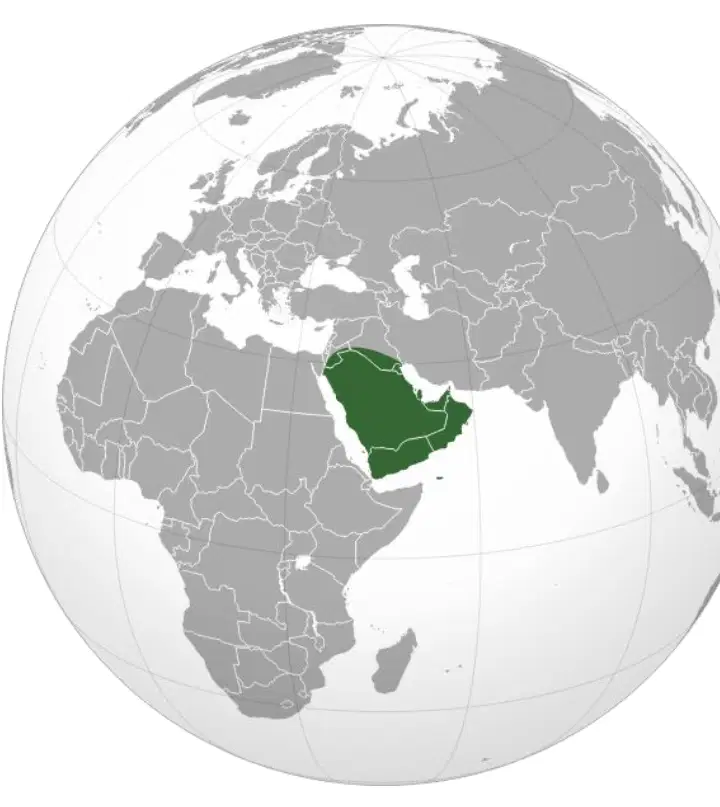
Using the maps provided, explain why the Arabian Peninsula might have been an important location for trade and cultural exchange in history.
It is located at the crossroads of Africa, Asia, and Europe.
It is completely isolated from other continents.
It is surrounded only by mountains.
It is located in the far north of Europe.
Which regions did the first Islamic empire spread across?
Asia, Africa, and into Spain
Only Europe
Only Africa and Australia
Only Asia and North America
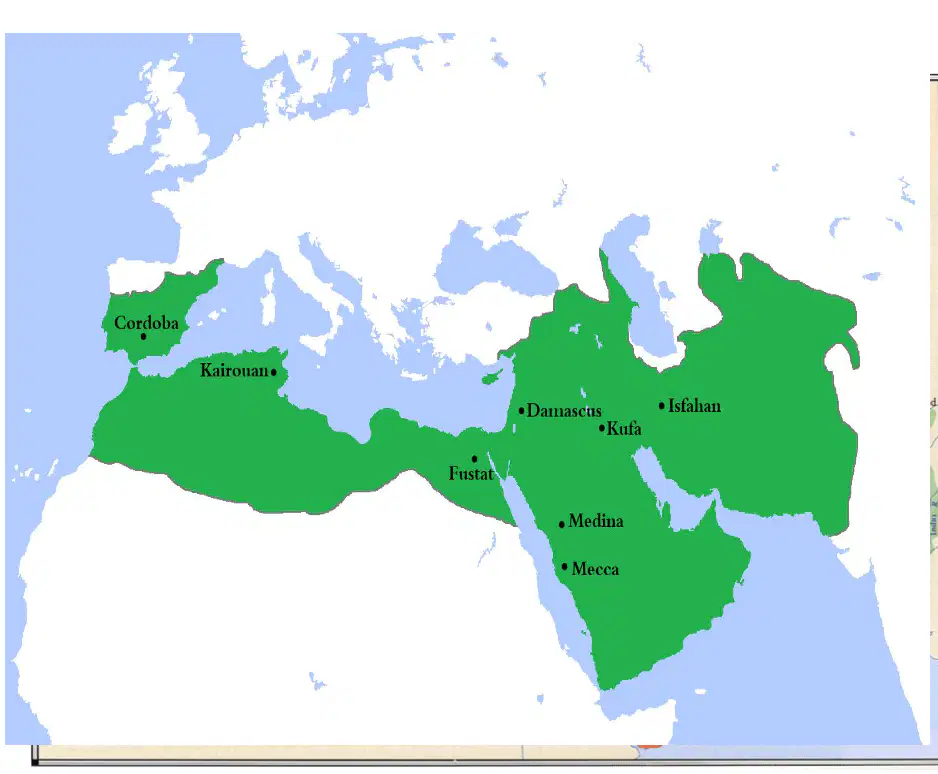
What does the green area on the map represent?
The Roman Empire
The first Islamic empire
The Mongol Empire
The British Empire
Why is the geographic extent of the first Islamic empire significant in world history?
It shows the rapid spread of a major world religion and culture across continents.
It marks the beginning of the Industrial Revolution.
It represents the discovery of the Americas.
It shows the rise of the Roman Empire.
What was the result of the development of Islamic traditions and practices over centuries?
The creation of a distinctive culture
The disappearance of Islamic culture
The decline of traditions
The merging of all world cultures
Which of the following best describes how Islamic culture was formed?
It developed over centuries through traditions and practices
It was created in a single year
It was borrowed entirely from other cultures
It did not change over time
Explain how the development of traditions and practices can contribute to the creation of a distinctive culture, using Islamic culture as an example.
Traditions and practices shape beliefs, values, and customs, which over time create a unique culture, as seen in the development of Islamic culture.
Traditions and practices have no impact on culture.
Distinctive cultures are only created by laws, not traditions.
Islamic culture did not develop from traditions and practices.
What is the Arabic word for God in Islam?
Yahweh
Allah
Krishna
Buddha
Which holy book is considered the word of God in Islam?
Bible
Torah
Qur’an (Koran)
Vedas
Which of the following is a core practice in Islam?
The Eightfold Path
The Five Pillars
The Ten Commandments
The Four Noble Truths
Which earlier prophets are accepted in Islam?
Moses and Jesus
Buddha and Confucius
Abraham and Krishna
Zoroaster and Socrates
Why is the acceptance of earlier prophets such as Moses and Jesus significant in Islam?
It shows Islam’s connection to earlier monotheistic religions.
It means Muslims worship Moses and Jesus.
It replaces the teachings of the Qur’an.
It is not mentioned in Islamic beliefs.

In the first three centuries after Muhammad’s death, what factor helped Muslim rule expand rapidly?
Strong political empires
Overcoming geographic barriers and weakened political empires
Isolation from other regions
Lack of interest in expansion

Which of the following best describes the geographic challenges faced by Muslim rulers in the first three centuries after Muhammad’s death?
They were unable to cross any geographic barriers.
They overcame geographic barriers during their expansion.
They only expanded within the Arabian Peninsula.
They avoided all geographic barriers.
Explain how weakened political empires contributed to the rapid expansion of Muslim rule after Muhammad’s death. Use evidence from the text to support your answer.
Weakened empires made it easier for Muslim rule to expand.
Weakened empires stopped all expansion.
Weakened empires had no effect on expansion.
Weakened empires made expansion more difficult.
Which cities were important starting points for the diffusion of Islam along trade routes?
Mecca and Medina
Baghdad and Cairo
Damascus and Jerusalem
Istanbul and Tehran
What geographic challenges did the expansion of Islam overcome?
Oceans and rainforests
Great distances, desert environments, and mountain barriers
Dense forests and icy tundras
Rivers and lakes
How did the weakness of the Byzantine and Persian empires influence the spread of Islam?
It slowed the spread of Islam
It facilitated the spread into the Fertile Crescent, Iran, and Central Asia
It caused Islam to remain only in Arabia
It led to the collapse of Islam
Based on the information provided, why was the spread of Islam into Central Asia significant?
It showed the influence of trade and weakened empires on cultural diffusion
It was the only region Islam spread to
It happened without any geographic challenges
It was not influenced by trade routes

Which feature on the map most likely helped the spread of Islam from Mecca and Medina?
Trade routes connecting major cities
Large forests blocking movement
Isolated islands in the ocean
Uninhabited polar regions
What were two factors that facilitated trade and stimulated intellectual activity according to the text?
Political unity and the Arabic language
Military power and religious diversity
Economic isolation and local dialects
Geographic barriers and cultural differences
How did political unity and the Arabic language impact society, based on the information provided?
They made trade easier and encouraged intellectual activity.
They caused economic decline and discouraged learning.
They led to increased conflict and reduced communication.
They promoted isolation and limited cultural exchange.
Why might a common language, such as Arabic, be important for trade and intellectual activity? (Use reasoning based on the statement provided.)
It allows people to communicate and share ideas more easily.
It prevents people from traveling to new places.
It limits the spread of new technologies.
It increases misunderstandings between traders.
What was true about the political unity of the first Islamic empire?
It lasted for centuries
It was short-lived
It never existed
It was based on democracy
How did the spread of the Arabic language impact trade across Islamic lands?
It made trade more difficult
It facilitated trade and the spread of new ideas
It limited the production of goods
It caused economic decline
Which of the following products were produced across Islamic lands as a result of trade?
Gold and diamonds
Silk, textiles, and pottery
Oil and coal
Spices and tea

How was slavery in Islamic lands different from some other societies?
It was based on race
Only women were enslaved
Muslims would never enslave other Muslims
It was only for prisoners of war
Explain how the spread of the Arabic language contributed to both economic and intellectual development in Islamic lands.
It created language barriers and limited trade
It allowed for the exchange of goods and ideas, promoting both economic growth and the spread of knowledge
It led to the decline of local cultures
It only benefited religious leaders
Which two areas were early Islamic civilization especially known for achieving advancements in?
Science and the arts
Agriculture and sports
Literature and politics
Engineering and medicine
What was the global significance of the achievements of early Islamic civilization?
They only affected the local region
They had a major global impact
They were not recognized outside the Islamic world
They were limited to religious practices
Explain how achievements in science and the arts during early Islamic civilization contributed to transforming the Islamic world and influencing other regions.
By introducing new technologies and artistic styles that spread beyond the Islamic world
By isolating the Islamic world from other cultures
By focusing only on religious teachings
By discouraging scientific and artistic development
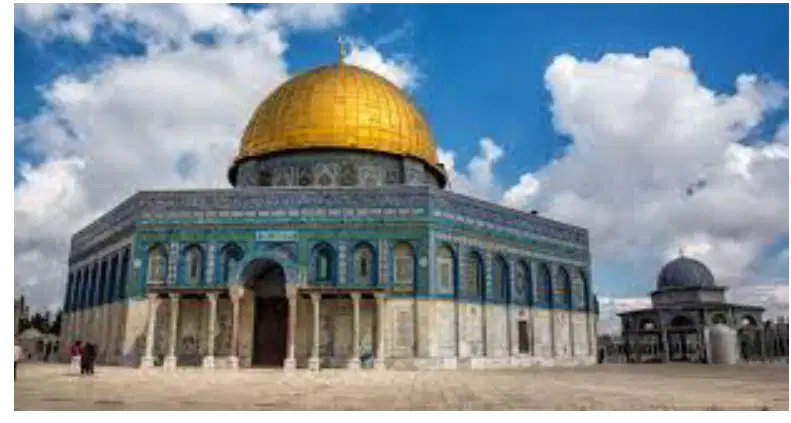
Where is the Dome of the Rock located?
Jerusalem
Mecca
Cairo
Istanbul
According to tradition, what significant event involving Muhammad is believed to have happened at the Dome of the Rock?
He ascended into Heaven to meet with God
He received the Ten Commandments
He was born there
He wrote the Quran there
Why is the spot where the Dome of the Rock is built considered holy to both Jews and Muslims?
It is believed to be the site where Abraham was to sacrifice Isaac
It is the birthplace of Jesus
It is where the first mosque was built
It is the site of the Last Supper
What has the shared significance of the Dome of the Rock’s location led to between Jews and Muslims?
Tension between the two groups
Complete unity and peace
Indifference to the site
Joint religious ceremonies
Explain why the Dome of the Rock is an important cultural and religious site for both Jews and Muslims.
It is believed to be the site of significant religious events for both groups, making it a holy place and a source of tension due to its shared importance.
It is the tallest building in Jerusalem.
It is the oldest building in the world.
It is used as a government building.
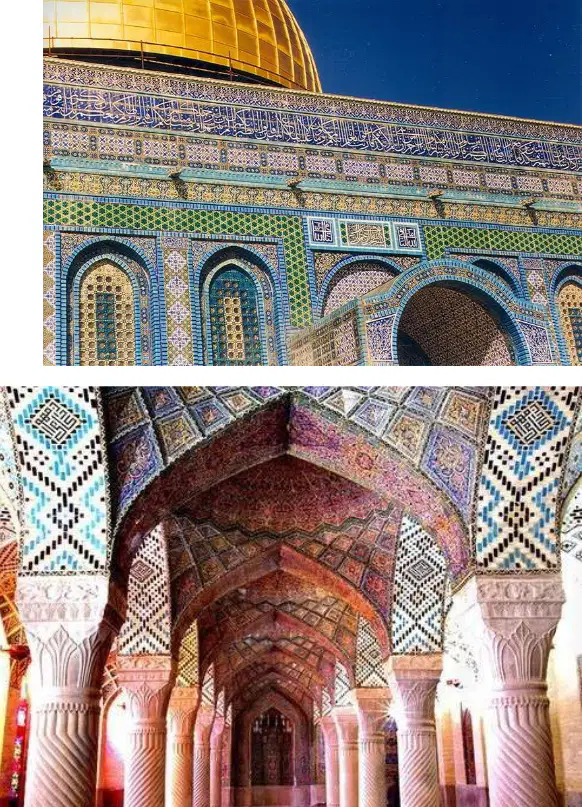
What materials are mosaics typically made from?
Colored glass, stone, or tile
Wood and metal
Paper and ink
Fabric and thread
Why did Muslims focus on creating geometric shapes in their mosaics?
They believed geometric shapes were easier to make
They didn’t believe in creating images of people
They wanted to copy Roman art
They only had access to certain materials
Which other empire is mentioned as having the same type of mosaic artwork as the Muslims?
Roman Empire
Byzantine Empire
Persian Empire
Ottoman Empire
Explain how religious beliefs influenced the style of mosaics created by Muslims.
Muslims used only black and white colors in their mosaics.
Muslims avoided creating images of people due to religious beliefs, so they focused on geometric shapes, similar to the Byzantine Empire.
Muslims preferred to use animal images in their mosaics.
Muslims created mosaics only for religious buildings.
What is the language of the Koran (Qur’an)?
Arabic
Hebrew
Latin
Greek
How is Arabic written and read?
From right to left
From left to right
From top to bottom
From bottom to top
Why is the Arabic alphabet considered a significant cultural contribution?
It is the script of the Koran (Qur’an)
It is the oldest alphabet in the world
It is only used for poetry
It is written in numbers
A student is learning to write in Arabic. What is an important concept they must remember about the direction of writing?
They must write and read from right to left
They must write and read from left to right
They must write in a circular pattern
They must write only in capital letters

What does the image most likely represent?
The Arabic alphabet and its use in writing
A map of the Middle East
A mathematical equation
A painting of a famous person

Which of the following did Muslims honor as part of their cultural contributions?
Sports arenas
Universities and centers of learning
Marketplaces
Palaces
What was one way Muslims helped preserve ancient knowledge?
By destroying old texts
By translating ancient Greek and Persian texts
By building statues
By creating new languages
Muslims contributed to education by writing which of the following?
Novels and poems
Encyclopedias, handbooks, and textbooks
Plays and scripts
Letters and diaries
Explain why translating ancient texts was important for preserving knowledge during the Muslim cultural achievements.
It allowed knowledge to be forgotten
It made knowledge available to more people and preserved it for future generations
It replaced old knowledge with new ideas
It was only for entertainment
Which scientific field is highlighted for its contributions and achievements in the provided material?
Biology
Chemistry
Algebra
Physics
What is one of the main achievements mentioned in the material regarding algebra?
Invented the periodic table
Developed and expanded algebraic formulas
Discovered gravity
Created the first telescope
How did the development and expansion of algebraic formulas impact mathematics? (DoK Level 2)
It made mathematics less useful in science.
It allowed for more complex problem-solving and calculations.
It replaced all previous mathematical theories.
It limited the use of numbers in equations.
Why is the development of algebraic formulas considered a significant scientific achievement? (DoK Level 3)
Because it only helped in geometry.
Because it provided a foundation for solving a wide range of mathematical problems.
Because it was the first use of numbers in history.
Because it made mathematics obsolete.
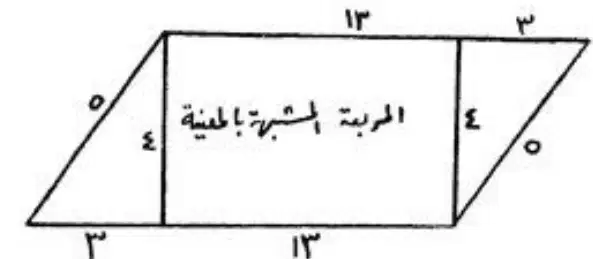
What does the diagram in the image most likely represent in the context of algebraic achievements?
A chemical reaction
A geometric proof or formula
A biological process
A historical timeline
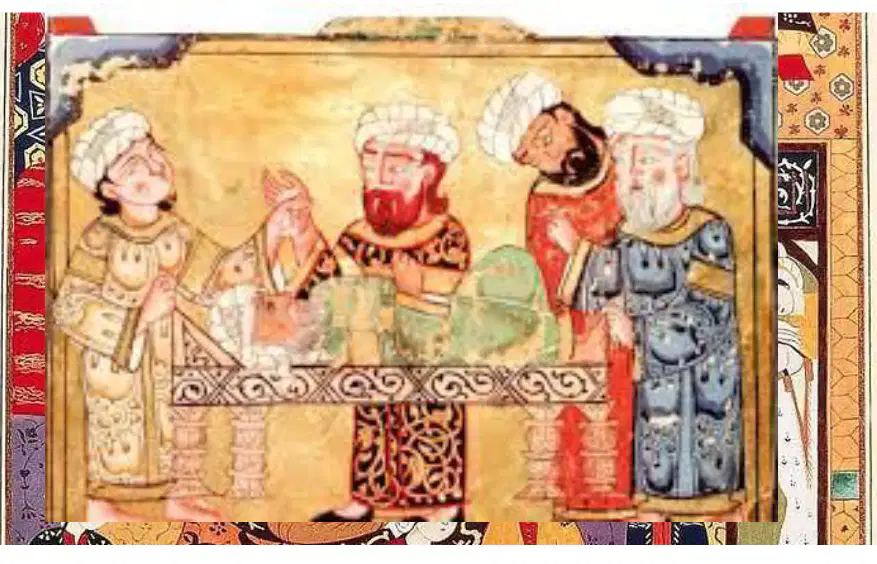
Which of the following scientific contributions in medicine is mentioned in the material?
Performed surgery and discussed diseases such as smallpox and measles; wrote medical encyclopedias.
Invented the microscope and discovered bacteria.
Developed vaccines for polio and influenza.
Created the periodic table of elements.
What diseases were specifically discussed by early medical scholars according to the material?
Smallpox and measles
Tuberculosis and malaria
Influenza and chickenpox
Diabetes and cancer
Why was the writing of medical encyclopedias an important achievement in the history of medicine?
It helped preserve and share medical knowledge for future generations.
It allowed doctors to avoid performing surgeries.
It replaced the need for hospitals.
It eliminated the spread of all diseases.
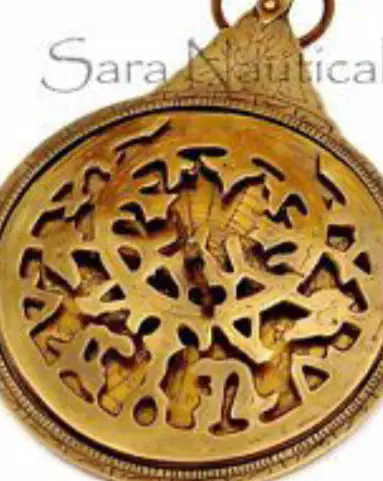
Which scientific device did Muslims invent to help sailors navigate using the stars?
Astrolabe
Telescope
Compass
Sextant
What was the primary purpose of the astrolabe invented by Muslims?
To measure land distances
To navigate using the stars
To tell time
To predict weather
How did the expansion of geographic knowledge benefit from Muslim scientific contributions?
It allowed for more extensive travel and navigation
It improved agricultural techniques
It led to the invention of the printing press
It increased the use of paper money
Which event led to the division between Sunni and Shi’a Muslims?
Muslim defeat at the Battle of Tours
Islamic capital moved to Baghdad by Abbasids
Death of Ali
Muslim conquests of Jerusalem and Damascus
Which cities were conquered by Muslims as mentioned in the historical turning points?
Mecca and Medina
Jerusalem and Damascus
Baghdad and Cairo
Constantinople and Cordoba
Who moved the Islamic capital to Baghdad?
Umayyads
Abbasids
Fatimids
Ottomans
What was the significance of the Battle of Tours in Islamic history?
It marked the beginning of the Sunni-Shi’a division.
It resulted in the Muslim conquest of Jerusalem.
It was a major defeat for Muslims, stopping their advance into Western Europe.
It led to the moving of the Islamic capital to Baghdad.
Explain how the death of Ali contributed to a major division within Islam. (DoK Level 3)
It led to the creation of new Islamic laws.
It resulted in the split between Sunni and Shi’a Muslims due to disagreements over leadership.
It caused the Islamic capital to move to Baghdad.
It ended Muslim expansion into Europe.
What was Muhammad considered in addition to being a prophet?
The Caliph
The Emperor of Rome
The King of Persia
The Pharaoh of Egypt
What is a caliph in the context of Islam?
The religious, military, and political leader of Islam
The main architect of mosques
The chief merchant of Mecca
The leader of the Christian church
What type of government was the Islamic Empire?
Theocracy
Democracy
Monarchy
Republic
Why did Islam become not only a religion but also an empire?
Because its leader was also the political and military head
Because it was based only on trade
Because it had no laws
Because it was only a spiritual movement
How does a theocracy differ from other forms of government?
Religion is the basis of all laws and decisions
Leaders are chosen by popular vote
The government is run by military generals
There are no laws
Who was Ali in the context of early Islamic history?
Muhammad’s son-in-law and the Fourth Caliph of Islam
The founder of Islam
The first Caliph of Islam
A famous Islamic scholar
What was the main reason for the conflict in Islam after the death of Ali?
Disagreement over religious texts
Dispute over who should be the next Caliph
Economic issues
Foreign invasions
Which belief distinguishes Sunni Muslims from Shi’a Muslims regarding the leadership of Islam?
Sunni Muslims believe any good man can lead Islam, while Shi’a Muslims believe the leader should be a descendant of Muhammad.
Sunni Muslims believe only women can lead, while Shi’a Muslims believe only men can lead.
Sunni Muslims believe in multiple leaders, while Shi’a Muslims believe in no leader.
Sunni Muslims believe in democracy, while Shi’a Muslims believe in monarchy.
Explain how the split between Sunni and Shi’a Muslims originated and why it continues to be significant today.
The split originated from a disagreement over leadership after Ali’s death and continues because the two groups have different beliefs about who should lead Islam.
The split originated from a disagreement over prayer times and continues because of language differences.
The split originated from economic issues and continues because of trade disputes.
The split originated from foreign invasions and continues because of territorial conflicts.

Which group believes that only descendants of Muhammad can be caliphs?
Shia
Sunni
Both
Neither

What is a belief shared by both Shia and Sunni Muslims?
Only descendants of Muhammad can be caliphs.
The Quran is the holy book of Islam.
Caliphs do not have to be descendants of Muhammad.
Only Shia practice the Five Pillars.

According to Sunni beliefs, who can be a caliph?
Only descendants of Muhammad
Any Muslim, not necessarily a descendant of Muhammad
Only religious scholars
Only people from Mecca

Which of the following is NOT a belief shared by both Shia and Sunni Muslims?
There is only one God, Allah.
The Quran is the holy book of Islam.
Only descendants of Muhammad can be caliphs.
Practice the Five Pillars.
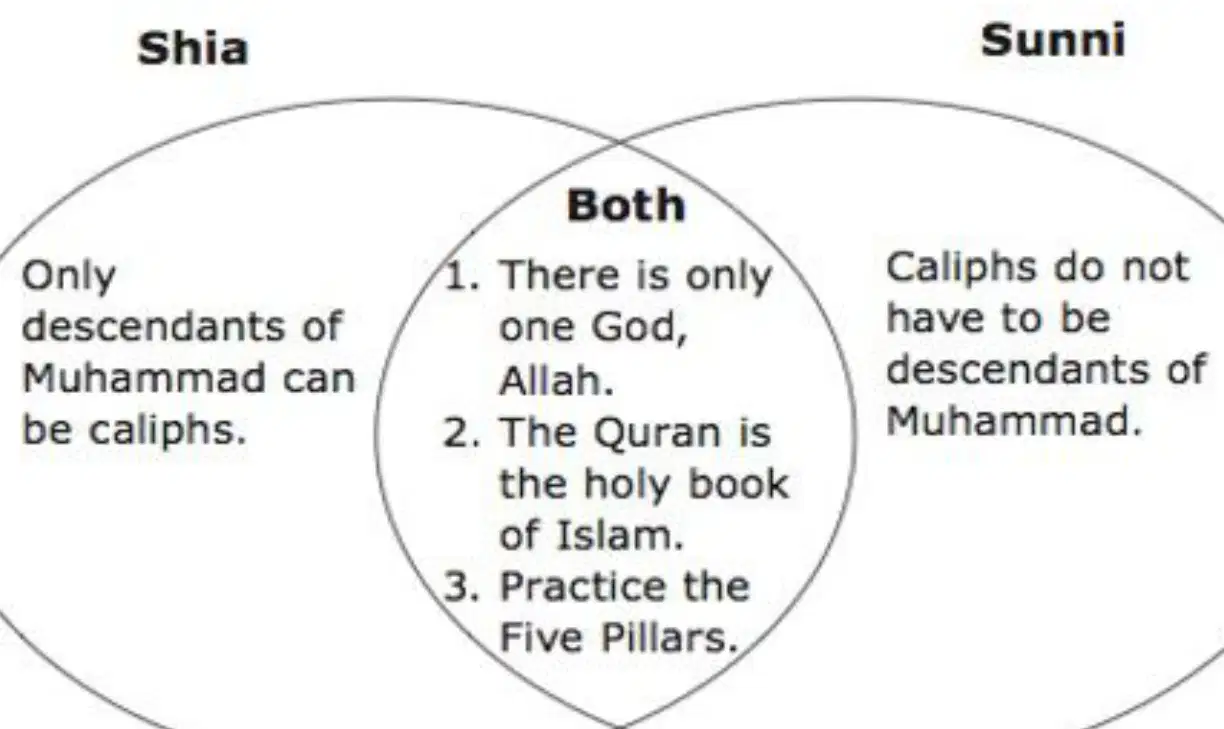
Explain how the beliefs about caliphs differ between Shia and Sunni Muslims, using evidence from the diagram.
Shia believe only descendants of Muhammad can be caliphs, while Sunni believe caliphs do not have to be descendants of Muhammad.
Both believe only descendants of Muhammad can be caliphs.
Both believe caliphs do not have to be descendants of Muhammad.
Shia believe caliphs do not have to be descendants of Muhammad, while Sunni believe only descendants of Muhammad can be caliphs.
Which dynasty controlled Islam and expanded the empire as far east as the Indus River Valley and as far west as Spain?
Abbasid Dynasty
Umayyad Dynasty
Ottoman Dynasty
Fatimid Dynasty
What was a key difference between the Umayyads and Muhammad and his descendants?
The Umayyads lived a simple life like Muhammad.
The Umayyads were rich, powerful, and loved wealth.
The Umayyads rejected expansion of the empire.
The Umayyads followed the same lifestyle as Muhammad.
According to the text, which regions did the Umayyad Empire expand into?
Only the Arabian Peninsula
Only North Africa
As far east as the Indus River Valley and as far west as Spain
Only Persia and Egypt
Why might the lifestyle of the Umayyads have caused tension with followers of Muhammad’s teachings?
They refused to expand the empire.
They followed a simple life like Muhammad.
Their wealth and love of luxury contrasted with Muhammad’s simple lifestyle.
They were not interested in religion.

Which two cities did the Muslims conquer that were considered holy to both Christians and Jews?
Damascus and Jerusalem
Mecca and Medina
Cairo and Istanbul
Athens and Rome
What was the main reason for the Muslim conquest according to the text?
To spread their religion and their empire
To find new trade routes
To escape persecution
To build new cities
Which of the following is considered the most important mosque in Makkah ( Mecca)?
Temple at the Wall
Ka'bah (kaaba)
St. Peters Cathedral
The Golden Temple at Amritsar

