
 Worksheets
Soil, Glass, Botany and Impressions
Total questions: 92
Worksheet time: 46mins
Name
Class
Date
1.
Which of these is FALSE about tire TRACK evidence?
a)
tire track evidence can tell CSI the brand of tire that made the impression
b)
tire track evidence can tell CSI the direction that the vehicle went
c)
tire track evidence can give an idea of the size of the vehicle
d)
tire track evidence is ONLY class evidence
2.
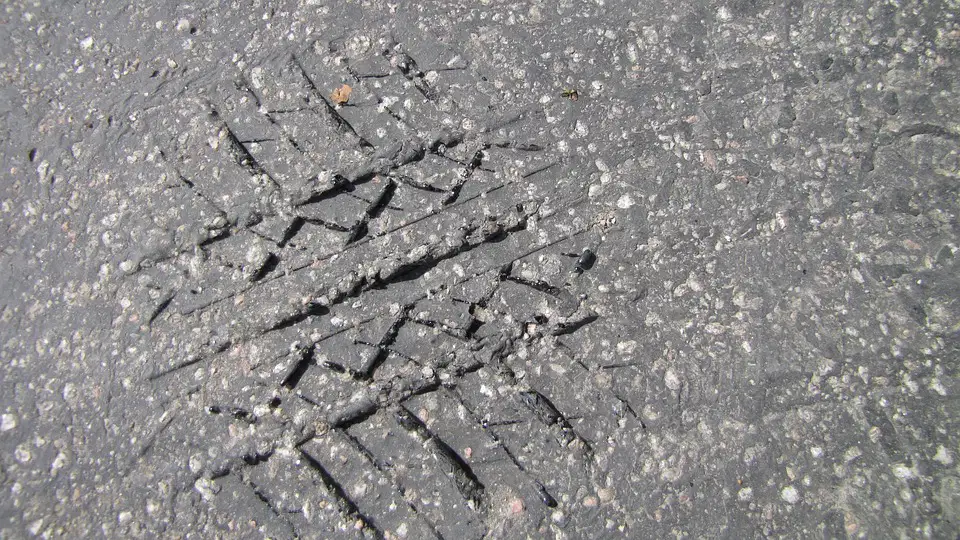
CSI can use this impression to determine...
a)
the wheelbase of the vehicle that made the impression
b)
the track width of the vehicle that made the impression
c)
the brand of tire that made the impression
d)
the direction the vehicle was traveling
3.
Which of these is NOT something that may be learned by analyzing footwear impressions?
a)
The possible gender of the culprit
b)
How long ago the crime happened
c)
How many individuals were at a crime scene
d)
That one person was present at two different crime scenes
4.

Your top/upper teeth are called...
a)
maxillary teeth
b)
mandibular teeth
5.
Which of these locations would you LEAST expect to find tool mark evidence?
a)
on a safe
b)
on a window frame
c)
on a cabinet door
d)
on door hinges
6.
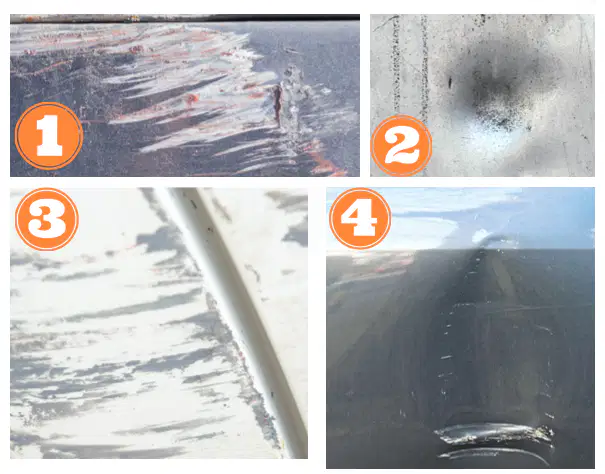
Which of these tool marks is a combination of BOTH striation and compression?
a)
Tool mark 1
b)
Tool mark 2
c)
Tool mark 3
d)
Tool mark 4
7.
When analysts make a test mark with a tool, what material do they use?
a)
lump of play doh
b)
square of clay
c)
piece of lead
d)
Mirkosil
8.
Which characteristic makes plant cells particularly resilient in forensic investigations?
a)
Their rapid regeneration
b)
Their ability to resist chemical breakdown
c)
Their capacity to survive digestive processes
d)
Their complex cell wall structure
9.
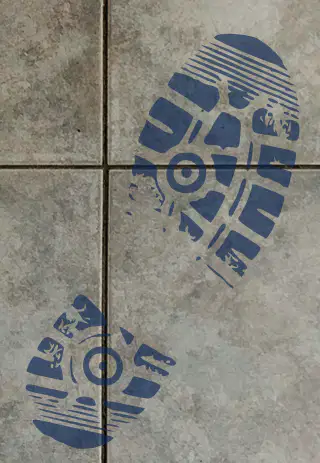
Which principle forms the foundational basis for using pollen and spores in forensic investigations?
a)
Newton's Law of Scientific Evidence
b)
Darwin's Theory of Evolution
c)
Locard's Principle of Exchange
d)
Mendel's Genetic Inheritance Principle
10.
In forensic botany, what does a 'pollen profile' primarily represent?
a)
A botanical crime scene reconstruction
b)
The number and type of pollen grains in a geographic area at a specific time
c)
A criminal's genetic map
d)
A plant's reproductive cycle
11.
Which reproductive characteristic makes cross-pollination more valuable in forensic investigations compared to self-pollination?
a)
Cross-pollinating plants have more complex cell structures
b)
Cross-pollinating plants produce more unique genetic markers
c)
Cross-pollinating plants generate more pollen
d)
Cross-pollinating plants have larger seeds
12.
What makes pollen and spore evidence particularly useful in forensic investigations?
a)
They only exist in tropical environments
b)
They are large and easily visible
c)
They have a durable cell wall that can persist for decades
d)
They are easily destroyed by environmental conditions
13.
In the classification of plants, what distinguishes gymnosperms from angiosperms?
a)
Gymnosperms produce seeds in exposed structures, while angiosperms produce seeds within fruits
b)
Gymnosperms cannot produce pollen
c)
Gymnosperms are always larger than angiosperms
d)
Angiosperms only exist in temperate climates
14.
What critical factor must forensic palynologists maintain when collecting pollen and spore evidence?
a)
Collect only from urban environments
b)
Avoid contamination
c)
Freeze all samples immediately
d)
Use plastic containers for storage
15.
In the Natalie Mirabel case, what specific botanical evidence helped convict her husband?
a)
Pollen from his car's undercarriage matching higher elevation plants
b)
Leaf fragments from his shoes
c)
Moss samples from his vehicle
d)
Tree bark evidence
16.
What unique characteristic of diatoms makes them useful in investigating drowning cases?
a)
They are always blue in color
b)
They only exist in saltwater
c)
They have cell walls containing silicon dioxide
d)
They can survive extreme temperatures
17.
What reproductive structure is responsible for pollen production in angiosperms?
a)
Stigma
b)
Ovary
c)
Pistil
d)
Stamen
18.
How do forensic botanists typically recognize a recent gravesite?
a)
By soil color changes
b)
By a mound of soil devoid of plants
c)
By the presence of fresh flowers
d)
By increased insect activity
19.
In forensic botany, why are pollen and spores considered valuable trace evidence?
a)
They can uniquely link a suspect to a specific location
b)
They are easily destroyed
c)
They are too small to be analyzed
d)
They only grow in urban environments
20.
What distinguishes seed-bearing plants from non-seed bearing plants in forensic analysis?
a)
Reproduction method
b)
Cellular complexity
c)
Chemical composition
d)
Geographic distribution
21.
Which botanical characteristic is most critical when mapping evidence at a crime scene?
a)
Species percentage and distribution
b)
Plant size
c)
Root structure
d)
Plant color
22.
Why are diatoms particularly useful in forensic investigations?
a)
They are visible to the naked eye
b)
They provide DNA evidence
c)
They can reconstruct entire ecosystems
d)
They indicate water-related crime scenes
23.
What makes botanical evidence challenging for perpetrators to eliminate?
a)
Their rapid decomposition
b)
Plants' complex cellular structures
c)
Their uniform appearance
d)
Their ability to transfer microscopic particles
24.
In forensic palynology, what makes pollen grains valuable for investigation?
a)
They can persist for extended periods
b)
They are uniform across all environments
c)
They are identical in all plant species
d)
They are easily contaminated
25.
What historical event significantly advanced forensic botany techniques?
a)
The Industrial Revolution
b)
The Charles Lindbergh kidnapping case
c)
The Renaissance
d)
World War II
26.
Which factor is most crucial when collecting botanical evidence?
a)
Collecting in plastic bags
b)
Preserving original context
c)
Ignoring root systems
d)
Collecting large quantities
27.
What makes plant cells particularly useful in forensic gastric analysis?
a)
They dissolve immediately
b)
They change color rapidly
c)
They can survive digestive processes
d)
They are too fragile to analyze
28.
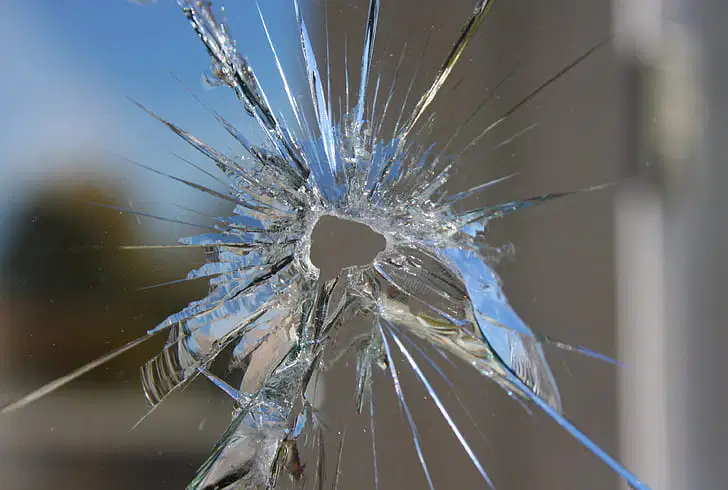
Which of the following statements is FALSE?
a)
Glass is mostly composed of silica sand
b)
Lead makes glass sparkle like crystal
c)
Aluminum added to glass makes it stronger
d)
Cobalt added to glass makes it a red color
29.
Which of the following accurately describes glass?
a)
Glass is an amorphous solid
b)
Over time, glass molecules slowly flow downward due to gravity
c)
The molecules that make up glass are organized in a specific repeated pattern
d)
Glass of the same thickness and composition will always break in the same pattern
30.
Which of these does NOT describe laminated glass?
a)
This glass breaks into tiny, not-sharp pieces
b)
This glass is very difficult to break
c)
This glass has a layer of plastic in the middle
d)
This glass is found on car windshields and in bullet proof glass
31.
Which of these statements is FALSE?
a)
Glass evidence is most often found at house breaks and hit and runs
b)
Analysts use heat and acetone to test a sample - if it melts, it is glass
c)
Glass can be found on victim and suspect shoes, clothing, and hair
d)
Glass evidence can indicate when a person what at a crime scene
32.
Which statement about collecting questioned glass evidence is FALSE?
a)
If glass may be on an article of clothing, collect the whole item
b)
To find glass evidence in hair, comb the hair over a white sheet of paper
c)
Use a broom to collect glass in carpet
d)
Place large pieces of glass into appropriately sized ridged containers
33.
Which statement about collecting known glass evidence is FALSE?
a)
For laminated glass, collect a 2x2 inch sample
b)
In the case of a double pane window, collect samples from both
c)
It is important to mark the inside vs outside of the glass
d)
Collect broken glass from the ground near the broken window
34.
All of these are among the FIRST tests done when analyzing samples of glass EXCEPT...
a)
Compare the color of the glass
b)
Compare the edge sharpness of the glass
c)
Test the chemical make up of the glass
d)
Look for any films, marks, or residue on the glass
35.
What does a micrometer do?
a)
it measures the density of a piece of glass
b)
it measures the thickness of a piece of glass
c)
it measures the refractive index of a piece of glass
d)
it measures the chemical makeup of a piece of glass
36.
Which of these describes the refractive index of a piece of glass?
a)
The measure of how dense a piece of glass is
b)
The measure of how much a light ray bends when it passes through the glass
c)
The exact wavelength of light that is reflected by the glass
d)
The exact wavelength of light that is absorbed by the glass
37.
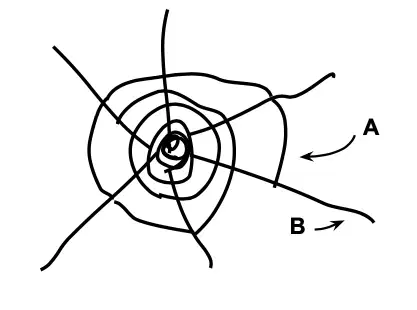
Which of these is TRUE?
a)
A - concentric, B - radial. Radial lines form first when a force strikes glass
b)
A - radial, B - concentric. Radial lines form first when a force strikes glass
c)
A - radial, B - concentric. Concentric lines form first when a force strikes glass
d)
A - concentric, B - radial. Concentric lines form first when a force strikes glass
38.
CSI can learn a lot of information from studying the fracture pattern of glass...
a)
unless it is soda lime glass, fracture patterns are not helpful for soda lime glass
b)
unless it is laminated glass, fracture patterns are not helpful for laminated glass
c)
unless it is annealed glass, fracture patterns are not helpful for annealed glass
d)
unless it is tempered glass, fracture patterns are not helpful for tempered glass
39.
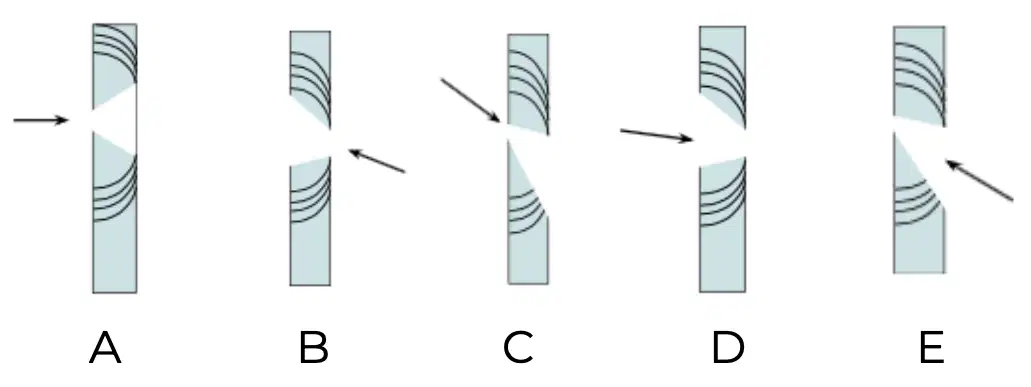
The arrow points in the direction of a bullet which hit the piece of glass, resulting in a bullet hole and ridge lines. Which of the following illustrates an accurate bullet hole and ridge lines based on the direct of impact?
a)
A
b)
B
c)
C
d)
D
e)
E
40.
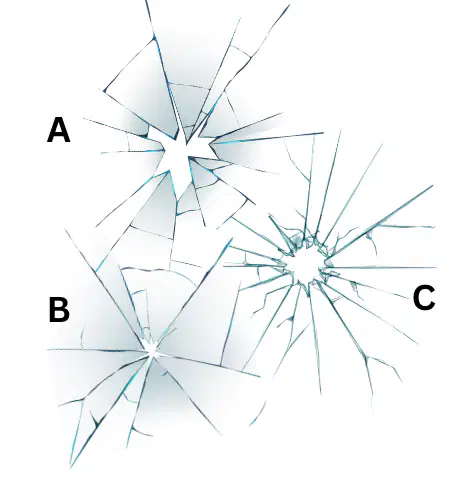
In what order were these impacts made? (zoom in on the image if needed)
a)
A, B, C
b)
C, B, A
c)
B, A, C
d)
C, A, B
e)
B, C, A
41.
You borrow your mom's car this weekend, and on Monday, your mom notices a crack in the car windshield that was not there before. She blames you for following too close to a truck and letting a rock hit the windshield. But you are sure that it is thermal cracking. All of the following are evidence of thermal cracking EXCEPT...
a)
the crack has no center point
b)
you can feel the crack only on the inside of the windshield
c)
the crack has wavy fracture lines
d)
the crack has no distinct radial or concentric fracture lines
42.
Which of the following is individual evidence?
a)
The elemental composition of the questioned glass is identical to the known glass
b)
The constellation of pollen and dirt on the questioned glass is identical to the known glass
c)
The questioned glass fits into the known glass like a puzzle piece
d)
Glass is always class evidence
43.
A tool mark is found on the trunk of a car. What substance is used to collect a cast of the tool mark?
a)
lump of play doh
b)
square of clay
c)
piece of lead
d)
Mirkosil
44.
Which of these is FALSE about striation tool marks?
a)
striation marks can be matched to a specific tool
b)
striation marks are considered class evidence
c)
striations are scratch marks made by a tool scraping across a surface
d)
striation marks can be collected by making a cast of the mark
45.
Which of these is FALSE about compression tool marks?
a)
compression marks can be matched to a specific tool
b)
compression marks are considered class evidence
c)
compression marks are made when a tool is pushed forcefully into a surface
d)
compression marks can be collected by making a cast of the mark
46.
Which of these statements is FALSE?
a)
CSI must dust for fingerprints before making a cast of a tool mark
b)
CSI will document the location of a tool mark by creating a sketch of the area
c)
CSI will document the location of a tool mark by taking an overall photograph of the area
d)
trace evidence in the tool mark is collected as it gets stuck to the cast
47.
When photographs are taken of a tool mark, which of these types of photos are NOT necessary?
a)
an overall photo
b)
an overall photo with a scale
c)
a close up photo
d)
a close up photo with a scale
48.
Which of these is FALSE?
a)
When a tool is used at a crime scene, flecks of paint from the scene may get stick to the tool
b)
Tools are collected in a ridged container
c)
A tool found at a crime scene should be placed into the tool mark to see if it fits the mark
d)
Tools are wrapped in cloth before collecting
49.
What type of microscope is used to analyze tool marks?
a)
comparison microscope
b)
compound microscope
c)
dissecting microscope
d)
scanning electron microscope
50.

Which tooth is number 10 below?
a)
lateral incisor
b)
3rd molar
c)
2nd molar
d)
1st molar
e)
central incisor
51.

Which tooth is number 1 below?
a)
3rd molar
b)
2nd molar
c)
1st molar
d)
central incisor
e)
canine
52.
Bite marks are...
a)
class evidence
b)
individual evidence
53.
Check ALL the ways Odontology should be used in forensics.
a)
Identify unknown bodies
b)
Eliminate possible suspects whose teeth could not have made a particular bite mark
c)
Make a positive (exact) identification of a suspect to the exclusion of all others
54.
A woman is brought to the hospital in critical condition. She claims she was attacked while walking near her home, and is showing signs of a beating. She also has what appears to be a bite mark on her arm, but it is hard to make out any individual tooth impressions, the area is red and swollen. It is in ______________
a)
Stage 1
b)
Stage 2
c)
Stage 3
d)
Stage 4
55.
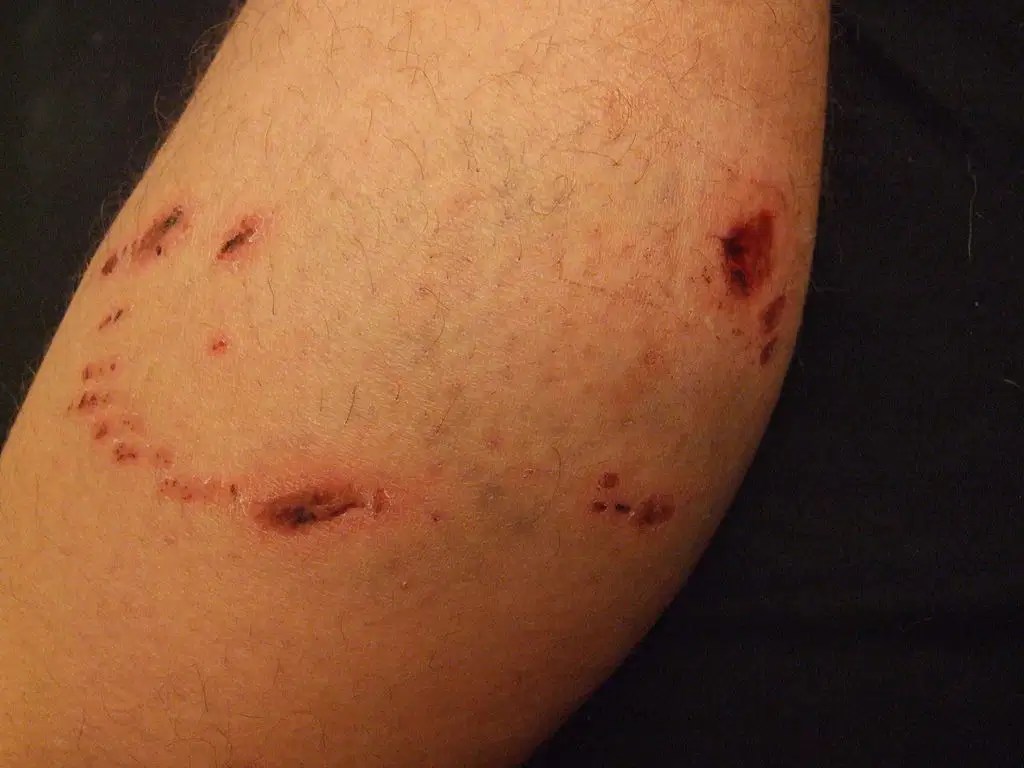
What level bite mark is this?
a)
Level 4
b)
Level 1
c)
Level 2
d)
Level 3
e)
Level 5
56.
You are looking at what you believe to be a Level 1 bite mark on a victim. Which of the following is FALSE?
a)
This bite mark is faint
b)
There is no broken skin at the bite mark
c)
The mark is not very useful for matching a suspect to the mark
d)
The mark should not be photographed
57.
What is an overlay?
a)
A high definition photograph of a bite mark with a scale
b)
A cast used to collect bite mark evidence found on a victim
c)
A transparent sheet with a tracing of the teeth, used to compare a bite mark to suspect's dentition
d)
A detailed mold made of the suspect's teeth
58.
Which of the following is FALSE?
a)
Bite mark evidence has been proven to be reliable
b)
Bite mark analysis is subjective
c)
Ted Bundy was convicted based largely on bite mark evidence
d)
Many people have been wrongly convicted due to faulty bite mark evidence
59.
Which of these is considered INDIVIDUAL evidence?
a)
Stride length of a suspect
b)
Accidental characteristics found in an impression
c)
Brand / type of shoe that made an impression
d)
The sole pattern / design of a footwear impression
60.
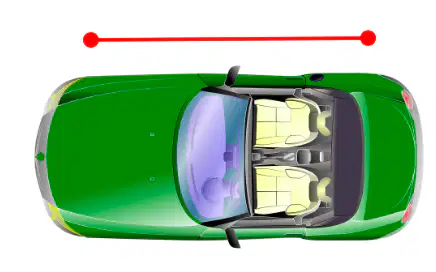
The measurement indicated by the red line (from center of front wheel to center of back wheel) is the....
a)
track width of the car
b)
wheelbase of the car
c)
turning diameter of the car
d)
diagonal line of the car
61.
A woman is brought to the hospital in critical condition. She claims she was attacked while walking near her home, and is showing signs of a beating. She also has what appears to be a bite mark on her arm, but it is hard to make out any individual tooth impressions, the area is red and swollen. It is in ______________
a)
Stage 1
b)
Stage 2
c)
Stage 3
d)
Stage 4
62.
Which of these is INDIVIDUAL evidence?
a)
the turning diameter of a car
b)
the wheelbase of a car
c)
the brand / type of tire
d)
wear marks due to tire use
63.
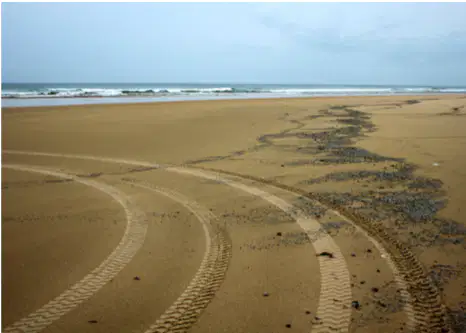
A car made a sharp turn in the sand, leaving these impressions. Which of these statements is FALSE?
a)
CSI can use these impressions to determine the brand of all four tires of the car
b)
CSI can use these impressions to determine the turning diameter of the car
c)
CSI can use these impressions to determine the wheelbase of the car
d)
CSI can use these impressions to determine the track width of the car
64.
Measuring the foot length and stride length of a footwear impression can be used to approximate the ____________ of the suspect.
a)
weight
b)
age
c)
height
d)
walking speed
65.
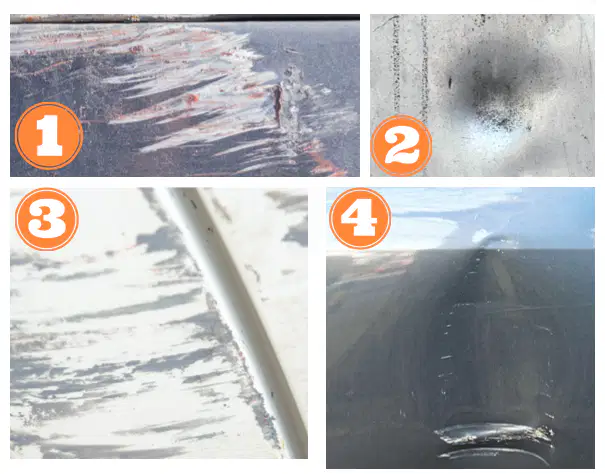
Which of these tool marks is a combination of BOTH striation and compression?
a)
Tool mark 1
b)
Tool mark 2
c)
Tool mark 3
d)
Tool mark 4
66.
This type of footwear impression must be collected with casting material.
a)
Latent Impression
b)
2D Visible impression
c)
3D Plastic impression
d)
All three types of impressions can be collected with casting material
67.
A driver was traveling along a dirt road( Speed limit 25) beside a farm. A chicken jumps in front of the car, and the driver skids to a stop in an attempt to avoid the chicken. Sadly, the driver hits and kills the chicken just before coming to a stop.
The farmer wishes to sue the driver, claiming this was his prize chicken and that the driver was speeding when he hit the chicken.
Skid lines are 69.75 feet long, the two front tires and one back tire.
The drag of the road is 0.5
Was he speeding?
a)
Yes
b)
No
68.

The measurement indicated by the red line (from center of front wheel to center of back wheel) is the....
a)
track width of the car
b)
wheelbase of the car
c)
turning diameter of the car
d)
diagonal line of the car
69.
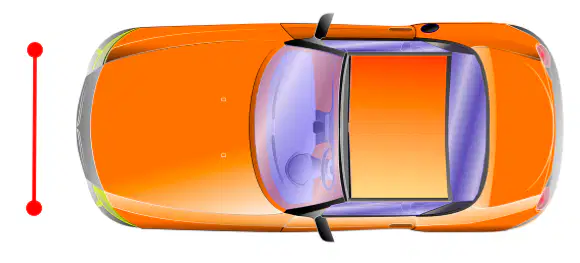
The measurement indicated by the red line (from center of front right tire to center of front left) is the....
a)
track width of the car
b)
wheelbase of the car
c)
turning diameter of the car
d)
diagonal line of the car
70.
Which of these vehicles most likely has the LARGEST wheelbase?
a)
Pick up truck
b)
SUV
c)
Volkswagen bug
d)
UPS truck
71.
Which of these is INDIVIDUAL evidence?
a)
the turning diameter of a car
b)
the wheelbase of a car
c)
the brand / type of tire
d)
wear marks due to tire use
72.
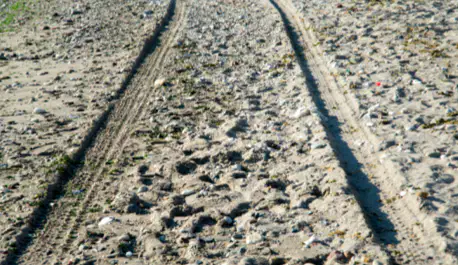
Which statement is FALSE about this tire impression evidence?
a)
this impression is 3D
b)
this impression includes tire TREAD evidence
c)
this impression includes tire TRACK evidence
d)
you can see all four tires in this impression
73.
Which statement is FALSE?
a)
CSI only need to photograph 2D tire impression evidence
b)
3D tire impression evidence is collected by making a cast / mold of the impression
c)
3D tire impression evidence can be linked to one specific tire
d)
Investigators use tire databases to find the brand of tire that left a 3D impression
74.
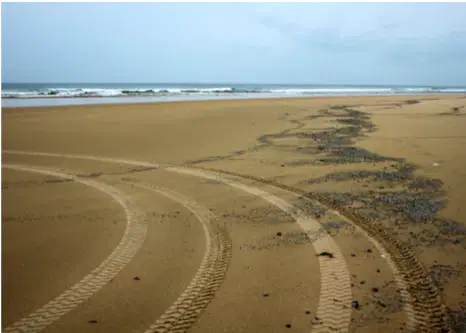
A car made a sharp turn in the sand, leaving these impressions. Which of these statements is FALSE?
a)
CSI can use these impressions to determine the brand of all four tires of the car
b)
CSI can use these impressions to determine the turning diameter of the car
c)
CSI can use these impressions to determine the wheelbase of the car
d)
CSI can use these impressions to determine the track width of the car
75.
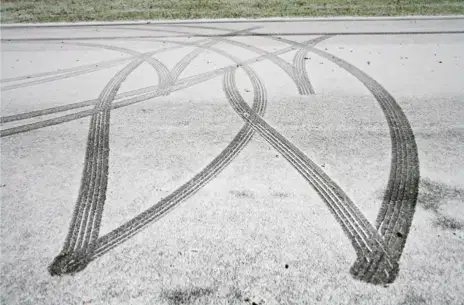
A car made a three point turn, leaving these impressions. Which of these statements is FALSE?
a)
CSI can use these impressions to determine the brand of all four tires of the car
b)
CSI can use these impressions to determine the turning diameter of the car
c)
CSI can use these impressions to determine the wheelbase of the car
d)
CSI can use these impressions to determine the track width of the car
76.
Last name
4 lines
77.
Which of these is NOT something that may be learned by analyzing footwear impressions?
a)
The possible gender of the culprit
b)
How long ago the crime happened
c)
How many individuals were at a crime scene
d)
That one person was present at two different crime scenes
78.
Which of these is considered INDIVIDUAL evidence?
a)
Stride length of a suspect
b)
Accidental characteristics found in an impression
c)
Brand / type of shoe that made an impression
d)
The sole pattern / design of a footwear impression
79.
Which of these describes the common approach path?
a)
the path that all CSI take in / out / through the scene as they collect evidence
b)
the path that the culprit took when he / she came in to the crime scene to commit a crime
c)
the path that the culprit took when he / she left the crime scene
d)
the path that surrounds the outer edge of a crime scene that must be protected from onlookers
80.
Measuring the foot length and stride length of a footwear impression can be used to approximate the ____________ of the suspect.
a)
weight
b)
age
c)
height
d)
walking speed
81.
Which of these statements is FALSE?
a)
when searching for the brand of shoe that left an impression, CSI use databases that store thousands of shoe images
b)
knowing the brand of shoe that left an impression is not helpful to an investigation because many people have the same brand of shoe
c)
knowing the height of the culprit can allow CSI to eliminate possible suspects
d)
it is nearly impossible for two shoes to have the same accidental characteristics in the same locations
82.
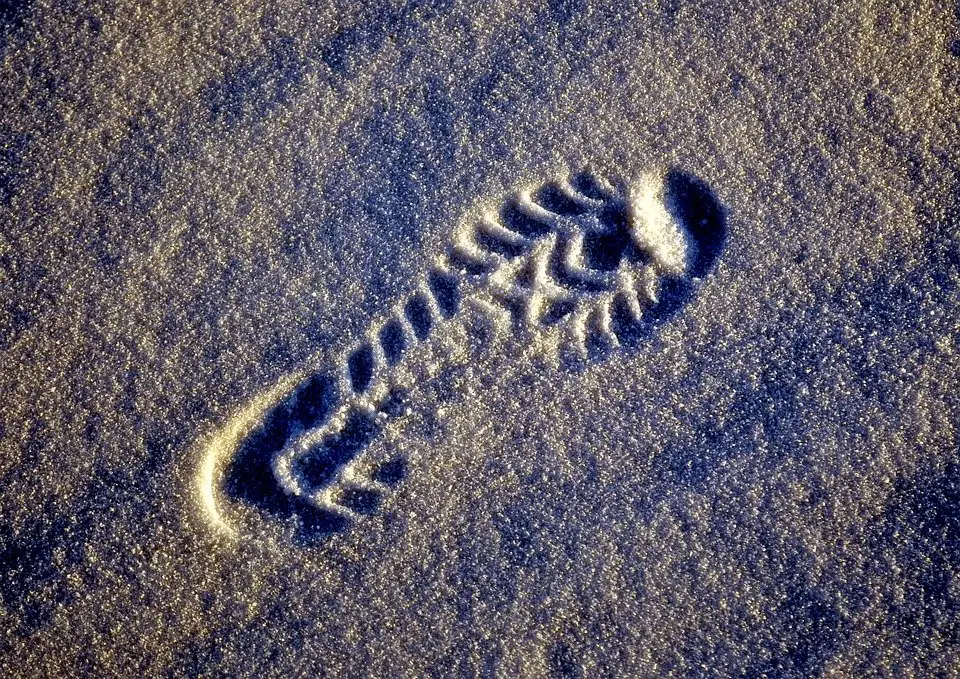
You find this impression made in sand. This type of footwear impression is considered a...
a)
Latent Impression
b)
2D Visible impression
c)
3D Plastic impression
83.
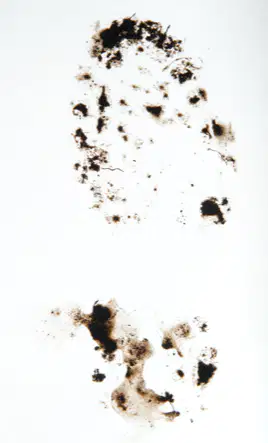
You find this muddy impression left on a tile floor. This type of footwear impression is considered a...
a)
Latent Impression
b)
2D Visible impression
c)
3D Plastic impression
84.
You believe there may be bloody shoe prints at the scene of a murder, but you can not see any. You spray a special chemical called Amino Black, which turns a deep blue when it reacts with the proteins in blood. Sure enough, several impressions become visible. This impression is considered...
a)
Latent Impression
b)
2D Visible impression
c)
3D Plastic impression
85.
This type of footwear impression must be collected with casting material.
a)
Latent Impression
b)
2D Visible impression
c)
3D Plastic impression
d)
All three types of impressions can be collected with casting material
86.
Which types of impressions must be photographed? Check all that apply.
a)
Latent Impression
b)
2D Visible impression
c)
3D Plastic impression
87.
An electrostatic dust lifter would be used to collect which type of impression?
a)
Latent Impression
b)
2D Visible impression
c)
3D Plastic impression
d)
All three types of impressions can be collected with an electrostatic dust lifter.
88.
On which type of impression might CSI use fingerprint powder?
a)
Latent Impression
b)
2D Visible impression
c)
3D Plastic impression
d)
Fingerprint powder may be used in processing of all three types of impressions.
89.
After placing the scale beside the impression, what is the NEXT step towards photographing a footwear impression?
a)
check for windspeed
b)
be sure your camera is parallel (level) with the impression
c)
put hardening spray on the print so it does not get messed up
d)
take a selfie with the print to prove that you were the one who took the photographs
90.
How many pictures must you take of a 3D footwear impression?
a)
just one
b)
two - one with high light source and one with a low light source
c)
four
d)
six
91.
The purpose of hardening spray is...
a)
to harden the soil around a footwear impression so that it does not get messed up when pouring a cast
b)
to speed up the hardening process of the casting material after it is poured on an impression
c)
to protect the cast / mold after is is collected, applied before it is washed, so that the water does not remove the details of the impression
d)
to protect the cast / mold after it is washed to prevent the cast from chipping / breaking as it is sent to the lab for analysis
92.
Which type of glass is most likely to shatter into large, sharp pieces upon impact?
a)
Tempered glass
b)
Bulletproof glass
c)
Annealed glass
d)
Laminated glass
100 %

