
NEW
Font size
 Worksheets
Laryngeal System Review
Total questions: 23
Worksheet time: 17mins
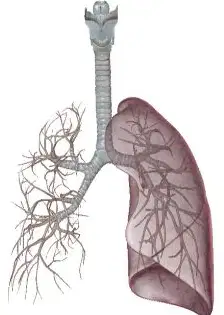
According to the slide, which statement correctly identifies the position and composition of the larynx?
It is a posterior air valve between the esophagus and the nasal cavity, composed only of muscles.
It is an anterior air valve that sits between the trachea and the pharynx, made up of cartilages, a bone, ligaments, and tendons.
It is a lateral air valve inferior to the lungs, made entirely of elastic tissue.
It is a superior air valve within the oral cavity consisting of the thyroid bone only.
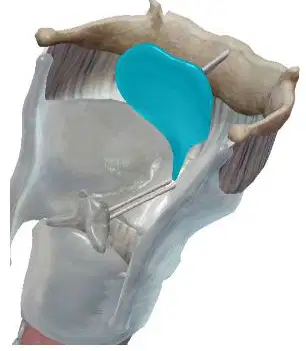
According to the diagram, which statement correctly identifies its position and attachments?
It is paired cartilage located anterior to the hyoid bone and attaches to the thyroid notch via its lingual surface.
It is a single cartilage positioned posterior to the hyoid bone; its lingual surface connects to the hyoid bone, and its stalk connects inside the thyroid cartilage just below the thyroid notch.
It is a single cartilage positioned superior to the hyoid bone; its laryngeal surface connects to the hyoid bone, and its stalk connects to the cricoid cartilage.
It is paired cartilage positioned posterior to the thyroid cartilage; its stalk connects to the arytenoids.
Which statement best defines the laryngeal cavity as described?
The external bony frame surrounding the pharynx
The space inside the larynx extending from the laryngeal inlet at the top down to the trachea, housing the vocal folds and protecting the airway
Only the space between the false vocal folds
A cavity limited to the subglottic region below the cricoid cartilage
During normal breathing, what is the expected configuration of the glottic space?
Narrow or closed
Wide open
Fixed and unchanging
Partially covered by the epiglottis
Which statement best describes the anatomical boundaries of the subglottic space?
It lies above the false vocal folds and ends at the epiglottis
It is the space below the true vocal folds, extending to the cricoid cartilage and into the trachea
It is a pocket between the arytenoid cartilages and the thyroid cartilage
It spans only the length of the vestibular folds
A student explains that the laryngeal ventricle helps speech because it contains mucous glands that lubricate the vocal folds, allowing smooth vibration. Where is this ventricle located?
Between the cricoid cartilage and the trachea
Between the false (vestibular) folds and the true vocal folds, extending most of their length
Between the epiglottis and the hyoid bone
Within the arytenoid cartilage at the vocal process
Which statement correctly distinguishes the ventricular/vestibular folds from the true vocal folds based on their structure and function?
Ventricular folds are the primary structure for sound production and vibrate during phonation, lying inferiorly in the larynx.
Ventricular folds are much thicker, lie superior to the true vocal folds, and primarily protect the airway during swallowing or labor‑intensive activities.
True vocal folds are shelf‑like structures extending from the sidewalls of the laryngeal cavity and are less prominent than the ventricular folds.
True vocal folds are sometimes referred to as “false vocal folds” because they rarely vibrate during phonation.
The laryngeal cavity is divided into three spaces. Which option correctly lists these divisions from superior to inferior?
Glottic space, supraglottic space (laryngeal vestibule), subglottic space
Supraglottic space (laryngeal vestibule), glottic space, subglottic space
Subglottic space, glottic space, supraglottic space
Glottic space, subglottic space, supraglottic space
Which intrinsic muscle pairing correctly matches its primary action on the vocal folds: opening the vocal folds versus increasing pitch?
Posterior cricoarytenoid opens; cricothyroid increases pitch
Lateral cricoarytenoid opens; thyroarytenoid increases pitch
Interarytenoids open; cricothyroid decreases pitch
Posterior cricoarytenoid closes; thyroarytenoid increases pitch
Which statement best describes the functional role of the suprahyoid muscles as shown?
Laryngeal depressors that pull the larynx downward
Laryngeal elevators that attach above the hyoid and pull the larynx upward
Stabilizers of the trachea that limit laryngeal motion
Primary muscles of phonation that adduct the vocal folds
Which specific muscle is the sole abductor that opens the vocal folds?
Lateral cricoarytenoid
Posterior cricoarytenoid
Transverse interarytenoid
Thyroarytenoid
Which function of the thyroid cartilage directly contributes to raising vocal pitch?
Anchoring the arytenoid cartilages to the trachea
Tilting forward to stretch and tense the vocal folds (VFs)
Closing the airway during swallowing
Forming the epiglottis to cover the laryngeal inlet
Which statement best explains how the cricoid cartilage supports phonation mechanics?
It primarily protects the VFs from aspiration during swallowing.
It provides a base connecting the larynx to the trachea and helps regulate VF tension and length, influencing pitch control.
It solely forms the anterior attachment of the VFs without muscular connections.
It tilts forward to elongate the VFs while the thyroid cartilage remains fixed.
Which set of movements do the arytenoid cartilages perform on the cricoid cartilage to control vocal fold position and voice characteristics?
Flexion and extension only, affecting swallowing but not phonation
Rotation, gliding, and tilting that allow adduction, abduction, and adjustment of pitch and voice quality
Pure rotation that opens the vocal folds and decreases pitch
Gliding only, stabilizing the laryngeal opening without affecting voice
A clinician notes asymmetric vibration of a patient's vocal folds with irregular closure patterns. Which vocal quality outcome is most directly implicated?
Changes in pitch range due to cricothyroid action
Altered vocal quality such as breathiness, harshness, or hoarseness
Improved loudness from increased subglottal pressure
Enhanced resonance from wider pharyngeal space
Which intrinsic laryngeal muscle abducts the vocal folds (opens the glottis) to facilitate breathing and producing voiceless sounds, by pulling the muscular process of the arytenoids posteriorly and laterally so that the vocal processes swing apart?
Lateral cricoarytenoid
Posterior cricoarytenoid
Thyroarytenoid (vocalis)
Cricothyroid
Which muscle action is primarily responsible for increasing pitch by lengthening and tensing the vocal folds through moving the thyroid cartilage downward and forward?
Action of cricothyroid muscle
Action of lateral cricoarytenoid muscles
Action of arytenoideus muscles
Action of vocalis (thyroarytenoid) muscles
During swallowing, what coordinated movement of the larynx is performed by the suprahyoid muscles to protect the airway and guide food/liquid into the esophagus?
Lowering the larynx downward and backward
Lifting the larynx upward and forward
Rotating the larynx laterally
Fixating the larynx in a neutral position
Which statement best describes the function of the infrahyoid muscles?
They raise the larynx to increase pitch during phonation
They pull the hyoid bone and larynx downward, lowering the larynx during breathing and low-pitched phonation
They abduct the vocal folds directly
They stabilize the mandible during mastication
Which statement best describes the role of the thyroarytenoid muscles in relation to the vocal folds (VFs)?
They lengthen and tense the VFs to raise pitch
They act as relaxers that shorten and relax the VFs
They abduct the VFs to open the airway
They provide the elastic vibrating surface for phonation
Based on the Bernoulli Effect sequence, which event happens immediately after subglottic pressure becomes strong enough to open the VFs?
The VFs remain abducted and pressure continues to rise
Air rushes through the glottis and pressure decreases, creating suction
Tissue elasticity stops the airflow completely
Pitch increases because of increased lung volume
What is fundamental frequency?
The maximum loudness produced by the larynx, measured in decibels (dB)
The basic rate of vibration measured in Hertz (Hz), perceived as pitch
The airflow rate through the glottis measured in liters per minute
The range of overtones above the fundamental, perceived as timbre
Vocal quality (including breathiness, harshness, and hoarseness) is primarily determined by which factors?
Subglottal pressure and airflow only
Closure patterns and symmetry of vibration
Tongue position and oral resonance
Lung capacity and ribcage expansion

