
 Worksheets
dasd
Total questions: 99
Worksheet time: 50mins
Fill in the blank: Human dignity comes from being the crowning glory of ______ creation.
God's
nature's
man's
animal's
Fill in the blank: Man as steward means being entrusted with creation’s care and ______.
preservation
neglect
destruction
ignorance
Which of the following is NOT a point about gender and sexuality from the module?
A) God gives man and woman an equal personal dignity
B) Man and woman are both different and complementary
C) Sexuality is only for reproduction
D) Sexuality contributes to their integral maturation by opening them up to the gift of self in love.
Fill in the blank: Old Testament: Yahweh’s fidelity; despite man’s sins, God ______ His people.
gathers
abandons
ignores
punishes
Fill in the blank: Creation narrative: Humans made in God’s ______ and likeness.
image
wisdom
power
temple
Dignity is earned through actions.
True
False
Being human means being in constant relationship with God and creation.
True
False
Sin disrupts but does not erase dignity.
True
False
Fill in the blank: The Incarnation refers to God becoming flesh in ________.
Jesus Christ
Moses
Abraham
David
Fill in the blank: The Incarnation restored the image of God in man after the ________.
Fall
Resurrection
Ascension
Pentecost
Fill in the blank: The Incarnation is a sign of God's ________ and reconciliation with humanity.
love
anger
indifference
judgment
Fill in the blank: The divinizing act of God means humanity is sanctified through ________.
Christ
rituals
angels
sacraments
Fill in the blank: The Paschal Mystery refers to Christ's passion, death, and ________.
resurrection
baptism
ascension
temptation
Fill in the blank: The Paschal Mystery perfects the ________.
Incarnation
Resurrection
Ascension
Baptism
Fill in the blank: The Cross affirms the value and dignity of every ________.
human person
animal
building
nation
Fill in the blank: Christ's sacrifice includes even the most ________.
marginalized
wealthy
powerful
famous
privileged
Fill in the blank: Christ's death in the lowest form of execution shows ________.
inclusivity
exclusivity
indifference
uncertainty
Fill in the blank: The message of the Cross is: 'The human person is worth His ________ and ________.'
blood, life
wealth, power
words, teachings
miracles, wonders
Fill in the blank: Resurrection gives hope of eternal ________ in heaven.
bliss
rest
work
punishment
Fill in the blank: Life on earth is imperfect but destined for ________ in the afterlife.
perfection
confusion
despair
chaos
Fill in the blank: Christians remain ________ despite earthly suffering.
hopeful
fearful
resentful
indifferent
According to CCC 357, how is man defined in terms of human dignity?
A) Man is something, not someone.
B) Man is someone, not something.
C) Man is an animal.
D) Man is a machine.
Which of the following is NOT one of the three truths grounding human dignity?
A) Man as image of God.
B) Man as child of God.
C) Man destined for eternal life.
D) Man as ruler of the world.
Fill in the blank: Human dignity is ______ (born with it), inviolable (cannot be violated), inalienable (cannot be taken away), and universal (for all humanity).
innate
acquired
conditional
temporary
Which characteristic of human dignity means it cannot be violated?
Innate
Inviolable
Inalienable
Universal
Which characteristic of human dignity means it cannot be taken away?
Innate
Inviolable
Inalienable
Universal
Human rights are fundamental rights essential to human dignity.
True
False
What are the two types of human rights mentioned in the module?
Civil and Political
Natural and Legal
Social and Economic
Moral and Ethical
Fill in the blank: Natural rights come from ______ itself, while legal rights are granted by government and are culture-specific.
human nature
the government
written laws
cultural traditions
According to Cicero, what separates humans from animals?
Strength
Reason
Language
Emotions
According to St. Leo the Great, man's dignity comes from being God's ______.
image
servant
creation
follower
According to St. Thomas Aquinas, the Great Chain of Being means ______ beings have more dignity.
higher
lower
equal
all
According to the UN's UDHR (1948), dignity is the foundation of which of the following?
A. Freedom, justice, peace
B. Wealth, power, fame
C. Science, technology, art
D. Health, education, sports
The Philippine Constitution (1987) enshrines dignity, social justice, and _______.
equality
prosperity
obedience
neutrality
Which of the following rights are listed in Church documents (Rerum Novarum, Pacem in Terris, Laborem Exercens, etc.)?
A. Life, work, worship, migration, social security, rest
B. Wealth, fame, power, education
C. Science, technology, art, sports
D. Health, entertainment, travel, luxury
Rights are always correlative with ______—others must respect them.
duties
privileges
opinions
powers
According to Rerum Novarum (1891) by Pope Leo XIII, what was the first major social encyclical responding to?
Unjust working conditions during the Industrial Revolution.
The rise of communism in Eastern Europe.
The spread of Protestantism in the 16th century.
The decline of the Roman Empire.
Which document emphasizes the rights of workers and the duty of employers?
Rerum Novarum (1891) by Pope Leo XIII
Divini Redemptoris (1937) by Pope Pius XI
Quadragesimo Anno (1931) by Pope Pius XI
Laborem Exercens (1981) by Pope John Paul II
Which right is highlighted in Rerum Novarum (1891) as #4 and #10?
Right to life, food, shelter
Right to free speech and press
Right to vote in all elections
Right to bear arms
Which right is highlighted as #5 in Rerum Novarum (1891)?
Right to private property
Right to free speech
Right to universal suffrage
Right to bear arms
Which right is highlighted as #9 in Rerum Novarum (1891)?
Right to choose one’s state in life
Right to private property
Right to fair wages
Right to form labor unions
Which right is highlighted as #38 in Rerum Novarum (1891)?
Right of workers to form unions
Right to private property for all citizens
Right to free education for children
Right to universal healthcare
Who wrote Pacem in Terris (1963)?
Pope John XXIII
Pope Paul VI
Pope Benedict XVI
Pope John Paul II
During which historical period was Pacem in Terris (1963) written?
The Cold War
The Renaissance
The Industrial Revolution
The Middle Ages
What does Pacem in Terris (1963) promote?
Peace based on truth, justice, charity, and freedom.
Economic prosperity through industrialization.
Military alliances for national security.
Technological advancement as a path to peace.
Which right is highlighted as #11 in Pacem in Terris (1963)?
Right to life and a worthy standard of living
Right to private property
Right to freedom of speech
Right to participate in public affairs
Which right is highlighted as #12-13 in Pacem in Terris (1963)?
Right to moral and cultural values
Right to private property
Right to fair trial
Right to freedom of movement
Which right is highlighted as #14 in Pacem in Terris (1963)?
Right to worship according to conscience
Right to private property
Right to a fair trial
Right to free education
Which right is highlighted as #15–17 in Pacem in Terris (1963)?
Right to choose one’s state of life and establish a family
Right to freedom of speech and expression
Right to private property and enterprise
Right to participate in cultural life
Which right is highlighted as #25 in Pacem in Terris (1963)?
Right to emigrate and immigrate
Right to private property
Right to free speech
Right to education
According to Dignitatis Humanae (1968) – Vatican II, what is the main declaration?
Declaration on religious freedom
Declaration on economic rights
Declaration on education
Declaration on healthcare
Dignitatis Humanae (1968) – Vatican II states that no one should be forced to act against their beliefs, nor prevented from acting according to conscience in religious matters.
True
False
Justicia in Mundo (1971) – Synod of Bishops stresses that action for justice is part of evangelization.
True
False
Which right is highlighted in Justicia in Mundo (1971) – Synod of Bishops?
Right to development (#15)
Right to property
Right to education
Right to healthcare
Which right is highlighted in Justicia in Mundo (1971) – Synod of Bishops?
Right to freedom of expression and thought (#44)
Right to vote
Right to privacy
Right to travel
Laborem Exercens (1981) – Pope John Paul II focused on the dignity of ______ and workers.
work
money
power
technology
Which right is highlighted in Laborem Exercens (1981) – Pope John Paul II?
Right to a living wage (#19)
Right to free speech
Right to property
Right to education
Laborem Exercens (1981) – Pope John Paul II highlights the right to rest (#19).
True
False
According to Laborem Exercens (1981) – Pope John Paul II, which right is especially mentioned for maternity?
Right to pensions and social security (#19)
Right to education
Right to property
Right to vote
On which anniversary was the document written?
100th anniversary of Rerum Novarum.
50th anniversary of Rerum Novarum.
75th anniversary of Rerum Novarum.
150th anniversary of Rerum Novarum.
Which right is highlighted in the document?
Right to private initiative and ownership
Right to free speech
Right to education
Right to vote
What does the document balance?
Freedom of enterprise with the common good.
Individual rights with absolute monarchy.
Economic growth with environmental destruction.
Personal gain with disregard for law.
According to St. Thomas Aquinas, what are the three natural inclinations of the human person?
1. Self-Preservation 2. Propagation of Species 3. Just Dealings with Others
1. Pursuit of Wealth 2. Artistic Expression 3. Political Power
1. Physical Strength 2. Social Status 3. Technological Advancement
1. Obedience to Authority 2. Accumulation of Knowledge 3. Personal Happiness
Man is a person. An individual substance endowed with ________, ________, and ________.
Knowledge, Freedom, and Voluntariness
Strength, Power, and Wealth
Beauty, Intelligence, and Skill
Emotion, Instinct, and Habit
Man is social. He exists in multiple layers of relationships. Name two examples of these relationships.
Family, Church, State, Broader Human Communities (any two)
Mountains, Rivers, Forests, Deserts (any two)
Books, Paintings, Sculptures, Poems (any two)
Shoes, Hats, Gloves, Scarves (any two)
The state is natural to man and is basically good towards which man is called to be ________ and ________.
Happy and Fulfilled
Rich and Powerful
Obedient and Silent
Lonely and Isolated
Justice is a ________ whereby a person with a lasting and perpetual will renders to each his due.
habit
emotion
law
agreement
Which of the following is NOT one of the three properties of justice?
Otherness
Indebtedness
Generosity
Equality
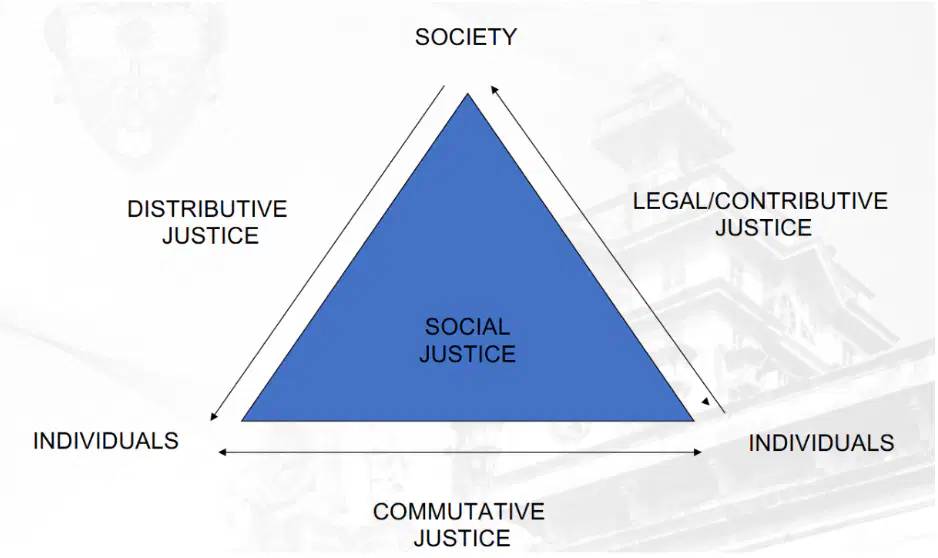
Which type of justice directs the relationship of the social whole or society to the individual according to proportionate equality?
Distributive Justice
Commutative Justice
Legal Justice
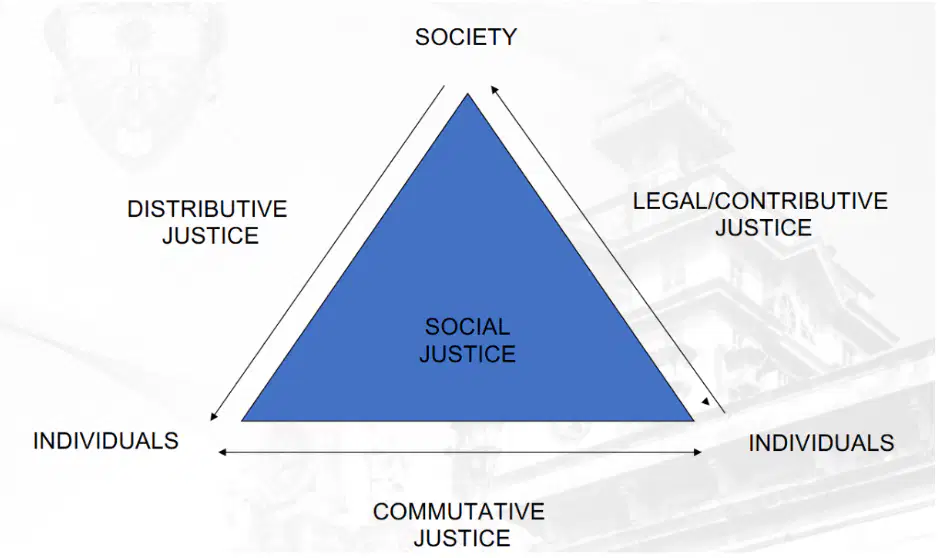
Which type of justice is regulated by private rights of contracts and demands that exchanges between persons must be of equal value?
Distributive Justice
Commutative Justice
Legal Justice
Legal justice is established by laws through which leaders direct citizens towards the achievement of _________?
common good
personal wealth
political power
individual fame
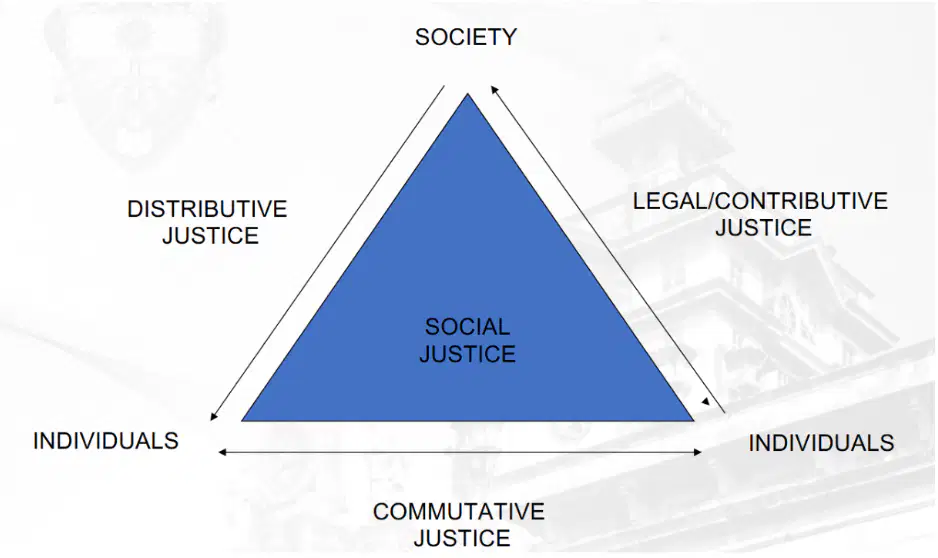
In the context of social justice, which type of justice involves the individual person to society and is carried out by citizens in obedience to just laws enforced by civil authorities?
Distributive Justice
Commutative Justice
Legal Justice
According to the Oxford Dictionary of Sociology, what are social problems caused by? Fill in the blank: Social problems are aberrant conditions/behaviors caused by ________.
social disorganization
technological advancement
natural disasters
individual intelligence
According to the Oxford Dictionary of Sociology, what is a present threat related to social problems? Fill in the blank: Present threats include an extraordinary increase of ________ to life.
dangers
opportunities
pleasures
benefits
Which of the following is NOT listed as a threat to life?
Abortion
Euthanasia
Recycling
Genocide
Threats to life include actions that violate human integrity. Which of the following are examples?
Mutilation
Torture
Both A and B
None of the above
List two examples of actions that insult human dignity according to the worksheet.
Subhuman living conditions, slavery, imprisonment, trafficking, unjust labor (any two)
Wearing traditional clothes, celebrating festivals, reading books, playing sports (any two)
Donating to charity, helping neighbors, planting trees, recycling (any two)
Attending school, eating healthy food, exercising, making friends (any two)
What is the irony mentioned in the section 'Threats to Life'? Fill in the blank: Progress in science/technology vs ________ in moral life.
regress
success
growth
improvement
What is the social mission of the Church according to the worksheet? Fill in the blank: The social mission of the Church is 'to denounce ________, to proclaim ________.'
injustice, justice
justice, injustice
violence, peace
sin, forgiveness
Which of the following is NOT an aim of the social mission of the Church?
Save man in totality
Form people's consciences
Provide values/principles for humane society
Promote social disorganization
What does religious pluralism demand according to the worksheet? Fill in the blank: Religious pluralism demands tolerance and fidelity to proclaim ________ kingdom.
God's
man's
earthly
royal
The Philippine Church promotes constructive critical collaboration with the ________.
government
media
business sector
educational institutions
Fill in the blank: The Philippine Church works for cultural change and ________ renewal.
moral
economic
technological
political
Which of the following is NOT one of the CBCP's 5 Areas of Conversion?
Common good above self-interest
Honesty and integrity in public service
Accumulation of wealth
Value of human work
Fill in the blank: One of the CBCP's 5 Areas of Conversion is commitment to the ________ above self-interest.
common good
personal gain
material wealth
individual rights
Fill in the blank: One of the CBCP's 5 Areas of Conversion is honesty and ________ in public service.
integrity
loyalty
popularity
wealth
Fill in the blank: CBCP's 5 Areas of Conversion include an understanding of the destination of the goods of the earth for all, and of the social dimension of the right to ________.
property
education
health
expression
Fill in the blank: CBCP's 5 Areas of Conversion include conversion from ________ mentality.
consumerism
materialism
individualism
secularism
Fill in the blank: CBCP's 5 Areas of Conversion include the value of ________ work.
human
spiritual
mechanical
temporary
Fill in the blank: The vision of the Philippine Church is a Filipino society that is pro-person, pro-country, and pro-God (Maka-tao, Maka-bayan, ________).
Maka-Diyos
Maka-kalikasan
Maka-sarili
Maka-negosyo
Which of the following is NOT listed as a principle of the Social Mission of the Church?
Principles Of Action
Guides To Social Responsibilities
Primary Solutions
Moral Principles And Priorities
Catholic Social Teaching is considered the Church's best-kept secret.
True
False
What is a key to Catholic Identity according to the document?
Catholic Social Teaching
Modern Art Appreciation
Economic Theory
Political Campaigning
Our faith is profoundly ________.
social
individualistic
materialistic
temporary
According to the central message, we cannot be called truly 'Catholic' unless we hear and heed the Church's call to serve those in need and work for justice and peace.
True
False
The Social Teaching of the Church is at the core of ________.
Christianity
Economics
Science
Politics
Who is described as an active agent in the renewal of society in the Social Teaching of the Church?
Jesus
Moses
Abraham
Peter
The proclamation of the Kingdom of God, according to the Social Teaching of the Church, means:
A call for the community to live in justice, peace, and solidarity.
The establishment of a political regime.
The rejection of all social structures.
A focus only on individual salvation.
Which of the following is NOT emphasized in the Nature of the Social Teaching of the Church?
Emphasis on the Human Person as Imago Dei
Promotion of Justice according to God's Plan
Denial of Humanity and Interconnectedness
Celebrates Humanity and our Interconnectedness

