wayground logo

Free Printable Worksheets

Font size

S
M
L
XL
Worksheets

Bilingual: Unit 3 Review - The US Constitution

Total questions: 34

Worksheet time: 1hrs 17mins
Name
Class
Date
1.
Implied Powers - Poderes implícitos
a)
Powers that are given to the states (10th amendment) - Poderes que se otorgan a los estados (décima enmienda)
b)
Powers shared by the federal and state governments. - Poderes compartidos por los gobiernos federal y estatal.
c)
Powers not explicitly stated but are understood - Poderes que se otorgan a los estados (décima enmienda)
2.
Expressed Powers - Poderes expresados
a)
Powers written in the Constitution - Poderes escritos en la Constitución
b)
Powers that the government gets because it is a sovereign nation - Poderes que obtiene el gobierno por ser una nación soberana
c)
Powers not explicitly stated but are understood - Poderes que se otorgan a los estados (décima enmienda)
3.
Inherent Powers - Poderes inherentes
a)
Powers that the government gets because it is a sovereign nation - Poderes que obtiene el gobierno por ser una nación soberana
b)
Powers that are given to the states (10th amendment) - Poderes que se otorgan a los estados (décima enmienda)
c)
Powers not explicitly stated but are understood - Poderes que se otorgan a los estados (décima enmienda)
4.
Reserved Powers - Poderes reservados
a)
Powers that the government gets because it is a sovereign nation - Poderes que obtiene el gobierno por ser una nación soberana
b)
Powers that are given to the states (10th amendment) - Poderes que se otorgan a los estados (décima enmienda)
c)
Powers not explicitly stated but are understood - Poderes que se otorgan a los estados (décima enmienda)
5.
Concurrent Powers - Poderes concurrentes
a)
Powers written in the Constitution - Poderes escritos en la Constitución
b)
Powers shared by the federal and state governments. - Poderes compartidos por los gobiernos federal y estatal.
c)
Powers that only belong to the federal government. - Facultades que sólo pertenecen al gobierno federal.
6.
Exclusive Powers - Poderes exclusivos
a)
Powers that the government gets because it is a sovereign nation - Poderes que obtiene el gobierno por ser una nación soberana
b)
Powers that are given to the states (10th amendment) - Poderes que se otorgan a los estados (décima enmienda)
c)
Powers that only belong to the federal government. - Facultades que sólo pertenecen al gobierno federal.
7.
Separation of Powers - Separación de poderes
a)
Controls that each branch of government has over the other branches. - Controles que cada poder del gobierno tiene sobre los demás poderes.
b)
The idea that the people have the power in a nation. - La idea de que el pueblo tiene el poder en una nación.
c)
The division of power between the three branches of government in the U.S. - La división del poder entre las tres ramas del gobierno en EE.UU.
8.
Popular Sovereignty - Soberanía popular
a)
Controls that each branch of government has over the other branches. - Controles que cada poder del gobierno tiene sobre los demás poderes.
b)
The idea that the people have the power in a nation. - La idea de que el pueblo tiene el poder en una nación.
c)
The division of power between the three branches of government in the U.S. - La división del poder entre las tres ramas del gobierno en EE.UU.
9.
Judicial Review - Revisión judicial
a)
The power of the Supreme Court to determine the constitutionality of laws and government actions - El poder de la Corte Suprema para determinar la constitucionalidad de leyes y acciones gubernamentales
b)
Controls that each branch of government has over the other branches. - Controles que cada poder del gobierno tiene sobre los demás poderes.
c)
The idea that the people have the power in a nation. - La idea de que el pueblo tiene el poder en una nación.
10.
Checks and Balances - Controles y equilibrios
a)
The power of the Supreme Court to determine the constitutionality of laws and government actions - El poder de la Corte Suprema para determinar la constitucionalidad de leyes y acciones gubernamentales
b)
Controls that each branch of government has over the other branches. - Controles que cada poder del gobierno tiene sobre los demás poderes.
c)
The idea that the people have the power in a nation. - La idea de que el pueblo tiene el poder en una nación.
11.
Federalism - Federalismo
a)
Controls that each branch of government has over the other branches. - Controles que cada poder del gobierno tiene sobre los demás poderes.
b)
The division of power between the federal and state governments. - La división del poder entre los gobiernos federal y estatal.
c)
The division of power between the three branches of government in the U.S. - La división del poder entre las tres ramas del gobierno en EE.UU.
12.
“We the People” is an example of… - “Nosotros el Pueblo” es un ejemplo de…
a)
the rule of law - el estado de derecho
b)
popular sovereignty - soberanía popular
c)
the separation of power - la separación del poder
13.
Which of the following best describes the concept of limited government? - ¿Cuál de las siguientes opciones describe mejor el concepto de gobierno limitado?
a)
Government must operate within certain bounds set by the people. - El gobierno debe operar dentro de ciertos límites establecidos por el pueblo.
b)
Powers are divided among three independent branches of government. - Los poderes se dividen entre tres poderes independientes del gobierno.
c)
The people must behave according to rules set by the government. - El pueblo debe comportarse según las reglas establecidas por el gobierno.
14.
Why has the Constitution been able to adapt to the situations for the past 200 years? - ¿Por qué la Constitución ha podido adaptarse a las situaciones de los últimos 200 años?
a)
Strict rules designed to resist changes in the government structure - Reglas estrictas diseñadas para resistir cambios en la estructura gubernamental.
b)
Very specific language that limits understanding - Lenguaje muy específico que limita la comprensión.
c)
Built-in rules for changing the written words or interpretation - Reglas integradas para cambiar las palabras escritas o la interpretación.
15.
Which of the following is NOT an example of the checks and balances system? - ¿Cuál de los siguientes NO es un ejemplo del sistema de controles y contrapesos?
a)
Congress overrides a presidential veto. - El Congreso anula un veto presidencial.
b)
The President signs an executive order - El presidente firma una orden ejecutiva
c)
The Senate approves the President's nominee for Supreme Court justice. - El Senado aprueba al candidato del Presidente para juez de la Corte Suprema.
16.
The informal amendment process - El proceso de enmienda informal
a)
Can result from changing traditions or customs - Puede resultar del cambio de tradiciones o costumbres.
b)
involves changing the written words of the Constitution implica cambiar las palabras escritas de la Constitución
c)
can occur only with the approval of the States - Sólo puede ocurrir con la aprobación de los Estados.
17.
Which of the following have the power to informally amend the Constitution? - ¿Cuál de los siguientes tiene el poder de modificar informalmente la Constitución?
a)
Congress - Congreso
b)
the Courts - los tribunales
c)
All of these - Todos estos
18.
Which of the following is NOT true of the Constitution? - ¿Cuál de las siguientes NO es cierta respecto de la Constitución?
a)
It has not changed in 150 years. - No ha cambiado en 150 años.
b)
It sets guidelines within which the government must operate. - Establece directrices dentro de las cuales debe operar el gobierno.
c)
It is the highest form of law in the United States. - Es la forma más alta de ley en los Estados Unidos
19.
What is an example of an expressed power in the Constitution? - ¿Cuál es un ejemplo de un poder expresado en la Constitución?
a)
Creating laws - Creando leyes
b)
Declaring war - Declarando la guerra
c)
Having a judicial system - Tener un sistema judicial
20.
Henry commits a crime in Florida but then flees to Pennsylvania. Pennsylvania agrees to send him back to Florida due to which interstate relation clause? - Henry comete un delito en Florida pero luego huye a Pensilvania. ¿Pensilvania acepta enviarlo de regreso a Florida debido a qué cláusula de relación interestatal?
a)
the Full Faith and Credit Clause - la cláusula de plena fe y crédito
b)
Extradition - Extradición
c)
the Privileges and Immunities Clause - la Cláusula de Privilegios e Inmunidades
21.
The necessary and proper clause allows congress to… - La cláusula necesaria y adecuada permite al Congreso…
a)
Pass whatever laws needed to fulfill their duties - Aprobar todas las leyes necesarias para cumplir con sus deberes.
b)
Pass any law that restrict the rights of citizens - Aprobar cualquier ley que restrinja los derechos de los ciudadanos.
c)
Create additional branches of government as they see fit - Crear ramas de gobierno adicionales como mejor les parezca.
22.
Which clause requires that Nebraska accept an Illinois driver’s license? - ¿Qué cláusula requiere que Nebraska acepte una licencia de conducir de Illinois?
a)
supremacy clause - cláusula de supremacía
b)
full faith and credit clause - cláusula plena de fe y crédito
c)
necessary and proper clause - cláusula necesaria y adecuada
23.
According to the Supremacy Clause, what is the "supreme law of the land?" - Según la Cláusula de Supremacía, ¿cuál es la "ley suprema del país"?
a)
state laws - leyes estatales
b)
local laws - leyes locales
c)
the Constitution - la Constitución
24.
Funds given to a state by the national government with special conditions attached are examples of - Los fondos otorgados a un estado por el gobierno nacional con condiciones especiales son ejemplos de
a)
block grants -subvenciones en bloque
b)
revenue sharing - reparto de ingresos
c)
categorical grants -subvenciones categóricas
25.
What is an amendment that was added to the constitution? - ¿Qué es una enmienda que se agregó a la constitución?
a)
Presidential term limits -Límites del mandato presidencial
b)
Reproductive rights - Derechos reproductivos
c)
Mandated religion - Religión obligatoria
26.
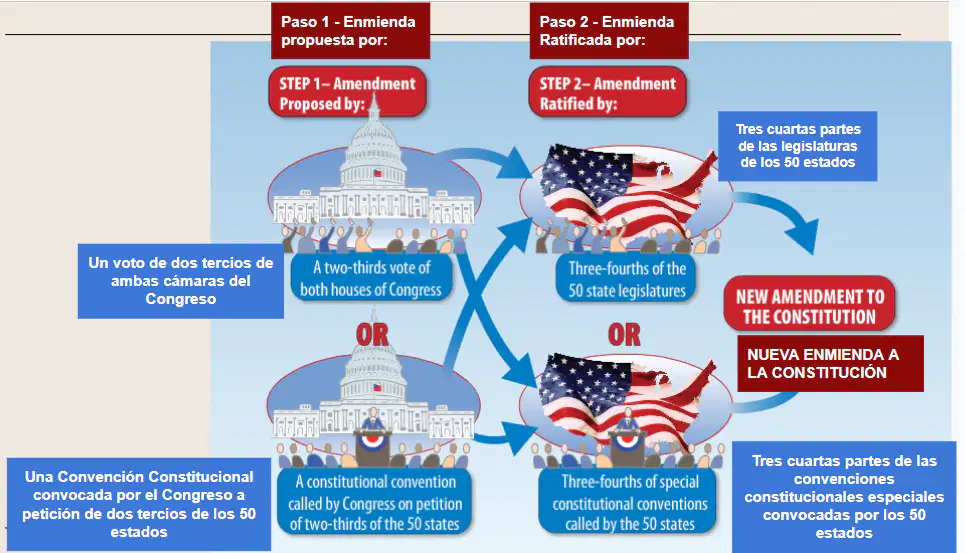
How many votes are needed in both houses of congress to PROPOSE an amendment? - ¿Cuántos votos se necesitan en ambas cámaras del congreso para PROPONER una enmienda?
a)
3/4ths
b)
2/3rds
c)
Unanimous - Unánime
27.
How many states need to adopt the amendment before it is RATIFIED? - ¿Cuántos estados necesitan adoptar la enmienda antes de que sea RATIFICADA?
a)
2/3rds
b)
3/4th
c)
Unanimous - Unánime
28.
What is the most used process to ratify amendments? - ¿Cuál es el proceso más utilizado para ratificar enmiendas?
a)
Proposed in congress, adopted by states - Propuesto en el Congreso, adoptado por los estados.
b)
Proposed by national convention, adopted by states - Propuesto por convención nacional, adoptado por los estados.
c)
Proposed by national convention, passage of 3/4ths special state conventions - Propuesto por convención nacional, aprobación de 3/4 de convenciones estatales especiales
29.
Which is an example of federalism? - ¿Cuál es un ejemplo de federalismo?
a)
States and congress must work together to accept an amendment - Los estados y el congreso deben trabajar juntos para aceptar una enmienda
b)
Congress can force states to accept an amendment - El Congreso puede obligar a los estados a aceptar una enmienda
c)
The people can create their own amendment - El pueblo puede crear su propia enmienda.
d)
The national government is not involved, it’s only up to the states - El gobierno nacional no interviene, solo corresponde a los estados
30.
How can the executive branch check the power of the judicial branch? - ¿Cómo puede el poder ejecutivo controlar el poder del poder judicial?
a)

The executive branch can dissolve the Supreme Court. - El poder ejecutivo puede disolver la Corte Suprema.

b)

The executive branch can veto judicial decisions. El poder ejecutivo puede vetar decisiones judiciales.

c)

The executive branch checks the judicial branch by appointing judges and granting pardons. - El poder ejecutivo controla al poder judicial nombrando jueces y concediendo indultos.

d)

The executive branch can create new laws to override court rulings. - El poder ejecutivo puede crear nuevas leyes para anular los fallos judiciales.

31.
How can the judicial branch check the power of the legislative branch? - ¿Cómo puede el poder judicial controlar el poder del poder legislativo?
a)

The judicial branch checks the legislative branch by declaring laws unconstitutional. - El poder judicial controla al poder legislativo declarando inconstitucionales las leyes.

b)

The judicial branch can create new laws. - El poder judicial puede crear nuevas leyes.

c)

The judicial branch can influence elections. - El poder judicial puede influir en las elecciones.

d)

The judicial branch can veto legislation. -El poder judicial puede vetar la legislación.

32.
How can the legislative branch check the power of the executive branch? - ¿Cómo puede el poder legislativo controlar el poder del poder ejecutivo?
a)

The legislative branch can veto executive orders directly. - El poder legislativo puede vetar órdenes ejecutivas directamente.

b)

The legislative branch can declare war without the president's approval. - El poder legislativo puede declarar la guerra sin la aprobación del presidente.

c)

The legislative branch can appoint judges to the Supreme Court. - El poder legislativo puede nombrar jueces para la Corte Suprema.

d)

The legislative branch can control the executive branch by approving appointments and impeaching the president. - El poder legislativo puede controlar al poder ejecutivo aprobando nombramientos y destituyendo al presidente.

33.

READ THE PREAMBLE TO STUDY:

We the People of the United States, in Order to form a more perfect Union, establish Justice, insure domestic Tranquility, provide for the common defence, promote the general Welfare, and secure the Blessings of Liberty to ourselves and our Posterity, do ordain and establish this Constitution for the United States of America.

LEA EL PREÁMBULO PARA ESTUDIAR:

Nosotros, el pueblo de los Estados Unidos, con el fin de formar una Unión más perfecta, establecer la justicia, asegurar la tranquilidad interna, proveer a la defensa común, promover el bienestar general y asegurar los beneficios de la libertad para nosotros y nuestra posteridad, ordenamos y establecemos esta Constitución para los Estados Unidos de América.

a)

I've got it!! - ¡¡¡Lo tengo!!!

b)

I need to study more.. - Necesito estudiar más..

34.

This is your long form answer! Study so you know! - ¡Esta es tu respuesta larga! ¡Estudia para que la sepas!

Explain how the Supremacy Clause relates to Federalism. *What are two types of laws? *What powers do STATE laws have? *What powers do FEDERAL laws have? *How would the Supremacy Clause resolve a dispute between the state and federal governments? *Explain how the Supremacy Clause relates to Federalism.

Explica cómo la Cláusula de Supremacía se relaciona con el Federalismo. *Cuáles son dos tipos de leyes *¿Qué poderes tienen las leyes ESTATALES *¿Qué poderes tienen las leyes FEDERALES? *¿Cómo resolvería la Cláusula de Supremacía una disputa entre el gobierno estatal y el federal? *Explica cómo la Cláusula de Supremacía se relaciona con el Federalismo.

a)

I've got it! - ¡Lo tengo!

b)

I need to study more.. Necesito estudiar más..