wayground logo

Free Printable Worksheets

Font size

S
M
L
XL
Worksheets

Structure of Matter Review

Total questions: 45

Worksheet time: 42mins
Name
Class
Date
1.
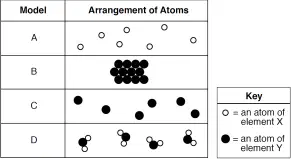
Base your answer to the following question on the four models below that represent the arrangement of atoms in four samples of matter. Which model best represents the arrangement of atoms in a molecule?
a)
A
b)
B
c)
C
d)
D
2.
When two or more elements unite chemically, they form a
a)
molecule
b)
mixture
c)
metalloid
d)
solution
3.
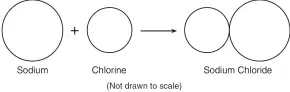
The diagram below represents a sodium atom bonding to a chlorine atom to form sodium chloride. Which statement is supported by this diagram?
a)
Sodium chloride is an element.
b)
Sodium chloride is a mixture.
c)
Sodium chloride is a molecule.
d)
Sodium chloride is composed of only one atom.
4.
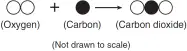
The diagram below represents two atoms in a molecule of oxygen that combine chemically with one atom of carbon to form a carbon dioxide molecule. Carbon dioxide is an example of
a)
a mixture
b)
an element
c)
a solution
d)
a compound
5.
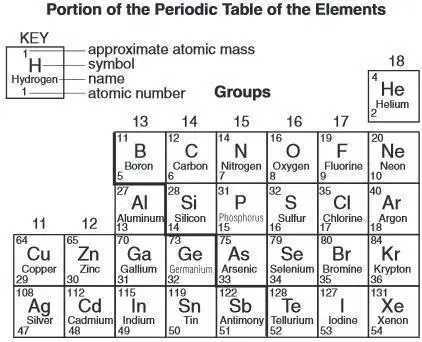
Base your answer to the following question on the portion of the Periodic Table of the Elements shown below and on your knowledge of science. Water (H2O) is not found on the Periodic Table of the Elements because water is
a)
an atom
b)
a liquid
c)
a mixture
d)
a compound
6.
The basic particle of an element. They contain a nucleus with protons and neutrons, and are surrounded by a cloud of electrons
a)
Atom
b)
Protons
c)
Neutrons
d)
Electrons
7.
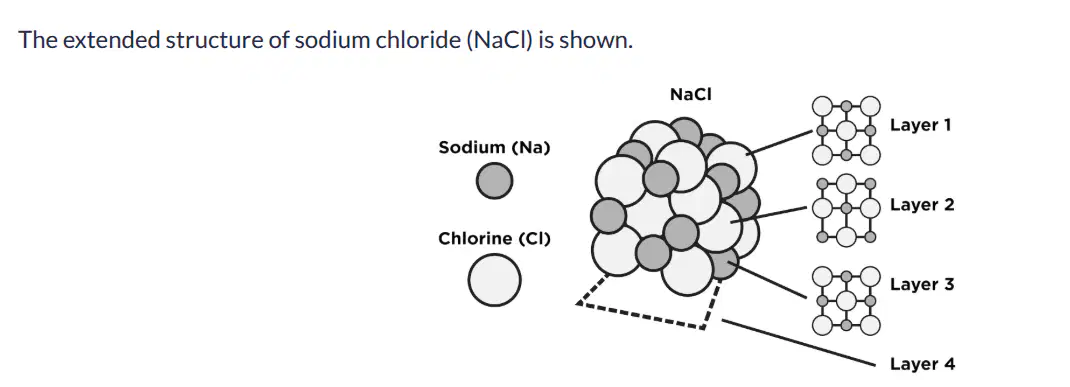
Which of the following describes the configuration of Layer 4 of the sodium chloride crystal?
a)
It will be identical in all of its characteristics to Layer 1.
b)
It will contain 4 atoms of chlorine and 5 atoms of sodium.
c)
It will have chlorine atoms in all four of its corners.
d)
It will have sodium that are bonded only to other sodium atoms.
8.
Which of the following is true about how hydrogen and oxygen can combine to form molecules?
a)
Hydrogen and oxygen can combine in many ways to form different molecules.
b)
Two atoms of hydrogen are always required to bond with two atoms of oxygen.
c)
When oxygen combines with hydrogen to make a molecule, water will always be produced.
d)
Molecules composed of hydrogen and oxygen must have at least four atoms.
9.
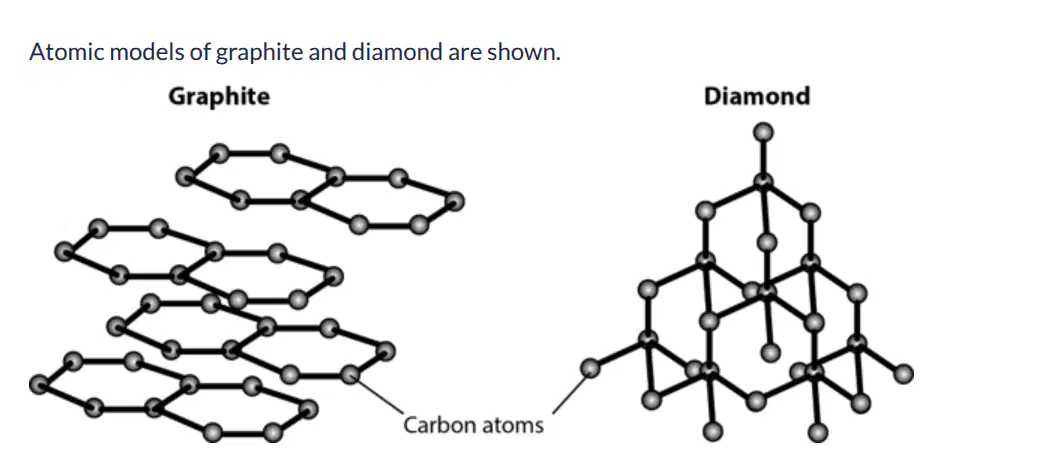
Graphite is a soft, dark material often used as a lubricant. Diamond is often a clear, hard crystal. Which of the following best explains the difference in these materials?
a)
The arrangement of the atoms of each one.
b)
The elements of which each one is made.
c)
The number of atoms each one is made of.
d)
The size and shape of the individual atoms.
10.
Consists of only one kind or type of atom
a)
Element
b)
Molecule
c)
Compound
d)
Mixture
11.
An organized table of elements that are arranged by increasing atomic number
a)
Atomic Number
b)
Periodic Table
c)
Nucleus
d)
Elements
12.
The small, dense region in the center of an atom that contains protons and neutrons
a)
Atomic Mass
b)
Atomic Number
c)
Nucleus
d)
Nucleolus
13.
A subatomic particle found inside the nucleus of an atom, that has a neutral charge (neither positive nor negative) and has slightly more mass than protons
a)
Neutrons
b)
Electrons
c)
Protons
d)
Atom
14.
The mass of an atom of a chemical element, that is approximately equivalent to the number of protons and neutrons in the atom
a)
Atomic Number
b)
Periodic Table
c)
Nucleus
d)
Atomic Mass
15.
A negatively charged subatomic particle that is found in the outer cloud of the atom
a)
Neutrons
b)
Electrons
c)
Protons
d)
Atom
16.
The number of protons in the nucleus of an atom, which determines the chemical properties of an element. It is then organized on a Period Table by this number.
a)
Atomic Number
b)
Periodic Table
c)
Nucleus
d)
Atomic Mass
17.
A subatomic particle found inside the nucleus of an atom, that has a positive charge
a)
Neutrons
b)
Electrons
c)
Protons
d)
Atom
18.
Particles that are found within the atom (that are also smaller than the atom), such as protons, neutrons, and electrons
a)
Subatomic Particles
b)
Compound
c)
Homogeneous Mixture
d)
Heterogeneous Mixture
19.
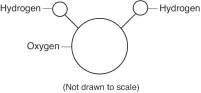
Base your answer to the following question on the model of a water molecule below and on your knowledge of science. Hydrogen and oxygen are classified as
a)
minerals
b)
elements
c)
organisms
d)
energy
20.
Which statement concerning elements is true?
a)
Different elements must have different numbers of isotopes.
b)
Different elements must have different numbers of neutrons.
c)
All atoms of an element must have the same mass.
d)
All atoms of a given element must have the same number of protons.
21.
All matter is made up of
a)
cells
b)
atoms
c)
molecules
d)
compounds
22.

Which of the following best describes a molecule?

a)

A substance made of only one type of atom

b)

A group of atoms bonded together

c)

A mixture of different elements

d)

A subatomic particle with a positive charge

23.

What is the basic building block of matter (made of protons, electrons, and neutrons)?

a)

Matter

b)

Molecule

c)

Atom

d)

Crystal

24.

What is the smallest unit of a compound?

a)

Matter

b)

Molecule

c)

Atom

d)

Crystal

25.

Solid material whose atoms are arranged in an ordered pattern

a)

Matter

b)

Molecule

c)

Crystal

d)

Substance

26.

Anything with both volume and mass

a)

Matter

b)

Molecule

c)

Atom

d)

Crystal

27.

Matter with consistent properties throughout

a)

Matter

b)

Molecule

c)

Crystal

d)

Substance

28.

Atoms can be combined to form [BLANK] of various substances

a)

Molecules

b)

Substances

c)

Solids

d)

Electrons

29.

What can be combined to form molecules?

a)

Electrons

b)

Neutrons

c)

Atoms

d)

Substances

30.

In crystals, atoms are arranged in an ordered [BLANK]

a)

Molecule

b)

Matter

c)

Compound

d)

Pattern

31.

What has atoms arranged in an ordered pattern?

a)

Protons

b)

Crystals

c)

Solids

d)

Matter

32.

Anything that takes up space is called WHAT?

a)

Atoms

b)

Crystals

c)

Solids

d)

Matter

33.

What is matter?

a)

Atoms

b)

Anything that takes up space

c)

Atoms that are combined

d)

Definite volume and shape

34.

Which has a definite volume and shape?

a)

Gas

b)

Liquid

c)

Solid

35.

How are elements different from atoms?

a)

Elements are made out of atoms

b)

Atoms are made out of elements

c)

Elements are made out of molecules

d)

Molecules are made out of atoms.

36.

A model of a single atom is shown.

The model represents and atom of a certain element. Which is the atomic number of that element?

a)

5

b)

6

c)

11

d)

16

37.

Which of the following best describes a compound?

a)

A pure substance made of only one kind of atom

b)

A mixture of different elements

c)

A substance made of two or more different elements chemically combined

d)

A group of molecules

38.

What is a crystal?

a)

A pure material that can’t be changed.

b)

Material with a regular,repeating arrangement of atoms.

c)

A foggy like material.

39.

This is an example of a 

a)

Polymer

b)

Crystal

c)

Box

d)

Atom

40.

How many elements are in C2H8O ?

a)
2
b)
1
c)
3
d)
0
41.

How many Nitrogen atoms are in the in H3C2ON5?

a)

2

b)

3

c)

4

d)

5

42.

What does the subscript in a chemical formula tell you?

a)

How many molecules are present

b)

How many atoms are present

c)

How many elements are present

d)

How many neutrons are present

43.

Select the subscript

44.

Pure Substances: matter that is always made up of the same combination of atoms.

Elements and compounds can both be considered pure substances.

a)

True

b)

False

45.

Which of these is a compound?

a)

Aluminium (Al)

b)

Carbon Dioxide (CO2)

c)

Nitrogen (N)

d)

Sand