
 Worksheets
Force & Motion 5th NC
Total questions: 45
Worksheet time: 40mins

If a car travels 140 km in 2 hours, what is the speed of the car?
60 km per hour
280 km per hour
70 km per hour
140 km per hour
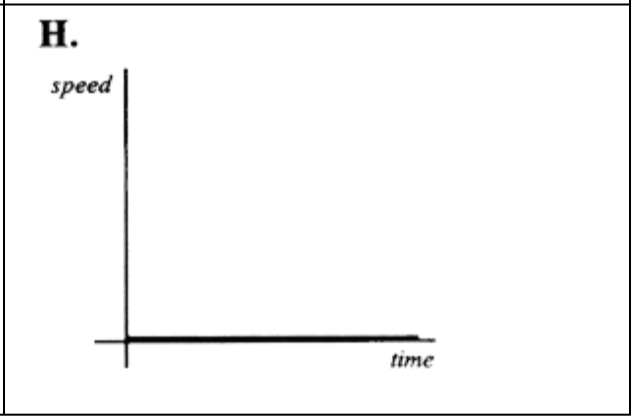
Match the description to the graph:
"The car is stopped."


Match the description to the graph:
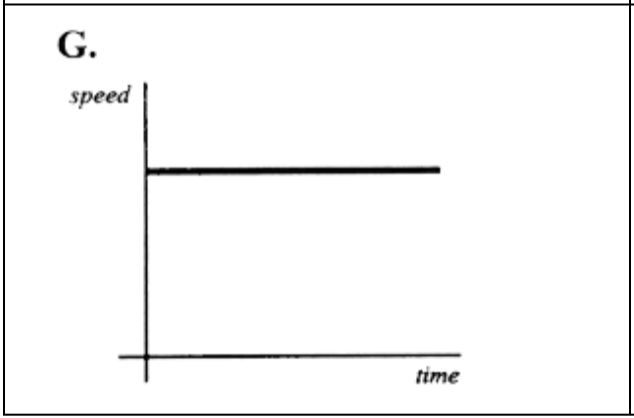
"The car is traveling at a constant speed."
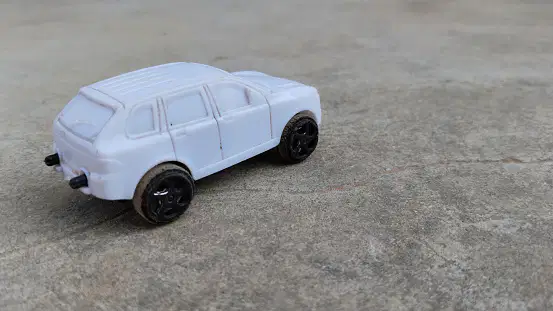
Sam pushed a toy car across the concrete floor.
The car traveled quickly until it reached the carpet,
where it slowed down and eventually stopped.
What happened to the car?
the car's mass increased
the car's mass decreased
the force of friction on the car increased
the force of friction on the car decreased
Match the description to the graph:
"The car is coming back."

Segment A-B The bus is _________________.
at rest
returning (to original position)
moving forward


A snail can travel 50 yards in an hour. How far will the snail travel in 4 hours?
50yds
12.5yds
200yds
Maria walked slowly to college along the road, she stopped to look at her watch, she realized she was going to be late for science lab, and she began running.


Mateo walked to the local store, stopped and bought a newspaper from outside the store, and then ran home.


Match the graph to the description:
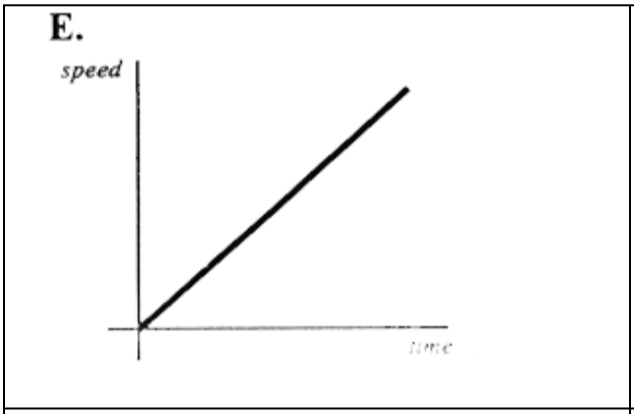
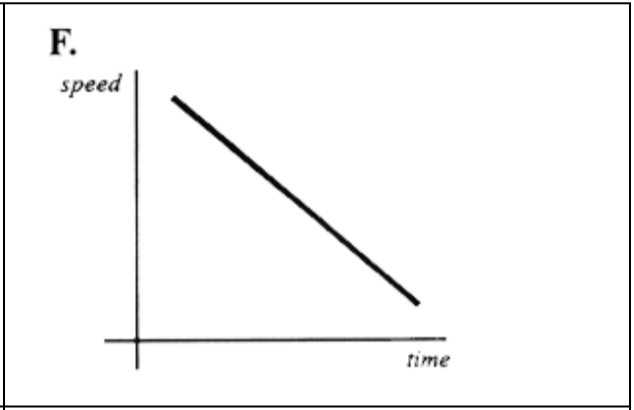
"The car is accelerating."
A turtle crawls at a pace of 2 m/hr. How far does it move after 4 hours?
8
8 m
2 m
0.5 m

Which of the following best describes "position"?
the direction an object is moving
the location of an object compared to a reference point
the distance an object travels over time
the speed of an object
If an object starts at rest and moves 20 meters in the first 4 seconds, what is its average speed?
5 meters per second
10 meters per second
4 meters per second
20 meters per second
Which of these affects the motion of an object?
the position of nearby objects
the force acting on an object
the object's length
the age of the object
Which of these is a force?
a spring scale
an object's mass
a push upwards
an object's matter

What is gravity?
the amount of matter that makes up an object
a measure of how far an object moves in a certain amounts of time
a force that pulls things toward each other
a force that pushes things away from each other

Which statement BEST describes friction?
Friction is a force that pulls objects toward Earth
Friction is a force that resists motion between surfaces
Friction is a force that causes objects to move faster
Friction is a force that pulls surfaces away from each other
What causes an object to fall to the ground?
air resistance
time
friction
gravity
Which tool can be used to measure the distance an object moved?
meterstick
spring scale
watch
compass
What effect does friction tend to have on an object's motion?
it slows an object's motion
it has no effect on an object's motion
it makes an object start moving
it makes an object move faster
If an object is not moving, what can a force do to it?
increase its mass
decrease its mass
make it start moving
make it stay in place
What is speed?
how much an object's position changes
how far an object moves
how long an object moves
how far an object moves in a certain amount of time

Two cars are in motion for the same amount of time. What will determin which car covers more distance?
the starting position of each car
the speed of each car
the direction in which each car moves
the length of each car

Wind pushes a toy sailboat across a pond. The boat moves in a straight path. What is changing?
the boat's direction
the boat's path
the wind's direction
the boat's position

The position of a runner in a race changes as time passes. What could be a reference point to describe the change in position?
the starting line
the runner's speed
the runner's right foot
another runner

A student uses a bat to hit a softball with a certain force. Then she hits a heavier ball with the same force. How does the heavier ball move comparted with the lighter softball?
faster & farther
faster & not as far
more slowly & farther
more slowly & not as far

A student pulls four classroom objects with the same amount of force. On which object's motion will the pull have the greatest effect?
desk
chair
pencil
textbook
How does the distance between objects affect the force of gravity between them?
the greater the distance, the greater the force of gravity
the smaller the distance, the greater the force of gravity
the smaller the distance, the smaller the force of gravity
distance has no effect on the force of gravity

How does air resistance affect the motion of a falling object?
it reduces the object's speed
it increases the object's speed
it reverses the objects direction
it has no effect on the object's motion

Your friend kicks a rolling ball with a certain force. Then you kick the same ball with a larger force. What will most likely happen?
the ball will move faster and farther when your friend kicks it
the ball will move faster and farther when you kick it
the ball will move more slowly and farther when you kick it
the ball will move faster and not as far when your friend kicks it
A scientist drops two objects from the same height. One object is a metal ball, and the other is a plastic ball. Both objects are the same size but have different weights. The scientist observes that both balls hit the ground at the same time. What force is responsible for this result, and why does it happen?
Gravity pulls on both objects equally, regardless of their weight
Friction slows down the lighter object
Air resistance pushes both objects downward
Magnetism attracts the heavier ball to the ground faster

Why do parachutes slow down a skydiver?
Gravity stops working
Friction between the air and the parachute slows their fall
The parachute makes them heavier
The parachute increases their speed

A ball is thrown in the air. As it rises, it slows down until it stops and then begins to fall back to the ground. Which two forces are working together to change the ball's motion, and how do they work?
Friction slows the ball, and air resistance pushes it higher
Gravity pulls the ball back down, and air resistance slows its motion upward
Magnetism pulls the ball upward, and gravity slows it down until it hits the ground and stops
Friction and gravity work together to push the ball higher

If you roll a ball on the grass and on a smooth floor, what happens?
The ball will roll faster on the grass
The ball will roll the same distance on both surfaces
The ball will stop immediately on the grass
The ball will roll farther on the smooth floor
Which of these shows the effects of gravity?
A kite floating in the sky
A ball rolling down a hill
A car slowing down on a flat surface
A magnet attracting a nail
What happens if you roll a ball on a perfectly smooth and flat surface with no friction?
the ball would roll forever
the ball would stop quickly
the ball would bounce
the ball would roll slower and slower

A car travels 60 miles in 2 hours. What is the car's speed?
30 miles per hour
60 miles per hour
120 miles per hour
20 miles per hour

A train travels 100 kilometers in 2 hours. If it continues at the same speed, how far will it travel in 5 hours?
200 kilometers
250 kilometers
500 kilometers
400 kilometers
Which force makes it harder to push a heavy box across a carpet?
Gravity
Magnetism
Friction
Air Resistance

A toy car is placed at the top of a ramp and allowed to roll down. The ramp is covered with different materials: smooth plastic, rough sandpaper, and soft carpet. After testing, the car rolls farthest on the smooth plastic. Why does the car roll farther on the smooth plastic?
the smooth plastic has less friction to slow down the car
the ramp is steeper when covered with plastic
the smooth plastic increases the car's weight
the rough materials make the car lighter
A boy rolls a ball across two different flat surfaces with the same amount of force.
The list below describes the motion of the ball on each surface.
Surface 1: The ball rolled one meter in three seconds.
Surface 2: The ball rolled two meters in three seconds.
What could have caused the ball to go farther in the same amount of time on Surface 2?
Surface 1 had less mass than Surface 2.
Surface 1 had more mass than Surface 2.
The ball experienced more friction while rolling on Surface 2.
The ball experienced less friction while rolling on Surface 2.

