
 Worksheets
AI_Session_1
Total questions: 53
Worksheet time: 27mins
What is Artificial Intelligence (AI)?
A branch of biology that studies living organisms
A branch of computer science that develops systems capable of performing tasks that normally require human intelligence
A type of mechanical engineering
A form of traditional agriculture
Fill in the blank: Artificial Intelligence (AI) uses ________, deep learning, natural language processing, robotics, and expert systems to simulate intelligent behavior.
machine learning
data mining
cloud computing
blockchain
Which of the following is NOT a scope of AI?
A) Automation
B) Data-Driven Insights
C) Personalization
D) Manual labor
Fill in the blank: AI in Food Processing & Quality Control includes ________ computer vision for detecting defects in grains, fruits, and vegetables.
AI-enabled
manual
traditional
basic
Which application of AI in Food Technology involves real-time monitoring of storage and transportation conditions?
Food Processing & Quality Control
Food Safety & Hygiene
Product Development
Supply Chain & Waste Management
Fill in the blank: AI for flavor prediction, ingredient substitution, and recipe optimization is an example of AI in ________.
Product Development
Marketing
Supply Chain Management
Customer Service
Which of the following is an application of AI in Supply Chain & Waste Management?
AI-based demand forecasting to reduce food waste
AI for flavor prediction
AI systems for contamination detection
AI-enabled computer vision for detecting defects
Fill in the blank: AI accelerates identification of drug candidates by predicting ________ interactions.
molecular
financial
social
thermal
Which of the following is a benefit of using AI in clinical trials?
Increases time and cost
Reduces time and cost
Has no effect on time and cost
Only increases accuracy
Which AI-powered algorithms are used for DNA sequencing, mutation detection, and gene editing in Genomics & Proteomics?
AI-powered algorithms for DNA sequencing, mutation detection, and gene editing.
AI-powered algorithms for protein folding and drug design.
AI-powered algorithms for image recognition in radiology.
AI-powered algorithms for speech recognition and natural language processing.
What is an example of a protein structure prediction tool mentioned in Genomics & Proteomics?
AlphaFold
BLAST
ClustalW
GATK
Which AI application is used for personalized medicine in Medical Biotechnology?
Personalized medicine through AI models that analyze patient genetic profiles.
AI-powered robotic surgery for organ transplantation.
Automated image analysis for plant disease detection.
AI-based weather prediction for agricultural planning.
What are two uses of AI in Agricultural Biotechnology?
AI models for crop improvement through genetic engineering; Pest/disease prediction using biosensors and AI forecasting.
AI for livestock breeding only; Manual soil testing.
AI for weather prediction only; Traditional irrigation methods.
AI for food packaging; Manual crop harvesting.
Which processes are optimized by AI in Industrial Biotechnology?
Bioprocess optimization (fermentation, enzyme production).
Text translation and language processing.
Weather forecasting and climate modeling.
Financial trading and stock market analysis.
Who is considered the father of modern computing and AI, as depicted in the conceptual illustration?
Alan Turing
Charles Babbage
John von Neumann
Ada Lovelace
What do the gears and circuits inside the head symbolize in the conceptual illustration of Alan Turing?
The mechanistic and logical operations of a machine, a nod to the Turing Machine.
The artistic creativity and emotional intelligence of Turing.
The biological processes of the human brain.
The historical context of World War II.
What do the binary codes (0s and 1s) typically illustrate in the context of AI and computing systems?
Digital logic, the building block of AI and computing systems.
The graphical user interface of computers.
The physical hardware components of a computer.
The networking protocols used in AI.
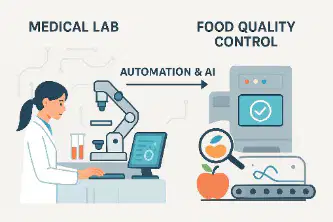
Based on the illustration and explanation, what does the left side of the dual-purpose laboratory setup represent?
Food Quality Control Machine
Medical Laboratory
Chemical Plant
Robotics Lab
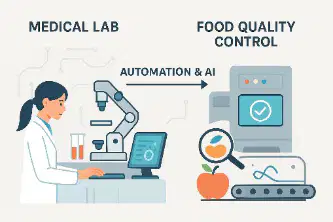
Which of the following is NOT a function of the food quality control machine as described in the explanation?
Testing food safety and nutritional quality
Detecting contaminants and chemical residues
Performing blood tests
Ensuring food safety standards
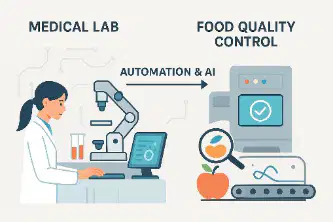
Fill in the blank: The key idea of the figure is that AI and automation technologies are applied in both _______ and food industries to improve accuracy, efficiency, and safety.
medical labs
retail stores
automobile factories
textile mills
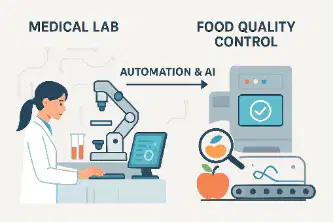
The right side of the dual-purpose laboratory setup highlights the role of AI in disease detection and biological research.
True
False
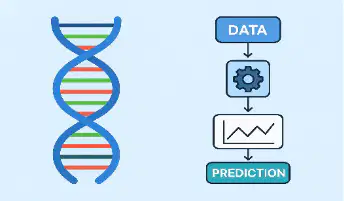
What does the DNA double helix + ML workflow figure represent in the context of the 2000s Machine Learning Boom?
Use of ML for protein folding, genetic analysis, and food supply optimization
Use of ML for robotics
Use of ML for weather prediction
Use of ML for chemical engineering
Which side of the illustration represents biological data and genetic information?
Left Side
Right Side
Both Sides
None of the above
Fill in the blank: The DNA double helix symbolizes how the structure of life (DNA sequences) provides inspiration for algorithms in ________, particularly in bioinformatics, genomics, and healthcare AI.
machine learning
astrophysics
civil engineering
linguistics
Which of the following is NOT a step in the Machine Learning Workflow as described in the illustration?
DNA Sequencing
Data Collection
Evaluation
Data Preprocessing
Model Training
ML models trained on DNA barcoding data can be used in food science to:
Identify species in food products for authentication and safety.
Increase the shelf life of food products.
Enhance the taste of food products using genetic modification.
Reduce the cost of food production by automating packaging.
Fill in the blank: DNA is a metaphor for '______' — much like genes carry information for life, datasets carry information for AI models.
data encoding
genetic mutation
protein synthesis
cell division
The illustration highlights the convergence of biology and AI by showing how machine learning deciphers biological complexity for applications in medicine, biotechnology, and food quality control.
True
False

What does 'Food Quality Inspection' mean in the context of machine learning in food technology?
ML models classify food items as ripe, unripe, fresh, or spoiled.
ML models are used to automate food packaging processes.
ML models predict the nutritional value of food items.
ML models generate recipes based on available ingredients.
What is 'Shelf-life Prediction' in machine learning for food technology?
ML models predict how long packaged food will remain fresh.
ML models estimate the nutritional value of food.
ML models identify food packaging materials.
ML models detect food allergens.
What does 'Recipe Recommendation' refer to in machine learning for food technology?
ML detects contamination by analyzing sensor data and lab results.
ML suggests personalized food recipes based on user preferences and dietary restrictions.
ML automates the cooking process using robotic chefs.
ML predicts food shelf life using chemical analysis.
What is 'Supply Chain Optimization' in the context of machine learning in food technology?
ML predicts food demand, reducing waste and improving logistics.
ML is used only for food packaging design.
ML replaces all human workers in food factories.
ML is used exclusively for marketing food products.
What does 'Food Safety' mean in machine learning for food technology?
ML detects contamination by analyzing sensor data and lab results.
ML is used to automate food packaging processes.
ML helps in designing new food flavors.
ML is only used for marketing food products.
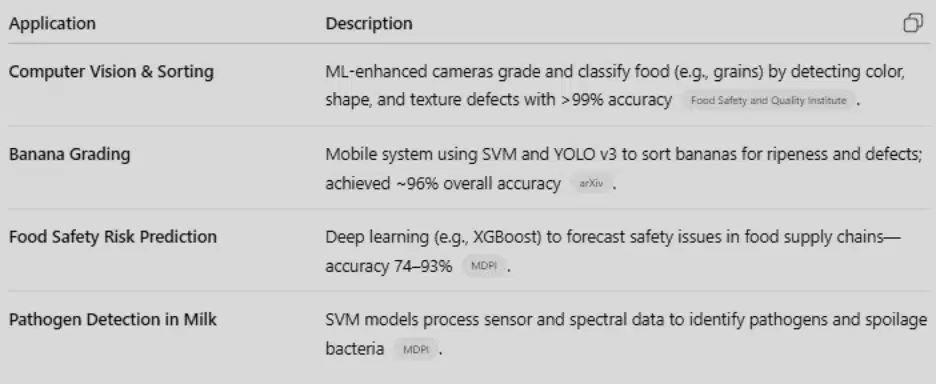
Which application uses ML-enhanced cameras to grade and classify food by detecting color, shape, and texture defects with >99% accuracy?
Computer Vision & Sorting
Banana Grading
Food Safety Risk Prediction
Pathogen Detection in Milk
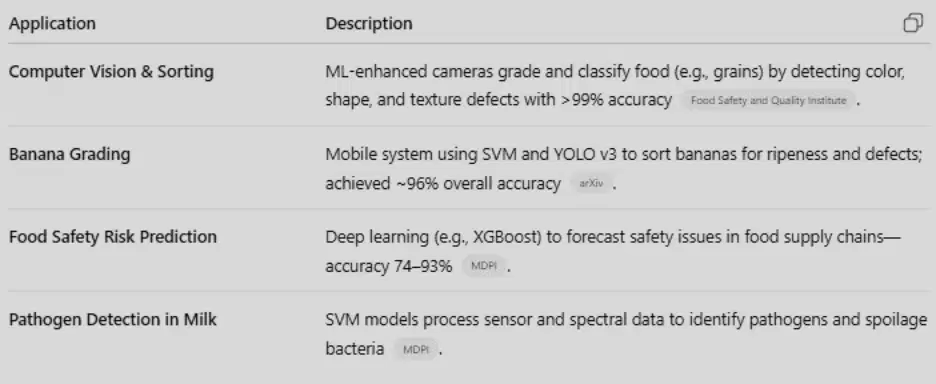
Which application uses a mobile system with SVM and YOLO v3 to sort bananas for ripeness and defects, achieving ~96% overall accuracy?
Computer Vision & Sorting
Banana Grading
Food Safety Risk Prediction
Pathogen Detection in Milk
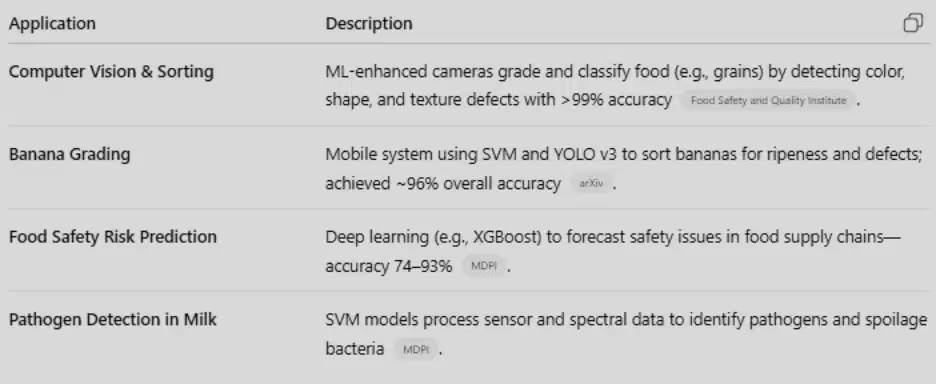
Which application uses deep learning (e.g., XGBoost) to forecast safety issues in food supply chains with accuracy 74–93%?
Computer Vision & Sorting
Banana Grading
Food Safety Risk Prediction
Pathogen Detection in Milk
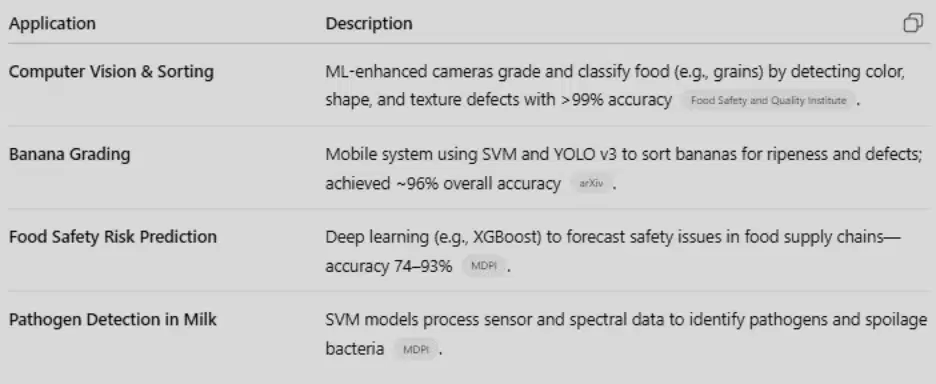
Which application uses SVM models to process sensor and spectral data to identify pathogens and spoilage bacteria?
Computer Vision & Sorting
Banana Grading
Food Safety Risk Prediction
Pathogen Detection in Milk
Fill in the blank: In the ML flow for food technology, ________, sensors, and environmental readings capture food-related data.
images
robots
chemicals
vehicles
Fill in the blank: Techniques such as ________ analysis or textural profiling convert raw inputs into measurable features in food technology.
spectral
thermal
chemical
visual
Fill in the blank: ML classifiers such as CNN, SVM, and ________ learn patterns of defects or contamination in food technology.
XGBoost
KNN
Naive Bayes
Random Forest
Fill in the blank: Models deployed for real-time detection and quality grading in food technology can reject spoiled produce or flag ________.
toxins
colors
shapes
sizes
Fill in the blank: The operational impact of ML in food technology includes enhancing efficiency, reducing waste, and strengthening ________.
food safety
marketing strategies
packaging design
customer loyalty
Fill in the blank: In the 2010s, deep learning in image recognition was applied to AI in medical imaging, microbial detection in food, and ________ agriculture.
precision
organic
sustainable
traditional
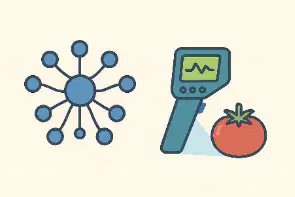
The illustration shows the application of machine learning in food technology as:
Predicting food quality and safety using data analysis.
Manual inspection of food products.
Traditional cooking methods without technology.
Use of artificial flavors in food production.
What is the process shown on the left side in the description of machine learning in food technology?
Scanning or capturing images of food items or crops using cameras or sensors
Output results such as quality grading
Processing scanned data using a neural network
Packaging food products
Fill in the blank: The center in the ML process represents a ________, which processes the scanned data and learns patterns from large datasets.
neural network (ML model)
database server
web browser
data entry operator
Which of the following is NOT an application example in food technology mentioned in the text?
Quality control in food processing
Shelf-life prediction
Food safety monitoring
Weather forecasting
Fill in the blank: Automated sorting systems in factories are an example of ________ in food technology.
application of machine learning
food preservation techniques
manual labor processes
traditional cooking methods
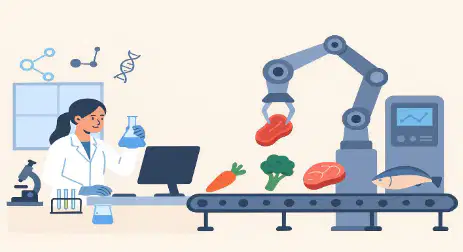
According to the illustration caption, what does the biotech lab integrate with?
Automated packaging system
Robotic food processing line
Food safety monitoring system
Neural network model
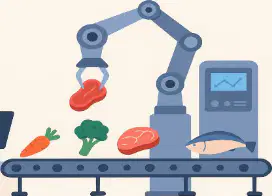
Fill in the blank: In the illustration, the right side shows a robotic food processing line with automated conveyor belts, robotic arms, and ________ preparing and packaging food products.
sensors
chefs
drivers
painters
Fill in the blank: Machine Learning (ML) is a branch of _______ Intelligence (AI) that enables computers to learn patterns from data and improve performance without being explicitly programmed.
Artificial
Natural
Mechanical
Human
Which type of Machine Learning learns from labeled data?
Supervised Learning
Unsupervised Learning
Reinforcement Learning
Which type of Machine Learning finds hidden structures in unlabeled data?
Supervised Learning
Unsupervised Learning
Reinforcement Learning

