wayground logo

Free Printable Worksheets

Font size

S
M
L
XL
Worksheets

Science

Total questions: 65

Worksheet time: 40mins

Name
Class
Date
1.

The heart is surrounded by this sac

a)

peritoneum

b)

pericardium

c)

meninges

d)

pleura

2.

Your heart is pounding, racing, and feels like it is skipping a beat. You are having:

a)

flutters

b)

Pronation

c)

palpation

d)

palpitations

3.

The patient has inflammation surrounding the heart. He/she has:

a)

postcarditis

b)

pericarditis

c)

precarditis

d)

hypercarditis

4.

Your patient has tachycardia. On an EKG, you would expect to see the lines (beats):

a)

irregularly spaced

b)

with uneven lines

c)

close together

d)

far apart

5.

The heart consists of:

a)

two atria and two ventricles

b)

two ventricles

c)

two atria and one ventricle

d)

two atria

6.

These are the smallest vessels in the body:

a)

veins

b)

arteries

c)

venules

d)

capillaries

7.

What large vein returns blood to the heart?

a)

aorta

b)

capillaries

c)

venules

d)

venae cavae

8.

Which terms means surgical removal of an artery?

a)

atherectomy

b)

arterectomy

c)

endarterectomy

d)

atherosclerectomy

9.
Kepler's first law states that the orbits of the planets are oval in shape or 
a)
ellipses
b)
perfect circles
10.
Kepler's 2nd Law deals with 
a)
the shape of the planets' orbits
b)
the speed/area the planet travels 
c)
the length of time it takes the planet to orbit the sun
11.
Planets orbit the Sun in a shape called a(n)
a)
circle
b)
ellipse
c)
focus
d)
perihelion
12.
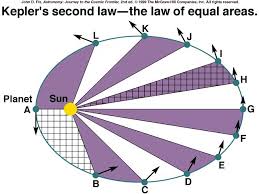
Where is the planet moving faster
a)
Position A to B
b)
Position B to C
c)
Position H to I
d)
Position I to J
13.
What is true about the area between points A, B and the Sun, and the area between points H, I and the Sun?
a)
The area between A, B and the Sun is the largest.
b)
The area between H, I and the Sun is the largest
c)
Both areas are equal in size
d)
There is not enough information to determine the areas
14.
According to Kepler's 3rd law, the square of the time it takes for an object to orbit, T, is directly related to the cube of the distance, r, between the object and what it is orbiting.            
a)
 T3 = k*r2
b)
T2 = k*r3
c)
T3 = k/r2
d)
T2 = k/r3
15.
According to Kepler's 3rd law, the square of the time it takes for an object to orbit, T, is directly related to the cube of the distance, r, between the object and what it is orbiting.    
What this means is that if a satellite moves away from what it is orbiting,
a)
the larger the constant k is.
b)
the smaller the constant k is.
c)
the longer the orbital period is.
d)
the shorter the orbital period is.
16.
The speed at which any planet moves through space is constantly changing. In a perfectly circular orbit, the orbital radius of the planet would be constant and therefore so would be its observed angular velocity. In elliptical orbits, the velocity varies. In elliptical orbits, the orbital radius of the satellite will vary and therefore so will its velocity. The planet travels "faster" when closer to the Sun, then "slower"  at a more distant radius.   According to Newton's 2nd Law, what is the underlying force behind this change in velocity?
a)
Friction
b)
Gravity
c)
Mass
d)
Projectile motion 
17.
Kepler’s 3rd law states the square of the orbital period is proportional to the cube of the orbital radius. (T2=r3)

If a planet's orbital radius is doubled, what happens to the length of a year on that planet?
a)
It will become twice as long
b)
It will become about 8 times as long
c)
It will become 2.8 times as long
d)
It will remain the same
18.
Kepler’s first law states that planets travel in a(n)  orbit.
a)
Circular
b)
Spherical
c)
Elliptical
d)
Triangular
19.
Where is the planet moving faster
a)
Position A to B
b)
Position B to C
c)
Position H to I
d)
Position I to J
20.
Planets orbit the Sun in a shape called a(n)
a)
circle
b)
ellipse
c)
focus
d)
perihelion
21.
An ellipse is drawn around two points called
a)
aphelion
b)
perihelion
c)
foci
d)
axis
22.
When a planet orbits the Sun, one of the foci of the elliptical orbit is 
a)
the axis
b)
the perihelion
c)
the center
d)
the Sun
23.
What has an eccentricity of zero
a)
a straight line
b)
a large ellipse
c)
a circle
d)
a small ellipse
24.
Which ellipse has the lowest eccentricity?
a)
Top
b)
Middle
c)
Bottom
25.
Which ellipse has the highest eccentricity?
a)
Top
b)
Middle
c)
Bottom
26.
What is the term for the point at which the Earth is closest to the sun?
a)
Perihelion
b)
Aphelion
c)
Precession
d)
Inclination
27.
What is the term for the point at which the Earth is farthest from the sun?
a)
Perihelion
b)
Aphelion
c)
Precession
d)
Inclination
28.

Kepler's first law is

a)

planets travel in an ellipse e=f/d

b)

planets sweep out equal areas in equal times A1=A2

c)

the farther the distance from the sun the longer it takes to orbit p^2=a^3

29.

Which of these planets have the most eccentricity (most squishiness of their ellipse): Planet A 0.2, Planet B 0.4, Planet C 0.6, Planet D at 0.8

a)

Planet A at 0.2

b)

Planet B at 0.4

c)

Planet C at 0.6

d)

Planet D at 0.8

30.
Which diagram shows a planet with the least eccentric orbit?
a)
1
b)
2
c)
3
d)
4
31.
Calculate the eccentricity for the following orbit. 
a)
1.6
b)
0.8
c)
0.6
d)
1.2
32.

What is the eccentricity of this ellipse?

a)

3.00

b)

4.00

c)

.25

d)

0.33

33.

As distance between the foci increases the eccentricity

a)

increases

b)

decreases

c)

remains the same

d)

decreases than increases

34.

The distance between the foci is 6 cm and the length of the major axis is 10 cm. What is the eccentricity?

a)

1.667

b)

6.0

c)

60

d)

.600

35.

In this diagram, the length of the semi-major axis is labeled with _?_.

a)

a

b)

x

c)

y

d)

F

36.

Half of the major axis of an ellipse.

a)
Angular momentum
b)
Orbital period
c)
Semimajor axis
d)
Eccentricity
37.
In an ellipse, the ratio of the distance between the foci to the major axis
a)
Angular momentum
b)
Orbital period
c)
Semimajor axis
d)
Eccentricity
38.
What is eccentricity? 
a)
a measurement of how elliptical an orbit is. 
b)
a measurement of the distance between the planet and the sun
c)
a measurement of how long the planet takes to rotate around the sun
d)
none of these
39.

What effect does increasing the distance between an ellipse’s foci have on the shape of an ellipse?

a)

Increases eccentricity

b)

Decreases eccentricity

c)

no effect

40.

Yolanda has...new English Book.

a)

a

b)

an

c)

the

d)

a,an and the

41.

The smart student always gives us ... interesting idea.

a)

a

b)

an

c)

the

d)

a,an and the

42.

My little sister eats .... cupcake from my mom

a)

an

b)

a

c)

the

d)

a,an

43.

Diana reads...corona update news every day.

a)

an

b)

a

c)

the

d)

an,the

44.

The students should use ... uniform of their virtual teaching and learning process

a)

an

b)

a

c)

the

d)

a,an

45.

Cindy should not have ... close boyfriend.

a)

the

b)

an

c)

a

d)

an, the

46.

That great suggestion is ... expensive advice.

a)

the

b)

an

c)

a

d)

an, the

47.

Ahmad is .... unhappy boy.

a)

the

b)

an

c)

a

d)

a, the

48.

.... sun is shining brightly.

a)

The

b)

An

c)

A

d)

An, The

49.

Close ... door!

a)

the

b)

an

c)

a

d)

a, an

50.

Open ... window!

a)

the

b)

an

c)

a

d)

a, an

51.

Clean ... room!

a)

the

b)

an

c)

a

d)

a, an

52.

Wash ... floor!

a)

the

b)

an

c)

a

d)

a, an

53.

It is ... best channel.

a)

the

b)

an

c)

a

d)

a, an

54.

The teacher think you are ... smartest student of Mandamen.

a)

the

b)

an

c)

a

d)

a, an

55.

What is the molecular formula of caustic soda?

a)

NaOH

b)

KOH

c)

Na2CO3

d)

K2CO3

56.

What is the atomic number of Hydrogen?

a)

1

b)

2

c)

3

d)

4

57.

The molecular formula for Ammonium carbonate is

a)

(NH4 )2CO3

b)

(NH4 )CO3

c)

(NH4 )2CO

58.

Symbol of copper is

a)

Co

b)

Cu

c)

Ca

59.

Short hand representation for the atom of a specific element

a)

element

b)

atom

c)

symbol

60.

Name the elements present in Ammonia

a)

nitrogen

b)

hydrogen

c)

both nitrogen and hydrogen

61.

The molecular formula for Nitric acid

a)

HNO3

b)

HNO2

c)

HNO

62.

The symbol of tungsten is :

a)

Te

b)

Ta

c)

Ti

d)

W

63.

The Latin name of Silver is :

a)

Argantum

b)

Argentam

c)

Argentum

d)

Argentom

64.

Co represents :

a)

Carbon monoxide

b)

Carbon dioxide

c)

Cobalt

d)

Calcium

65.

Atomic mass of Copper is :

a)

65.3 u

b)

64.5 u

c)

63.3 u

d)

63.5 u