
 Worksheets
Heat Capacity and Temperature Concepts
Total questions: 52
Worksheet time: 3hrs 52mins
What is specific heat capacity?
The amount of heat required to raise the temperature of one gram of a substance by 1°C
The amount of radiant energy required to increase the temperature of one gram of a substance by 1°C
The amount of energy required to increase the temperature of one gram of a substance by 1°C
The amount of friction required to increase the temperature of one gram of a substance by 1°C
The specific heat of platinum is 0.133 J/g°C. How much heat is released when a 10.0 g piece of platinum cools from 100.0°C to 50.0°C?
-66.5 J
-665 J
-0.0266 J
-0.665 J
The specific heat of copper is 0.39 J/g °C. What is the temperature change when 100 Joules of heat is added to 20.0 grams? Hint: Q =mc(deltaT), solving for deltaT gives you Q/mc
1.85°C
24.1°C
12.8°C
5130°C
A substance with a low specific heat heats up __________, while a substance with a high specific heat heats up __________.
Slowly, quickly
Quickly, slowly
What is the formula used to calculate the heat required to raise the temperature of any substance?
Q=mc
Q=mc∆t
Q= ½mv
m=QC
Defined as the measure of the average kinetic energy of all the molecules found in a substance.
Thermal Energy
Heat
Temperature
Heat Capacity
Defined as the amount of thermal energy a substance can absorb before it's temperature rises 1oC.
Thermal Energy
Heat
Temperature
Heat Capacity
On a very hot sunny day the sand of a beach gets hot very quickly while the water continues to stay cool. This can be explained because..
Water has a high heat capacity while sand has a low heat capacity
Water has a low heat capacity while sand has a high heat capacity
Both the sand and water have a high heat capacity.
Both the sand and water have a low heat capacity.

Which will heat up slowest?
copper
granite
iron
liquid water

Which will heat up slower?
water
lead
granite
iron
Which of the following best explains why the sand at the beach is hotter than the water?
Sand has a higher specific heat than water.
Sand has a lower specific heat than water.
There is more water than sand at the beach.
There is more sand than water at the beach.
The amount of energy required to raise the temperature 1ºC for every gram is called____?
Thermal Energy
Specific Heat
Temperature
Kinetic Energy
The specific heat of platinum is 0.133 J/g°C. How much heat(Q) is released when a 10 g piece of platinum cools from 100°C to 50°C? Hint: Q = mc (Delta T)
66.5 J
665 J
0.0266 J
0.665 J
The specific heat of platinum is 0.133 J/g°C. How much heat(Q) is released when a 10 g piece of platinum cools from 100°C to 50°C?
66.5 J
665 J
0.0266 J
0.665 J
The amount of energy required to raise the temperature 1ºC for every gram is called____?
Thermal Energy
Specific Heat
Temperature
Kinetic Energy
Which will heat up faster?
copper
granite
iron
basalt
During a lab investigation, energy was removed from two different materials. Material A had a temperature change of 7°C
Material B had a temperature change of 42°C Which conclusion about the specific heat of the materials is best supported by this information?
Material A has a lower specific heat value than B because it had the least change in temperature.
Material B has a lower specific heat value than material A because it showed the greatest change in temperature.
Material B has the same specific heat value as material A
No reasonable conclusion possible
How much energy is needed to raise the temperature of 5.0 grams of lead from 25°C to 35°C? [specific heat (c) = 0.129 J/(g•°C)]
6.45 J/(g•°C)
6.45 J
16.1 J/(g•°C)
d.16.1 J
The temperature of a 6.0 g sample of glass changed from 20.0°C to 45.0°C when it absorbed 550 J of heat. What is the specific heat of this glass?
0.27 J/g °C
3.7 J/g °C
130 J/g °C
12 J/g °C
Which of the following best explains why the sand at the beach is hotter than the water?
Sand has a higher specific heat than water.
Sand has a lower specific heat than water.
There is more water than sand at the beach.
There is more sand than water at the beach.


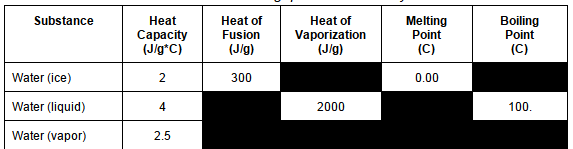

What is the temperature of the metal cube when thermal equilibrium is achieved between the cube and the liquid?
For a skillet, used for cooking, do you want a high or low specific heat
High, so that it will need more energy to heat up
Low, so that it will change temperature quickly

What does the triangle in front of the T symbol mean?
"change in"
"divide by"
"subtract"
"exothermic"

What does the symbol q represent in the equation?
the mass of the substance
the initial temperature
the heat capacity
the heat added to the system

What does the symbol m represent in the equation?
the final temperature
the mass of the substance
the amount of energy released
the heat capacity

The picture of the students beside the fire represents what type of energy transfer?
radiation
conduction

Which substance will require more energy to raise its temperature?
Air
Water
Oil
Lead
The energy of particles in motion is ___.
thermal energy
heat
temperature
motion

