
 Worksheets
Closer-to-nature forest management a European prospective
Total questions: 25
Worksheet time: 14mins

Which eco-region is represented by the dark green colour on the map of European Eco-regions?
A) Alpine
B) Temperate
C) Boreal
D) Atlantic
What was a major concern regarding forests in Germany during the 1600-1700s?
Concern about wood flow and overuse
Spread of tropical diseases
Sustainability
Shortage of mineral resources
Increase in desertification
Who coined the term 'sustainability' in 1713?
von Carlowitz
Alexander von Humboldt
Rachel Carson
James Lovelock
John Muir
Which of the following statements is true about the emergence of even-aged silviculture in Germany?
It was limited to central Europe
It formed an expanding frontier from central to northern Europe
It decreased the supply of wood
It was unrelated to industrial use
What country in Europe has the most remaining last intact forests.
Russia
Sweden
Romania
Finland
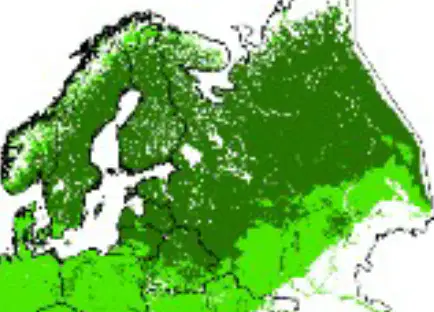
Which map shows a greater area of coniferous forests in Europe ?
European forest type (EFI 2021)
Potential natural forest type (Bohn 2004)
What three tree species have the longest mean life spans in Northern Europe?
Oak, Linden and Beech
Oak, Norway spruce and Scots pine
Black alder, Aspen, and Ash
Hornbeam, Norway maple, Aspen
What is the mean harvest age in Lithuania?
50 years
100 years
150 years
75 years
True or False, current Lithuanian forest stand age distribution' showed too much old forests compared to natural forest stand age distributions.
True
False
Based on Wood production vs. biodiversity conservation in Boreal Europe, which country has the highest forest management intensity?
A) Sweden
B) Latvia
C) Belarus
D) Russia
What does the EU new forest policy aim towards
Multi-functional forests
Closer-to-nature forest Management
Even-aged, continuous cover management
Close to nature forestry
Clear cuts with tree retention
Which type of forest management is described as 'uneven-aged, continuous cover management'?
Reserve
Intensive
Extensive
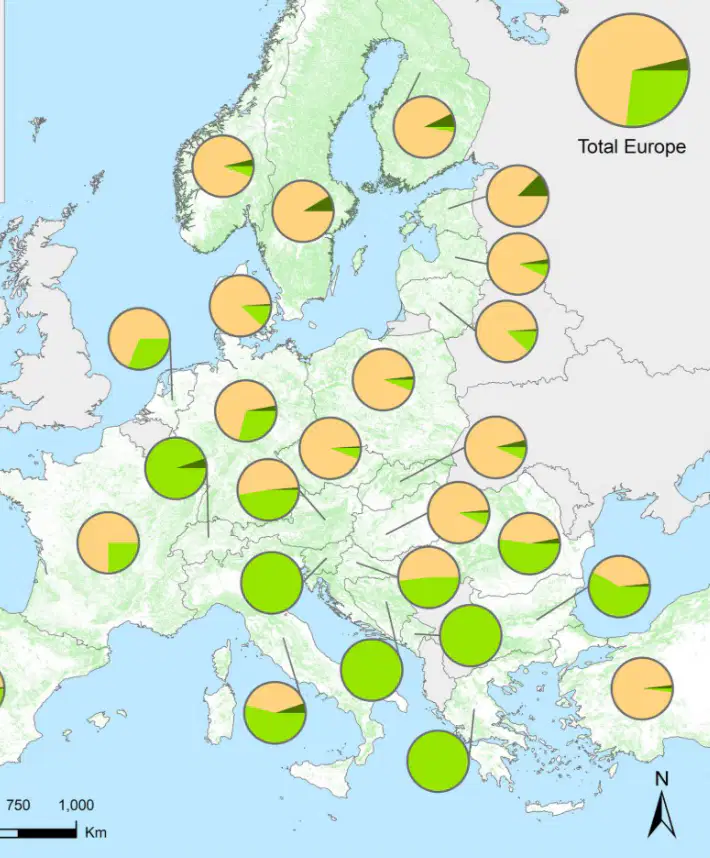
Based on the map, which type of forest management appears to be most common in Norther Europe?
Reserve
Intensive
Extensive
The Helsinki Process / Ministerial Conference on the Protection of Forests in Europe (MCPFE) — later Forest Europe defined sustainable forest management in which year?
1992
1987
1995
2000
The EU Forest Strategy for 2030 was introduced in which year?
2021
2018
2015
2023
The EU Nature Restoration Law was established in which year?
2024
2020
2018
2015
According to the EU forest strategy 2021, what functions does sustainable forest management involve?
biodiversity
it is up to the owner
economic
social
What is Closer-to-Nature Forest Management? Fill in the blank: Closer-to-Nature Forest Management is a new concept proposed in the EU Forest Strategy for 2030, which aims to improve the ________ values and climate resilience of multifunctional, managed forests in Europe.
conservation
economic
recreational
timber
What is the aim of Closer-to-Nature Forest Management?
To maximize timber production
To make forestry practices more ecologically aligned with natural forest processes
To reduce forest biodiversity
To ignore ecological integrity
Fill in the blank: Closer-to-Nature Forest Management emphasizes maintaining and enhancing the ecological integrity, resilience, and ________ of forest ecosystems.
biodiversity
productivity
timber yield
carbon storage
Fill in the blank: Closer-to-Nature Forest Management promotes natural tree ________.
regeneration
removal
harvesting
plantation
Fill in the blank: Closer-to-Nature Forest Management supports landscape heterogeneity and ________.
functioning
fragmentation
degradation
monoculture
What are the three common disturbance regimes in Northern Europe?
Cohort
Succession
Gap
Mono
What natural process could be implemented under closer-to-nature forest management?
Mixed species regeneration
Low intensity prescribed fire
Rewetting
predator - prey systems
How much should each EU member state protect?
30%
17%
20%
10%

