
 Worksheets
Reaction Forces in Beams and Support Types
Total questions: 15
Worksheet time: 8mins
How would you plan an investigation to understand the effect of different support types on the direction of reaction forces in a beam, and what evidence would you collect to support your conclusions?
By setting up beams with various support types, measuring the reaction forces, and comparing the results to theoretical predictions.
By only reading textbook definitions without performing any experiments.
By assuming all support types have the same effect on reaction forces.
By ignoring the direction of reaction forces and focusing only on their magnitude.
Given a simply supported beam with two support points, how would you strategically determine the support reaction forces to ensure static equilibrium? Explain the reasoning and planning involved in your approach.
By guessing the forces at random and checking if the beam balances.
By calculating the forces using the magnitude and position of all forces acting on the beam, applying equilibrium equations.
By ignoring the position of forces and only considering their magnitudes.
By assuming the support reactions are always equal regardless of load placement.
A beam is supported at two points and subjected to various forces. How would you use evidence and reasoning to verify that the beam is in static equilibrium?
Check if the sum of all forces and moments acting on the beam equals zero.
Only check if the beam looks balanced visually.
Ignore the direction of forces and only add their magnitudes.
Assume equilibrium without any calculations.

Given a scenario where a car is parked on a bridge, analyze and justify which type of load—concentrated or uniformly distributed—best represents the force exerted by the car on the beam, and explain your reasoning.
Concentrated load, because the car's weight acts at a specific point on the beam.
Uniformly distributed load, because the car's weight is spread evenly across the entire bridge.
Uniformly distributed load, because the car moves along the bridge.
Concentrated load, because the bridge itself is heavy.

Strategically evaluate why the weight of the bridge itself is considered a uniformly distributed load (UDL) rather than a concentrated load, and discuss the implications for structural design.
Because the bridge's weight is spread evenly along its entire length, affecting every part of the beam.
Because the bridge's weight only affects one point on the beam.
Because the bridge's weight changes depending on the number of vehicles present.
Because the bridge's weight is negligible compared to other loads.

Given a uniformly distributed load (UDL) of 8 kN/m over a beam of length 6 meters, describe the strategic steps required to convert this UDL into a single concentrated load for moment calculations. Explain your reasoning for each step.
Calculate the total load by multiplying the UDL by the length, find the midpoint for load application, and redraw the beam with the concentrated load.
Divide the UDL by the length, place the load at one end, and redraw the beam with the load at the end.
Ignore the UDL, use the length as the load, and place the load at a random point on the beam.
Calculate the total load by adding the UDL and length, and distribute the load evenly across the beam.
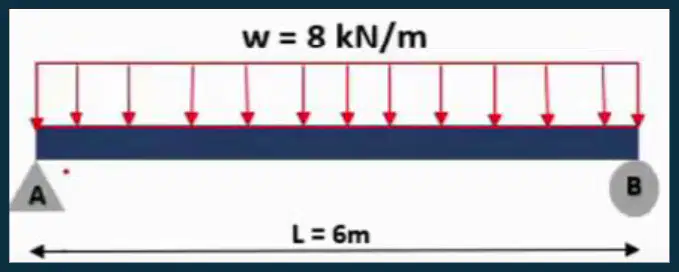
A beam is subjected to a uniformly distributed load of 8 kN/m over a length of 6 meters. Using strategic reasoning, determine the location where the equivalent concentrated load should be placed and justify your answer.
At the midpoint of the beam, 3 meters from either end, because the load is uniformly distributed.
At one end of the beam, because the load starts there.
At a quarter of the beam length, because it balances the load.
At three-quarters of the beam length, because it is closer to the support.
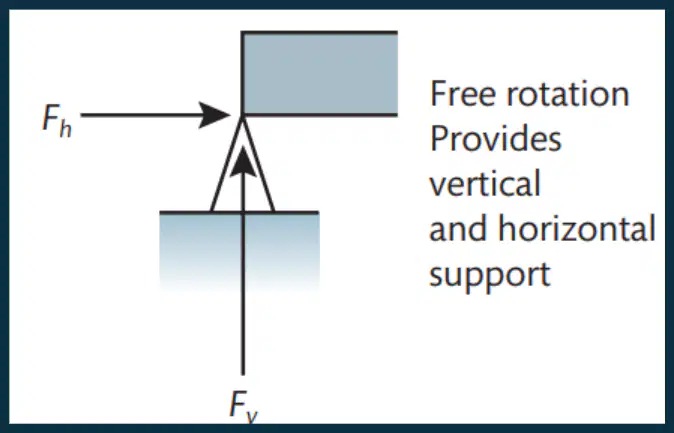
A horizontal beam is supported at one end by a roller and at the other end by a pin. If a vertical load is applied at the center of the beam, explain how the reactions at the supports will be distributed and why.
The roller will provide only a vertical reaction, while the pin will provide both vertical and horizontal reactions.
Both the roller and the pin will provide only vertical reactions.
The roller will provide both vertical and horizontal reactions, while the pin will provide only a vertical reaction.
Both the roller and the pin will provide only horizontal reactions.
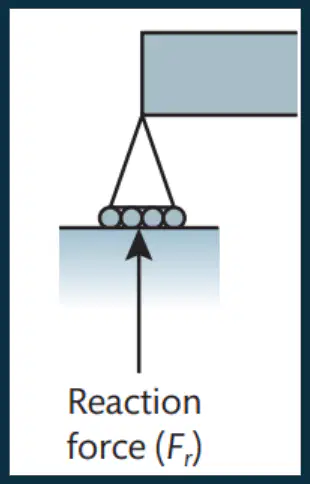
Given a structure with a horizontal beam, if the support at one end is replaced from a pin to a roller, how does this change affect the possible directions of the reaction forces at that end? Justify your answer.
The reaction at the roller end will now only be vertical, whereas the pin could provide both vertical and horizontal reactions.
The reaction at the roller end will now only be horizontal, whereas the pin could provide only vertical reactions.
The reaction at the roller end will now be both vertical and horizontal, whereas the pin could provide only vertical reactions.
There will be no change in the direction of the reaction forces.

A simply supported beam AB is 5 meters long with a point load of 15 kN acting at 3 meters from support A. Using the principle of moments about point A, what is the value of the reaction force at support C (RC)?
9 kN
6 kN
12 kN
15 kN

Given the support reactions RC = 9 kN and a downward force of 15 kN on a simply supported beam, use the equilibrium of vertical forces to determine the reaction at support A (RA).
6 kN
9 kN
15 kN
3 kN
When solving for the support reaction at C (RC) for a simply supported beam with a point load, which equation correctly represents the moment equilibrium about point A?
(15 × 3) = (3 + 2)RC
(15 × 2) = (3 + 2)RC
(15 × 5) = (3 + 2)RC
(15 × 3) = (2)RC
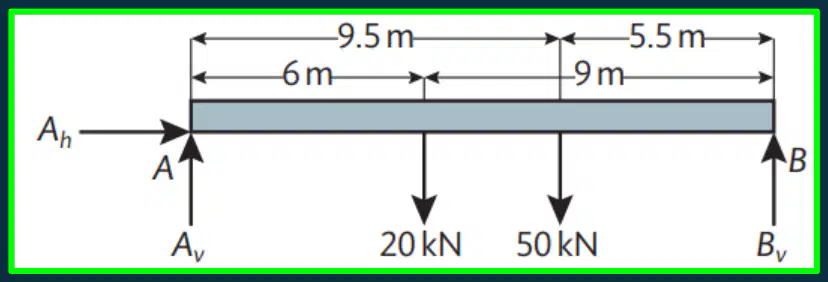
Given a simply supported beam with a uniformly distributed load (UDL) of 10 kN/m over a length of 5 m, and point loads of 20 kN and 50 kN at specified positions, explain the strategic steps required to determine the support reactions at points A and B. What reasoning and calculations are involved in converting the UDL to a concentrated load and solving for the reactions?
Convert the UDL to a concentrated load, redraw the diagram, take moments about one support, solve for one reaction, and use equilibrium to find the other.
Ignore the UDL, sum the point loads, and divide equally between supports.
Only consider the largest load and assign it to the nearest support.
Assume both supports have equal reactions without calculation.
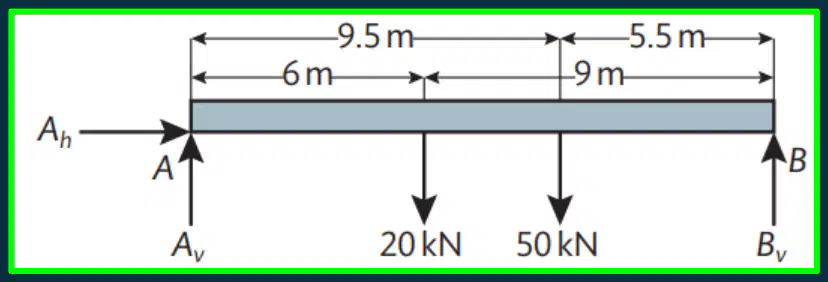
Strategically analyze the moment equation used to solve for the reaction at support B (RB) in the beam problem. Why is it necessary to take moments about point A, and how does this help in finding RB?
Taking moments about A eliminates the unknown reaction at A, allowing RB to be solved directly using the principle of moments.
Taking moments about A is unnecessary; RB can be found by inspection.
Moments about A are only used to check the equilibrium, not to solve for RB.
Moments about A are used to find the total load on the beam, not the reactions.
After calculating the reaction at support B (RB) as 39.67 kN, use strategic reasoning to determine the reaction at support A (RA) and explain why the sum of the reactions equals the total downward load on the beam.
The beam is in equilibrium, so the sum of upward reactions equals the sum of downward loads; RA = total load - RB.
The reaction at A is always zero regardless of the loads.
The reaction at A is equal to RB because the beam is symmetric.
The reaction at A is found by dividing the total load by two.

