
 Worksheets
Open Channel and Types of Flow
Total questions: 109
Worksheet time: 55mins
An Open Channel is a conduit in which a liquid flows with a _________
free surface
closed pipe
vacuum seal
pressurized cover
Which of the following best describes Open Channel Flow?
Flow confined in a closed conduit, has no free surface
Flow having a free surface and subjected to atmospheric pressure
Flow with no surface at all
Flow under vacuum
Which of the following statements is true about Pipe Flow?
It has a free surface and is subjected to atmospheric pressure
It is confined in a closed conduit, has no free surface, and exerts only hydraulic pressure
It is always open to the atmosphere
It is not confined in any conduit
What does the 'Energy Grade Line' represent in open channel flow?
The line joining the elevations of the channel bottom
The line joining the sum of elevation head, pressure head, and velocity head
The line joining only the velocity head
The line joining the pressure head only
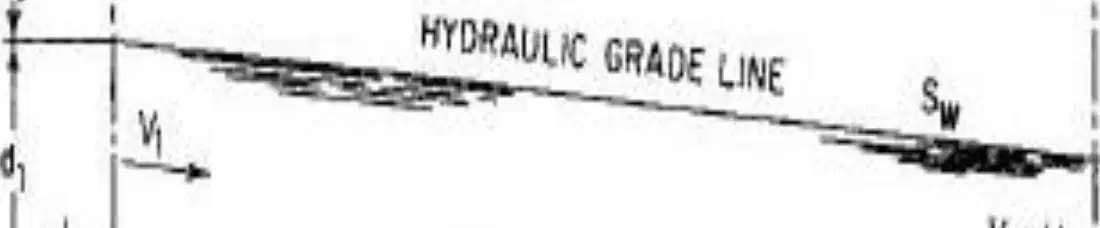
In the diagram, what does the 'Hydraulic Grade Line' indicate?
The sum of elevation head and pressure head
The sum of velocity head and pressure head
The sum of elevation head and velocity head
Only the elevation head
The difference in elevation between the Energy Grade Line and the Hydraulic Grade Line at any section represents the _________.
velocity head (v^2/2g)
pressure head (p/γ)
total head loss
potential head
Fill in the blank: Flow condition in open channel is complicated by the fact that the portion of the free surface is likely to change with respect to time and space and by the fact that the depth of flow, the discharge, and the slopes of the channel bottom and of the free surface are ____________.
interdependent
constant
independent
irrelevant
Fill in the blank: Physical condition in open channel varies much more widely than that of ____________.
pipes
rivers
lakes
channels
Which of the following shapes can the cross section in open channel take? (Choose all that apply)
Rectangular
Square
Triangular
Circular
Irregular forms of natural streams
In open channel, roughness varies with the position of the free surface, therefore, the selection of friction coefficient is attended by greater efficiency.
True
False
The treatment of open channel is somewhat more empirical than that of pipe flow.
True
False
Open channel flow depend on energy gradient.
True
False
Fill in the blank: In pipes, the cross section of flow is ____, since it is completely defined by the geometry of the conduit.
fixed
variable
irregular
unknown
Fill in the blank: The cross-section of a pipe is generally ____.
round
square
triangular
hexagonal
Fill in the blank: Pipe flow depends on ____ gradient.
hydraulic
thermal
magnetic
optical
What is Steady Flow in open channel flow?
The depth of flow changes continuously during the time interval under consideration.
The depth of flow does not change or can be assumed to be constant during the time interval under consideration.
The discharge is not constant throughout the channel.
The flow is always turbulent.
For Steady Flow, the discharge is ______ throughout the reach of the channel under consideration.
constant
variable
intermittent
decreasing
In Steady Flow, the flow is: Choose the correct option.
Discontinuous
Continuous
Variable
None of the above
Fill in the blank: Unsteady flow occurs if the ______ changes with time.
depth
temperature
velocity
pressure
The term Unsteady Flow is used to describe which of the following?
Steady Varied Flow
Unsteady Varied Flow
Steady Uniform Flow
Non-Varied Flow
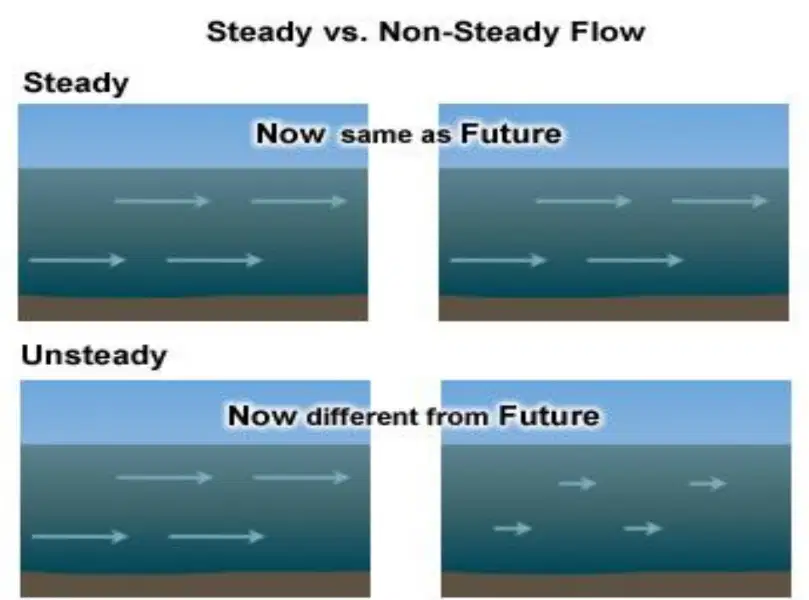
Refer to the diagram labeled 'Steady vs. Non-Steady Flow'. Which statement is true about steady flow?
The current state is different from the future state
The current state is the same as the future state
The depth changes with time
The flow is always turbulent
What is Uniform Flow?
If the depth of flow is the same at every section of the channel
If the flow direction changes at every section
If the flow is always turbulent
If the channel is closed
Fill in the blank: ________ is the fundamental type of flow in open channel hydraulics.
Steady Uniform Flow
Turbulent Flow
Laminar Flow
Critical Flow
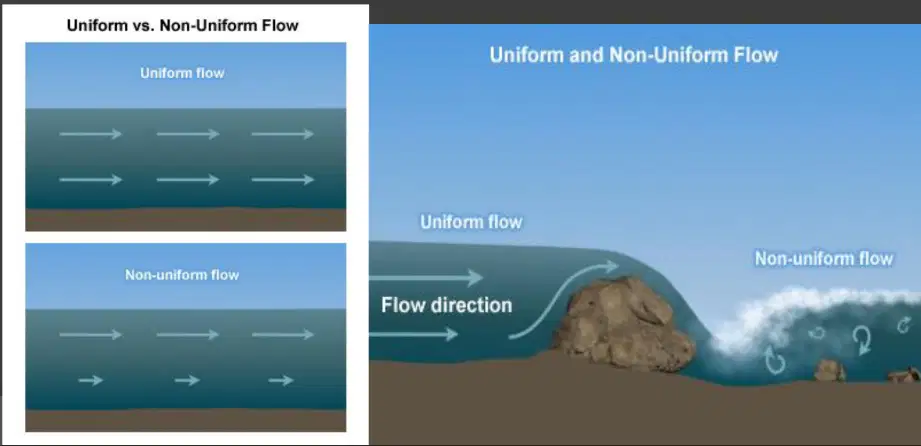
Refer to the diagram labeled 'Uniform vs. Non-Uniform Flow'. Which type of flow shows the same depth at every section of the channel?
Uniform flow
Non-uniform flow
Turbulent flow
Laminar flow
Steady Uniform Flow refers to a type of flow where the depth of flow is the same at every section of the channel.
True
False
Which of the following best describes Rapidly Varied Flow (RVF)?
Flow in which depth changes gradually over a long distance
Flow in which depth changes rapidly over a short distance
Flow with constant depth and velocity
Flow with no variation in channel bottom
Match the following types of flow with their correct descriptions:
Uniform Flow
RVF
Gradually Varied Flow
GVF
Rapidly Varied Flow
UF
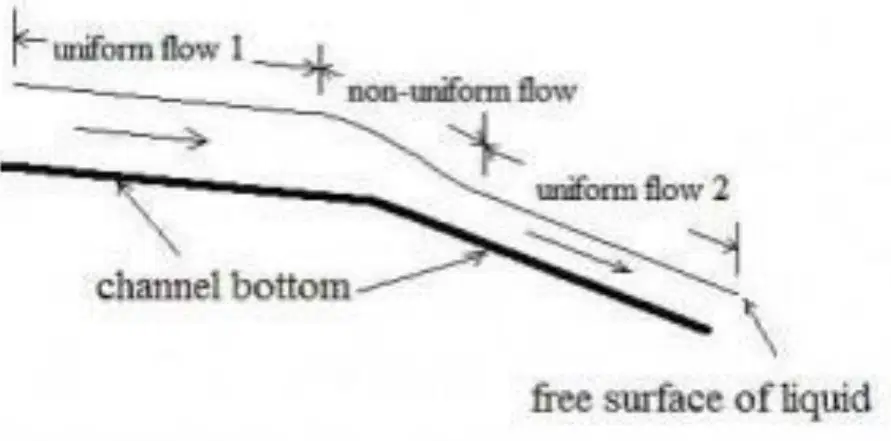
In the diagram, the section labeled as 'uniform flow 1' represents a region where the depth and velocity of the liquid are ________.
constant
increasing
decreasing
variable

In a gradually varied flow (GVF), the depth of flow changes gradually over a long distance.
True
False
What is Varied/Non-uniform Flow? Fill in the blank: Varied/Non-uniform Flow is when the depth of flow _______ along the length of the channel.
changes
remains constant
increases only
decreases only
Varied/Non-uniform Flow is also known as:
Uniform Flow
Spatially Varied or Discontinuous Flow
Steady Flow
Laminar Flow
Which of the following is an example of Varied/Non-uniform Flow?
Roadside gutters
Main drainage channels
Feeding channels in irrigation systems
All of the above
Fill in the blank: Manning’s Equation in a prismatic channel, where Q, v, y, A, P, B, S, and roughness are all constant, describes _________.
Uniform flow
Critical flow
Laminar flow
Steady non-uniform flow
Fill in the blank: The Specific Energy Equation (Froude Number) is used to describe _________.
Critical flow
Laminar flow
Turbulent flow
Uniform flow
Fill in the blank: Gradually varied flow (steady flow) and determination of floodplains are associated with _________
Non-uniform flow
Uniform flow
Laminar flow
Turbulent flow
Fill in the blank: Flood waves are associated with ________ and Non-uniform flow.
Unsteady
Steady
Laminar
Turbulent
What type of flow is described as water particles appearing to move in definite smooth paths or streamlines, with infinitesimally thin layers of fluid sliding over adjacent layers?
Laminar
Turbulent
Transitional
Which type of flow is characterized by viscous forces being weak relative to inertial forces, and water particles moving in irregular paths which are neither smooth nor fixed?
Laminar
Turbulent
Transitional
What is the term for the type of flow that is intermediate between laminar and turbulent flow?
Transitional
Steady
Viscous
Uniform
Which type of flow is characterized by smooth, parallel layers of fluid?
Turbulent
Laminar
The flow with irregular, swirling motion is called ________ flow.
Turbulent
Laminar
Steady
Uniform
Which type of flow is more orderly?
Turbulent
Laminar
In the formula for Reynolds Number (Re=VL/v), what does 'V' represent?
Volume
Velocity
Viscosity
Voltage
For Laminar Flow, the Reynolds Number (R) is less than _____
500
1000
2000
2500
Which of the following ranges of Reynolds Number (R) corresponds to Transitional Flow?
R < 500
R > 2,000
500 < R < 2,000
500 < R > 2,000
What is the effect of gravity upon the state of flow represented by?
Reynolds Number
Froude Number
Mach Number
Weber Number
Fill in the blank: The Froude Number (F) is given by the formula __, where V is the mean velocity, g is the acceleration due to gravity, and L is the characteristic length.
F = V / sqrt(gL)
F=gLV2
F = sqrt(VgL)
F = g / (VL)
In the formula F = V / sqrt(gL), what does 'L' represent?
characteristic length
linear velocity
load factor
luminous intensity
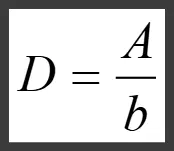
In open-channel flow, the characteristic length is equal to the hydraulic radius D, which is given by the formula D = A / b. What does 'A' represent in this formula?
cross-sectional area
wetted perimeter
flow velocity
channel slope
In the formula D = A / b, what does 'b' represent?
width of the free surface
depth of the fluid
density of the fluid
velocity of the fluid
If F = 1, what is the type of flow?
Supercritical
Subcritical
Critical
Laminar
If F > 1, what is the type of flow?
Supercritical
Subcritical
Critical
Laminar
If F < 1, what is the type of flow?
Supercritical
Subcritical
Critical
Laminar
According to the information on 'Kinds of Open Channel', which of the following is a natural open channel?
Navigation canal
Stream
Spillway
Flume
According to the information on 'Kinds of Open Channel', which of the following is an artificial open channel?
Brook
Underground stream
Power canal
Tidal estuary
Fill in the blank: Natural open channels include all watercourses that exist _______ on the earth.
naturally
artificially
temporarily
underground
Fill in the blank: Artificial open channels are those constructed or developed by _______.
human
animals
nature
machines
Which of the following is NOT an example of a natural open channel?
Rivulet
Drainage ditch
Small river
Brook
Which of the following is NOT an example of an artificial open channel?
Flume
Floodway
Tidal estuary
Spillway
A canal is usually a long and mild-sloped channel built in the ground which may be ______ or unlined.
lined
painted
covered
sealed
Which of the following materials can be used for lining canals?
Stone masonry
Concrete
Wood
All of the above
Look at the images provided. What do all these images have in common?
They all show objects that are round in shape.
They all show objects that are made of metal.
They all show objects that are used for cooking.
They all show objects that are found in nature.

Which canal is shown on the left map?
Suez Canal
Panama Canal
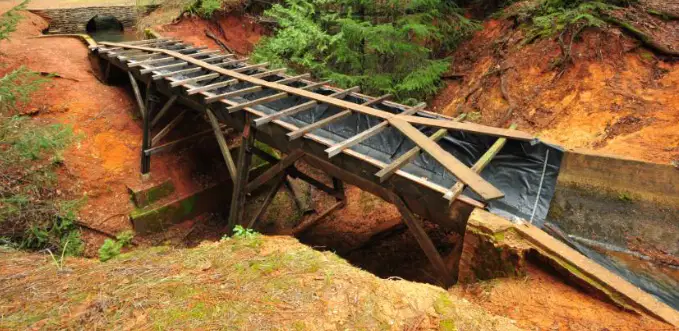
What is a flume?
A flume is a channel made of wood, metal, or concrete supported above the surface of the ground to carry water across a depression.
A flume is a type of pump used to extract water from underground sources.
A flume is a device used to measure air pressure in weather stations, which can also be used for music and an orchestra for a band or music festivities.
A flume is a container used for storing rainwater.

The images show a metal structure. What is the likely purpose of this structure?
To support a bridge
To store water
To generate electricity
To provide shade

What is a chute?
A channel having a moderate to steep slope
A flat channel
A channel with no slope
A channel with a very gentle slope
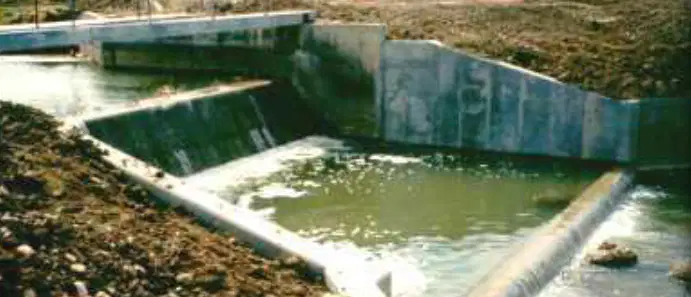
What is a 'Drop' in the context of water management structures?
A structure that allows water to flow uphill
A structure similar to a chute, but the change in elevation is effected in a short distance
A structure that stores water for long periods
A structure that filters water

What is a culvert?
A bridge for vehicles
A covered channel of comparatively short length installed to drain water through a highway and railroad embankments
A tunnel for trains
An open ditch for water
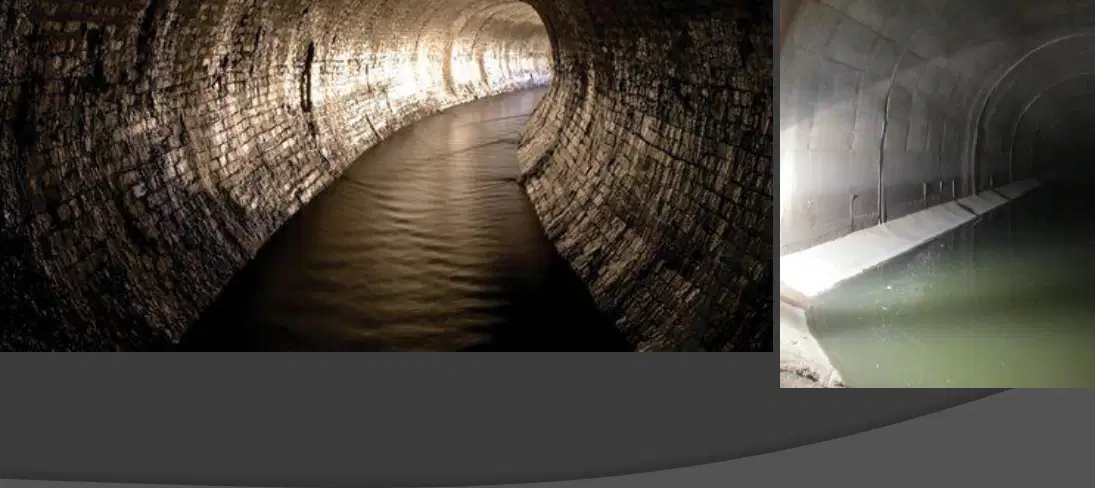
What is an Open-Channel Tunnel?
A short open channel used to carry air
A comparatively long covered channel used to carry water through a hill or any obstruction on the ground
A tunnel for cars only
A bridge over a river that carries river water to the ocean, to the Pacific Ocean, or Antarctic Ocean
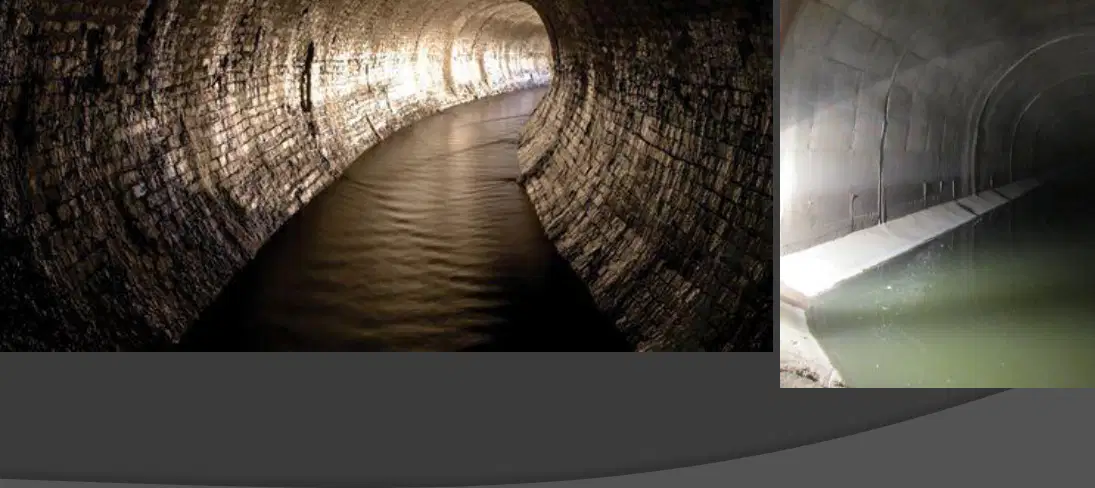
\An Open-Channel Tunnel is a comparatively long covered channel used to carry ______ through a hill or any obstruction on the ground.
water
electricity
vehicles
air
A ________ is a channel built with uniform cross-section and constant bottom slope.
Prismatic Channel
Meandering Channel
Compound Channel
Natural Channel
Which type of channel is built with uniform cross-section and constant bottom slope?
Prismatic Channel
Non-Prismatic Channel
Which of the following is a characteristic of a uniform flow?
The depth, water area, velocity, and discharge at every section of the channel reach are constant
The energy line, water surface, and channel bottom are all parallel, that is, their slopes are equal
The velocity changes at every section of the channel
The channel bottom is not parallel to the water surface
In a uniform flow, the energy grade line, water surface, and channel bottom are all ________ to each other, meaning their slopes are equal.
parallel
perpendicular
curved
intersecting
Uniform flow is considered to be ______, since unsteady uniform flow is practically non-existent. Even in natural streams where steady flow is rare and it scarcely experiences a uniform flow condition, it is assumed to be a uniform flow to offer a relatively simple and satisfactory solution to many practical problems.
steady
turbulent
laminar
transient
Uniform flow cannot occur at very high velocities or rapid flow. This is because, when uniform flow reaches a certain high velocity, it becomes very ______. At higher velocities, the flow will eventually entrain air and become unsteady.
unstable
laminar
smooth
predictable
The depth and slope corresponding to a uniform flow discharge in any channel is called ______ and ______.
normal depth and normal slope
critical depth and critical slope
specific depth and specific slope
maximum depth and minimum slope
What is the value of C_m in English units according to Manning's Formula?
1.49
0.85
2.00
1.00
What is the value of C_m in Metric units according to Manning's Formula?
1.0
0.85
1.5
0.75
In Manning's Formula, what does R represent?
A/P (hydraulic radius)
Reynolds number
Radius of curvature
Resistance factor
In Manning's Formula, what does S represent?
slope
surface area
speed
solubility
In Manning's Formula, what does n represent?
Manning’s roughness coefficient
Channel slope
Hydraulic radius
Flow velocity
Which of the following is the correct form of Manning's Formula for open channel flow?
V=Cm/nR(2/3)S(1/2)
V = Cm∗nR(2/3)S(1/2)
V=Cm/nR(1/2)S(2/3)
V = Cm∗nR(1/2)S(2/3)
Which of the following is a formula for computing discharge (Q) in open channels?
Q = AV
Q=A(1.49/n)R(2/3)S(1/2)
A(1/n)R2/3S1/2
All of the above
It is represented by the size and shape of the grains of the
material forming the wetted perimeter and producing a retarding
effect on the flow.
Surface Roughness
It is, in itself, a kind of surface roughness but also markedly
reduces the capacity of the channel and retards the flow. This
effect depends mainly on height, density, distribution, and type
of vegetation.
It is very important in designing small drainage channels
Water temperature
Channel width
Soil composition
Vegetation
comprises irregularities in wetted perimeter
and variations in cross section, size, and shape along the channel
length.
Irregularities in wetted perimeter
Variations in flow rate and temperature
Channel Irregularity
Consistent wetted perimeter
The presence of log jams, bridge piers, and the like tends to
increase n. The amount of increase depends on the nature of their size, shape, number, and distribution.
obstruction
Alignment
Silting and Scouring
These are lined and built-up channels which can withstand
erosion satisfactorily. Lining material maybe stone masonry, steel, cast iron, timber, glass,
and plastic.
Non-Erodible Channel
Erodible Channel
Unlined channel
Temporary Channel
which of the ff. are design factors for non-erodible channels:
Minimum Permissible Velocity or the Non-Silting Velocity
Channel Slope and Side Slope
Freeboard
Maximum Permissible Velocity Method
The ff. are design methods for erodible channels, except:
Maximum Permissible Velocity Method
Tractive Force Metho
Channel Slope and Side Slope
Grassed Channels
It is the velocity that will not start sedimentation and will not
induce the growth of aquatic plants and moss
Minimum Permissible Velocity or the Non-Silting Velocity
Channel Slope and Side Slope
Freeboard
It is the vertical distance from the top of the channel to the
water surface at the design condition. This is provided to
prevent waves or fluctuations in water surface from overflowing
the sides.
freeboard
Freeboard used in the design vary from ___ to ___ of the depth
of flow.
5%-30%
10%-20%
8%-10%
15%-25%
Freeboard in an unlined canal or lateral is normally governed by
the following considerations:
size and location
availability of excavated material
storm-water inflow
operating road requirements
pull of water on the wetted area
is the greatest mean
velocity that will not cause erosion of the channel body
Maximum permissible flow rate
Maximum Permissible Velocity Method
is the pull of water on the wetted area
Tractive Force
Manning coefficient of roughness for grassed channels is
specifically known as ______.
Retardance Coefficient
Which is not a characteristic of critical flow?
The specific energy is minimum for a given discharge.
The discharge is maximum for a given specific energy.
The specific force is a minimum for a given discharge.
The velocity head is equal to half of the hydraulic depth in a
channel of small slope.
The specific force is a maximum for a given discharge.
The slope of the channel that sustains a given
discharge at a uniform and critical depth is called the _____.
_____ is the depth, at which, for a given total head,
the discharge is a maximum or, conversely, the depth at which a
given flow occurs with a minimum content of energy.
_____ is the vertical distance of the lowest
point of a channel section from the free surface
elevation or vertical distance of the free surface above a datum
If the datum is the lowest point of the channel section, the
stage is
equal to the depth of flow
______ is the width of channel section at the free surface
______ is the cross-sectional area of the flow normal
to the direction of flow
Water area
The length of the line of intersection of the
channel wetted surface with a cross-sectional plane normal to the
direction of flow.
The ratio of water area to its wetted perimeter.
Water Area to Wetted Perimeter Ratio (Hydraulic Ratio)
It is the channel section having the least wetted
perimeter for a given area and maximum conveyance. It applies only
to the design of non-erodible channels.
Best Hydraulic Section

