
 Worksheets
The Nervous System
Total questions: 52
Worksheet time: 26mins
Which cranial nerve is associated with blindness in all or part of a visual field if damaged?
Olfactory nerve
Optic nerve
Facial nerve
Vagus nerve
Damage to which cranial nerve results in an impaired sense of smell?
Trigeminal nerve
Glossopharyngeal nerve
Olfactory nerve
Spinal accessory nerve
Which cranial nerve, if damaged, leads to an impaired ability to move the head, neck, and shoulders?
Facial nerve
Spinal accessory nerve
Oculomotor, trochlear, and abducens nerves
Trigeminal nerve
Loss of sensation in the upper face is caused by damage to which cranial nerve?
Trigeminal nerve
Facial nerve
Vagus nerve
Optic nerve
Sagging facial muscles are a result of damage to which cranial nerve?
Facial nerve
Glossopharyngeal nerve
Olfactory nerve
Spinal accessory nerve
Deafness, dizziness, nausea, and loss of balance are symptoms of damage to which cranial nerve?
Trigeminal nerve
Glossopharyngeal nerve
Facial nerve
Oculomotor, trochlear, and abducens nerves
Damage to which cranial nerve might cause slow heart rate, dizziness, fainting, and difficulty breathing?
Vagus nerve
Facial nerve
Optic nerve
Spinal accessory nerve
Drooping eyelid and inability to move the eye in some directions are caused by damage to which cranial nerve?
Oculomotor, trochlear, and abducens nerves
Facial nerve
Glossopharyngeal nerve
Trigeminal nerve
Poor tongue movement, swallowing, and impaired gag reflex are symptoms of damage to which cranial nerve?
Glossopharyngeal nerve
Vagus nerve
Olfactory nerve
Spinal accessory nerve
Which cranial nerve is responsible for the sense of smell?
Optic
Olfactory
Trigeminal
Facial
What is the primary function of the Optic nerve?
Sense of taste
Movement of the eyeball
Sense of sight
Contraction of neck and shoulder muscles
The Oculomotor nerve is responsible for which of the following functions?
Movement of the eyeball; constriction of the pupil
Sense of hearing and balance
Sensation of face, scalp, chewing
Contraction of neck and shoulder muscles
Which cranial nerves are involved in the movement of the eyeball?
Olfactory and Optic
Trochlear and Abducens
Facial and Glossopharyngeal
Vestibulocochlear and Accessory
The Trigeminal nerve is associated with which of the following functions?
Sense of taste, swallowing
Sensation of face, scalp, chewing
Sense of hearing and balance
Maintains heart, lung, sweating, peristalsis, digestion, and urinary functions
Which cranial nerve is responsible for the sense of taste and contraction of facial muscles?
Facial
Glossopharyngeal
Vagus
Hypoglossal
The Vestibulocochlear nerve is primarily responsible for:
Sense of smell
Sense of hearing and balance
Movement of the eyeball
Contraction of neck and shoulder muscles
Which cranial nerve is involved in the sense of taste and swallowing?
Glossopharyngeal
Facial
Vagus
Hypoglossal
The Vagus nerve is responsible for which of the following functions?
Sense of taste, swallowing
Maintains heart, lung, sweating, peristalsis, digestion, and urinary functions
Movement of the eyeball
Contraction of neck and shoulder muscles
Which cranial nerve is responsible for the contraction of neck and shoulder muscles?
Accessory
Hypoglossal
Facial
Vestibulocochlear
The Hypoglossal nerve is associated with which function?
Sense of taste, swallowing
Movement of the eyeball
Contraction of neck and shoulder muscles
Sense of taste, contraction of facial muscles
The division of the nervous system that carries signals from nerve endings to the central nervous system is the:
sensory (afferent) division.
motor (efferent) division.
sympathetic division.
parasympathetic division.
The part of the nervous system that carries signals from the skin, bones, joints, and muscles to the central nervous system is the:
autonomic motor.
somatic motor.
visceral sensory.
somatic sensory.
The central nervous system includes the:
somatic motor system.
sympathetic division.
brain and spinal cord.
autonomic motor system.
The blood-brain barrier primarily consists of which type of nerve cell?
Microglia
Schwann cell
Astrocyte
Oligodendrocyte
When you touch something hot, the type of neurons that send impulses allowing you to withdraw your hand are:
afferent neurons.
efferent neurons.
interneurons.
neuroglia.
The purpose of the sympathetic nervous system is:
to relay information from the somato-sensory system to the thalamus in the brain.
to relay sensations from the skin and the extremities to the brain.
to calm the body and promote a 'rest and digest' state which is essential for energy conservation and maintaining basic bodily functions.
to prepare the body for a 'fight or flight' response in stressful situations by rapidly increasing heart rate, blood pressure, and alertness.
The purpose of the parasympathetic nervous system is:
to relay information from the somato-sensory system to the thalamus in the brain.
to relay sensations from the skin and the extremities to the brain.
to calm the body and promote a 'rest and digest' state which is essential for energy conservation and maintaining basic bodily functions.
to prepare the body for a 'fight or flight' response in stressful situations by rapidly increasing heart rate, blood pressure, and alertness.
When a neuron's cell membrane is polarized and contains an abundance of sodium on the inside and an abundance of potassium on the outside, the cell is:
in resting potential, waiting to react if a stimulus comes along.
in the process of depolarizing.
in the process of conducting an action potential down the axon.
unable to react to a new stimulus.
What is the purpose of myelin?
To facilitate the free movement of ions across the cell membrane.
To provide an insulating layer around nerves, which allows electrical impulses to transmit rapidly and efficiently.
To slow down the rapid electrical impulses arriving at the brain so that those signals can be processed and moved to the correct parts of the brain.
To increase the sensitivity of temperature and pressure receptors in the skin.
What are the parts of the Central Nervous System?
The brain and spinal cord.
All sensory and motor neurons.
The sympathetic and parasympathetic nervous systems.
The somatic and visceral sensory systems.
Nerves from which region of the spinal cord innervate the chest, head, neck, shoulders, arms, hands, and diaphragm?
Thoracic
Lumbar
Cervical
Sacral
White matter appears white because of
its lack of myelin.
its abundance of myelin.
a preponderance of neuron cell bodies.
the presence of the meninges.
Descending (efferent) spinal tracts carry
sensory signals up the spinal cord to the brain.
sensory signals down the spinal cord to the body.
motor impulses up the spinal cord to the brain.
motor impulses down the spinal cord to skeletal muscles.
A patient is admitted to the hospital with paralysis on the right side of the body. Magnetic resonance imaging reveals that he has suffered a stroke on the left side of his brain. What is the most likely explanation for the location of his symptoms?
A stroke on the left side of the brain would affect corticospinal tracts responsible for movement.
A stroke on the left side of the brain would affect motor signals being sent to the right side of the body.
A stroke on the left side of the brain would affect the area responsible for movement.
There is no logical explanation because a stroke on the left side of the brain would affect movement on the left side of the body.
How many pairs of spinal nerves connect to the spinal cord?
38
31
12
28
A patient who is experiencing severe pain down the back of the leg most likely has an injury to a nerve in which plexus?
Cervical
Lumbar
Sacral
Brachial
Which portion of the brain contains the midbrain, pons, and medulla oblongata?
Cerebrum
Diencephalon
Cerebellum
Brainstem
Which statement about the medulla oblongata is true?
It plays a role in balance and posture.
It aids in smooth, coordinated movements.
It evaluates sensory input such as touch and sound.
It aids in the regulation of breathing.
Which portion of the brain controls the autonomic nervous system?
Thalamus
Hypothalamus
Cerebellum
Cerebrum
An injury to which part of the brain is most likely to impair reasoning and cause socially inappropriate behavior?
Frontal
Parietal
Temporal
Occipital
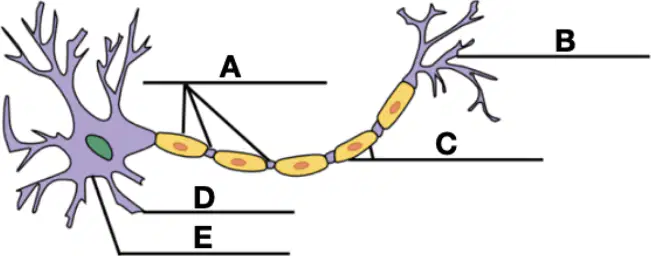
What is letter "A"?
Myelin sheath
Dendrite
Axon terminal
Schwann cell
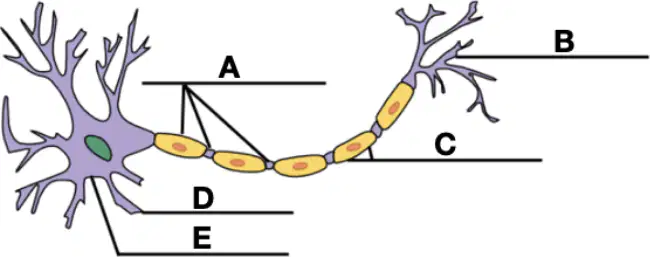
What is letter "E"?
Myelin sheath
Dendrite
Axon terminal
Nerve cell body
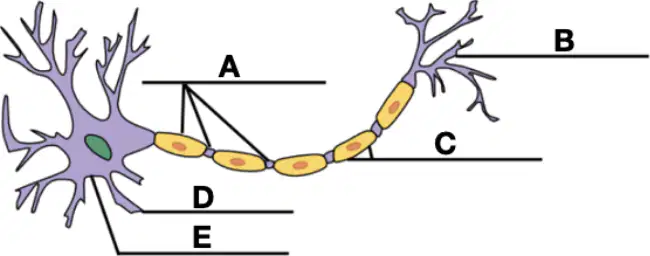
What is letter "B"?
Myelin sheath
Dendrite
Axon terminal
Schwann cell
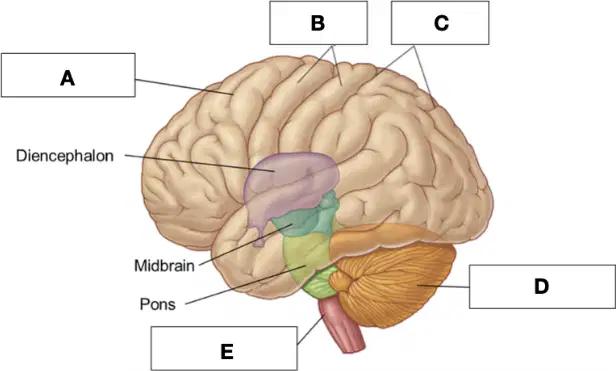
What is letter "A" in the diagram of the brain?
cerebellum
cerebrum
medulla oblongata
gyri
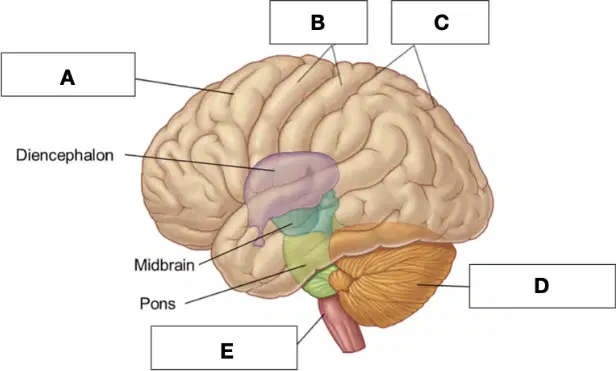
What is letter "B"?
Cerebellum
Sulci
Medulla oblongata
Gyri
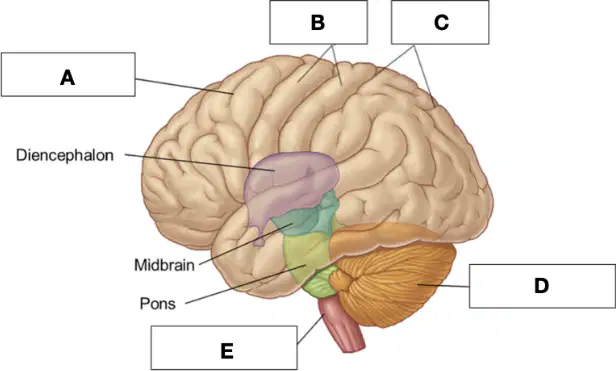
What is letter "C"?
Cerebellum
Sulci
Medulla oblongata
Gyri
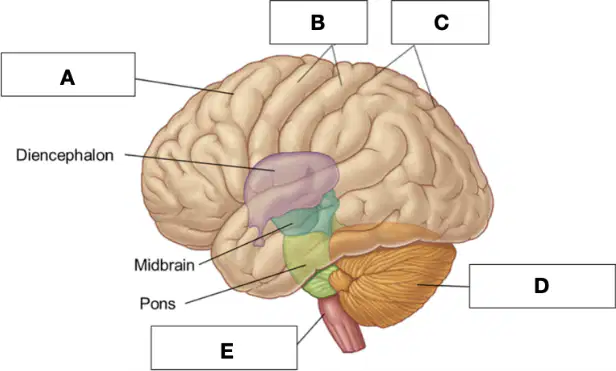
What is letter "D"?
cerebellum
cerebrum
medulla oblongata
thalamus
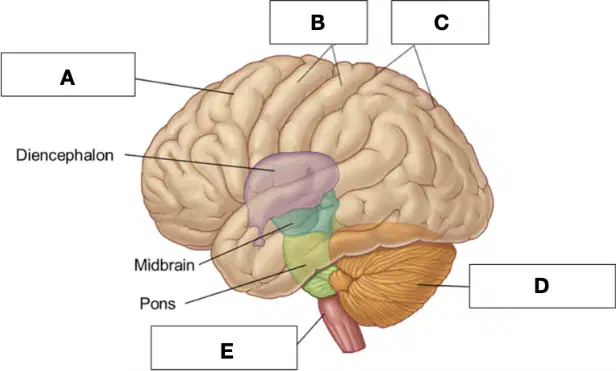
What is letter "E"?
cerebellum
cerebrum
medulla oblongata
thalamus
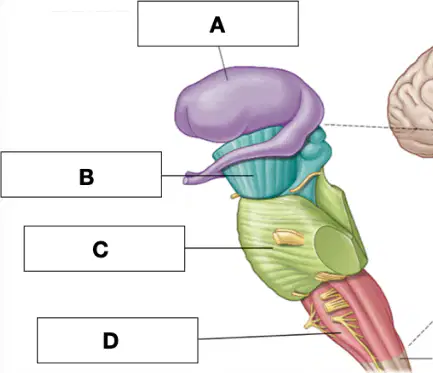
What is letter "A" in the diagram?
Thalamus
Midbrain
Pons
Medulla oblongata
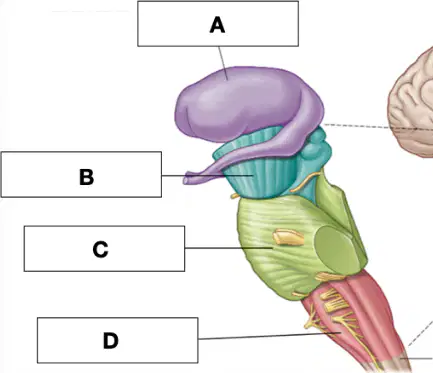
What is letter "B" in the diagram?
Thalamus
Midbrain
Pons
Medulla oblongata
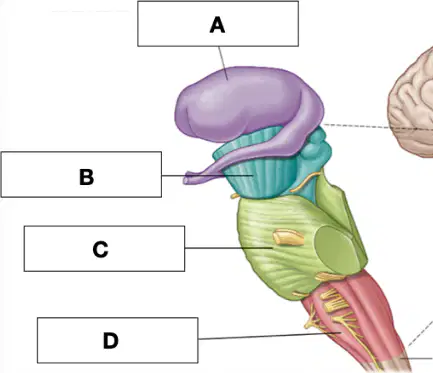
What is letter "C" in the diagram?
Thalamus
Midbrain
Pons
Medulla oblongata
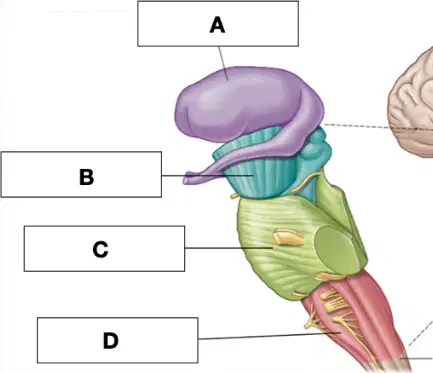
What is letter "D" in the diagram?
Thalamus
Midbrain
Pons
Medulla oblongata

