
Font size
 Worksheets
rnn_lstm_gru_autoencoder
Total questions: 71
Worksheet time: 33mins

What is the primary objective of an Autoencoder?
Classification
Clustering
Data Reconstruction
Dimensionality Increse
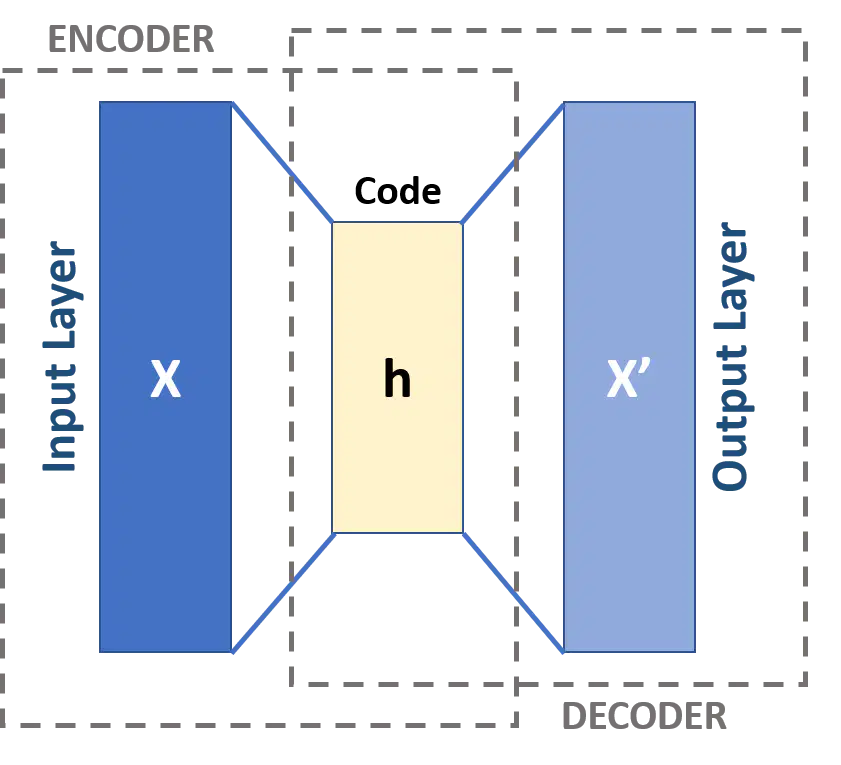
Which of the following is NOT a component of an Autoencoder?
Optimizer
What does the latent space in an Autoencoder represent?
Which of the following techniques is commonly used to train an Autoencoder?
Semi-supervised Learning
Supervised Learning
Reinforcement Learning
Unsupervised Learning
What is the role of the decoder in an Autoencoder?
To reconstruct the input data from the latent space.
To compress the input data.
To classify the input data.
To visualize the input data.
Which loss function is commonly used in Autoencoders for reconstruction?
What is a common application of Autoencoders?
Data Augumentation
Image Denoising
Sentiment Analysis
Text Classification
What is a Denoising Autoencoder trained to do?
Reconstruct clean data from noisy input
Reconstruct the noise
Encode noisy data
Maximize reconstruction error
What distinguishes a Variational Autoencoder (VAE) from a standard Autoencoder?
It has no decoder
It uses probabilistic latent variables
It skips the encoding process
It does not use a loss function
In a Variational Autoencoder, what distribution is typically assumed for the latent variables?
Exponential distribution
Bernoulli distribution
Uniform distribution
Gaussian distribution
What is the purpose of the KL-divergence term in the VAE loss function?
To measure reconstruction error
To minimize noise
To regularize latent space distribution
To increase model complexity
What is a Sparse Autoencoder trained to encourage?
Very few neurons Active at a time
More neurons Active at a time
No hidden Layers
Random Noise in Output
What regularization technique is commonly used in Sparse Autoencoders?
Gradient Clipping
What is the purpose of Contractive Autoencoders?
Maximize the size of latent space
Penalize sensitivity to input variations
Denoise input data
Increase reconstruction error
Which of the following is NOT a regularized Autoencoder?
Sparse Autoencoder
Convolutional Autoencoder
Denoising Autoencoder
Contractive Autoencoder
Feedback networks are used for?
auto association
pattern storage
both auto association & pattern storage
pattern recognition
_________ is used to find local minima of the cost function
stochastic gradient descent
gradient descent
linear regression
logistic regression
A = 1/(1 + e-x) is an equation representing which activation function?
ReLU
Sigmoid
Leaky ReLu
Tanh

Identify the activation function from the given diagram
Sigmoid, ReLU
ReLU, Leaky ReLU
ReLU, Tanh
TanH, ReLU
What type of deep learning architecture is used in a multimodal multistream framework to tackle egocentric activity recognition using both video and sensor data?
A) Single Convolutional Neural Network (CNN)
B) Feedforward Neural Network
C) Dual CNNs and Long Short-Term Memory (LSTM)
D) Recurrent Neural Network (RNN)
they perform the same task for every element of a sequence, with the output being depended on the previous computations.
RNN or Recurrent Neural Network
CNN or Convolution Neural Network
LSTMor Long-Short Term Memory
What are general limitations of back propagation rule? Pick the right choice from the given options
i) local minima problem
ii) slow convergence
iii) scaling
only i
both ii and i
both ii and iii
i, ii and iii
What does RNN stand for?
Recurring Neural Network
Removable Neural Network
Recurrent Neural Network
None

Which type of Neural Network is suitable to solve spatial feature recognition?
CNN
Fully Connected Network
ANN
RNN

These are all problems suitable to be solved by DL, except.....
Image processing
Syntax segmentation
NLP
Speech recognition
Which statement best describes the training process of an LSTM model?
a) It uses gradient descent to optimize the model’s weights
b) It uses the forward-backward algorithm for sequence labeling
c) It leverages the attention mechanism for contextual information
d) It involves unfolding the LSTM through time and applying backpropagation through time (BPTT)
Which variant of LSTM is designed to handle bidirectional sequence modeling?
a) Gated Recurrent Unit (GRU)
b) Clockwork RNN
c) Bidirectional LSTM
d) Stacked LSTM
Which of the following techniques is commonly used to alleviate the vanishing gradient problem in LSTM networks?
a) Dropout regularization
b) Batch normalization
c) Gradient clipping
d) Learning rate decay
Which component(s) is/are present in an LSTM cell?
a) Input gate
b) Output gate
c) Forget gate
d) All of the above
Which activation function(s) are commonly used in LSTM networks?
a) Sigmoid
b) Tanh
c) ReLU
d) Both a) and b)
Which of the following is not the promise of artificial neural network?
a) it can explain result
b) it can survive the failure of some nodes
c) it has inherent parallelism
d) it can handle noise
Which of the following is the component of learning system?
a) goal
b) model
c) learning rules
d) all of the mentioned
What is the purpose of the recurrent connection in an RNN?
a) To propagate the hidden state across different time steps
b) To adjust the weights and biases of the network
c) To reduce the dimensionality of the input data
d) None of the above
Which layer type is commonly used in RNNs for speech recognition tasks?
a) Input layer
b) Hidden layer
c) Output layer
d) None of the above
What is the primary purpose of a Recurrent Neural Network (RNN)?
a) Image classification
b) Text generation
c) Reinforcement learning
d) Object detection
What is the basic concept of Recurrent Neural Network?
Use previous inputs to find the next output according to the training set.
Use a loop between inputs and outputs in order to achieve the better prediction.
Use recurrent features from dataset to find the best answers.
Use loops between the most important features to predict next output.
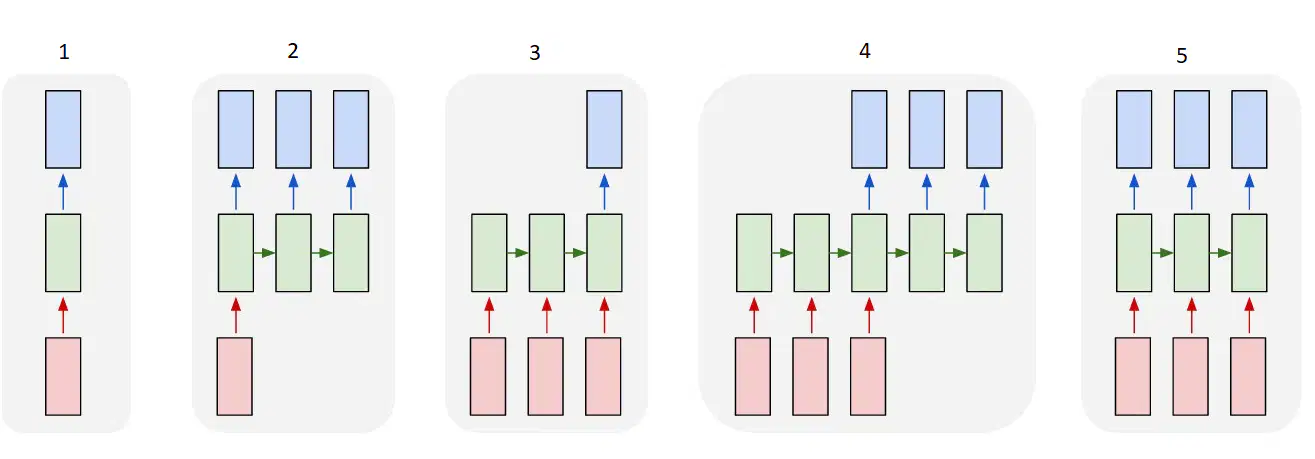
According to the image, classify the type of connection we have in the example 1.
One to one
One to many
Many to one
Many to many
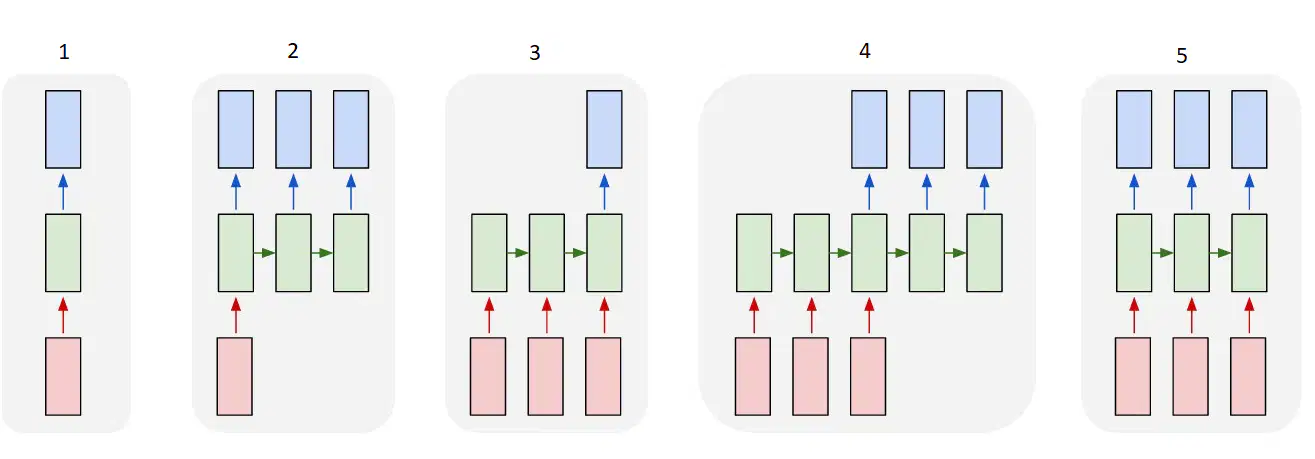
According to the image, classify the type of connection we have in the example 3.
Many to one
Many to many
One to one
One to many
What is 'gradient' when we are talking about RNN?
A gradient is a partial derivative with respect to its inputs
It is how RNN calls its features
The most important step of RNN algorithm
A parameter that can help you improve the algorithm's accuracy
The other RNN's issue is called 'Vanishing Gradients'. What is that?
When the values of a gradient are too small and the model stops learning or takes way too long because of that.
When the values of a gradient are too big and the model stops learning or takes way too long because of that.
When the values of a gradient are too small and the model joins in a loop because of that.
When the values of a gradient are too big and the model joins in a loop because of that.
LSTM? What is that?
LSTM networks are an extension for recurrent neural networks, which basically extends their memory. Therefore it is well suited to learn from important experiences that have very long time lags in between
LSTM networks are an extension for recurrent neural networks, which basically extends their memory. Therefore it is well suited to learn from important experiences that have very low time lags in between
LSTM networks are an extension for recurrent neural networks, which basically shorten their memory. Therefore it is well suited to learn from important experiences that have very low time lags in between
LSTM networks are an extension for recurrent neural networks, which basically extends their memory. Therefore it is not recommended to use it, unless you are using a small Dataset.

Question 3
To which of these tasks would you apply a many-to-one RNN architecture?
Image classification (input an image and output a label)
Music genre recognition
Language recognition from speech (input an audio clip and output a label indicating the language being spoken)
Speech recognition (input an audio clip and output a transcript)
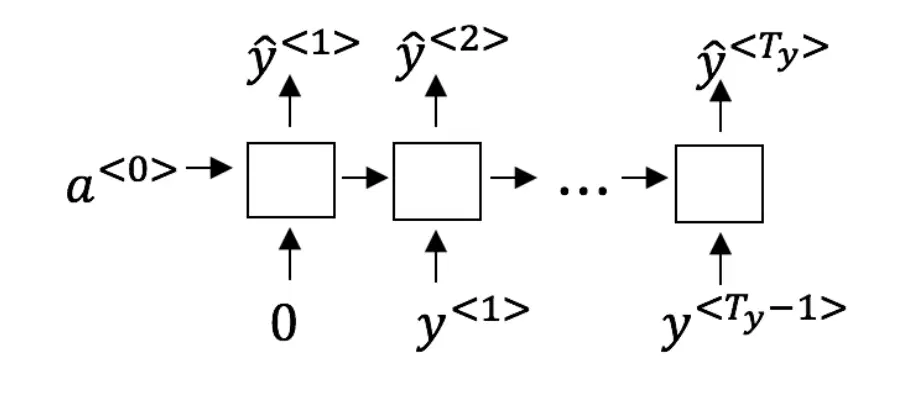
Using this as the training model below, answer the following:
True/False: At the tth time step the RNN is estimating
P (y<t> y<1>, y<2>, ..., y<t−1>)
p/s: This is ' P( ....| ....)'
False
True
Suppose your training examples are sentences (sequences of words). Which of the following refers to the jth word in the ith training example?
x(i)<j>
x<i>(j)
x(j)<i>
x<j>(i)

Consider this RNN:
This specific type of architecture is appropriate when:
Tx = Ty
Tx <Ty
Tx >Ty
Tx = 1
Question 3
To which of these tasks would you apply a many-to-one RNN architecture?
Image classification (input an image and output a label)
Music genre recognition
Language recognition from speech (input an audio clip and output a label indicating the language being spoken)
Speech recognition (input an audio clip and output a transcript)
Using this as the training model below, answer the following:
True/False: At the tth time step the RNN is estimating
P (y<t> y<1>, y<2>, ..., y<t−1>)
p/s: This is ' P( ....| ....)'
False
True
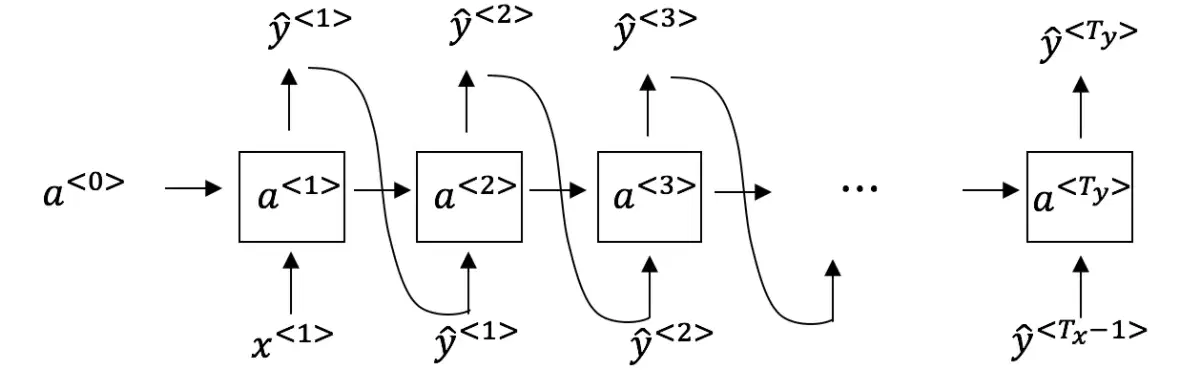
You have finished training a language model RNN and are using it to sample random sentences, as follows:
True/False: In this sample sentence, step t uses the probabilities output by the RNN to randomly sample a chosen word for that time-step. Then it passes this selected word to the next time-step.
False
True
True/False: If you are training an RNN model, and find that your weights and activations are all taking on the value of NaN (“Not a Number”) then you have an exploding gradient problem.
False
True
Suppose you are training an LSTM. You have an 80000 word vocabulary, and are using an LSTM with 800-dimensional activations a<t> . What is the dimension of Γu at each time step?
800
80000
100
8
True/False: In order to simplify the GRU without vanishing gradient problems even when training on very long sequences you should remove the Γr i.e., setting Γr= 1 always.
False
True
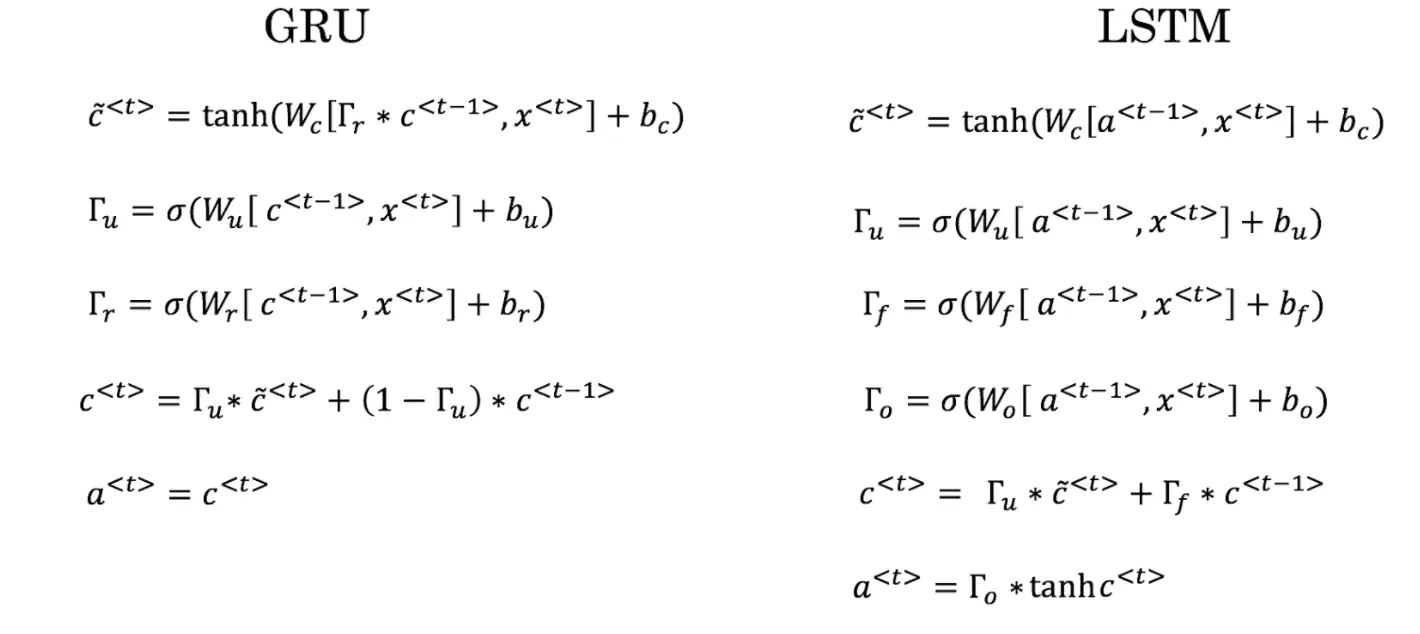
True/False: Using the equations for the GRU and LSTM below the Update Gate and Forget Gate in the LSTM play a different role to Γu and 1- Γu.
False
True
Your mood is heavily dependent on the current and past few days’ weather. You’ve collected data for the past 365 days on the weather, which you represent as a sequence as x<1> ,…, x<365> . You’ve also collected data on your mood, which you represent as y<1> ,…, y<365> . You’d like to build a model to map from x→y. Should you use a Unidirectional RNN or Bidirectional RNN for this problem?
Bidirectional RNN, because this allows the prediction of mood on day t to take into account more information
Undirectional RNN, because the value of y<t> depends on x<t> , and not other days' weather
Bidirectional RNN, because this allows the prediction of mood on day t to take into account more information
Undirectional RNN, because the value of y<t> depends only on x<1> ,..., x<t> , but not on x<1> ,..., x<365>
Which type of Neural Network is suitable to solve spatial feature recognition?
CNN
Fully Connected Network
ANN
RNN
Which statement best describes the training process of an LSTM model?
a) It uses gradient descent to optimize the model’s weights
b) It uses the forward-backward algorithm for sequence labeling
c) It leverages the attention mechanism for contextual information
d) It involves unfolding the LSTM through time and applying backpropagation through time (BPTT)
Which variant of LSTM is designed to handle bidirectional sequence modeling?
a) Gated Recurrent Unit (GRU)
b) Clockwork RNN
c) Bidirectional LSTM
d) Stacked LSTM
Which of the following techniques is commonly used to alleviate the vanishing gradient problem in LSTM networks?
a) Dropout regularization
b) Batch normalization
c) Gradient clipping
d) Learning rate decay
Which component(s) is/are present in an LSTM cell?
a) Input gate
b) Output gate
c) Forget gate
d) All of the above
Which activation function(s) are commonly used in LSTM networks?
a) Sigmoid
b) Tanh
c) ReLU
d) Both a) and b)
What is the purpose of the recurrent connection in an RNN?
a) To propagate the hidden state across different time steps
b) To adjust the weights and biases of the network
c) To reduce the dimensionality of the input data
d) None of the above
Which layer type is commonly used in RNNs for speech recognition tasks?
a) Input layer
b) Hidden layer
c) Output layer
d) None of the above
What is the primary purpose of a Recurrent Neural Network (RNN)?
a) Image classification
b) Text generation
c) Reinforcement learning
d) Object detection
How does the YOLO (You Only Look Once) algorithm improve object detection performance?
By dividing the image into a grid and predicting bounding boxes and class probabilities for each grid cell
By using a sliding window approach to scan the entire image for objects
By applying a separate classifier for each object class in the image
By resizing the input image to a fixed size before processing
What is the purpose of non-maximum suppression in object detection algorithms?
To reduce the number of redundant bounding box predictions for the same object
To increase the resolution of the feature maps for better object localization
To introduce randomness in the training process for better generalization
To adjust the learning rate dynamically during optimization
What is the primary advantage of using bidirectional LSTM networks over unidirectional ones?
Improved memory cell capacity
Ability to process sequence data in both forward and backward directions
Reduced computational complexity
Enhanced control over weight updates
How does the concept of attention mechanism enhance the performance of LSTM networks?
By focusing on specific parts of the input sequence during processing
By increasing the number of memory cells in the network
By reducing the number of layers in the LSTM architecture
By using a different activation function for the forget gate
What is the purpose of the forget gate in a Long Short-Term Memory (LSTM) network?
To store the output of the activation function
To control the flow of information through the network
To maintain long-term dependencies in the sequence data
To determine the learning rate for weight updates
How does the LSTM architecture differ from traditional recurrent neural networks (RNNs)?
LSTM networks have a single hidden layer, while RNNs have multiple layers
LSTM networks use a memory cell to store information over time steps
RNNs have a forget gate to control the flow of information
LSTM networks do not support sequential data processing
What is the purpose of the cell state in a Long Short-Term Memory (LSTM) network?
To store the output of the activation function
To control the flow of information through the network
To maintain long-term dependencies in the sequence data
To determine the learning rate for weight updates
Why is regularization important in machine learning models?
To control the size of the weight updates during optimization
To optimize model parameters and reduce overfitting
To define the number of layers in the neural network
To select the type of activation function for the model
What is the significance of the learning rate in gradient descent optimization?
To determine the number of epochs for training
To control the size of the weight updates during optimization
To define the number of layers in the neural network
To select the type of activation function for the model

