
 Worksheets
U3 Colonial Development Test Review
Total questions: 60
Worksheet time: 24mins
True or False: Rights such as life or liberty that a person is born with is NOT natural rights
True
False
A wide variety of people or things.
Diversity
Monotonous
Natural Rights
TRUE or FALSE: Religious Freedom is having the ability to practice your religion without government interference.
False
True
______ a series of laws passed by the English Parliament to protect English shipping by restricting the transport of goods to and from the English Colonies.
Triangular Trade
Magna Carta
The Silk Road
Navigation Acts
Under the Navigation Acts, where did all European goods bound for the American colonies go first?
Boston
England
New York
West Indies
Under the Navigation Acts, what happened to European goods shipped to the colonies?
They were first delivered to England, where they were inspected
They went to Caribbean ports first, where most of them were sold
they were shipped to New York or Boston because it was illegal to ship to other cities
They were sold immediately because the demand was so high
What synonyms would be used to define TOLERANCE?
resistance
sensitive
angry
acceptance
willingness
endurance
closed off
bias
unfair
prejudice
slavery
struggle
A person trained in a skill or labor.
Quaker
Artisan
Puritans
Debtor
Navigation Acts
A person or company who sells goods/products (merchandise)
In: goods coming into a country
Exit: goods going out of a country (selling)
The specific laws passed by England to control the trade
How did merchants in the American colonies react to British trade laws, like the Navigation Acts and the Molasses Act?
They ignored British trade laws and smuggled goods.
They obeyed British trade laws, even though they disagreed with the laws.
They used guerrilla warfare against the British Army.
They declared independence from Britain and wrote the Constitution.
In the 1700s, New Englanders engaged in global trade. What term do historians use for the trade routes that New England merchants used to trade large quantities of codfish, sugarcane, rum & slaves with the Caribbean Islands & West Africa?
Navigation Acts
Triangular trade
The Middle Passage
The Great Migration
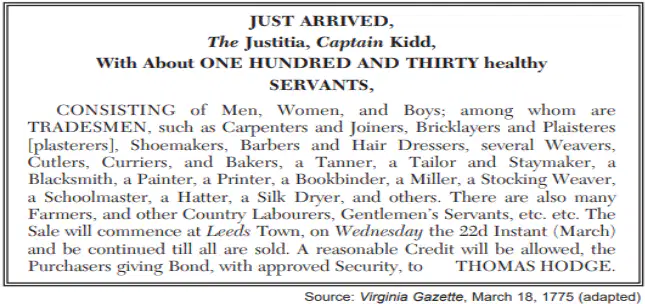
Based on this notice, what was the main reason immigrants were willing to enter into years of indentured servitude in British North America?
They faced harsh punishments for petty criminal acts.
They believed they could eventually prosper in the colonies.
They could immediately pay off the debt they owed to colonial sponsors.
They were facing severe hardship as a result of the Great Famine.
John Locke said your rights are natural, meaning:
You get them from a King
You get them from the government
You get them when you are born
You get them from your family

Why did the Colonies develop different economically?
Politics
Geography
Social Reasons
Religious Reasons
The definition of mercantilism is
an economic system where the colonies benefit the mother country
a government system where merchants have all the power
a religious system where people can buy their way into heaven
a social system that regards merchants as an important role


What was the British policy of salutary neglect towards their colonies?
A system of high taxes on nearly all goods to enrich the British monarch
A system where the British mostly ignored their colonies and let them rule themselves (turned their back)
A policy of severe punishment for anyone not following British laws or not paying taxes
The granting of independence to anyone who wants it
The main reason that Britain taxed the colonists was to
give raises to all of the soldiers
cover the cost of settling other lands
pay the debt they had because of war
provide extra money for supplies sent to the colonies
During the early to mid-1700s, the British policy of salutary neglect toward the American colonies contributed to
a decline in colonial maufacturing
the decline of slavery in the northern colonies
a decrease in French and Spanish influence in North America
the development of independent colonial trade practices
What aspect of South Carolina's colonial government was directly influenced by Barbadian practices?
Religious tolerance policies
Slave codes
Trade regulations (rules)
Property Rights
How did Barbadian influence affect South Carolina's social structure?
It created a more egalitarian society
It encouraged small family farms
It established a rigid class system
It promoted religious diversity
Which of the following were "Pull Factors" that encouraged settlers to move (migrate) to the Carolina Colony? (Pick 2)
The silver and gold deposits to mine
The headright system
To settle in colony that was primarily Puritan
To seek more land & new opportunities
Which group was primarily responsible for collecting quitrents in the colonies?
The British Parliament
Native American tribal leaders
The Port Authority
Proprietors or colonial landowners
Under the Fundamental Constitution, what title was given to the hereditary landowners who held the most power?
Governor
Plantation Manager
Lord Proprietor
Colonial Master
Why would the Fundamental Constitution of Carolina be considered a "Pull Factor"?
The promise of land to the Native Americans
The promise of titles and power to all settlers
The promise of plantations and slaves to all settlers
The promise of religious freedom and other natural rights
Place these events from colonial South Carolina history in chronological order.
Regulators enforce law and order in the South Carolina backcountry
SC assembly creates sheriffs, courts, jails for the backcountry
SC assembly creates townships in the backcountry
Thousands of settlers move to the South Carolina backcountry
Which map shows the shaded region where wealth and power was concentrated in colonial South Carolina because of rice and indigo plantations?


Choose all the correct reasons (there are three) for the tension between the Lowcountry and the Backcountry.
The Backcountry controlled most of the wealth and political power.
The Backcountry had a lack of representation in the colonial assembly.
There were ethnic and religious differences between the two regions.
Wealth and power was concentrated in the Lowcountry.
What was the main purpose of the Regulator Movement?
to promote random violence
to provide law and order
to overthrow the colonial govt.
to take control of the assembly
What helped end the Regulator Movement in the Up Country?
the passage of the Church Act making the Anglican Church the official church of South Carolina.
the start of the Yemassee War which caused the colonists to fight the Native Americans rather than each other.
the ruling by the governor to allow the French Hugenots citizenship rights including the right to vote.
the passage of the Circuit Court Act which established courthouses and sheriff's offices throughout South Carolina.
What was (were) the goal(s) of the Regulator Movement that occurred in the South Carolina Back Country? (Select 2)
to promote trade with the Native Americans
to enforce the British trade regulations on the colonies
to provide law and order on the frontier
to encourage farmers to grow more cash crops
to gain more political representation in the General Assembly
What condition resulted in the rise of the Regulator Movement in South Carolina?
Objections to the quartering of British troops led South Carolina to form its own independent militia.
Attacks by Native Americans on Low Country plantations led the wealthy to hire their own private armies.
A lack of law enforcement in the Back Country led citizens to establish their own system of vigilante justice.
Anger over the trade regulations set by the Lord Proprietors led the colonists to overthrow the governor and elect their own leader.
Which statement describes a result of the Revolution of 1719?
Match the following colony types with the corresponding definition.
Royal Colonies
Under direct control of the crown through a bicameral process.
Proprietary Colonies
Organized by a person to whom the king made a grant of land. Operated via a unicameral system.
Charter Colonies
Organized by colonists themselves. They were self-governing and using a bicameral system.
Match the following
This person led experiments with indigo, finding a strain that would grow in Carolina.
Eliza Lucas Pinckney
This person's was born in Africa, captured in Africa, and forced into slavery. They purchased their freedom and wrote and autobiography.
Olaudah Equiano
This was the most influential Lord Proprietor in setting up the Carolina Colony and co-wrote the Fundamental Constitution of the Carolinas.
Sir Anthony Ashley Cooper
The Lords Proprietors were able to do which of the following?
Build forts and castles
Grant titles of nobility
Collect Taxes
All of the above
True or False: Carolina stretched from the Atlantic to the Pacific Ocean.
True
False
Choose the three things settlers were promised...
Free Land (Headright System)
Religious Freedom
Ways to make money
A say in the government
Why did South Carolina become a royal colony?
SC felt neglected by the Proprietors
The Proprietors no longer wanted SC
Felt the Proprietors were too strict
Felt they would make more money as a royal colony
In general, which group had the right to vote during the colonial times?
white men owning land
women
Native Americans
White men
Which groups of people did SC settlers have to worry about getting attacked by?
Check all (3) that apply.
Pirates
Spanish
Native Americans
Lords Proprietors
With what do you best associate Eliza Lucas Pinckney?
Cotton
Indigo
Naval Stores
Rice
How did the Lords Proprietors respond to the Indian attacks?
They did nothing
They sent an army to attack the Indians
They made the Indians leave Carolina
They sent the Indians poisoned food
Once S.C. became a royal colony, rice planters ___________________
had to send their rice directly to England
were able to trade more with other countries and make a greater profit
got more and more in debt
went out of business
Why was indigo such a valuable product?
Bright color dyes were hard to find in nature, so indigo was in high demand, and sold for high prices.
It was an antidote for the Copperhead and Cottonmouth snake bites that they were important to cure slaves .
Indigo was a cheap food source that filled the slaves up quickly, so planters bought large quantities.
All answers are correct
Why was rice not a good for ALL of Carolina which led Carolina to find a 2nd cash crop?
It could only be grown in the clay soil of the Piedmont.
It had to be grown close to the ocean because the humidity helped the rice not dry too soon.
It could only be grown along coastal rivers near the ocean because tides were used to flood the fields.
African slaves were not allowed anywhere but in the up country and they were only ones who knew how to grow the rice.
Where did much of the information & skills about how to grow rice come from?
The English had been growing rice in England, so they already had prior knowledge.
The Native Americans had grown rice for years and showed them how to grow it on high land.
They read old African guide books that were sent by the King of Africa.
The African slaves brought their knowledge of rice growing over with them from West Africa.


What continents did the Atlantic Slave Trade include?
North America, South America, and Brazil
North America, South America, Europe, and Africa
North America, Europe, and Africa
South America, Asia, and Europe
What were the new crops grown in the colonies that demanded slave labor?
Indigo, rice, cotton, tobacco
Sugar cane, cotton, wheat, rice
Cotton, wheat, corn, indigo
Cotton, corn, indigo, sugar cane
What happened when the ships arrived in the New World?
Slaves were sold and then manufactured goods were bought.
Slaves were sold at an auction and then they bought raw materials.
The raw materials were traded for Slaves.
Cotton, sugar, spices, rum and tobacco were bought.
Ships left Europe loaded with....
Slaves
Raw Goods
Manufactured goods
Tools
Why were Africans captured and forced to work in the Americas?
Match the following terms and definition
English philosopher who heavily influenced the Age of Enlightenment through his theory of natural rights, arguing that people are born with basic rights to "life, liberty, and property".
John Locke
The idea that all humans are born with rights, which include the right to life, liberty, and property.
Natural Rights
A ruling class made up of wealthy planters who held great influence over a society's political, economic, and cultural life
Plantocracy
Rich, fertile soil that is made up of about equal parts of clay, sand, and silt
Loam
Items produced from raw materials using labor and investment resources
Manufactured Goods
Match the terms to the definitions
Materials used to build and maintain ships, such as tar, pitch, rosin, and turpentine
Naval Stores
Heavy material placed low in a vessel to improve its stability
Ballast
Cash crop which enriched the Carolina Colony. The skill to cultivate rice originated in West Africa.
Carolina Gold (rice)
In the traditional “foundation” story of Carolina rice, a storm-damaged ship from this location in 1685 sailed into Charleston for repairs. The English ship captain gave some rice seeds to a Charleston doctor, and the Carolina colony's rice industry supposedly grew from them.
Madagascar
A colorless oil made from pine sap, a traditional naval store used to waterproof wooden ships and sailing vessels
Turpentine

