
 Worksheets
PES 2025 Quiz
Total questions: 70
Worksheet time: 35mins
What does the impulse-momentum relationship describe in biomechanics?
The relationship between angular momentum and moment of inertia
The relationship between force and the change in momentum
The principle of Bernoulli's effect
The effect of drag on fluid mechanics
Which of the following is a key concept in angular kinetics?
Coefficient of restitution
Conservation of angular momentum
Laminar flow
Magnus effect
What is the primary difference between laminar and turbulent flow in fluid mechanics?
Laminar flow is smooth, while turbulent flow is chaotic
Laminar flow involves drag, while turbulent flow does not
Laminar flow occurs in solids, while turbulent flow occurs in liquids
Laminar flow is caused by Magnus effect, while turbulent flow is not
Which type of drag is caused by the shape and surface texture of an object?
Surface drag
Pressure drag
Wave drag
Magnus drag
What principle explains the lift force generated by a spinning ball?
Bernoulli's principle
Coefficient of restitution
Impulse-momentum relationship
Conservation of angular momentum
Which of the following is an example of a biomechanical principle applied to balance?
Segmental interaction
Optimal projection
Coefficient of restitution
Center of gravity
What is the Magnus effect in fluid mechanics?
The effect of angular momentum on rotational motion
The influence of spin on the trajectory of a ball
The relationship between impulse and momentum
The principle of laminar flow in fluids
Which of the following is an example of a third-class lever in biomechanics?
A seesaw
A pair of scissors
A human arm lifting a weight
A wheelbarrow
What does the term 'optimal projection' refer to in biomechanics?
The ideal angle and speed for achieving maximum distance or height
The balance of forces in fluid mechanics
The conservation of angular momentum
The effect of drag on an object
Which of the following is NOT a type of drag in fluid mechanics?
Surface drag
Pressure drag
Wave drag
Angular drag
What is biomechanics primarily concerned with?
The study of nutrition and its effects on the body
The study of motion and the effects of forces relative to the body
The study of mental health and its impact on performance
The study of environmental factors affecting human behavior
How does biomechanics contribute to sports performance?
By improving mental focus during competitions
By enhancing mechanical aspects of sports performance
By providing dietary recommendations for athletes
By analyzing team strategies and tactics
Which laws does biomechanics apply to human performance?
Laws of biology and chemistry
Laws of mechanics and physics
Laws of psychology and sociology
Laws of anatomy and physiology
What is one of the benefits of biomechanics in sports?
Technique inefficiency
Injury reduction through understanding injury causes
Increased risk of injury
Decreased accuracy in sports performance
How does biomechanics help in modifying sports equipment?
By making equipment heavier and harder to use
By reducing the size of equipment without improving usability
By making junior size equipment lighter and easier to use
By removing technological advancements from equipment
Which of the following is an example of technological development in sports equipment mentioned in biomechanics?
Cricket bats made heavier for better grip
Bowling machine in cricket
Tennis racquets with reduced accuracy
Golf equipment without technological advancements
What is the purpose of video software in biomechanics?
To reduce the efficiency of sports techniques
To assist in the transition from practice field to playing field
To increase injury risks during practice
To eliminate the need for practice sessions
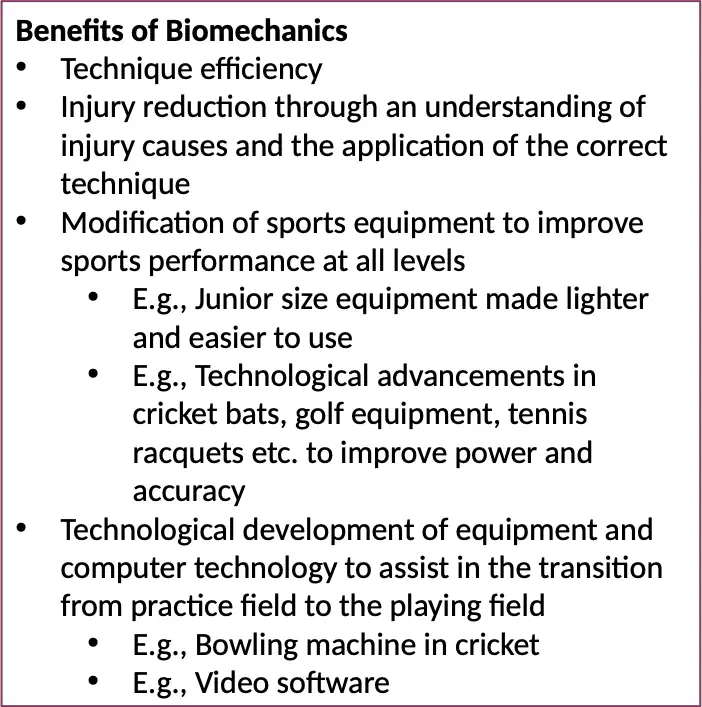
The benefits of biomechanics in sports include:
Improved performance and injury prevention
Increased risk of injury
Decreased understanding of movement
Reduced athletic ability
What is the relationship called that connects impulse and momentum in linear kinetics?
Force-velocity relationship
Impulse-momentum relationship
Energy-work relationship
Acceleration-mass relationship
Which of the following is NOT a characteristic of interacting bodies that affects the coefficient of restitution in sports?
Temperature
Equipment and surfaces
Velocity
Mass of the athlete
How does velocity influence the coefficient of restitution in sports?
It determines the direction of motion.
It affects the energy transfer during impact.
It changes the temperature of the interacting bodies.
It alters the mass of the objects involved.
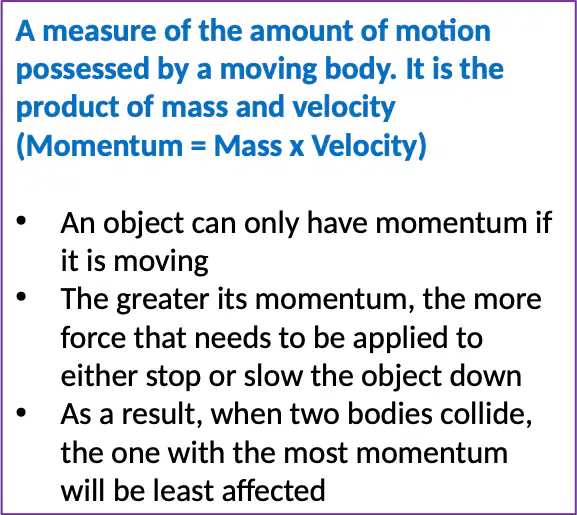
What is the formula for momentum?
Momentum = Mass x Velocity
Momentum = Mass x Acceleration
Momentum = Force x Velocity
Momentum = Force x Acceleration
Which of the following statements about momentum is true?
An object can have momentum even if it is stationary.
The greater the momentum, the less force is needed to stop the object.
Momentum is only affected by velocity, not mass.
An object can only have momentum if it is moving.
What happens when two bodies collide, and one has more momentum than the other?
Both bodies are equally affected.
The body with less momentum is least affected.
The body with more momentum is least affected.
Momentum is distributed equally between the two bodies.
How does greater momentum affect the force needed to stop or slow an object?
Greater momentum requires less force to stop or slow the object.
Greater momentum requires more force to stop or slow the object.
Momentum does not affect the force needed to stop or slow the object.
Momentum is inversely proportional to the force needed to stop or slow the object.
What is the formula for impulse?
Impulse = mass × acceleration
Impulse = force × time
Impulse = velocity × time
Impulse = force ÷ time
Which of the following best describes the role of impulse in momentum?
Impulse decreases the mass of an object
Impulse creates, changes, or stops momentum
Impulse increases the velocity of an object
Impulse reduces the acceleration of an object
What does the term "force" represent in the formula for impulse?
The object's mass multiplied by its acceleration
The object's velocity divided by time
The object's weight multiplied by gravity
The object's momentum divided by time
What happens when impulse is applied to an object at rest?
The object remains at rest
The object creates momentum and starts moving
The object loses mass
The object increases its acceleration but remains stationary
Which of the following is an example of stopping momentum using impulse?
A car accelerating on a highway
A ball rolling down a hill
A goalkeeper catching a soccer ball
A person pushing a box across the floor

What does the impulse-momentum relationship suggest about catching a ball?
A large peak force over a short time is always better.
A smaller peak force over a longer time reduces the risk of injury.
The impulse-momentum relationship does not apply to catching a ball.
Both methods are equally effective regardless of the situation.
What is the relationship between the duration of force application and the impulse or change in momentum of an object?
The shorter the force is applied, the greater the impulse.
The longer the force is applied, the greater the impulse.
The duration of force application has no effect on impulse.
Impulse is only dependent on the mass of the object.

Which method in shot put is likely to generate the greatest impulse and why?
Standing shot put throw, because it uses less force.
Glide method, because it applies force for a longer duration.
Rotation method, because it combines force and extended duration.
None of the methods generate impulse.

What is the importance of impulse in impact or collision situations?
It helps in maintaining the speed of an object.
It allows manipulation of momentum to produce desired outcomes like speeding up or slowing down an object.
It prevents objects from colliding.
It increases the mass of the colliding objects.
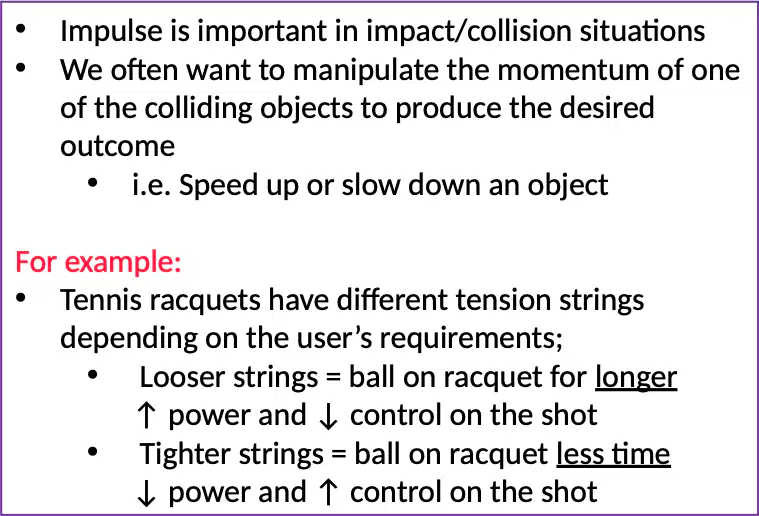
What happens when tennis racquets have looser strings?
The ball stays on the racquet for less time, increasing power and control.
The ball stays on the racquet for longer, increasing power but decreasing control.
The ball stays on the racquet for longer, decreasing power and control.
The ball stays on the racquet for less time, decreasing power but increasing control.
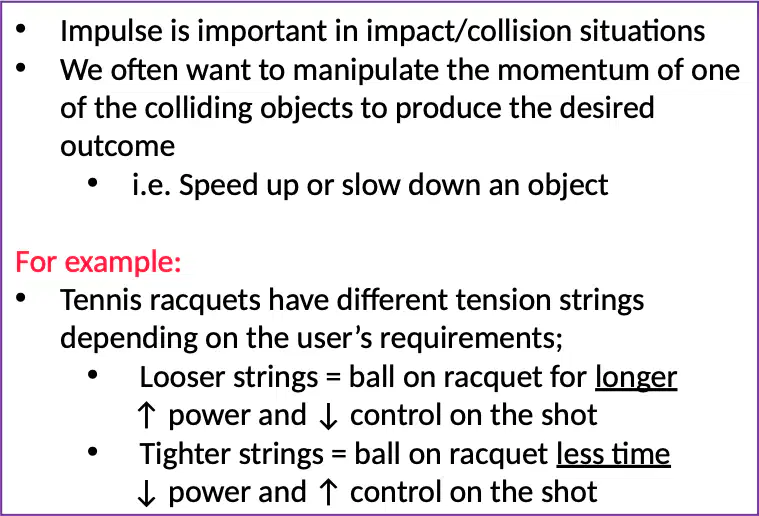
What is the effect of tighter strings on a tennis racquet?
The ball stays on the racquet for longer, increasing power but decreasing control.
The ball stays on the racquet for less time, decreasing power but increasing control.
The ball stays on the racquet for less time, increasing power and control.
The ball stays on the racquet for longer, decreasing power and control.
What are the two components that must be increased to maximize the momentum of an object?
Force and velocity
Force and time
Time and distance
Strength and technique
How can force be increased to maximize momentum?
By reducing equipment modifications
Through effective summation of force and improved strength
By decreasing the time component
By increasing the distance traveled
What is one way to increase the time component to maximize momentum?
By improving strength
Through technique and equipment modifications
By reducing force
By increasing velocity

What is the purpose of drawing the bowstring back in sports like archery?
To decrease the force applied to the arrow
To increase the change in momentum of the arrow
To reduce the speed of the arrow
To shorten the distance the arrow travels

How does drawing the bowstring back affect the arrow's movement?
It ensures the arrow travels at slower speeds
It ensures the arrow travels at greater speeds and covers larger distances
It reduces the force applied to the arrow
It prevents the arrow from moving in a straight line

Which concept explains the relationship between drawing the bowstring back and the arrow's speed in archery?
Friction
Impulse-momentum relationship
Gravity
Energy conservation

What happens when more time is allowed for the force of the bow to be applied to the arrow?
The arrow loses momentum
The arrow gains momentum and travels faster
The arrow becomes heavier
The arrow travels shorter distances
What is a common method to reduce the momentum of an object?
Decrease the time component
Increase the time component
Apply a large peak force over a short period
Apply no force at all
When a cricket ball is hit towards a fielder, what is the goal of the fielder in terms of momentum?
Increase the ball's momentum
Maintain the ball's momentum
Reduce the ball's momentum to zero
Double the ball's momentum
Which method is more likely to be successful in catching a cricket ball?
Creating a large peak force over a short period
Applying a small peak force over a longer period
Applying no force at all
Increasing the ball's speed

What is the primary function of the foam inside running shoes according to the impulse-momentum relationship?
To increase the speed of running.
To reduce the likelihood of injury by increasing the time the force is applied and absorbing impact forces.
To make the shoes more durable.
To improve the grip of the shoes on the ground.

How does the padding on high jump and pole vault mats help reduce the likelihood of injury?
By increasing the height of the jump.
By reducing the time the force is applied.
By increasing the time the force is applied and reducing the peak force experienced by the body.
By making the mats softer for landing.
What is the common goal of both the foam in running shoes and the padding on high jump mats?
To improve athletic performance.
To reduce the likelihood of injury by managing impact forces.
To increase the speed of movement.
To enhance the aesthetic appeal of sports equipment.
Which principle is demonstrated by the use of foam in running shoes and padding on high jump mats?
Conservation of energy.
Impulse-momentum relationship.
Newton's law of universal gravitation.
Law of inertia.

Why would an elasticised rope be more beneficial than a non-elastic rope in reducing an individual's momentum to zero during a bungee jump?
An elasticised rope increases the time over which the force is applied, reducing the impact.
An elasticised rope decreases the time over which the force is applied, increasing the impact.
A non-elastic rope increases the time over which the force is applied, reducing the impact.
A non-elastic rope decreases the time over which the force is applied, increasing the impact.

What concept is used to explain the benefit of an elasticised rope in a bungee jump?
Friction
Impulse
Gravity
Acceleration

How does an elasticised rope affect the force experienced by the jumper during a bungee jump?
It increases the force experienced by the jumper.
It decreases the force experienced by the jumper by spreading it over a longer time.
It has no effect on the force experienced by the jumper.
It decreases the force experienced by the jumper by shortening the time of impact.
What is one way to increase momentum during the throw in cheerleading, as described in the impulse-momentum relationship?
Apply maximum size force through effective force summation.
Decrease the time component during the throw.
Avoid using the full range of motion.
Minimize the force applied during the throw.
How can momentum be decreased during the catch in cheerleading, according to the impulse-momentum relationship?
Decrease her momentum over the shortest time possible.
"Give" with the catch by bending at the knees to increase the time over which momentum is taken back to zero.
Apply maximum force over a short period of time.
Keep the legs straight and rigid during the catch.
What is the purpose of increasing the time component during the throw in cheerleading?
To reduce the athlete's range of motion.
To increase the range of motion over which the athlete is moved.
To decrease the force applied during the throw.
To minimize the athlete's momentum.
Why is it important to "give" with the catch in cheerleading?
To decrease the time over which momentum is taken back to zero.
To increase the time over which momentum is taken back to zero.
To apply maximum force during the catch.
To reduce the athlete's momentum to zero instantly.
What is the relationship mentioned in the context of the coefficient of restitution?
Impulse-momentum relationship
Force-velocity relationship
Energy-transfer relationship
Acceleration-time relationship
Which of the following factors affect the coefficient of restitution in sports?
Equipment and surfaces, temperature, velocity
Equipment and surfaces, pressure, mass
Temperature, mass, acceleration
Velocity, pressure, energy
How does temperature influence the coefficient of restitution in sports?
By altering the elasticity of materials
By increasing the mass of objects
By reducing the velocity of objects
By changing the shape of surfaces
What is the primary role of equipment and surfaces in determining the coefficient of restitution?
They influence the energy transfer during impact
They determine the mass of the objects
They control the temperature of the environment
They regulate the acceleration of objects
What does the Coefficient of Restitution (COR) measure?
The elasticity of the collision between an object and a given surface.
The weight of an object during a collision.
The speed of an object after a collision.
The temperature change during a collision.
What does a COR value of 1 represent?
A perfectly inelastic collision.
A perfectly elastic collision.
A collision with no rebound.
A collision with partial rebound.
What happens when an object has a COR value of 0?
The object rebounds to its original height.
The object bounces slightly.
The object stops at the surface with which it collides.
The object accelerates after the collision.
Which of the following represents a perfectly inelastic collision?
A basketball bouncing back to its original height.
A tennis ball rebounding partially after hitting the ground.
Play dough stopping at the surface with which it collides.
A rubber ball bouncing higher than its original height.

What is elasticity in the context of collisions?
A measure of how much energy is lost during a collision.
A measure of how much rebound exists following a collision.
A measure of the weight of the object during a collision.
A measure of the speed of the object after a collision.
What property of baseballs allows them to return to their original shape quickly after deformation?
Hardness
Elasticity
Density
Rigidity
What was the primary reason for making baseballs more elastic in 1920?
To reduce the number of collisions
To encourage longer hitting
To make the game safer
To increase the weight of the baseballs
What was one major outcome of making baseballs more elastic in 1920?
The game became slower
The number of home runs doubled
Baseballs became heavier
The game became less popular

Why do baseballs lose less energy during a collision with a bat?
They are made of hard material
They are highly elastic and return to their original shape quickly
They are lightweight
They are designed to absorb energy

