
 Worksheets
Energy systems
Total questions: 71
Worksheet time: 40mins
How is the human body made to move?
Quickly and powerfully
Gracefully and coordinated
Sustained for many hours
All of the above
Quick movements...
Lasts a few seconds
Lasts for several minutes
Lasts for several hours
Reduced speed...
Lasts for several hours
Lasts a few seconds
Lasts for several minutes
Reduced intensity (50%)...
Lasts for several minutes
Lasts for several hours
Lasts a few seconds
How do you measure your max heart rate?
(a)
Low intensity
0-50%
<70%
0%
Moderate intensity
90-70%
30-50%
50%
High intensity
100%
70%>
90-100%
Food=energy
No energy=?
Minimal function
Body stops
Death
Do cells get their energy directly from foods?
True
False
What does ATP stand for?
(a)
What is ATP?
An energy system
A form of energy we immediately use, needed for cells to function and muscles to contract
It is ATP that is resynthesized in order for us to continue performing. How can ATP be resynthesized?
Food
Energy systems
Energy
Fuel sources
When digested, carbohydrates are broken down into...
Glucose
Fatty acids
Amino acids
When digested, fats are broken down into...
Glucose
Fatty acids
Amino acids
When digested, proteins are broken down into...
Glucose
Fatty acids
Amino acids
How are carbohydrates/glucose stored in the body?
Glycogen
Body fat
Amino acids
How are fats/fatty acids stored in the body?
Glycogen
Body fat
Amino acids
How are proteins/amino acids stored in the body?
Glycogen
Body fat
Amino acids
What is the body's preferred source of fuel?
Proteins
Carbohydrates
Fats
What are the two types of carbohydrates?
Simple carbohydrates, complex carbohydrates
Sugars, starches
All of the above
What are simple carbohydrates/sugars?
Composed of one or two glucose molecules. These are broken down quickly.
Made up of many hundreds of glucose molecules. These take longer to break down.
What are complex carbohydrates/starches?
Composed of one or two glucose molecules. These are broken down quickly.
Made up of many hundreds of glucose molecules. These take longer to break down.
What can glycogen provide the energy for ATP resynthesis for?
Aerobic
Anaerobic
All of the above
None of the above
During low intensity exercises, how much do carbohydrates contribute to the body's energy requirements?
1/3
1/2
3/4
2/3
Foods with a high glaecemic index (70 and above)...
Rapidly digested, and result in a rapid increase of blood sugar levels.
Produce gradual rises of blood glucose due to being slowly digested. Health benefits such as weight loss, blood sugar levels, insulin control, disease prevention, increased energy, improved mood.
Foods with a low glycaemic index (55 or less)...
Rapidly digested, and result in a rapid increase of blood sugar levels.
Produce gradual rises of blood glucose due to being slowly digested. Health benefits such as weight loss, blood sugar levels, insulin control, disease prevention, increased energy, improved mood.
What is the body's main source of fuel at rest?
Fats
Carbohydrates
Protein
What are the two types of fats?
Unsaturated fats, saturated fats
Food fats, body fats
What can saturated fats be found in?
Dairy products
Meat products
Vegetable oil
Oily fish
What are the two types of unsaturated fats?
Monosaturated
Polyunsaturated
Monounstaurated
Polysaturated
What is the most concentrated form of energy for ATP resynthesis?
Carbohydrates
Protein
Fats
Fats become increasingly more important when stores of carbohydrates/glycogen start to deplete. This occurs after around ______ _______ of continuous exercise
3-10 seconds
10-90 seconds
3 hours
90-120 minutes
What is protein mainly used for?
Used to fuel physical activity
Used for growth and repair
All of the above
What can protein and essential amino acids be found in?
Meat
Poultry
Fish
Eggs
Dairy Products
What can be manufactured by the body?
Essential amino acids
Non-essential amino acids
Excess amino acids are converted to ___ and stored within adipose tissue
Fat
Carbohydrates
Protein
What is the recommended daily intake of carbohydrates?
55-65%
20-25%
~15%
70%
What is the recommended daily intake of fats?
30%
55-65%
~15%
20-25%
What is the recommended daily intake of protein?
15-20%
~15%
55-65%
20-25%
What are energy systems?
Provide the energy required by muscles for movement.
Provides energy that is required to enable ATP resynthesis to occur.
What are the two types of energy systems?
(a)
What are the three energy systems?
ATP-PC system
Anareobic glycolysis system
Aerobic system
ATP-CP system
The energy system we use in dependent on ________ and _________ of the activity
Duration and Intensity
Time and Intensity
Duration of the ATP-PC system
10-90 seconds
1 hour
2-10 seconds
90+ seconds
Duration of the anaerobic glycolysis system
2-10 seconds
10-90 seconds
1 hour
90+ seconds
Duration of the aerobic system
1 hour
10-90 seconds
2-10 seconds
90+ seconds
Is the ATP-PC system anaerobic or aerobic?
Anaerobic
Aerobic
What is the ATP-PC system limited by?
Amount of PC stored in the muscles
Duration of activity
When PC stored are about 50% depleted, what system takes over as the major producer of ATP?
Anaerobic glycolysis system
Aerobic system
How long does it take the ATP-PC system to replenish PC?
50% after 10 seconds
90% after 20 seconds
100% after 30 seconds
50% after 30 seconds
90% after 1 minute
100% after 3 minutes
50% after 30 minutes
90% after 1 hour
100% after 2.5 hours
50% after 10 minutes
90% after 12 minutes
100% after 15 minutes
What does LIP stand for?
(a)
What is Lactate inflection point?
When the body can prevent the accumulation of H+ ions in the working muscles.
When the body can prevent the accumulation of H+ ions in the blood stream.
When does the lactate inflection point occur?
Occurs when there is maximal lactate production matched with maximal lactate removal
Occurs when more lactate is being removed than there is being produced
Beyond the lactate inflection point...
Production of lactate slows dramatically
Lactate is produced faster than it can be oxidised or broken down
Where does lactate accumulate?
Muscles
Bloodstream
Bones
Ligaments
What does OBLA stand for?
Oxygen, Blood, Lactate, ATP
Onset of blood lactate
Lactate level gives a good indirect measure of...
Density of bones
Blood sugar level
H+ ion concentration
ATP
A golf swing is an example of the ATP-PC system
True
False
Running a marathon is an example of the anaerobic glycolysis system
True
False
The aerobic system is the fastest system to contribute towards ATP resynthesis
True
False
Why are carbohydrates the prefered source of fuel during exercise?
Metabolism
Provide more energy per gram
Produce energy faster than fat
Stores are more readily available
Which energy system operates independently from the other energy systems?
Aerobic system
Anaerobic glycolysis system
ATP-PC system
None of the above
What factors affect which energy system is operating during exercise?
Intensity
Duration
Oxygen availability
Depletion of fuels
Are court/field sports an example of the energy interplay system at work?
True
False
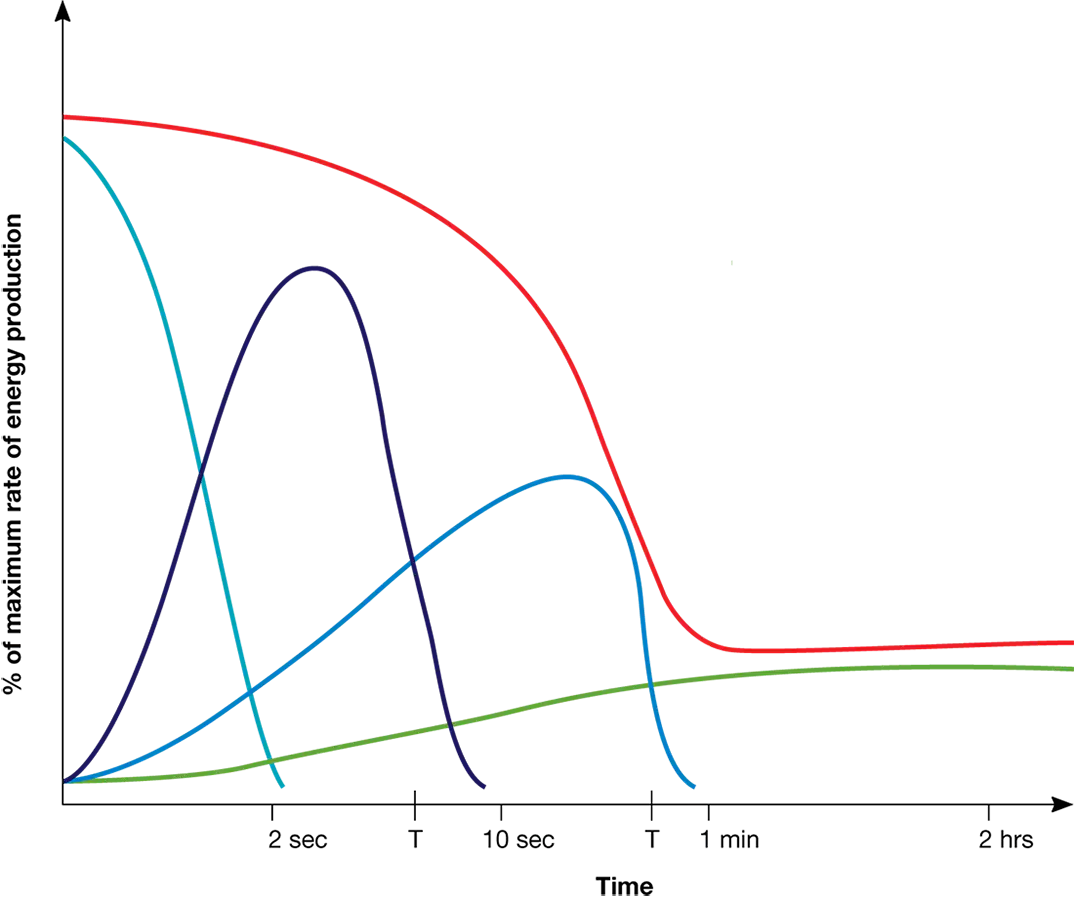
Which coloured line shows overall performance?
Red
Light blue
Blue
Green
Dark blue
Which coloured line shows ATP store?
Red
Light blue
Blue
Green
Dark blue
Which coloured line shows the ATP-PC system?
Red
Light blue
Blue
Green
Dark blue
Which coloured line shows the anaerobic glycolysis system?
Red
Light blue
Blue
Green
Dark blue
Which coloured line shows the aerobic system?
Red
Light blue
Blue
Green
Dark blue
What does ATP-PC stand for?
(a)

