
 Worksheets
11Gen Sport Psychology
Total questions: 56
Worksheet time: 29mins
What is one factor to consider when preparing mentally for physical activity? (Fill in the blank)
personal attitudes
weather conditions
type of shoes
number of participants
location of activity
Which of the following is a skill or strategy required for team building?
compromise
personal attitudes
participation
mental imagery
Which of the following is a skill or strategy required for team building?
commitment to group goals
values
positive mental talk
participation
What is one role of mental skills in creating a mind set to improve performance? (Fill in the blank)
know yourself
ignore feedback
avoid practice
focus only on winning
disregard emotions
What is one role of mental skills in creating a mind set to improve performance? (Fill in the blank)
use positive mental talk
ignore feedback from others
focus only on physical training
avoid setting goals
What is one role of mental skills in creating a mind set to improve performance?
believe in yourself
ignore your goals
avoid practice
doubt your abilities
focus on distractions
What is one role of mental skills in creating a mind set to improve performance? (Fill in the blank)
use your mind’s eye (mental imagery)
listen to loud music
eat a heavy meal before performing
ignore your emotions
What is one role of mental skills in creating a mind set to improve performance?
learn from success and failure
ignore feedback from others
avoid setting goals
focus only on physical training
Beliefs are assumed truths about ourselves, about others, and how we expect things to be in the world.
True
False
Beliefs are learned and based on ______ / socialisation with others.
interaction
meditation
punishment
imagination
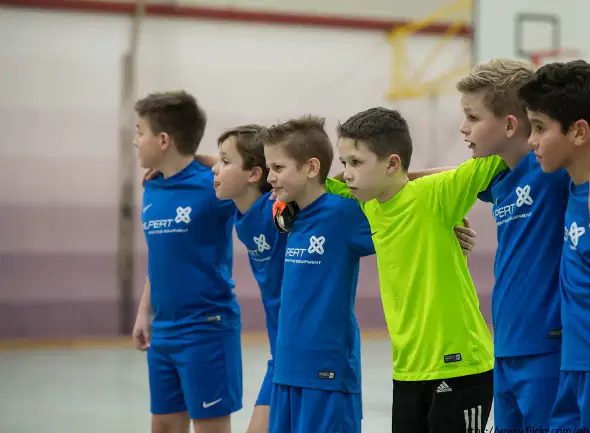
Our experiences in sport help to shape our beliefs either positively or negatively.
True
False
Values are what we have learned through the process of socialisation about right and wrong, good and bad.
True
False
Values determine behaviour when faced with choices. For example, do I cheat if I know I can get away with it? Values determine your response to this question.
True
False
What are attitudes?
A learned response towards people and situations based on an individual's beliefs and values
A set of rules for behaviour
A type of knowledge
None of the above
Which of the following is a characteristic of individuals with positive attitudes towards physical activity?
Participate on an irregular basis
Are likely to achieve goals and experience success
Find physical activity frustrating and boring
Have more stress and a less healthy lifestyle
Individuals with positive attitudes towards physical activity gain satisfaction from participating.
True
False
Individuals with negative attitudes towards physical activity find physical activity frustrating and boring.
True
False
Fill in the blank: Individuals with positive attitudes towards physical activity have a _______ physical self concept.
positive
negative
neutral
uncertain
Which of the following is a characteristic of individuals with negative attitudes towards physical activity?
Gain satisfaction from participating
Have a negative physical self concept
Have less stress and a healthier lifestyle
Are likely to achieve goals and experience success
Individuals with positive attitudes towards physical activity participate on a regular basis.
True
False
Which of the following is a skill or strategy required for team building?
Compromise
Competition
Isolation
Selfishness
Which of the following is required for team building?
Commitment to group goals
Individual achievement only
Disregard for others
Lack of trust
Fill in the blank: Using positive ________ talk is a mental skill that helps improve performance.
mental
physical
negative
silent
What is a group?
A collection of individuals who do not interact
A collection of at least two individuals who interact over a period, develop a collective identity and have shared interests, norms and values
A single person working alone
A random gathering of people
Fill in the blank: An aerobics class is considered a ______ because the members have common goals – fitness / weight loss – but do not depend on each other for success in achieving these goals.
group
team
committee
partnership
Fill in the blank: A team is like a group, but they ______ together and depend on each other to achieve a specific goal or outcome.
work
compete
ignore
separate
Is a beach volleyball team an example of a team or a group?
Team
Group
Club
Organization
A group of people meditating do not rely on each other to achieve their goals. Are the people meditating an example of a team or a group?
Group
Team
Committee
Organization
According to Tuckman (1965), what is the first stage of group development?
Storming
Forming
Norming
Performing
Fill in the blank: The stage of group development where the team begins to play and train together, and dispute and conflict are greatest as players compete for roles, is called ________.
Storming
Forming
Performing
Adjourning
Which stage of Tuckman's group development model is characterized by relationships being well understood and commitment to team goals?
A) Forming
B) Storming
C) Norming
D) Performing
Fill in the blank: In the ________ stage, the team is committed to performing well, social and task cohesion levels are optimal, and conflict resolution is swift.
Performing
Forming
Storming
Adjourning
In Tuckman's Stages of Group Development, what is the first stage called?
Forming
Storming
Norming
Performing
In the 'Forming' stage, a high level of guidance is required from the manager.
True
False
Which of the following is true about individual roles during the 'Forming' stage?
Roles are clearly defined
Individual roles are unclear
Roles are assigned by team members
Roles are not important
Processes are ______ well established during the 'Forming' stage.
not
always
fully
completely
What are group norms in the context of the 'Forming' stage?
Group norms are shared expectations of how group members should behave. They can be both formal and informal and include things such as training expectations, dress codes, etc.
Group norms are the financial contributions required from each group member during the forming stage.
Group norms refer to the physical location where the group meetings are held.
Group norms are the specific tasks assigned to each member at the start of the group.
Group roles refer to the shared expectation of how an individual should behave in a certain position. This includes ______ roles and playing roles.
leadership
support
communication
creative
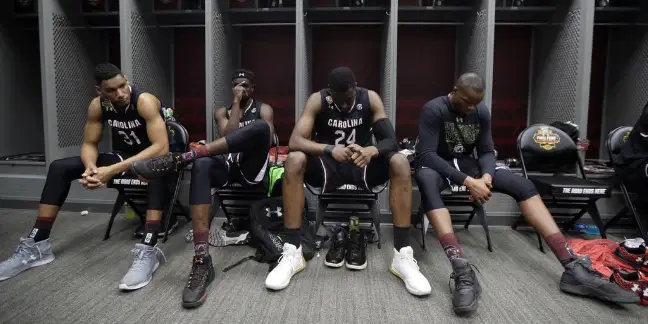
Conflict between players is common in the Storming stage as team members compete for status and roles.
True
False
What do group members start to understand during the Storming stage, even though struggles may erupt?
Group members start to understand how team decisions are made but struggles erupt over approaches, direction and control.
Group members start to understand each other's personal backgrounds and hobbies.
Group members start to understand the final goals and outcomes of the project.
Group members start to understand the technical skills required for the task.
How does Positive self talk benefit performance?
Re-inforces skill learning
Changes bad habits
motivates the performer
builds self confidence
all of the above
Who starts to emerge during the Storming stage of group development?
Dominant group members start to emerge.
The group leader starts to emerge.
Quiet members start to emerge.
External facilitators start to emerge.
A lack of clarity around which aspects can prevent teams from progressing to the next stage during Storming?
A lack of clarity around leadership, authority, rules, policies, norms etc. can prevent teams progressing to the next stage.
A lack of clarity around team celebrations and social events can prevent teams progressing to the next stage.
A lack of clarity around office location and seating arrangements can prevent teams progressing to the next stage.
A lack of clarity around individual hobbies and interests can prevent teams progressing to the next stage.
What do coaches put in place during the Storming stage to help the team?
Coaches put in place strategies to develop social and task cohesion.
Coaches assign individual tasks without team interaction.
Coaches remove all team rules and let members act freely.
Coaches discourage communication among team members.
According to Tuckman's Stages of Group Development, what happens to the team during Stage 3 – Norming? Fill in the blank: Team is now more settled with greater _______ of individuals.
acceptance
conflict
isolation
competition
According to Tuckman's Stages of Group Development, what replaces hostility between team members during Stage 3 – Norming? Fill in the blank: Hostility between team members is replaced by individuals working together to achieve a _______ goal.
common
personal
competitive
unclear
According to Tuckman's Stages of Group Development, which of the following best describes group interactions during Stage 3 – Norming?
Group interactions are more difficult and less productive
Group interactions are easier, more cooperative and productive
Group interactions are competitive and unproductive
Group interactions are unchanged
According to Tuckman's Stages of Group Development, what is the team committed to during Stage 4 – Performing?
The team is committed to performing well and functions at a very high level.
The team is committed to resolving conflicts and clarifying roles.
The team is committed to forming relationships and establishing ground rules.
The team is committed to addressing individual concerns and uncertainties.
According to Tuckman's Stages of Group Development, what are the levels of task and social cohesion during Stage 4 – Performing?
Task and social cohesion levels are very high.
Task cohesion is low, but social cohesion is high.
Task and social cohesion levels are very low.
Task cohesion is high, but social cohesion is low.
According to Tuckman's Stages of Group Development, how does the group work during Stage 4 – Performing?
The group has a very clear vision and works in a very open and trusting atmosphere. Flexibility is the key and hierarchy is of little importance.
The group is still struggling with roles and responsibilities, and conflicts are common.
The group is focused on individual tasks rather than collective goals, and communication is limited.
The group is just beginning to form and members are unsure of their roles.

What is group cohesion?
The process of dividing a group into smaller teams
The extent to which a group stays together and united in the pursuit of common goals and objectives
The ability of a group to compete against others
The number of members in a group
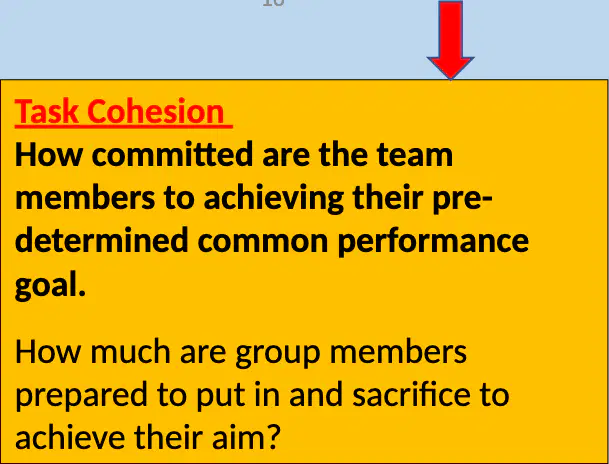
Task cohesion refers to how committed team members are to achieving their pre-determined common performance goal.
True
False
Fill in the blank: Cohesion can be regarded as "the _____" which holds people together.
glue
thread
wall
rope
A team can win a match even if its members are not socially cohesive, as long as they are highly task motivated.
True
False
According to the passage, can a team in a social competition have little task cohesion but still have high social cohesion?
True
False
(a) involves talking or thinking to yourself prior to or during performance

