
 Worksheets
Phylum Porifera (Assessment)
Total questions: 30
Worksheet time: 15mins
Name
Class
Date
1.
Flagella inside a sponge keep water moving through its body. Why is this necessary?
a)
It allows the sponge to feed.
b)
It prevents the sponge from floating away.
c)
It allows the sponge to absorb carbon dioxide.
d)
It maintains the water pressure inside the sponge.
2.
Sponges get their food by ________.
a)
Filter feeding
b)
Going through photosynthesis
c)
Absorption
d)
Decomposition
3.
Most sponges are monoecious. What does this mean?
a)
Sponges can produce both eggs and sperm
b)
Sponges can produce their own food
c)
Sponges cannot reproduce
d)
Sponges cannot swim around
4.
What is the name of the phylum sponges belong to?
a)
Porifera
b)
Cnidaria
c)
Echinodermata
d)
Mollusca
5.
________ are tiny hard particles that give a sponge support and can provide protection when they stick out of a sponge.
a)
Spicules
b)
Spongin
c)
Pores
d)
Buds
6.
The cells inside the sponge that have flagella and absorb food are called _______.
a)
Collar cells
b)
Pinacocytes
c)
Mesenchyme cells
d)
Porocytes
7.
Sponges are primarily sessile organisms. What does this mean?
a)
They live permanently live in one place
b)
They move around their whole life
c)
They exhibit internal fertilization
d)
They exhibit external fertilization
8.
Mesenchyme cells are also known as ________.
a)
Amoeboid cells
b)
Collar cells
c)
Porocytes
d)
Pore cells
9.
Which of the following type of cell digests and distributes food for the sponge?
a)
Amoebocytes
b)
Choanocytes
c)
Porocytes
d)
Mesenchyme cells
10.
________ are specialized buds made to survive harsh weather.
a)
Gemmules
b)
Spicules
c)
Flagella
d)
Plankton
11.
Which part of the sponge body is the central cavity that leads to the osculum?
a)
Spongocoel
b)
Ostia
c)
Radial canal
d)
Incurrent canal
12.
The water flows out of this opening in a sponge.
a)
Osculum
b)
Ostia
c)
Ocular
d)
Operculum
13.
Where are ostia located?
a)
On the outside of the sponge body
b)
In the small chambers of choanocytes
c)
At the tope of the sponge
d)
Inside the osculum
14.
Skeletal elements of sponges consist of:
a)
Calcium carbonate
b)
Calcium dioxide
c)
Carbonate
d)
Carbonic acid
15.
In sponges, ostia is an opening through which ______.
a)
Water enters into the sponges
b)
Water leaves the sponges
c)
It is a series of small openings
d)
It is the predator's entrance
16.
In sponges, sex cells are released via _______.
a)
Osculum
b)
Ostia
c)
Pores
d)
Choanocytes
17.
Larva of sponge is known as _______.
a)
Planktonic larva
b)
Planula larva
c)
Tropochore larva
d)
Glochidium larva
18.
Which of the following is true about sponges?
a)
Innumerable mouths and one exit
b)
A large spaceous stomach
c)
Spicules are made of chitin
d)
One mouth and innumerable exits
19.
What level of organization of tissues do sponges have?
a)
Cellular
b)
Organ
c)
Tissue
d)
Organ system
20.
Which one of the following cell types is not found in sponges?
a)
Neurons
b)
Collar cells
c)
Amoebocytes
d)
Porocytes
21.
What is the function of collar cells?
a)
Create water currents that pass through the sponge
b)
Protection
c)
Reproduction
d)
Pass nutrients to other cells
22.
How do collar cells create water currents?
a)
Beating of their flagella
b)
By swimming freely in circles in the central cavity
c)
By causing a vortex for the water to flow through
d)
By contraction and relaxation of the cells
23.
What is the function of amoebocytes?
a)
Pass nutrients to other cells
b)
Protection
c)
Create water currents that pass through the sponge
d)
Reproduction
24.
Because sponges stay in one place all their lives and feed off of food particles in the water they are called _____.
a)
Sessile filter feeders
b)
Sessile autotrophs
c)
Mobile autotrophs
d)
Mobile filter feeders
25.
A thin flat cell that covers the outer surface of the sponges are called ______.
a)
Pinacocytes
b)
Porocytes
c)
Chondrocytes
d)
Leukocytes
26.
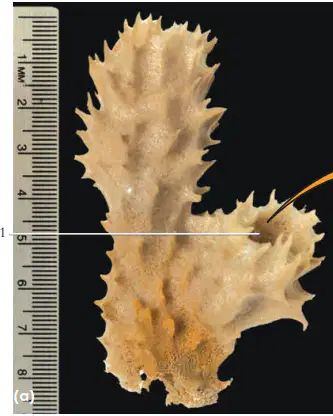
What is the name of structure #1?
(a)
27.
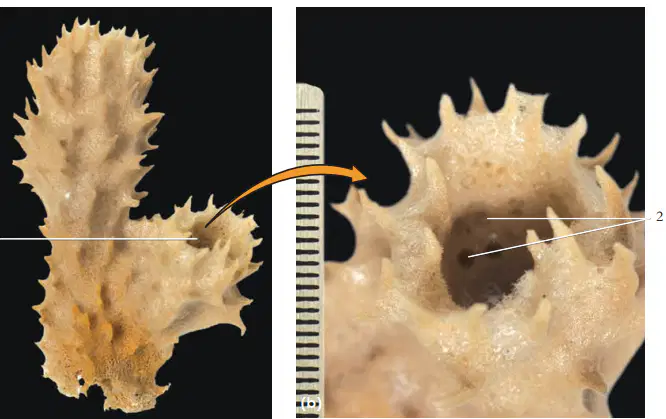
Identify structure #2.
(a)
28.
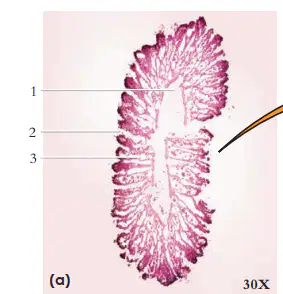
Identify structure #1.
(a)
29.
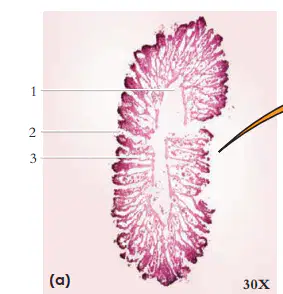
Identify structure #3.
(a)
30.
Give at least 1 class of Phylum Porifera
(a)
100 %

