
 Worksheets
MIDTERM EXAM - BPM
Total questions: 40
Worksheet time: 20mins
Which approval path is labeled with the condition 'invoice amount > 2000'?
Manager Approval
Finance Director Approval
CFO Approval
Procurement Approval
What is the primary purpose of a parallel gateway in BPMN as illustrated?
To choose one path based on conditions
To merge and split flows to execute tasks simultaneously
To trigger events based on messages
To terminate the process
Which review is NOT listed as occurring before Quality Assurance Review and Approve?
Manufacturing Review
Documentation Review
Security Review
Both Manufacturing and Documentation Reviews
Which statement best characterizes the decision logic of the gateway?
Event-driven choice among mutually exclusive paths
Data-driven evaluation allowing multiple paths
Static routing to a single predetermined task
Parallel activation of all subsequent tasks
What does the green circle at the far left represent in the process diagram?
End event
Manual task
Start event
Intermediate timer
Choose the best description of Sequence Flow based on the listed Connecting Objects.
A relationship connector between flow objects
A type of storage element
A swimlane divider
A user interface component
Where is a Message Flow typically drawn in BPMN diagrams?
Inside a single pool to connect tasks
Between separate pools or participants
Only within a single lane
Across data objects and artifacts
Which endpoint symbol is at the source of a Message Flow in BPMN?
Filled arrowhead
Open circle
Diamond
Square
Which phrase from the material precisely defines default flow?
Chosen if any condition evaluates to true
Default branch to be chosen if all other conditions evaluate to false
Executed only during exception handling
Activated when the system times out
What organizing principle do swimlanes provide within a business process?
Chronological order of tasks
Categorization by participant, role, department, or system
Severity of issues
Complexity of algorithms
In terms of process control, Conditional Flow primarily handles which aspect?
Concurrency
Error handling
Decision-based routing
Resource allocation
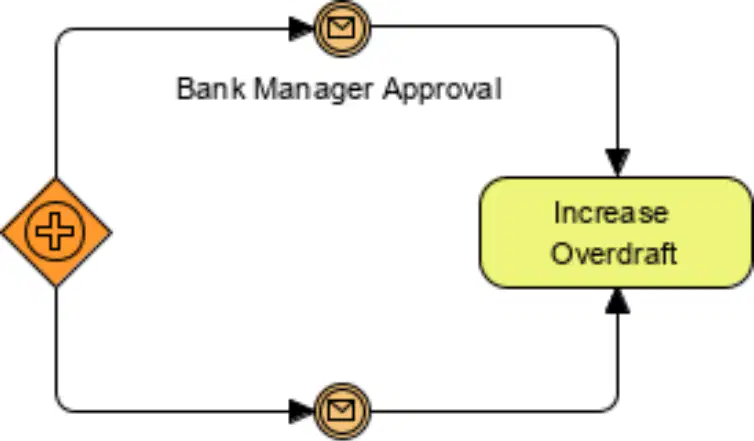
In a parallel event-based gateway, how are branches activated compared to an exclusive gateway?
Only one branch activates based on conditions
All defined event branches must be completed before proceeding
Branches activate randomly
Branches activate based on user selection
Which element is best used to depict a repository where data persists beyond the activity’s duration?
Data Object
Data Store
Data Output
Association
Considering standard BPMN semantics, what does a dashed line linking an activity to a data object typically mean?
The activity is a gateway.
The data object is a message.
The activity reads or writes the data object.
The data object is an event.
In the diagram, what is the name of the central process that changes the input into the output?
Transform Document
Generate Report
Validate Data
Archive File
Which statement best explains why B uses select rather than update?
B is prohibited from accessing the Data Store
B’s responsibility is to retrieve data rather than modify it
Updates are slower than selects
Selects are only for administrators
If Component A inserts a new record, what operation would Component B use to view that record later?
update
delete
select
commit
Suppose the system requires strict separation of duties. Which mapping aligns with the diagram’s separation?
A: read; B: write
A: write; B: read
A and B: both write
A and B: both read
A BPMN Group can contain which types of diagram elements?
Only tasks
Only events and gateways
Any elements that the modeler wants to visually cluster
Only artifacts
Where is a Text Annotation presented in relation to the BPMN diagram?
In a hidden metadata panel
Directly on the diagram
Only in the model repository
Inside the execution engine
Which statement best defines Business Process Model and Notation (BPMN)?
A programming language for automating servers
A standardized method for visually representing business processes
A database schema for managing enterprise data
A project management framework for agile teams
In BPMN, which connecting object should you use to indicate the order in which activities are executed within the same pool?
Message Flow
Association
Sequence Flow
Group
Which BPMN task type best fits the activity "Inspecting a product on a factory line"?
Manual Task
Business Rule Task
Script Task
Service Task
What symbol represents a decision point in the Send Task example (“Approve?”)?
Circle (event)
Diamond (gateway)
Square (data object)
Pentagon (subprocess)
Which sequence correctly describes the Service Task example’s flow when sharing is approved?
Start → Review Article → Approve? → Manage Publishing
Start → Answer a Question → Share on Twitter? → Publish Answer on Twitter
Start → Receive Pickup Request → Arrange Pickup
Start → Send Rejection Message → Author
Which iconography indicates a User Task in the diagrams?
A hand symbol
A person silhouette symbol
A gear symbol
A document symbol
Which element determines the routing after 'Approve Order' in the user task example?
A parallel gateway
An exclusive gateway (orange diamond)
A timer event
A manual task
What is the best justification for classifying 'Approve Order' as a User Task?
It is performed by a device
It is executed without any software
The buyer interacts with a software application to approve
It is an automated service
What is the purpose of using a Business Rule Task in the survey context?
To manually interpret data
To analyze collected survey data via a rule engine and return results
To store reports in a database
To send emails to respondents
Which path is taken if the decision after the gateway is "Yes"?
Assess Risk
Approve Application
Send Rejection Letter
Receive Loan Request
What initiates the loan approval process in the script task example?
Start Event labeled Receive Loan Request
Approve Application
Check Credit
Assess Risk
What does the task define in a Script Task so the engine can interpret it?
A business rule
A pre-written script
A user form
A timer event
Which of the following best matches the flow order in the Business Rule Task example?
Start → Print Survey Report → Analyze Result of Surveys → Mail Survey Report
Start → Analyze Result of Surveys → Print Survey Report → Mail Survey Report
Start → Mail Survey Report → Print Survey Report → Analyze Result of Surveys
Start → Approve Application → Send Rejection Letter → End
In the depicted order handling scenario, what activity occurs immediately after the article is available?
Financial Settlement
Procurement
Ship Article
Inform Customer
What is the outcome shown after Financial Settlement is completed?
Customer Informed
Article Removed
Payment Received
Order Received
In BPMN, what does a loop marker on a sub-process indicate?
The sub-process executes only once
The sub-process repeats itself in sequence
The sub-process executes in parallel with others
The sub-process is optional
Which statement best describes a Multi-Instance marker on a sub-process?
It signals sequential repetition of one sub-process
It indicates simultaneous execution of identical sub-processes
It denotes cancellation of a sub-process
It marks a conditional start event
What is the execution pattern implied by a loop sub-process?
Random order
Parallel execution
Sequential repetition
Single pass
A designer wants one sub-process to repeat steps until a condition is met, executing each attempt after the previous completes. Which marker fits?
Multi-Instance
Loop
Error
Terminate
Why might a modeler use an Ad-Hoc sub-process?
To represent temporary, case-specific activities
To document routine payroll steps
To enforce compensation rules
To ensure tasks are always automated

