
 Worksheets
DFT-EMREE-MINI TEST-16/10/2025-STUDYWITHMAXEMO
Total questions: 20
Worksheet time: 15mins
A young lady presents with a 3-month Hx of palpitations, dizziness, and intense fear during work meetings. She feels scrutinized and fears harsh judgment from colleagues. Last week, she feigned illness to avoid a presentation, fearing criticism. These symptoms are exclusively tied to social or performance situations at work and do not occur when she is alone or in public spaces like a supermarket. What is the most likely diagnosis?
Panic disorder
Agoraphobia
Social anxiety disorder (Social phobia)
Generalized anxiety disorder
Specific phobia, situational type
A 72 Y/O M presents for a routine annual check-up. He feels well and denies fever, weight loss, or night sweats. Hx is notable for HTN. O/E reveals palpable cervical and axillary lymph nodes, each ~1.5 cm, non-tender, and mobile. Spleen tip is palpable 2 cm below the left costal margin. Ix labs show: WBC 35,000/µL (normal 4,000-11,000) with 85% lymphocytes, Hb 12.8 g/dL, and Platelets 160,000/µL. Peripheral smear is ordered. Which of the following findings on the peripheral blood smear is most characteristic of this patient's most likely diagnosis?
Auer rods
Smudge cells
Rouleaux formation
Tear drop cells
Hypersegmented neutrophils
An 82-year-old male with a history of chronic constipation presents with a 2-day history of crampy abdominal pain, vomiting, and obstipation. On physical examination, his abdomen is distended and tympanitic. Auscultation reveals high-pitched bowel sounds. There is no guarding or rebound tenderness, and his vital signs are stable. What is the most appropriate next investigation to confirm the diagnosis and identify the underlying cause?
Abdominal X-ray (supine and erect views)
CT scan of the abdomen and pelvis with contrast
Urgent colonoscopy
Barium enema
Abdominal ultrasound
A man undergoes a difficult laparoscopic cholecystectomy where a partial transection of the CBD is identified. The injury is repaired intraoperatively over a T-tube. Post-op, the patient is stable. The T-tube is scheduled for removal in 3 weeks. Prior to removal, the surgical team wants to confirm the integrity of the repair and patency of the biliary tract. Which of the following is the most appropriate investigation to perform before removing the T-tube?
Magnetic Resonance Cholangiopancreatography (MRCP)
T-tube Cholangiogram
Liver Function Tests (LFTs)
Endoscopic Retrograde Cholangiopancreatography (ERCP)
Abdominal CT with IV contrast
A healthy 34 Y/O G3P2 at 28 weeks gestation, with a BMI of 32 kg/m ², undergoes a 3-hour 100g OGTT after an abnormal 50g GCT. Her results are as follows: Fasting: 5.8 mmol/L 1-hour: 10.9 mmol/L 2-hour: 9.1 mmol/L 3-hour: 7.5 mmol/L Based on these results, what is the most likely diagnosis?
Normal pregnancy
Gestational diabetes mellitus (GDM)
Impaired fasting glucose
Pre-existing Type 2 diabetes mellitus
Impaired glucose tolerance
An adult pt with a newly diagnosed 5 cm rectal villous adenoma is admitted with severe secretory diarrhea. Despite 24h of aggressive IV fluid and potassium repletion, the stool output remains >4L/day, hampering preoperative stabilization. Vitals are stable, but serum K+ remains difficult to correct. Which adjunctive medication is most appropriate to help control this pt's refractory diarrhea?
Loperamide
Cholestyramine
Indomethacin
Ondansetron
Furosemide
An adult M with a prosthetic aortic valve is being treated for infective endocarditis. He develops acute-onset, severe left hypochondriac pain that worsens with inspiration. O/E: Marked tenderness in the left upper quadrant. Which is the best imaging modality to investigate this specific complication?
Abdominal X-ray
Abdominal ultrasound
CT abdomen with contrast
MRI of the spleen
Repeat TTE
A 6 Y/O F is brought in for early physical development. O/E: Tanner stage 3 breast development and Tanner stage 2 pubic hair are present. Ix: Basal LH and FSH levels are in the pubertal range, with a correspondingly high estradiol. Bone age is advanced by 2 years. These findings are most consistent with which diagnosis?
McCune-Albright Syndrome
Premature Thelarche
Gonadotropin-Dependent Precocious Puberty
Non-classic Congenital Adrenal Hyperplasia
Premature Adrenarche
A patient with HIV on a stable ART regimen presents with new-onset petechiae and mucosal bleeding. Ix: Isolated severe thrombocytopenia with a platelet count of 12 x 10⁹/L. Hemoglobin and WBC count are normal. A peripheral smear shows decreased platelets with some large forms. In addition to continuing ART, what is the most appropriate initial intervention for this specific hematological complication?
Splenectomy
Platelet transfusion
High-dose corticosteroids
Eltrombopag
Immediate change of ART regimen
A patient with hypertension and diabetes mellitus is started on Lisinopril. Routine labs are checked 2 weeks later. Which electrolyte abnormality is a well-known side effect of this medication?
Hypokalemia
Hyponatremia
Hyperkalemia
Hypercalcemia
Hypomagnesemia
A sigmoidoscopy performed for painless rectal bleeding reveals an ulcerated mass. Lab investigations show a microcytic anemia with Hb 82 g/L, low serum iron, and low ferritin. Biopsy of the mass confirms adenocarcinoma. What is the primary mechanism responsible for the patient's anemia?
Anemia of chronic disease
Bone marrow infiltration
Autoimmune hemolysis
Chronic occult blood loss
Malabsorption of vitamin B12
A case of chronic osteoarthritis in a pregnant patient at 22 weeks' gestation requires initiation of analgesia for moderate, persistent joint pain. The goal is to select the agent with the most favorable safety profile for both the mother and fetus. What is the most appropriate first-line pharmacological agent?
Ibuprofen
Paracetamol
Naproxen
Low-dose oral Prednisolone
Topical Diclofenac
Following an acute right-hemispheric stroke, a patient exhibits left hemiplegia. Speech is noted to be slurred and difficult to articulate. However, the patient demonstrates intact comprehension, correct grammar, and appropriate word choice when communicating. What is the most precise term for this patient's speech impairment?
Broca's aphasia
Wernicke's aphasia
Dysarthria
Global aphasia
Apraxia of speech
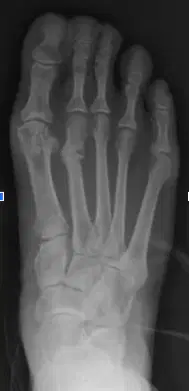
A military recruit develops insidious-onset forefoot pain after weeks of intense training. The pain is localized over the dorsum of the foot and worsens with activity. A plain radiograph reveals a non-displaced hairline fracture through the distal shaft of the second metatarsal. This finding is best described as a:
Jones fracture
Lisfranc injury
Pathological fracture
March fracture
Avulsion fracture

A 45 Y/O M, a long-distance truck driver, presents with chronic low back pain, hamstring tightness, and noted hyperlordosis. His lateral lumbar spine X-ray is shown. This finding is characteristic of:
Lumbar Spondylosis
Ankylosing Spondylitis
Spondylolisthesis
Spinal Tuberculosis (Pott's Disease)
Spondylolysis

A 35-year-old female presents with a "thunderclap headache." What is the likely diagnosis based on the provided non-contrast CT scan of the head?
Subdural hematoma (SDH)
Subarachnoid hemorrhage (SAH)
Epidural hematoma (EDH)
Intraventricular hemorrhage (IVH)
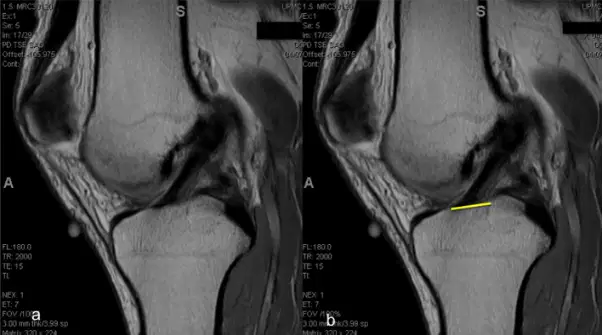
A 24-year-old footballer presents with knee pain and instability after a sudden twisting injury. An MRI shows a tear of the most commonly injured knee ligament. What is the most likely diagnosis?
Posterior cruciate ligament (PCL) tear
Anterior cruciate ligament (ACL) tear
Medial collateral ligament (MCL) tear
Lateral meniscus tear
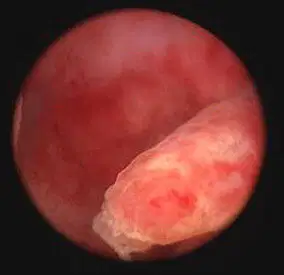
A 48 Y/O F, G3P3, presents with a 6-month Hx of intermenstrual bleeding. Her menstrual cycles were previously regular. Pelvic exam is unremarkable. Transvaginal ultrasound was suggestive of endometrial thickening. She undergoes a diagnostic hysteroscopy, and the following image is obtained. Based on the hysteroscopic image, what is the most likely diagnosis?
Submucosal leiomyoma
Endometrial polyp
Endometrial carcinoma
Retained products of conception
Intrauterine adhesions
A 30 Y/O F is diagnosed with a complete hydatidiform mole at 11 weeks GA. Her USG shows the classic "snowstorm" appearance with a uterine size of 16 weeks. She is hemodynamically stable but has persistent vaginal bleeding. Pre-operative workup is otherwise unremarkable. What is the most appropriate definitive management for this patient?
Medical induction of labor with oxytocin
Suction Dilation and Curettage (D&C)
Systemic methotrexate therapy
Total abdominal hysterectomy
Expectant management with serial β-hCG monitoring
A 34-year-old female presents for counseling regarding her risk for thrombosis. She is asymptomatic but reports a significant family history: both her father and her brother experienced unprovoked deep vein thrombosis at ages 58 and 38, respectively. The patient is considering starting oral contraceptive pills and wishes to be evaluated for a potential underlying inherited predisposition. What is the most common hereditary thrombophilia she is at risk for?
Antithrombin III deficiency
Protein C deficiency
Factor V Leiden mutation
Prothrombin G20210A gene mutation
Antiphospholipid syndrome

