
NEW
Font size
 Worksheets
Urinary (Excretory) System- Ayre
Total questions: 50
Worksheet time: 25mins
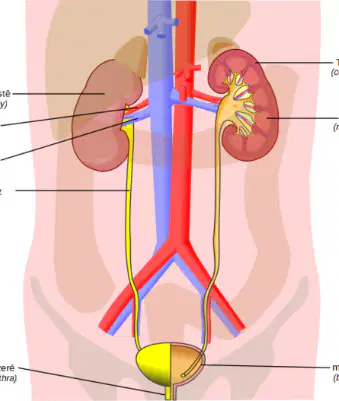
What is the main function of the kidneys?
The kidneys act as the internal garbage men, excreting nitrogenous waste, toxins, and drugs from the body.
The kidneys produce insulin to regulate blood sugar levels.
The kidneys help in the digestion of carbohydrates.
The kidneys are responsible for oxygen transport in the blood.
Which of the following is NOT a function of the kidneys?
Regulate volume
Maintain salt/water balance
Produce insulin
Maintain acid/base balance
What do kidneys excrete?
Nitrogenous (Nitrogen containing) waste, toxins, and drugs from the body.
Oxygen and carbon dioxide only.
Digestive enzymes and hormones.
Glucose and vitamins.
The kidneys help maintain acid/base balance in the body.
True
False
Name two other organs of the urinary system besides the kidneys.
Ureters, urinary bladder, urethra
Liver, pancreas, gallbladder
Heart, lungs, spleen
Stomach, intestines, esophagus
Which hormone produced by the kidneys stimulates RBC production?
Erythropoietin
Insulin
Thyroxine
Cortisol
Fill in the blank: Kidney cells convert ______ to its active form.
Vitamin D
Vitamin C
Calcium
Iron
Which enzyme produced by the kidneys regulates blood pressure?
Renin
Amylase
Pepsin
Lipase
Where are the kidneys actually located?
Lower back
Superior lumbar region (From T12-L3)
Thoracic cavity
Pelvic region
Why is the right kidney slightly lower than the left?
Because it is crowded by the liver.
Because it is larger than the left kidney.
Because it is attached to the diaphragm.
Because it is closer to the spine.
What is the structure size of a kidney?
5 in long x 2.5 in wide x 1 in thick
3 in long x 1 in wide x 0.5 in thick
7 in long x 4 in wide x 2 in thick
10 in long x 5 in wide x 3 in thick
The adrenal glands sit on top of the kidneys and are part of the ______ system.
endocrine
digestive
respiratory
nervous
Which of the following is NOT one of the three protective layers of the kidney?
Fibrous capsule
Fat capsule
Renal Fascia
Peritoneum
What is the function of calyces in the kidney?
Calyces are cup-shaped drains that enclose the tip of the pyramid and collect urine, which continuously drains from the tip of the pyramid to the pelvis.
Calyces filter blood to form urine.
Calyces produce hormones that regulate blood pressure.
Calyces reabsorb nutrients from the urine.
1/4 of the blood supply passes through the kidney each minute.
True
False
What is the structural and functional unit of the kidney called?
Nephron
Neuron
Alveolus
Glomerulus
Each kidney has over ______ nephrons.
1 million
100 thousand
10 million
500 thousand
Which of the following is NOT a main structure of a nephron?
Renal corpuscle
Renal tubule
Renal pelvis
Collecting duct
Which of the following is NOT a step in urine formation?
A) Glomerular Filtration
B) Tubular Reabsorption
C) Tubular Secretion
D) Cellular Respiration
Glomerular filtration is a ________, passive process. Fluid (called FILTRATE) passes from the blood into the glomerular capsule.
non-selective
selective
active
regulated
Blood cells and proteins are typically too large to pass through the filtration membrane during glomerular filtration.
True
False
Tubular Reabsorption involves reclaiming useful substances such as water, glucose, ions, and amino acids and returning them to the blood.
True
False
Which of the following nitrogenous waste products is formed by the liver as an end product of protein breakdown?
Urea
Uric acid
Creatinine
Ammonia
Uric acid is released when ________ are metabolized.
nucleic acids
carbohydrates
lipids
proteins
How many liters of blood plasma are filtered in 24 hours to form urine?
150-180 liters
10-20 liters
500-600 liters
50-70 liters
What is the typical color of urine and what causes its yellow color?
Urine color is clear/pale to deep yellow. The yellow color is due to urochrome, a product of hemoglobin destruction.
Urine color is always red due to the presence of blood cells.
Urine is typically blue because of bile pigments.
Urine is always colorless because it contains only water.
What is the typical smell of fresh urine?
Sterile & slightly aromatic
Foul & pungent
Sweet & fruity
No smell at all
Strongly ammonia-like
Over time, urine takes on the smell of ______ due to bacterial action.
ammonia
sulfur
chlorine
acetone
What is the typical pH of urine?
about 6 (slightly acidic)
about 2 (highly acidic)
about 8 (slightly alkaline)
about 12 (highly alkaline)
A high protein diet and whole wheat cause urine to be (acidic/alkaline), while a vegetarian diet causes urine to be (acidic/alkaline).
acidic; alkaline
alkaline; acidic
alkaline; alkaline
acidic; acidic
What does specific gravity measure in a urine lab test?
How heavy urine is vs distilled water
The amount of sugar in urine
The color of urine
The presence of bacteria in urine
What is the role of the ureters?
Carries urine from kidney to the bladder
Filters blood to form urine
Stores urine until excretion
Produces hormones for blood pressure regulation
How many openings does the bladder have, and what are they?
3 openings (2 ureters and 1 urethra)
2 openings (1 ureter and 1 urethra)
4 openings (2 ureters and 2 urethras)
1 opening (only urethra)
A moderately full bladder holds about ______ cc (1 pt), but can hold about ______ cc.
500; 1000
200; 400
700; 1200
300; 600
What is the function of the urethra?
Carries urine by peristalsis from bladder to the outside
Produces urine in the kidneys
Stores urine until it is excreted
Filters blood to remove waste products
What is micturition?
Voiding or the act of emptying the bladder
The process of digestion in the stomach
The exchange of gases in the lungs
The filtration of blood in the kidneys
Which of the following is NOT a function of the kidneys?
Excrete nitrogen containing waste
Maintain H2O balance of blood
Maintain electrolyte balance of blood
Produce insulin
Ensure proper blood pH
Fill in the blank: Composition of blood depends on 3 factors: _______, cellular metabolism, and urine output.
diet
exercise
temperature
hormones
Fill in the blank: H2O accounts for ___ or more of body weight.
1/2
1/4
3/4
1/8
The posterior pituitary gland releases ADH (Anti diuretic hormone) to prevent excess water loss.
True
False
What is the role of aldosterone in the body?
Regulates blood sugar
Helps regulate blood composition and volume (Regulates sodium content)
Produces red blood cells
Breaks down proteins
Fill in the blank: Pyelonephritis is also called _______.
pyelitis
nephrosis
glomerulonephritis
cystitis
Cystitis is inflammation of the urethra.
True
False
What is the medical term for kidney stones?
Pyelonephritis
Renal calculi
Oliguria
Anuria
Fill in the blank: Urethritis is inflammation of the _______.
urethra
bladder
kidney
prostate
Fill in the blank: Cystitis is inflammation of the _______.
bladder
kidney
liver
lung
UTI can cause confusion in the elderly.
True
False
Fill in the blank: ________ is the inability to control the external sphincter. However, it is normal in children less than 2 years old.
Incontinence
Constipation
Diuresis
Retention
Fill in the blank: ________ is the opposite of incontinence.
Retention
Infection
Obstruction
Secretion
Fill in the blank: ________ is the enlargement of the prostate (located by the bladder).
Hyperplasia
Atrophy
Necrosis
Fibrosis

