
 Worksheets
Neolithic Revolution and Early Civilizations Questions
Total questions: 45
Worksheet time: 25mins
One effect of the Neolithic Revolution was to
introduce commercial investment in joint stock companies
expand the use of realism in portraits and landscape paintings
develop surplus food production and permanent settlements
prove that the Sun, not Earth, was the center of the solar system
To increase the supply of food, some Neolithic communities living in arid regions of the world developed
three-field systems
petrochemical fertilizers
irrigation systems
slash-and-burn methods
Patterns of high population density have most often been associated with
elevations above 10,000 feet
regions with dense tropical vegetation
areas receiving less than 10 inches of rainfall per year
access to waterways and transportation systems
Which development occurred during the Neolithic Revolution?
Food was grown on haciendas.
Stone tools were used for the first time.
The factory system replaced the domestic system.
Permanent settlements were established in river valleys.
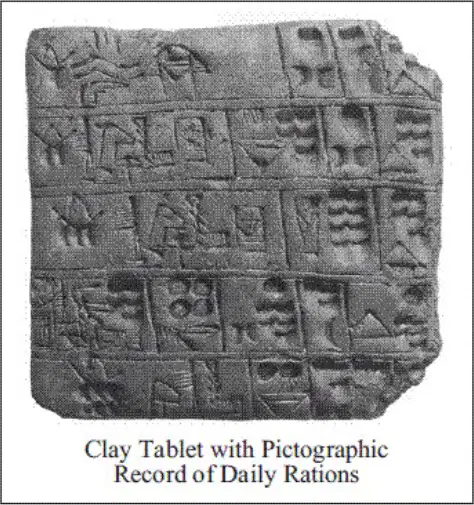
[Refer to figure 2] The image above could be included as part of a presentation showing evidence about which topic?
Geographic features of Mesopotamia
Education systems of the first civilizations
Common characteristics of early civilizations
Trade routes and early exploration of the world
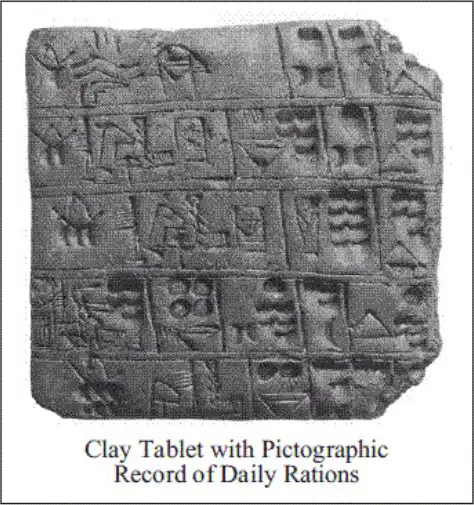
[Refer to figure 2] Which of the following statements accurately describes a reason for the innovation presented in the image?
People in Mesopotamia had a complicated system of laws that had to be written down.
Early scribes were mainly in charge of writing down prayers.
Mesopotamians learned to read so they could keep up with the latest news around their vast empire.
Writing was first created to keep track of daily food supplies and payments.
The development of civilizations in the Nile River Valley, Mesopotamia (Tigris and Euphrates Rivers), Indus River Valley, and Yellow River/Shang China was made possible because of ______?
Formation of art and architecture
Cultural diffusion
Invention of farming
Discovery of trade
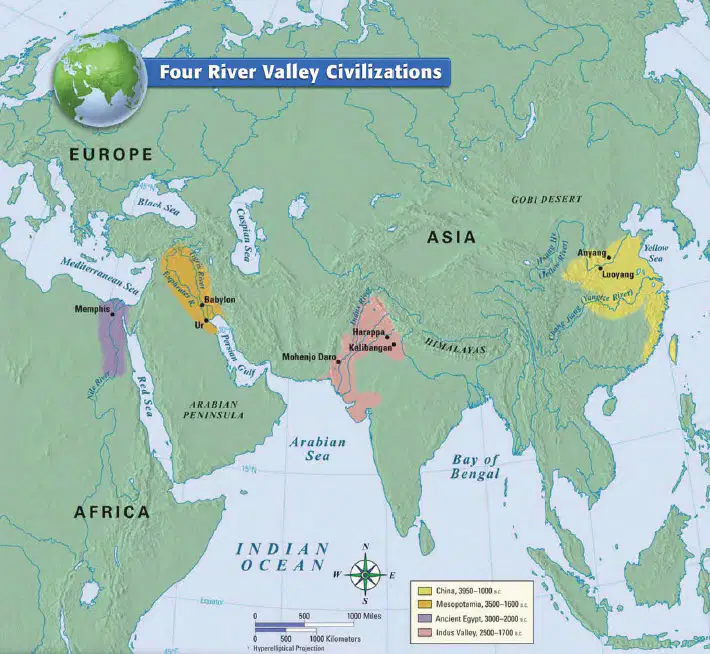
Which is a plausible claim based on this map ?
Early civilizations developed sea trade routes.
Communication between the first civilizations was common.
Cultural diffusion among early humans was evident.
The earliest civilizations developed around dependable water sources.
Figure 5: Passage about human survival during Ice Ages, nomadic adaptation to follow herds, and qualities of herding with animals as mobile food reserves. COMPREHENSION PASSAGE: “Man survived the fierce test of the Ice Ages because he had the flexibility of mind to recognise inventions and to turn them into community property. Evidently the Ice Ages worked a profound change in the way man could live. They forced him to depend less on plants and more on animals. The rigours of hunting on the edge of the ice also changed the strategy of hunting. It became less attractive to stalk single animals, however large. The better alternative was to follow herds and not to lose them — to learn to anticipate and the pace and to adapt their habits, including their wandering migrations. This is a peculiar adaptation — the transhumance [nomadic] mode of life on the move. It has some of the earlier qualities of hunting, because it is a pursuit; the place and the pace are set by the food animal. And it has some of the later qualities of herding, because the animal is tended and, as it were, stored as a mobile reservoir of food.”
Refer to figure 5. Which statement best describes a result of early humans’ adaption of a nomadic lifestyle to follow herds, including their wandering migrations?
Man remained in one location for all of known history.
Early man became extinct as a result of too much movement.
Early man adapted to animal movement and remained just on the edge of the ice for millions of years.
Early man learned to adapt and began to spread throughout the world.
Refer to figure 5. A historian could best use this information to study which topic?
Human life after the birth of farming
Human behavior before the Neolithic Revolution
Animal behavior before the Ice Ages
The early relationship between humans and plants
Refer to figure 5. Which later innovation would be a direct effect of humans learning to adapt over time and ultimately domesticate both plants and animals?
Farming
Nomadic behavior
Hunting and gathering
Warfare
What was a major reason the cities of Babylon, Harappa, and Kiev became important centers of civilization?
River valley trade made them key economic areas.
Their control of nearby straits made them powerful.
Direct access to the ocean made them pilgrimage sites.
Their locations near mountain passes made them gateways to other regions.
Which action is most closely associated with the early Mesopotamian civilizations?
building floating gardens to grow corn
establishing representative democracies
developing a writing system using cuneiform
constructing Hindu temples
The Neolithic Revolution is seen as a turning point in human history mainly because
farming led to settled communities
people started using animal skins for clothing
copper was first used to improve stone tools
cave paintings recorded the activities of nomadic groups
Which factor most influenced the construction of semipermanent settlements during the Neolithic period?
production of surplus food
drawings on cave walls
ability to harness fire
introduction of fishing nets
During the Neolithic Revolution, production of a food surplus led directly to
a nomadic lifestyle
a reliance on stone weaponry
an increase in population
a dependence on hunting and gathering
Which description best fits the Neolithic Revolution?
moving from urban centers to rural centers
using petrochemical fertilizers and pesticides to increase production
replacing human laborers with machines
shifting from hunting and gathering to farming as a way of life
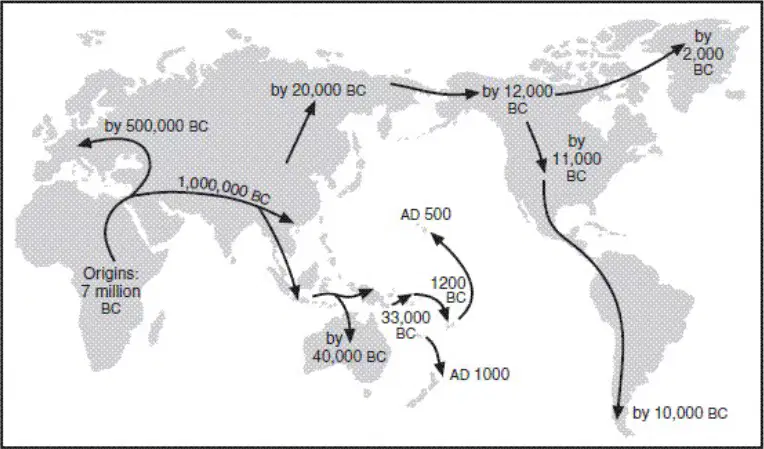
Use the map and your knowledge of social studies to answer the question. Based on this map, on which continent did humans first appear?
Asia
Europe
North America
Africa
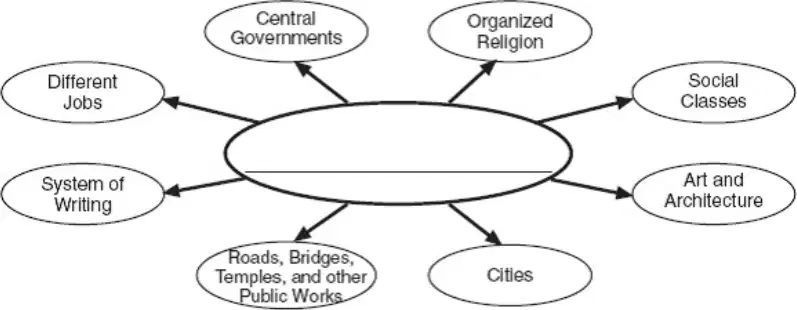
Which title best completes the graphic organizer below?
Elements of a Civilization
Features of a Nomadic Lifestyle
Elements of the Paleolithic Age
Features of the Middle Stone Age

What is the best title for the diagram below? Diagram shows: top box "Nomads / Hunters and Gatherers / Simple Tools and Weapons" leading to bottom box "Farmers / Domesticated Animals / Establishment of Villages".
Features of Belief Systems
Features of Classical Civilizations
Changes during the Fall of the Roman Empire
Changes during the Neolithic Revolution
The major river valley for early Chinese civilization was the
Nile
Tigris
Huang He
Euphrates
The life of early humans is difficult to understand. This is because early humans did NOT leave us
everyday tools
cave drawings
written records
stone jewelry
In the Old Stone Age, before 6000 BC, the hominid did all of the following EXCEPT
walk upright
farm land
make jewelry
use tools
Historians describe the pattern of the rise and fall of ruling families in ancient China as the
cycle of politics
feudalistic circle
winds of power
dynastic cycle
Every society goes through changes. The Chinese explained the change in rulers as the will of the gods. When floods, riots, famines and loss of battles hit China, the people believed that the ruler no longer had the favor of the gods to rule. This favor or power to rule was known as
Divine Right
Mandate of Heaven
Might Makes Right
Rollover Empires
One of China's great rivers is the Huang He. It is located in the northern part of China. The Chinese refer to the Huang He as "China's Sorrow." This nickname for the river indicates that it probably
has a history of violent flooding, killing many
dries up most of the year and is a good source of farmland
provides regular irrigation to surrounding areas
has served as a good reliable transportation link
The Indus River Civilization (2500 BC–1700 BC) is best known for its
written history
planned cities
military feats
postal system
Monsoons are
seasonal winds
seasonal rains
seasonal droughts
seasonal invasions
The ancient Indus (India) Civilization was similar to the ancient civilizations of Mesopotamia and Egypt in that ALL THREE
were protected from invasion by deserts
had monsoon winds that affected crops
were aided by the flooding of major rivers
experienced constant invasions due to open geography
Jared Diamond, a historian, has said that the development of agriculture was the biggest mistake ever made by humans! What is one drawback to the development of agriculture?
More food is available to more people.
People live a healthy life with better nutrition.
Disease spreads quickly among people living close together.
Providing food efficiently has allowed people to pursue the arts.
Another name for the Neolithic Revolution is the
Agricultural Revolution
Paleolithic Revolution
Commercial Revolution
Information Revolution

Which term refers to the transition (change) of human societies from nomadic/ hunting and gathering to farming?
Paleolithic Revolution
Agricultural Revolution
Industrial Revolution
Neolithic Revolution
Domestication is...
Breeding animals/plants for qualities you like
Migration from Africa to Asia
Cats & dogs
What was a major change in human lifestyle during the Neolithic Revolution?
People started living in caves.
People began farming and growing crops.
People only hunted and gathered food.
People moved constantly in search of food.
During the Mesolithic Age, the gradual in domestication of animals and agriculture led to what?
Better tools for hunting
Settled communities
Population decrease
Math concepts
Once humans lived began to settle down & become farmers, ___________ developed.
Factories
Cities & Governments
Paleolithic Man
Gunpowder
How did the domestication of animals benefit early human societies?
It provided a reliable food source.
It made hunting unnecessary.
It led to the extinction of wild animals.
It discouraged farming practices.
Which of the following was a result of permanent settlements?
Increased nomadic lifestyle
Development of complex societies
Decrease in population
Less interaction between communities
How did the Neolithic Revolution lead to the development of new tools?
People needed tools for hunting large animals.
Farming required new tools for planting and harvesting.
Tools were used to build temporary shelters.
Tools were only used for artistic purposes.

This image represents which historical aspect?
Geography
Religion
Social Structure
Achievement

They were the lowest class of people in ancient Egypt besides the servants and slaves. They were the _______?
Priests
Nobles
Farmers
Plebeians

The people of middle class in Egypt were the ________________?
Pharaoh
Lesser government officials, scribes, and a few rich craftspeople
Nobles, or people from rich and powerful families.
A surplus of food led to more complex societies
What was the name of a large village from the Neolithic time period that is in current day Turkey?
Catalhuyuk
Aleppo
Jerusalem
Israel

