wayground logo

Free Printable Worksheets

Font size

S
M
L
XL
Worksheets

Industrial Boom Quiz

Total questions: 27

Worksheet time: 14mins
Name
Class
Date
1.
In the years immediately following the Civil War, which change was brought about by the Industrial Revolution?
a)
More goods were being made at home than ever before
b)
More people left cities to live on farms
c)
More government regulation was placed on big business
d)
More machinery was used to make goods in large factories
2.
If you favored the positive influence of Big Business leaders you would refer to them as ________________. If you disliked the negative influence Big Business leaders had you would call them __________________.
a)
Influencers/Rejects
b)
Robber Barons/Captains of Industry
c)
Captains of Industry/Robber Barons
d)
Captains of Steel/Robber Barons
3.
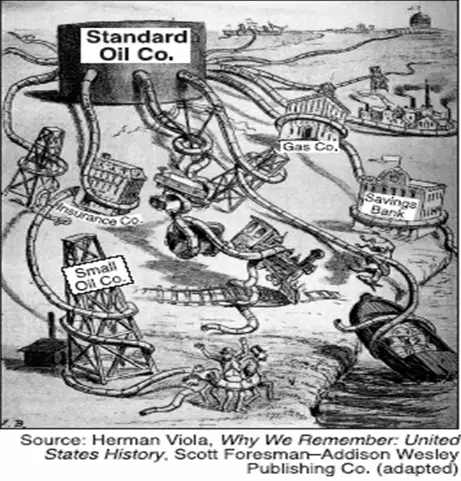
What is the main idea of the cartoon?
a)
The Standard Oil Company was a harmful monopoly
b)
The best way to develop major industries was to work closely with the government
c)
Government regulations were strangling Standard Oil
d)
Foreign competitors in the oil industry was hurting American companies
4.
Why did small Farmers/Businesses object (disagree) to railroads offering rebates?
a)
Because they kept all RR rates very low for everyone
b)
Because they brought too many settlers to the west making it crowded
c)
Because they helped miners and not farmers at all
d)
Because the discounts only applied to the biggest customers
5.
Which of the following terms is NOT associated with the growth of big business in the late 1800's?
a)
Trust
b)
Collectives
c)
Corporations
d)
Consolidation
6.
Which of the following statements is TRUE about business in the late 1800’s?
a)
Investors were unwilling to lend money to corporations
b)
Business leaders encouraged competition especially in the Railroad industry
c)
Large corporations eliminated their competition and forced many smaller businesses to close
d)
The government took over many failing businesses in order to save the economy
7.
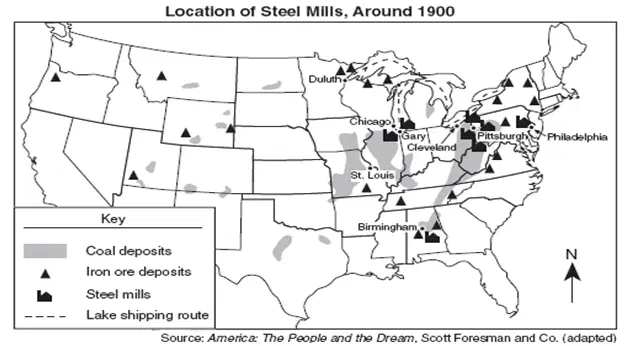
Based on the map above, which conclusion can be made about steel mills in 1900?
a)
To avoid air pollution, most steel mills were built in rural areas
b)
Most steel mills were located in the southeast
c)
Steel mills were usually built near coal or iron ore deposits
d)
New York was a major coal-producing state
8.
Which of the following was NOT a way that government supported industry after the Civil War?
a)
The federal government imposed high tariffs on imported goods
b)
Congress gave land grants to railroads
c)
The federal government discouraged the creation of new inventions
d)
Congress gave subsidies to businesses
9.
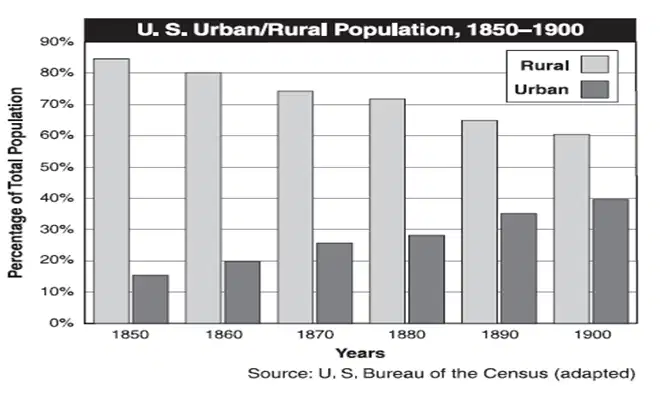
Which statement about urbanization is best supported by the information on the graph?
a)
Many of the people who lived in the urban areas were poor
b)
The percentage of urban population increased between 1850 and 1900
c)
By 1890, 70% of the population lived in rural areas
d)
Industrialization led to an increase in the rural population in the late 1800s
10.
Railroad companies consolidated (combined) by
a)
giving away free land
b)
buying up smaller RR lines
c)
giving rebates
d)
getting workers to work for free
11.
John D. Rockefeller would MOST LIKELY agree with which of the following?
a)
Railroad companies should not grant rebates to big business
b)
Monopolies encourage competition in the market
c)
Customers should not be pressured to buy products from one company
d)
Competition in the market is wasteful, and costly for business owners
12.
What did many workers try to do during this time period in response to the poor conditions they were subjected to?
a)
Workers formed labor unions to try and get better and safer working conditions
b)
Workers attempted to form their own monopolies to rival the corporations that were causing harm
c)
Workers gave their salaries to charity to try and make life better for those in need
d)
Workers left the country and fled to Cananda
13.
Which of the following was NOT a new invention during the late 1800's?
a)
Telephone
b)
Electric Light Bulb
c)
Automobile
d)
The television
14.

The growth of big business led to all EXCEPT which of the following?

a)

People moved by millions to rural areas

b)

By 1900, more Americans worked in factories than on farms

c)

Big business created millions of jobs

d)

The United States became the world’s leading producer of manufactured goods

15.

Who was a banker who bought Carnegie's steel company?

a)

J.P. Morgan

b)

Andrew Carnegie

c)

John D. Rockefeller

16.

Which of the following describes how railroads helped the United States?

a)

They used many tons of steel

b)

They helped end the shipping industry

c)

They charged high rates to farmers

d)

They helped businesses reach distant markets across the country

17.

What is a group of corporations run by a small group of people with the purpose of creating a monopoly?

a)

Monopoly

b)

Trust

c)

Besties

d)

Mrs. Farley's method

18.

Who got rich making steel?

a)

Andrew Carnegie

b)

John D. Rockefeller

c)

Henry Ford

19.

A Monopoly is a company that has control of an entire industry.

a)

True

b)

False

20.

In the years immediately following the Civil War, which change was brought about by the Industrial Revolution?

a)

More goods were made at home

b)

More people left cities to live on farms

c)

More government regulation was placed on big business

d)

More machinery was used to make goods

21.

Who created the Standard Oil Trust?

a)

John D. Rockefeller

b)

Andrew Carnegie

c)

Cornelius Vanderbilt

22.

A type of monopoly to consolidate many of the same type of company to eliminate competition

a)

Horizontal Integration

b)

Vertical Integration

c)

Homestead Strikes

d)

Protective tariffs

23.

Which of the following statements is TRUE about business in the late 1800’s?

a)

Investors were unwilling to lend money to corporations

b)

Business leaders encouraged competition especially in the Railroad industry

c)

Large corporations eliminated their competition and forced many smaller businesses to close

d)

The government took over many failing businesses in order to save the economy

24.

How did tariffs help American business?

a)

It taxed all American made goods

b)

It taxed all foreign made goods

c)

It taxed all goods

d)

It didn't tax any goods

25.
This process converted iron to steel and allowed for taller buildings, longer bridges, and heavier machinery.
a)
Carnegie Process
b)
Ironing Process
c)
Bessemer Process
d)
Bell Process
26.
What is the main idea of this cartoon?
a)
The Standard Oil Company was a harmful monopoly.
b)
The best way to support the Standard Oil Company was to form proprietorships.
c)
Foreign competition with the Standard Oil Company was hurting American companies.
d)
Government regulations were strangling the Standard Oil Company.
27.

A strategy to control all levels of production to make the most profit

a)

Horizontal Integration

b)

Vertical Integration

c)

Homestead Strikes

d)

Protective tariffs