
NEW
Font size
 Worksheets
Information Management
Total questions: 65
Worksheet time: 33mins
Information is ______ to business.
crucial
irrelevant
optional
detrimental
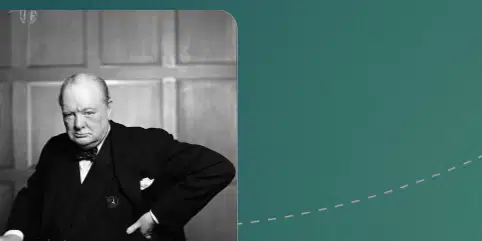
Who is the person shown in the first image (black and white photo, standing with hand on chair)?
Winston Churchill
Franklin D. Roosevelt
Joseph Stalin
Charles de Gaulle

Who is the person shown in the third image (man in suit in front of American flags)?
Ronald Reagan
John F. Kennedy
Richard Nixon
Dwight D. Eisenhower
Fill in the blank: Information Management (IM) is a business function that involves people, processes, and systems that ______, organize, store, and secure relevant data and information, and makes it accessible and useful for making informed decisions.
collect
ignore
delete
hide
Fill in the blank: IM ______ people.
involves
invites
includes
inspires
Fill in the blank: Information is only useful if ______ make good use of it.
people
computers
books
machines

IM involves processes that regularly and automatically collect information. Which of the following is a type of information collected by IM processes?
Sales transaction data
Surveys
Publicly available statistics
Customer Feedback
Pricing Information
IM involves processes that regularly and automatically collect information. Which of the following is a type of information collected by IM processes?
Publicly available statistics
Sales transaction data
Surveys
Pricing Information
Customer Feedback
IM involves processes that regularly and automatically collect information. Which of the following is a type of information collected by IM processes?
Customer Feedback
Publicly available statistics
Pricing Information
Sales transaction data
Surveys
IM involves processes that regularly and automatically collect information. Which of the following is a type of information collected by IM processes?
Publicly available statistics
Sales transaction data
Customer Feedback
Pricing Information
Surveys
IM involves processes that regularly and automatically collect information. Which of the following is a type of information collected by IM processes?
Sales transaction data
Publicly available statistics
Pricing Information
Surveys
Customer Feedback
IM involves processes that regularly and automatically collect information. Which of the following is a type of information collected by IM processes?
Private trade secrets
Pricing Information
Sales transaction data
Customer Feedback
Surveys
Fill in the blank: A Management Information System (MIS) is a __________ system that supports and enables the Information Management business function.
computerized
manual
randomized
isolated
Fill in the blank: IM also _______ and stores information.
organizes
destroys
forgets
ignores
IM organizes and stores information. Fill in the blank: The information is ________ to make searching, retrieving, and archiving easier.
organized
randomized
deleted
ignored
IM organizes and stores information. Where is the information stored?
In a database
On servers
On hard drives
In the cloud
All of the above
Which of the following is NOT listed as a key component of Information Management in the diagram?
A) People
B) Systems
C) Money
D) Processes
Fill in the blank: Information Management involves making ______ decisions.
Informed
Random
Unplanned
Guess
Which of the following actions are part of managing information according to the diagram?
Collect
Organize
Store
Secure
All of the above
Fill in the blank: Relevant Data & Information should be ______ and useful for effective Information Management.
Accessible
Expensive
Obsolete
Confidential
According to the diagram, 'Processes' is a component of Information Management.
True
False
Which of the following is a result of effective Information Management according to the diagram?
Informed Decisions
Increased Costs
Reduced Communication
None of the above
What is the first step in the process of Information Management as shown in the diagram?
Informed Decisions
Accessible
Relevant Data & Information
Useful
Fill in the blank: In the process of Information Management, information must be ______ and useful to make informed decisions.
accessible
expensive
hidden
obsolete
Which of the following is the ultimate goal of the process shown in the diagram?
Useful
Information Management
Accessible
Relevant Data & Information
According to the diagram, making informed decisions is possible only when the data and information are relevant, accessible, and useful.
True
False
What does 'relevant' mean in this context?
only important and useful data is collected and stored, so that the information is helpful in making decisions.
all data, regardless of importance, is collected and stored.
data is collected randomly without considering its usefulness.
information is ignored if it is not immediately available.
What does 'data' mean in this context?
the raw form of information before it actually becomes useful information.
a processed summary of facts and figures.
a type of computer software.
an organized collection of related information.
Complete the quote by Seth Godin: "Data is not useful until it becomes _______."
information
noise
numbers
statistics
Which of the following is the first step in the process of Information Management?
Informed Decisions
Relevant Data & Information
Accessible
Useful
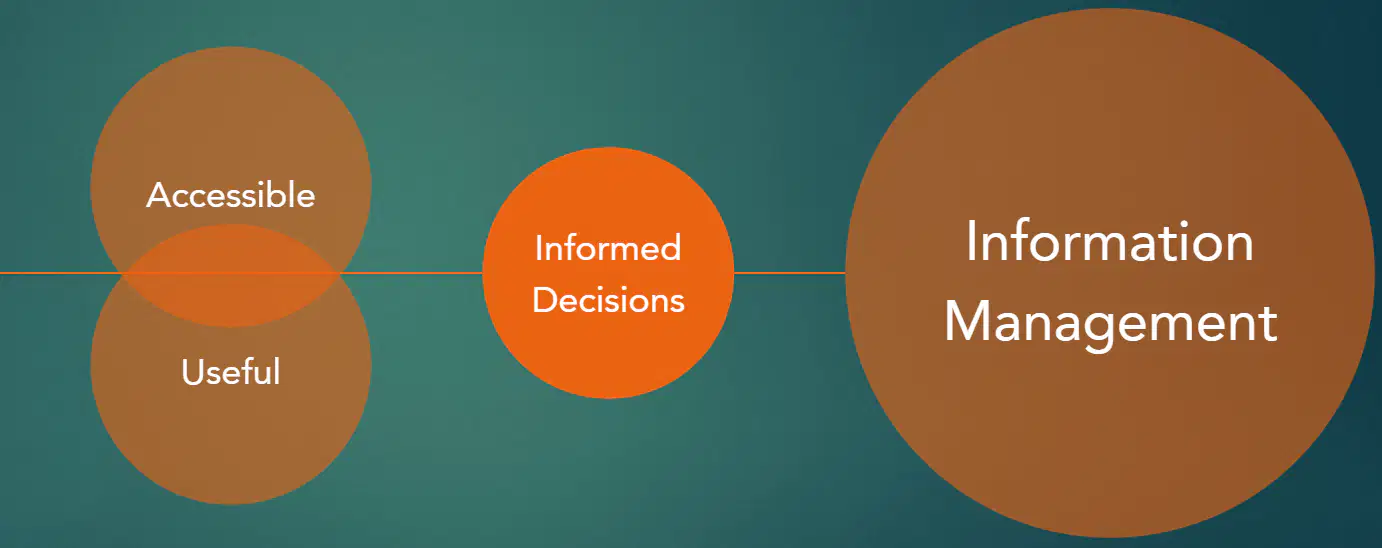
Fill in the blank: Information must be _______ and _______ to lead to informed decisions according to the diagram.
accessible, useful
hidden, complex
expensive, rare
outdated, irrelevant

According to the diagram, 'Useful' information is a result of information being both 'Relevant' and 'Accessible'.
True
False
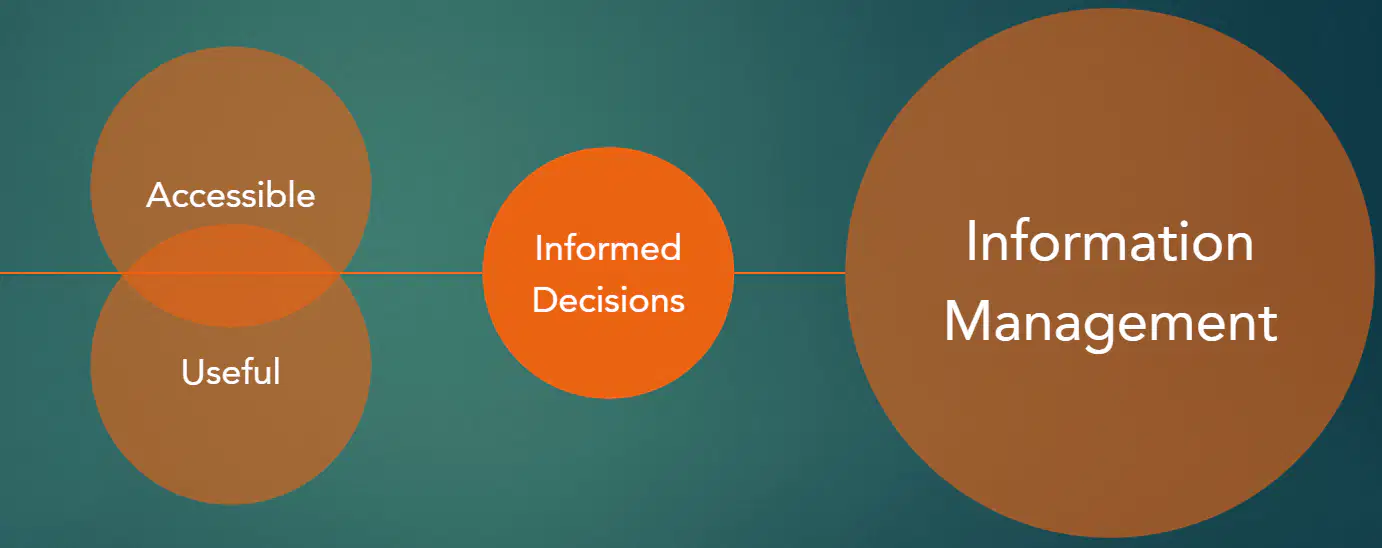
Which concept in the diagram is directly linked to making 'Informed Decisions'?
Accessible
Useful
Relevant Data & Information
Information Management

Fill in the blank: The ultimate goal of managing relevant, accessible, and useful information is _______ according to the diagram.
Information Management
Data Loss
System Failure
Resource Wastage
What does 'Accessible' mean?
Granting access to information, usually via a password, only to those who should have access to the information, and with different levels of access.
Making information public to everyone without restrictions.
Storing information in a secure location.
Deleting information after use.
Fill in the blank: By granting access, the information becomes ________, in many cases, on demand.
retrievable
irrelevant
encrypted
obsolete
Fill in the blank: Giving the right ________ to the right people at the right time.
access
password
location
reward
Data is collected, and then evaluated, analyzed, and presented in a way that is _________
useful
random
confusing
irrelevant
Which of the following is an example of raw data collection?
Organizing sales by region
Raw sales transactions
Analyzing market trends
Compiling sales reports
Until the data is organized, categorized, and compiled in a manner that is useful, it is just ________.
data
information
knowledge
wisdom
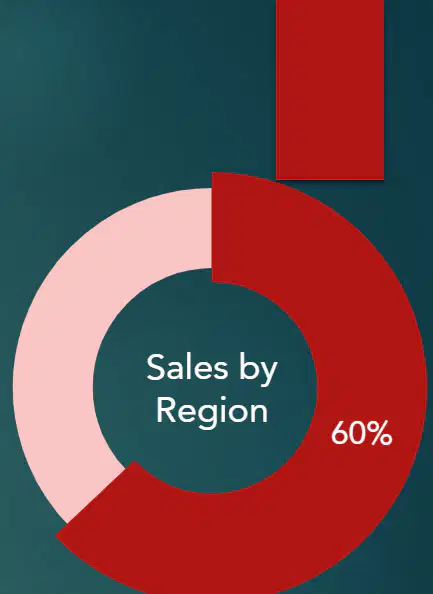
According to the chart, what percentage of a company's sales were from the Northeast United States?
40%
50%
60%
70%
Why is it useful to categorize sales data into geographical regions?
It helps identify where the majority of sales are occurring and which markets are struggling.
It increases the total sales.
It reduces the need for data collection.
It eliminates the need for analysis.
Fill in the blank: In the Information Management process, data must be _______ and useful to lead to informed decisions.
accessible
encrypted
expensive
obsolete
According to the diagram, 'Useful' information is necessary for making informed decisions.
True
False

Which of the following is the final outcome in the Information Management process as depicted in the diagram?
Accessible
Useful
Information Management
Relevant Data & Information
Information isn’t useful unless it is used to inform and make decisions.
True
False
Data integrity is:
the accuracy and consistency of data over its lifecycle
the process of backing up data regularly
the speed at which data can be accessed
the method of encrypting data for security
Fill in the blank: Data Integrity is the ________ and validity of data over its lifecycle.
accuracy
size
color
location
Which of the following is true about businesses and data integrity?
Businesses can run without information and data.
Businesses can't run without information and data.
Data integrity is not important for companies.
Data integrity is only needed for financial information.
Fill in the blank: Data integrity is needed to keep company and customer information ________, traceable, and connected.
searchable
invisible
expensive
unavailable
Fill in the blank: Data integrity helps companies keep true and ________, real-time information to assist them with their decision-making.
accurate
expensive
irrelevant
outdated
What if you didn’t have information?
You would be unable to make informed decisions.
You would have more knowledge.
You would always know what to do.
You would have access to all facts.
Who said the following quote? "Information is power, and the gain you get from empowering your associates more than offsets the risk of informing your competitor."
Jeff Bezos
Sam Walton
Bill Gates
Elon Musk
Fill in the blank: Without __________, you are making decisions in the dark.
information
money
luck
friends
What does Martha Rogers mean by the quote: "When your headlights aren’t on, the best rearview mirror available isn’t likely to improve your driving."?
It means that looking back is not helpful if you are not prepared for what lies ahead.
It means that having a good memory is more important than being aware of the present.
It means that driving is only safe when you have a good rearview mirror.
It means that headlights are more important than mirrors when driving at night.
IM is interrelated with the other five business functions in which of the following ways?
IM supports and integrates with the other five business functions to enhance overall business performance.
IM operates independently from the other five business functions.
IM replaces the need for the other five business functions.
IM only interacts with one of the other business functions.
Recall the six business functions. Fill in the blank: 1. ________ (Hint: It involves planning and setting goals for the business.)
Strategy
Finance
Operations
Marketing
Recall the six business functions. Fill in the blank: 2. ________ (Hint: It involves managing the day-to-day activities of the business.)
Operations
Marketing
Finance
Human Resources
Recall the six business functions. Fill in the blank: 3. ________ (Hint: It involves promoting and selling products or services.)
Marketing
Finance
Operations
Human Resources
Recall the six business functions. Fill in the blank: 4. ________ (Hint: It involves collecting, storing, and managing business data.)
Information Management
Marketing
Production
Finance
Recall the six business functions. Fill in the blank: 5. ________ (Hint: It involves managing employee relations and development.)
Human Resources
Marketing
Finance
Operations
Recall the six business functions. Fill in the blank: 6. ________ (Hint: It involves managing money, budgets, and financial records.)
Finance and Accounting
Marketing and Sales
Operations and Production
Human Resources
Fill in the blank: IM handles the confidential information including accounts receivable and payable, accounting records, tax matters, and financial statements for the ________ function.
Finance/Accounting
Human Resources
Marketing
Operations
Fill in the blank: IM stores information such as personnel records and job descriptions for the ________ function.
Human Resources
Finance
Marketing
Operations
Fill in the blank: IM keeps the information about customers and sales transactions and much more for the ________ function.
Marketing
Finance
Production
Human Resources

