
 Worksheets
LESSON 1: Levels of Organization in an Environment
Total questions: 54
Worksheet time: 45mins
Which level of ecological organization includes all parts of Earth and the surrounding atmosphere where there is life?
Community
Ecosystem
Biosphere
Population
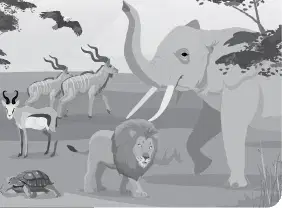
In the Kalahari Desert example, which description best matches an ecosystem?
All elephants living together in a wildlife refuge
A single elephant caring for its young
All populations of different species living in the area at the same time
All living things in an area plus nonliving things like soil, water, and rocks
Which statement correctly distinguishes population from community?
A population includes all living and nonliving things in an area.
A community includes all organisms of one species that live in the same area.
A population is all the organisms of the same species that live in the same area at the same time; a community is all the populations of different species that live together in the same area at the same time.
A community is a group of organisms with similar traits that can produce fertile offspring.
Which statement best defines a limiting factor in an ecosystem?
Anything that increases the number of organisms
Anything that restricts the size of a population
The total number of organisms an ecosystem can support
The fastest rate at which a population can grow
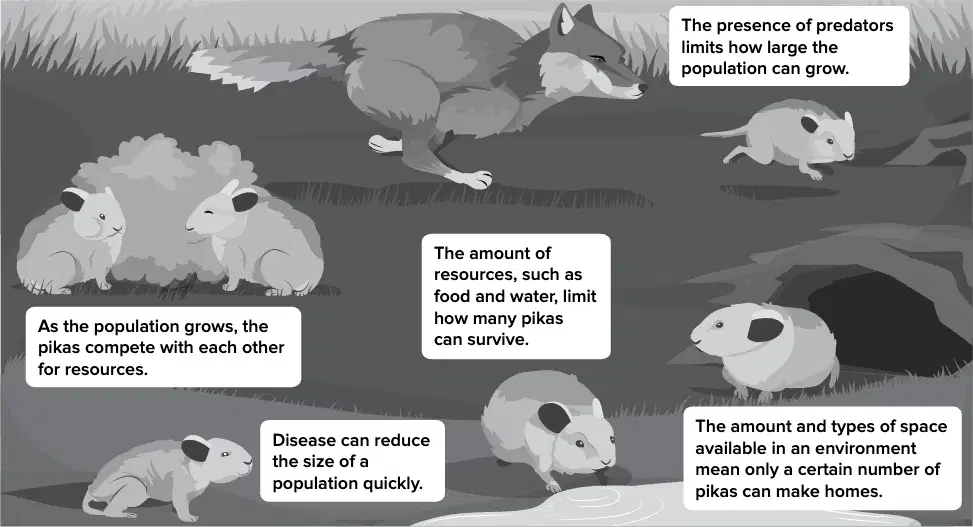
Based on the pika diagram description, which example shows how predators affect population size?
Predators reduce the amount of sunlight available.
Predators increase the fertility of the population.
The presence of predators limits how large the population can grow.
Predators provide additional den space for the population.
Which term refers to the largest number of individuals of one species an ecosystem can support over time?
Biotic potential
Carrying capacity
Overpopulation
Fertility
A raccoon population has plenty of food, water, space, and no disease or predators. According to the lesson, what would primarily limit its size in this scenario?
Temperature dropping below freezing
The number of offspring raccoons can produce (biotic potential)
Competition for sunlight
Natural disasters like floods
Which situation best illustrates overpopulation?
A population grows until it matches the available resources.
A population’s size grows so large that it causes damage to the environment.
A population decreases due to disease.
A population remains stable over time.
Which factor directly reduces a population by destroying habitats and food sources for organisms?
Predation
Natural disturbances such as floods and fires
Overpopulation
Disease
What is the best definition of an endangered species?
A species that has died out
A species at risk but not yet endangered
A species whose population is at risk of extinction
A species that faces no risk of extinction
A mouse population decreases during winter because less food is available, causing more mice to die than are born. Which concept does this example illustrate, and why?
Extinction, because the species has died out
Predation, because cats feed on mice
Population size decrease, due to lack of resources
Threatened status, because mice are not yet endangered
Which statement best describes how different populations can share the same habitat in an ecosystem?
They all use exactly the same resources in the same way.
They use resources like water, food, shelter, and other resources, but each population uses them in a different way.
Only one population can live in a habitat at a time.
Populations avoid using trees to prevent competition.
In a commensalism relationship, what happens to the two species involved?
Both species benefit.
One species benefits and the other is harmed.
One species benefits while the other is neither helped nor harmed.
Neither species is affected.
A dog infected with heartworms is an example of which type of symbiotic relationship, and why?
Mutualism, because both the dog and heartworms benefit.
Commensalism, because the heartworms benefit and the dog is unaffected.
Parasitism, because the heartworms benefit by getting food while the dog is harmed.
Resource partitioning, because the dog and heartworms share food.
Boxer crabs and sea anemones live together in coral reef communities. The crabs carry sea anemones in their claws, which have stinging cells that help crabs fight off predators, and the sea anemones eat leftovers from the crabs’ meals. What conclusion about their relationship is best supported by this description?
It is parasitism because the anemones harm the crabs.
It is commensalism because only the crabs benefit.
It is mutualism because both partners benefit.
It is competition because they fight for the same food.
Which statement best describes a cooperative relationship in an ecosystem?
Members of a population work together for survival, such as leafcutter ants growing fungus to eat
A predator hunts and eats prey, controlling the prey population size
Two species compete for the same limited resource like water or shelter
Organisms live separately and do not interact with other species
In a predator-prey relationship described in the lesson, what role does the harpy eagle play when it grabs a monkey?
Prey
Competitor
Predator
Decomposer
Why does competition occur among organisms in a community like the Kalahari Desert?
There are always abundant resources for every organism
Predators eliminate weak members
Resources such as food and water can be scarce, so multiple organisms need the same resources at the same time
Populations do not interact with each other
Which statement best defines ecological succession in a land ecosystem?
The sudden appearance of new species without environmental change
The process of one ecological community gradually changing into another
The immediate growth of trees after a storm
The permanent absence of plants after a disturbance
A climax community is described as a stable community that no longer goes through major ecological changes. Based on this, which scenario best represents a climax community?
New lava flow covers the land and only bare rock remains
Small plants begin to grow and soil is still thin
Mature grassland that remains relatively stable over hundreds of years
Lichens release acid that helps break down rock
After many years of primary succession, the soil becomes deep and nutrient-rich. Using this information, which reasoning best explains why new species of plants and animals can appear over time?
Nutrients stop cycling, preventing decay
Changing soil composition from decaying plants and animals supports different species
Shade levels never change as plants grow taller
Wind prevents spores from settling
Which statement best describes secondary succession?
The development of a new ecosystem on bare rock where no soil exists
The gradual regrowth of an ecosystem in a disturbed area where soil remains
The immediate return of an ecosystem to its original state after a disturbance
The creation of a climax community by planting crops each year
In the regrowth of forests described, which sequence happens first as abandoned cropland begins to recover?
Beech and maple trees form the climax forest immediately
White pines and poplars grow tall and then die out
Seeds of grasses and wildflowers sprout, followed by shrubs and young trees
A hurricane removes the remaining soil before plants can grow
Which event is most likely to trigger secondary succession because it damages living things but leaves the soil mainly intact?
A volcanic eruption covering the area with new lava
A forest fire that burns plants but leaves soil
The initial formation of soil from weathered rock
The daily photosynthesis of beech and maple trees
Which statement best defines aquatic succession?
A sudden change in a body of water caused by a storm
The natural, predictable process by which freshwater ecosystems change over time due to sediment buildup
The migration of fish from one lake to another
The human-made draining of ponds to create farmland
During aquatic succession, what primarily transports sediment into ponds, lakes, and wetlands?
Wind only
Animals moving soil
Water, including rainwater and runoff
Volcanic eruptions
Which sequence explains how eutrophication can lead to lower oxygen levels for fish?
Nutrients decrease → algae grow less → oxygen increases
Nutrients increase → algae and microscopic organisms grow → they use most dissolved oxygen → fish have less oxygen
Sediment decreases → plants receive more sunlight → oxygen increases
Fertilizers removed → nutrients increase → oxygen increases
Which term best describes the balance between different parts of an ecosystem that can be disrupted by changes?
Dynamic equilibrium
Carrying capacity
Habitat fragmentation
Natural selection
Which scenario most directly illustrates how human resource extraction can disrupt forest ecosystems?
An unexpected volcanic eruption covers a valley in ash
Clearing large areas of trees to build houses and roads
A drought reduces plant growth for one season
Introducing predators into a protected park
A nonnative species is introduced to an island and begins to compete with native species for resources, causing native populations to decline. Which reasoning best explains why the native populations decrease?
Nonnative species always have larger body sizes
The ecosystem’s carrying capacity for all species increases
Competition and predation by the nonnative species reduce native survival and reproduction
Native species stop using any available resources


What happens if a population grows past its carrying capacity?
The population keeps growing
The population reduces untl it is below carrying capacity again
The entire species will go extinct
The carrying capacity just increases


Which of the following statements is true?
A decrease in food availability lowers carrying capacity.
An increase in water will decrease the carrying capacity.
A fishes population cannot exceed the carrying capacity.
A population stays level once at carrying capacity.




Aphids are tiny insects that live on and eat the leaves of plants, removing vital nutrients from the plants.
Predation
Parasitism
Commensalism
Mutualism
When two organisms share the same niche (role in the ecosystem) and/or resources. What type of relationship do they have?
mutualistic
competition
parasitism
predation
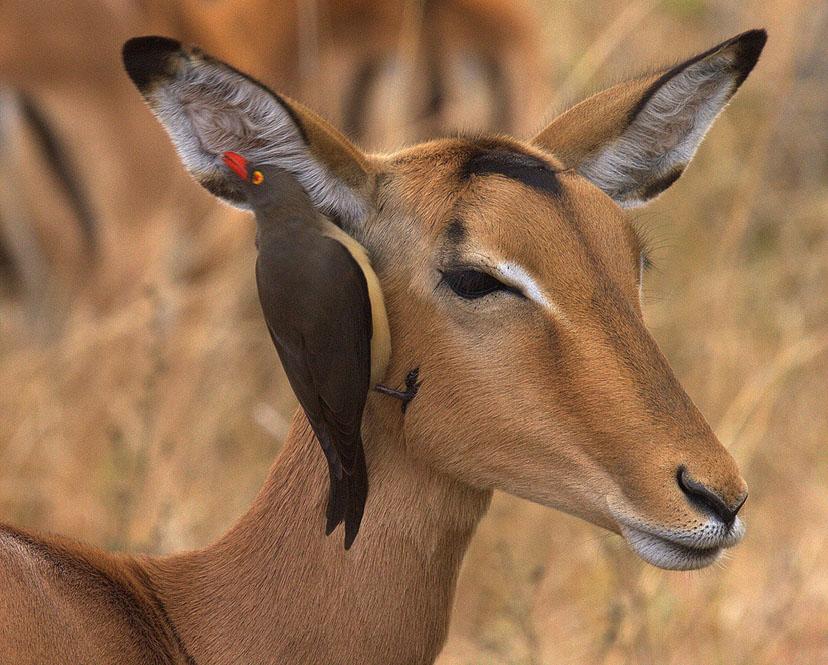
One advantage of large animal social groupings is
increased competition between members
increased chances of diseases spreading
division of labor among group members
decreased food gathering
One advantage of large animal social groupings is
increased competition between members
increased chances of diseases spreading
protection from predators
decreased food gathering
What is a Biotic Factor?
The carrying capacity of an ecosystem
A NON-living factor that can affect an ecosystem
A living factor that can affect an ecosystem
What is an Abiotic Factor?
A NON-living factor that can affect an ecosystem
A living factor that can affect an ecosystem
The carrying capacity of an ecosystem

A group of elephants gets stuck in mud at the edge of the river from a recent mud slide. A lion waits for an elephant to get tired before it attacks. What is the limiting factor to the elephant population?
Predator-Prey Relationships
Natural Disaster
Herbivory Effect
Competition
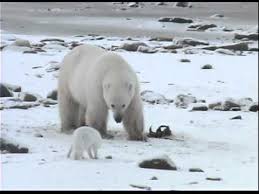
Two arctic fox are fighting with a polar bear for a sea lion carcass. One fox distracts the bear while the other eats. What type of limiting factor is the polar bear?
Predator-Prey Relationships
Competition
Herbivory Effect
Weather

