wayground logo

Free Printable Worksheets

Font size

S
M
L
XL
Worksheets

Gene Mutations & Protein Synthesis Quiz Review

Total questions: 88

Worksheet time: 1hrs 21mins

Name
Class
Date
1.
Which of the following components of a DNA molecule carries the genetic code?
a)
phosphate groups
b)
nitrogenous bases
c)
hydrogen bonds
d)
deoxyribose sugars
2.
The building blocks for proteins are
a)
nucleotides
b)
amino acids
c)
monsaccharides
d)
glycerol & fatty acids
3.
The genetic code is used to translate the information from DNA into proteins. The fact that genes from one organism can be spliced into another is evidence that
a)
each species has its own genetic code
b)
all living things use the same genetic code
c)
similar species have identical proteins
d)
genes are identical between species
4.
A short section of mRNA reads 3' CGGUAU 5' What DNA code probably produced this section of mRNA?
a)
5' GCCTUT 3'
b)
5' GCCAUT 3'
c)
5' ATTGCC 3'
d)
5' GCCATA 3'
5.
The fact that a strain of yeast (a type of fungi) with a certain defective gene can use the human version to repair itself is evidence that yeast and humans
a)
depend on the same food supply
b)
share a genetic code
c)
both have eukaryotic cells
d)
have identical DNA
6.
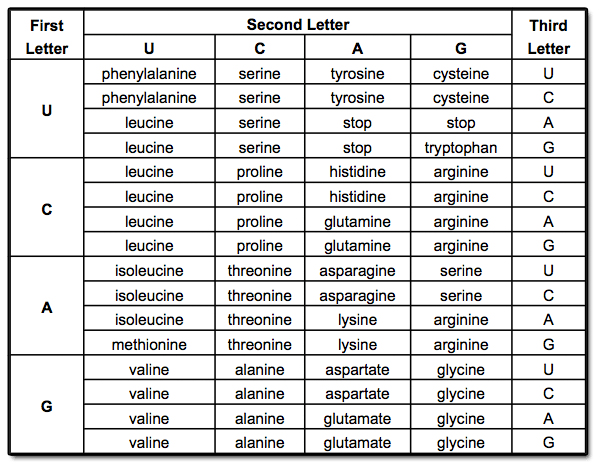
A sequence of a DNA template strand is shown. 3' TCC AAT GGC TTA TTT GCA 5'
a)
Arg - Leu - Pro - Asp - Lys - Arg
b)
Try - Phe - Leu - Gly - Asp - Phe
c)
Ser - Leu - Pro - Asp - Lys - Arg
d)
Try - Phe - Leu - Gly - Asp - Ser
7.
Human bone, muscle, and nerve cells all contain the same DNA. What enables these cells to perform specialized activities?
a)
The ability of some cells to remove unnecessary DNA sequences
b)
The regulation of gene expression within each cell type
c)
The mutation of genes not used in the cell
d)
Using unique methods of cell division
8.
a)
Insertion
b)
Deletion
c)
Frameshift
d)
Substitution
9.
a)
A silent mutation results in the insertion of a different amino acid
b)
A substitution occurs with the adenine base
c)
A deletion of a cytosine base occurs
d)
A base is inserted into one strand of the DNA
10.
a)
Mutations 1 & 3 only
b)
Mutation 1 only
c)
Mutation 2 only
d)
Mutations 1, 2, & 3
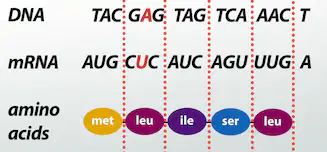
11.
a)
met - leu - his - asp - gly
b)
met - phe - his - asp - gly
c)
met - pro - his - asp - gly
d)
met - ser - his - asp - gly
12.
A medical test indicates that a patient has a defective protein. This condition is most likely due to a change in the directions coded in the
a)
number of hydrogen atoms in starch molecules
b)
sequence of monosaccharides in the carbohydrate chain
c)
number of carbon atoms in glucose
d)
Sequence of nucleotides in DNA
13.
What would happen if the first nucleotide "T" is removed from the following DNA sequence?
a)
The point mutation would cause protein synthesis to stop prematurely.
b)
The point mutation would cause a shift in the reading frame.
c)
The frameshift would change all of the amino acids in the sequence
d)
The frameshift would result in the synthesis of the same protein
14.
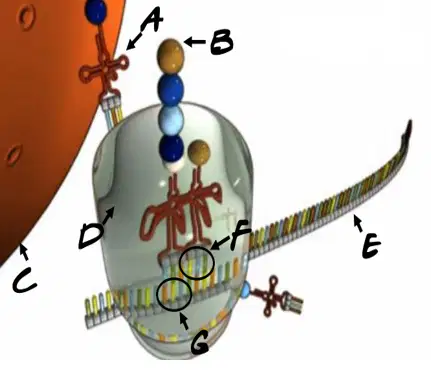
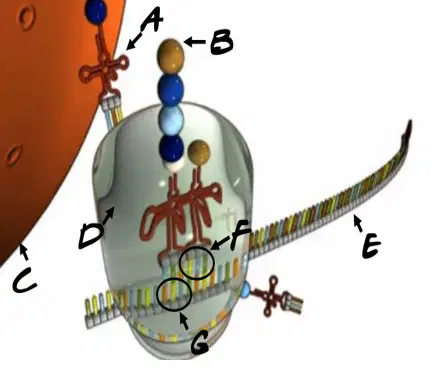
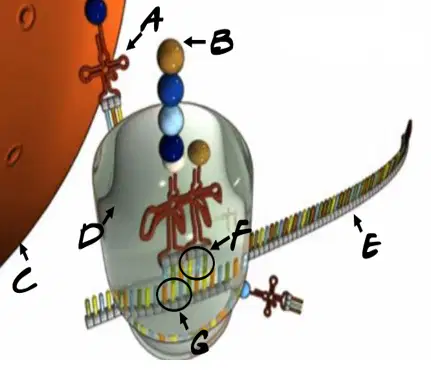
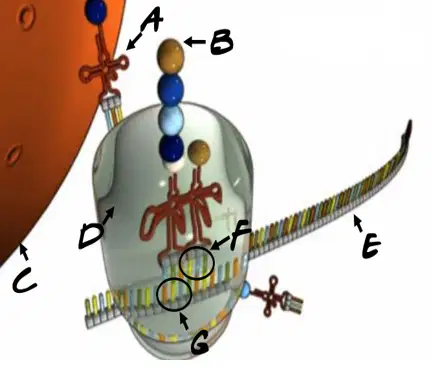
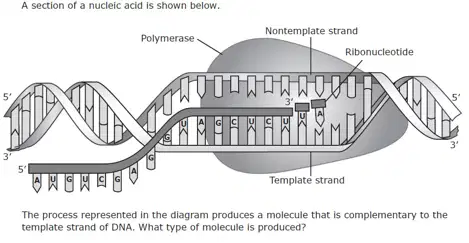
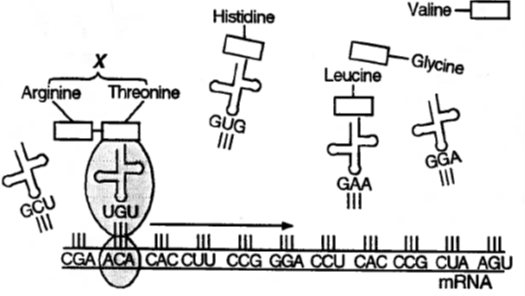
What process is being shown below?
a)
Replication
b)
Transcription
c)
Translation
15.
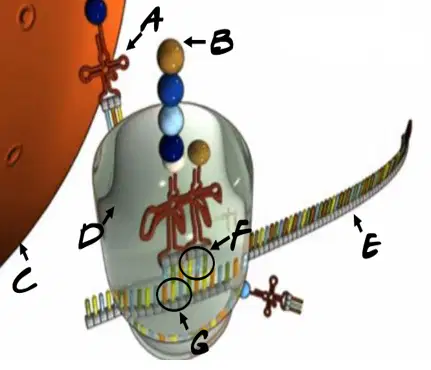
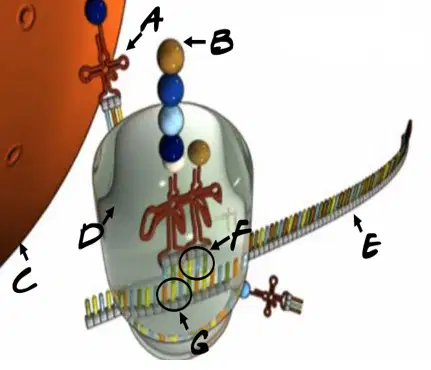
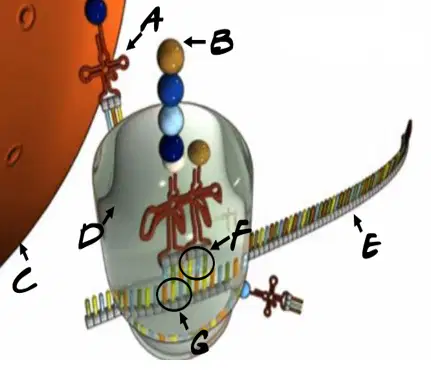
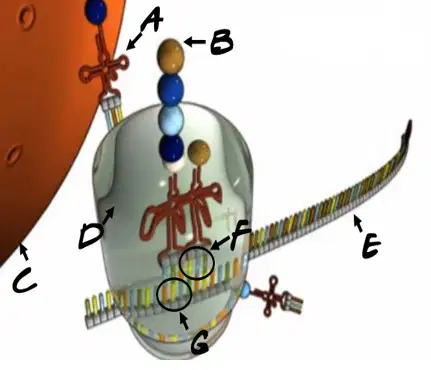
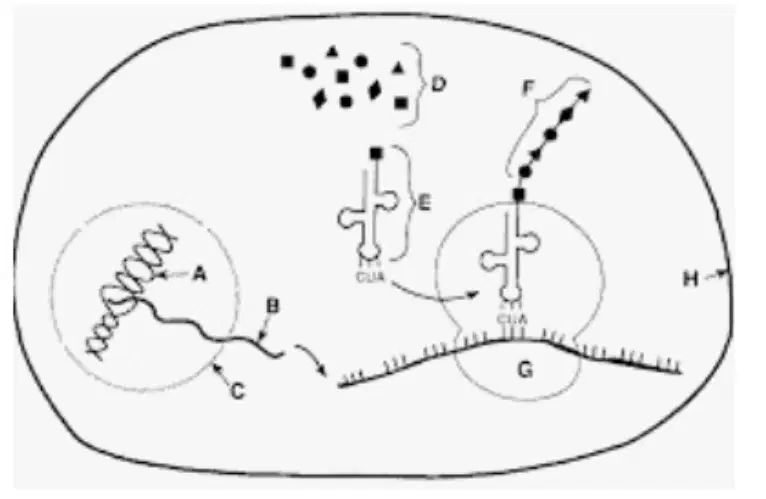
What is structure A?
a)
tRNA
b)
mRNA
c)
codon
d)
anticodon
e)
nucleus
16.
What is structure B?
a)
polypeptide
b)
mRNA
c)
tRNA
d)
codon
e)
anticodon
17.
What is structure C?
a)
nucleus
b)
mRNA
c)
tRNA
d)
codon
e)
anticodon
18.
What is structure D?
a)
ribosome
b)
mRNA
c)
tRNA
d)
codon
e)
anticodon
19.
What is structure E?
a)
mRNA
b)
tRNA
c)
codon
d)
anticodon
e)
nucleus
20.
What is structure F?
a)
anticodon
b)
mRNA
c)
tRNA
d)
codon
e)
nucleus
21.
What is structure G?
a)
codon
b)
mRNA
c)
tRNA
d)
anticodon
e)
nucleus
22.
Which of the following describes a frameshift mutation?
a)
An amino acid sequence is stopped, shortening the protein.
b)
Insertion or deletion of nitrogen bases alter the reading frame.
c)
The identity of a single amino acid is changed in a protein.
d)
The mutation results in no change to the amino acid sequence.
23.
Which of the following describes a nonsense mutation?
a)
An amino acid sequence is stopped, shortening the protein.
b)
Insertion or deletion of nitrogen bases alter the reading frame.
c)
The identity of a single amino acid is changed in a protein.
d)
The mutation results in no change to the amino acid sequence.
24.
Which of the following describes a silent mutation?
a)
An amino acid sequence is stopped, shortening the protein.
b)
Insertion or deletion of nitrogen bases alter the reading frame.
c)
The identity of a single amino acid is changed in a protein.
d)
The mutation results in no change to the amino acid sequence.
25.
Genes from a sea coral can be transferred into a zebra fish to make it glow in response to ultraviolet light. The fact that genes from one species can be placed into another is evidence that all organisms
a)
produce the same collection of proteins
b)
contain membrane bound organelles
c)
share a common genetic code
d)
are genetically identical
26.
a)
DNA
b)
mRNA
c)
ribosome
d)
tRNA
27.
Where does the process shown below take place?
a)
ribosome
b)
nucleus
c)
vacuole
d)
lysosome
28.
Which of the following describes how RNA is different from DNA?
a)
Contains the nitrogen base uracil instead of thymine
b)
Has ribose sugar
c)
Is single stranded
d)
Can leave the nucleus
e)
All are correct
29.
In the 1960s the molecular biologist George Streisinger developed the strand-slippage hypothesis. Streisinger noticed that mutations occurred in areas of DNA that contained many repeat sequences. When a strand-slippage occurs, an insertion mutation can result. How does the insertion mutation affect the DNA?
a)
Nitrogenous bases are added
b)
Nitrogenous bases are exchanged
c)
Nitrogenous bases are damaged
d)
Nitrogenous bases are deleted
30.
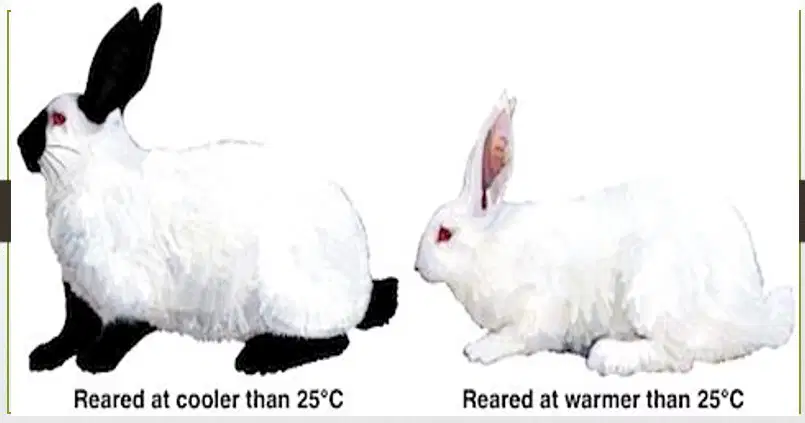
What affects the expression of the coat color gene in these rabbits?
a)
light exposure
b)
temperature
c)
soil acidity
d)
nutrition
31.
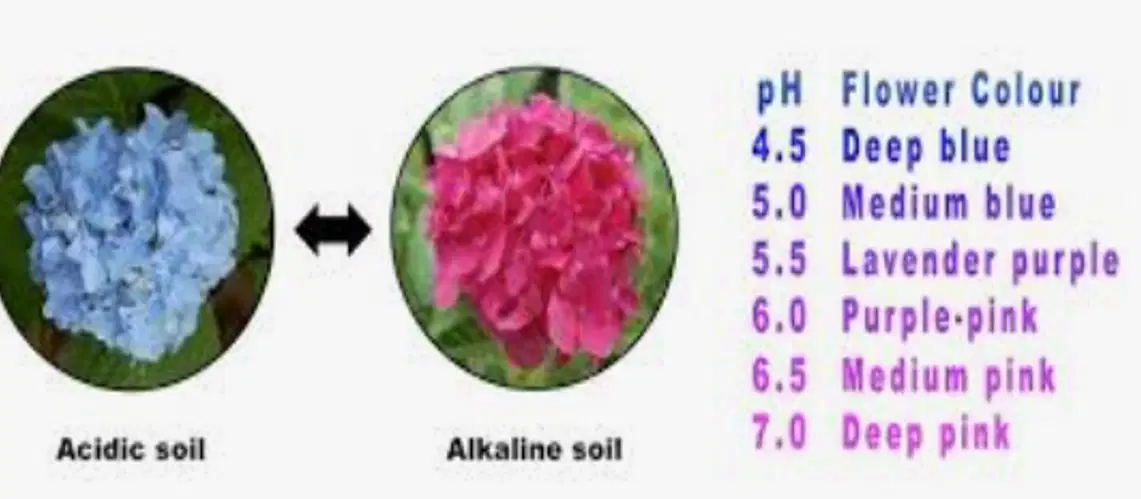
What affects the expression of the flower color gene in these plants?
a)
light exposure
b)
temperature
c)
soil acidity
d)
nutrition
32.
Every cell in the body has the EXACT SAME DNA instructions. Which of the options below accurately explains why different cells look and function differently?
a)
Specialized cells will splice and discard portions of the DNA not needed by the cell to complete its function.
b)
Specialized cells borrow the portions of DNA they need from other cells.
c)
Specialized cells will only activate the portions of DNA they need to complete their function.
d)
Specialized cells only have the sections of DNA they need to do their job.
33.
The first process of protein synthesis, where DNA is copied into mRNA is called
a)
replication
b)
transcription
c)
translation
34.
The second process of protein synthesis, where mRNA is read and converted into an amino acid chain is called
a)
replication
b)
transcription
c)
translation
35.
What is another name for a protein?
a)
amino acid
b)
peptide bond
c)
polypeptide
d)
monopeptide
36.
Proteins are made by joining many __________________________.
a)
nucleotides
b)
amino acids
c)
glycerol & fatty acids
d)
glucose molecules
37.
Where in the cell does transcription take place?
a)
in the nucleus
b)
on ribosomes in the cytoplasm
c)
in Golgi bodies
d)
in the cell membrane
38.
Where in the cell does translation take place?
a)
in the nucleus
b)
on ribosomes in the cytoplasm
c)
in Golgi bodies
d)
in the cell membrane
39.
The CENTRAL DOGMA OF BIOLOGY states that information is transferred in the following way:
a)
Option 1
b)
Option 2
c)
Option 3
d)
Option 4
40.
What process does the image below show?
a)
Replication
b)
Transcription
c)
Translation
41.
What process does the image below show?
a)
Replication
b)
Transcription
c)
Translation
42.
What process does the image below show?
a)
Replication
b)
Transcription
c)
Translation
43.
Which RNA is shown in the image below?
a)
messenger-RNA
b)
transfer-RNA
c)
ribosomal-RNA
44.
Which RNA is shown in the image below?
a)
messenger-RNA
b)
transfer-RNA
c)
ribosomal-RNA
45.
Which RNA is shown in the image below?
a)
messenger-RNA
b)
transfer-RNA
c)
ribosomal-RNA
46.

What are the two main types of gene mutations?

(a)  

47.

Which mutation involves the addition or deletion of a DNA base?

(a)  

48.

Suppose DNA polymerase incorrectly paired an adenine base with a guanine base. What type of mutation would this mistake result in?

(a)  
49.
Which type of gene mutation ALWAYS results in abnormal amino acid sequence?
a)
Frameshift
b)
Point Mutation
50.
Which type of mutation shifts the reading frame of mRNA?
a)
Frameshift
b)
Point Mutation
51.
Which type of mutation prematurely stops the translation of the mRNA?
a)
Nonsense
b)
Silent
52.
Which mutation (point or frameshift) causes more damage to the resulting protein? EXPLAIN.
4 lines
53.
A geneticist found that a particular mutation had no effect on the protein coded by a gene. What do you think is the most likely type of mutation in this gene? Explain how this type of mutation can have no effect on the protein produced.
4 lines
54.
a)
A
b)
B
c)
C
d)
D
55.
a)
A
b)
B
c)
C
d)
D
56.

What type of mutation is shown above:

a)

Inversion

b)

Insertion

c)

Substitution

d)

Deletion

57.

What type of mutation is shown above?

a)

Inversion

b)

Insertion

c)

Deletion

d)

Substitution

58.

What type of mutation is shown above?

a)

Substitution

b)

Insertion

c)

Deletion

d)

Frame-shift mutation

59.

What is the correct order for protein synthesis?

a)

DNA -> RNA -> codons

b)

proteins -> RNA -> DNA

c)

DNA -> RNA -> proteins

d)

RNA -> DNA -> proteins

60.

Muscle cells differ from nerve cells mainly because they

a)

express different genes.

b)

contain different genes.

c)

use different genetic codes.

d)

have unique ribosomes

61.
What mutation has occurred here? 
T-G-A-C-C-A
T-G-A-G-C-A
a)
Substitution
b)
Deletion
c)
Insertion
d)
Frameshift 
62.
What process is going on in this photo? 
a)
Transcription 
b)
Translation 
c)
Replication 
d)
All the above 
63.

A mutation is a _______________ in the nucleotide base sequence of a gene.

a)

wrinkle

b)

change

c)

bump

d)

tumor

64.
A triplet (3 bases)  of mRNA is called a
a)
codon
b)
anticodon
c)
amino acid
d)
peptide bond
65.
_______ is made during transcription and ________ is made during translation.
a)
mRNA / a protein
b)
a protein / mRNA
c)
Ribosome / Nucleus
d)
mRNA / tRNA
66.

True or False: All of your body cells contain the same genes.

a)

True

b)

False

67.

Which of the following images is a DELETION?

a)
b)
c)
68.

Which of the following images is a SUBSTITUTION?

a)
b)
c)
69.

Which of the following statements best describes why a change in only one DNA nucleotide base of a gene on the DNA strand could result in an incorrect protein being produced by the gene?

a)

The change prevents mRNA from being made.

b)

The change causes cells to divide in an uneven way.

c)

The change creates an additional mRNA strand.

d)

The change alters the amino acid sequence coded for by the

gene.

70.

What mutation to the DNA triplet bellow WILL NOT EFFECT the protein made?

3' CCA 5'

a)

CAG

b)

CCC

c)

TCA

d)

CTT

71.

Why are insertion and deletion (frameshift) mutations so harmful?

a)

They change all of the codons from the mutation on down the strand, which changes the entire amino acid sequence

b)

They insert things that an organism doesn't need.

c)

They often delete things that organisms need.

d)

Insertion and deletions are not any more harmful than substitution mutations.

72.
Which process is happening in this picture?
a)
Transcription
b)
Translation
c)
Replication
73.

In order for protein synthesis to occur, mRNA must leave the nucleus and travel to

a)

a ribosome in the cytoplasm

b)

a mitochondria in the cytoplasm

c)

a vacuole in the cytoplasm

d)

a chloroplast in the cytoplasm

74.

Original DNA = TAC GAC TTG AAT

Mutated DNA = TAC GTA CTT GAA T

What type of mutation has occurred?

a)

Chromosomal mutation

b)

Point mutation

c)

Frameshift mutation due to adding extra base

d)

Frameshift mutation due to deletion of base

75.

Original DNA = TAC GAC TTG AAT

Mutated DNA = TAC GAC TTG AAT

What type of mutation has occurred?

a)

Chromosomal mutation

b)

Point mutation

c)

Frameshift mutation

d)

No mutation occurred

76.

Original DNA = TAC GAC TTG AAT

Mutated DNA = TAC ACT TGA AT

What type of mutation has occurred?

a)

Chromosomal mutation

b)

Point mutation

c)

Frameshift mutation due to addition of base

d)

Frameshift mutation due to deletion of base

77.

Which type of mutation is MOST LIKELY to cause the greatest disruption?

a)

Frameshift

b)

Silent

c)

Point

78.

What codon is represented by the STOP amino acid?

a)

AUG

b)

UAA

c)

CUC

d)

GUA

79.
In eukaryotes, molecule 1 is found in
a)
ribosomes
b)
chloroplasts
c)
cytoplasm
d)
the nucleus
80.
Molecule 3 is synthesized in 
a)
ribosomes
b)
chloroplasts
c)
the cell membrane
d)
the nucleus
81.

what is the product of this process

a)

DNA

b)

mRNA

c)

tRNA

d)

amino acid

82.
Which of the following best defines a gene?
a)
A diploid cell containing two sets of chromosomes
b)
A unit made up of chromosomes that control for a specific trait
c)
A segment of DNA that codes for a particular protein
d)
All the other answers are correct.
83.

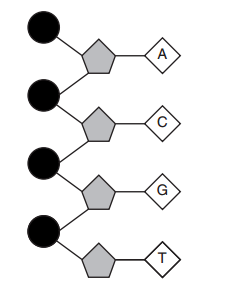
The diagram below represents a portion of a DNA molecule. which part carries the genetic information

a)

sugar molecules

b)

nitrogen bases

c)

enzymes

d)

proteins

84.

The arrow in the diagram represents the movement of which molecular structure?

a)

Protein

b)

DNA molecule

c)

mRNA molecule

d)

base pair

85.
Which process is shown?
a)
diffusion
b)
repiration
c)
recombination
d)
translation
86.
Question Image

Match the structure to the label on the diagram

a)

A

1.

DNA

b)

B

2.

mRNA

c)

F

3.

Protein

d)

D

4.

Amino acids

e)

E

5.

tRNA

87.

Match the statement to the correct process.

a)

mRNA is made

1.

Transcription

b)

Ribosome reads the mRNA message

2.

Translation

c)

Creates two identical daughter molecules

3.

Replication

88.

Match the statement to the correct process.

a)

Process of making a complimentary RNA message from a DNA code (DNA to mRNA)

1.

Transcription

b)

Process of making a copy of a DNA molecule (DNA to DNA)

2.

Replication

c)

Process of making a protein from a RNA message (RNA to protein)

3.

Translation