
NEW
Font size
 Worksheets
Force & Motion
Total questions: 50
Worksheet time: 28mins
Which of the following is used to measure speed?
meters
seconds
seconds per meter
meters per second
A bird flies 50 meters in 10 seconds. What is its speed?
0.2 second per meter
0.2 meters per second
5 seconds per meter
5 meters per second
A car travels 4 blocks in 1 minute at a constant speed. Which of the following graphs shows the car’s speed?

Graph 1

Graph 2

Graph 3

Graph 4
A flat horizontal line on a distance‑vs.-time motion graph shows
increasing speed
decreasing speed
no speed
acceleration
Carts of different masses are placed on a ramp at different heights. Which combination of features will have the greatest gravitational potential energy?
low mass and low height
low mass and high height
high mass and high height
high mass and low height
A student wants to conduct an investigation to determine if there is a relationship between the speed of a cart and the cart’s kinetic energy. They should
keep all variables the same except the kinetic energy of the cart.
keep all variables the same except the speed of the cart.
keep all variables the same except the mass of the cart.
do none of the above.
Which has the greater effect on the kinetic energy of a moving object, doubling its mass or doubling its speed?
doubling the object’s mass
doubling the object’s speed
doubling both have equal effects
neither
If there is no net force acting on a moving object, it will
continue moving at the same speed.
continue moving in the same direction.
continue moving at the same speed and in the same direction.
eventually slow down and stop.
What does it take to change the direction or speed of an object?
more than one force
an unbalanced force
a balanced force
no force
Which of the following describes an object that is speeding up? The object is
at rest.
accelerating.
in a frictionless environment.
moving with constant speed.
Which graph shows an object speeding up?
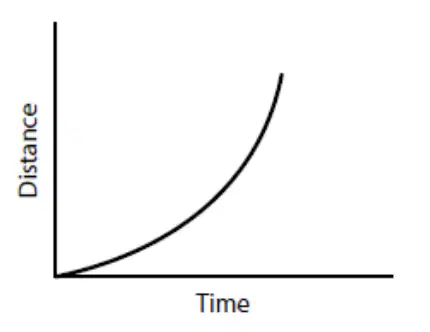
Graph 1
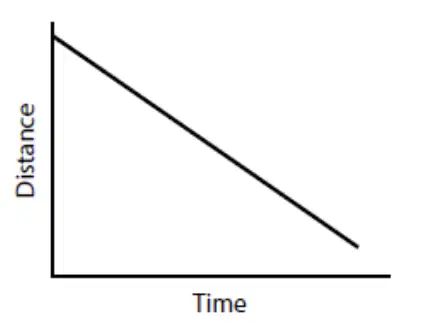
Graph 2
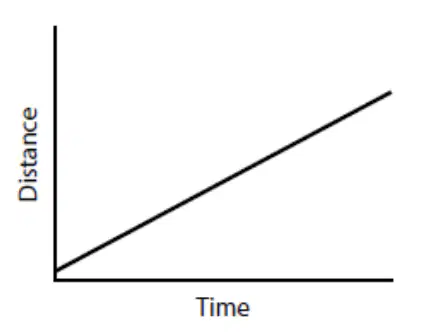
Graph 3
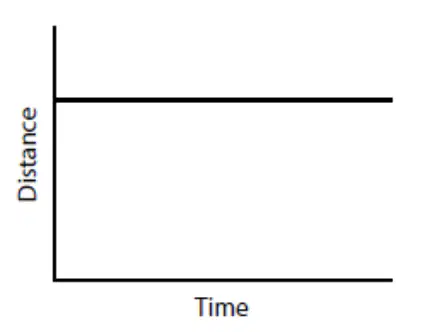
Graph 4
Imagine you were able to throw a ball in a frictionless environment without gravity. Once you let go of the ball, what will happen to the ball according to Newton’s laws of motion?
It will travel in a straight line forever.
It will travel in a straight line but eventually slow down.
It will continue to speed up forever.
It will slow down and turn.
When a person sits in a chair, they apply a force to the chair. The chair
applies a larger force to the person in the opposite direction.
applies the same size force on the person in the same direction.
applies the same size force on the person in the opposite direction.
does not apply a force to the person.
Car A and Car B are identical, but Car A is moving twice as fast as Car B. Both cars brake to a stop. Complete this sentence: The distance needed to stop Car A is ____________ the distance needed to stop Car B.
double
more than double
less than double
the same as
A car accelerates down the road. What is the “reaction” to the tires pushing on the road?
the air in the tires moving the car
the mass of the car pushing on the tires
the road pushing on the tires
the road moving away from the tires
The criteria of an engineering project describe the _____________ of the design.
goals and desired features
nonessential parts
limitations
end user
The constraints of an engineering project describe the __ of the design.
goals and desired features
nonessential parts
limitations
end user
Jayden designs, builds, and tests devices that solve electrical problems in cars. Jayden is likely considered
a scientist.
an inventor.
an engineer.
a manufacturer.
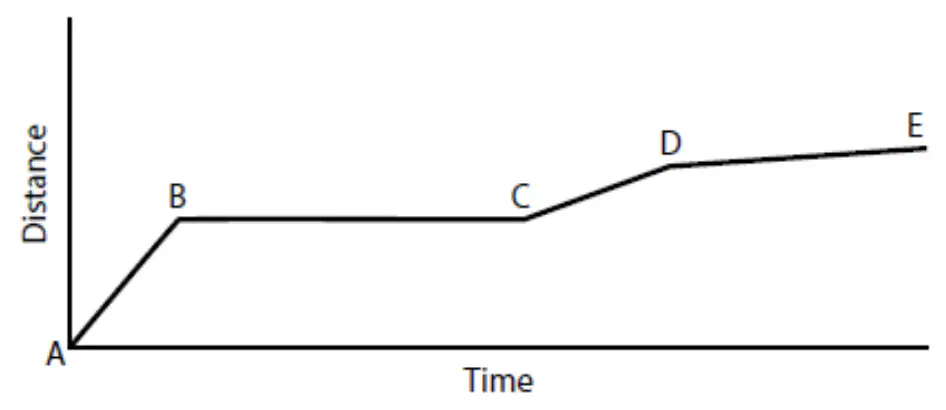
Which segment of the motion graph below shows the object moving the fastest?
A-B
B-C
C-D
D-E
Which segment of the motion graph below shows the object not moving?
A-B
B-C
C-D
D-E
Which of Newton's Laws of Motion does this statement best describe?
When you jump off a small boat, the boat moves backward.
Newton's 1st Law
Newton's 2nd Law
Newton's 3rd Law
Which of Newton's Laws of Motion does this statement best describe?
A soccer ball stays at rest until a player kicks it.
Newton's 1st Law
Newton's 2nd Law
Newton's 3rd Law
Which of Newton's Laws of Motion does this statement best describe?
When you push a shopping cart, it speeds up faster if it’s empty than if it’s full.
Newton's 1st Law
Newton's 2nd Law
Newton's 3rd Law
Which of Newton's Laws of Motion does this statement best describe?
A balloon flies around the room as air rushes out of it.
Newton's 1st Law
Newton's 2nd Law
Newton's 3rd Law
Which of Newton's Laws of Motion does this statement best describe?
A skateboard keeps rolling until friction or another force stops it.
Newton's 1st Law
Newton's 2nd Law
Newton's 3rd Law
Which of Newton's Laws of Motion does this statement best describe?
When a water balloon hits the ground and pops, the water splashes upward and outward.
Newton's 1st Law
Newton's 2nd Law
Newton's 3rd Law
Which of Newton's Laws of Motion does this statement best describe?
When you double the force on an object, it accelerates twice as much.
Newton's 1st Law
Newton's 2nd Law
Newton's 3rd Law
Which of Newton's Laws of Motion does this statement best describe?
The harder you hit a baseball, the faster it accelerates off the bat.
Newton's 1st Law
Newton's 2nd Law
Newton's 3rd Law
Which of Newton's Laws of Motion does this statement best describe?
A book stays on a desk until someone moves it.
Newton's 1st Law
Newton's 2nd Law
Newton's 3rd Law
Distance: 10m
Time: 5s
2m/s
1/2 m/s
50 m/s
100 m/s


A runner travels 20 meters in 4 seconds. What is the speed?
4 m/s
5 m/s
6 m/s
8 m/s
A dog runs 30 meters in 5 seconds. What is the speed?
5 m/s
6 m/s
150 m/s
160 m/s
A student walks 18 meters in 6 seconds. What is the speed?
3 m/s
4 m/s
54 m/s
55 m/s
A skateboard moves 25 meters in 5 seconds. What is the speed?
5 m/s
5 m/min
125 m/s
125 m/min
When a car accelerates, what happens to its kinetic energy?
It decreases
It remains constant
It increases
It becomes potential energy
A cyclist travels 30 kilometers in 2 hours. What is the average speed of the cyclist?
30 km/h
25 km/h
20 km/h
15 km/h
An engineer is best described as someone who:
Only works in a laboratory
Uses science and tools to build products solving practical problems
Writes scientific research papers
Teaches science in schools
"Evidence" in scientific context most closely means:
A random observation
A personal opinion
Information that supports or refutes a claim
A guess about scientific phenomena
A "trade-off" represents:
A financial transaction
A competitive game
A desirable outcome given up to gain another desirable outcome
A random exchange of goods
Which term describes a set of repeating things or events?
Phenomenon
Patterns
Speed
Kinetic energy
"Kinetic energy" specifically refers to:
Potential energy stored in an object
The energy an object has because of its motion
Chemical energy in batteries
Thermal energy from heat
Speed can be best defined as:
How fast something looks
The distance between two points
The rate at which an object moves
The weight of an object in motion
A "phenomenon" is:
A complicated scientific theory
An imaginary concept
An observable fact or event
A mathematical equation
Kinetic energy increases when an object:
Remains stationary
Slows down
Increases its motion
Loses momentum
Speed is calculated by:
Multiplying distance by time
Dividing distance by time
Adding distance and time
Subtracting time from distance
Which scenario best illustrates a trade-off?
Buying a more expensive car with better fuel efficiency
Choosing the cheapest product
Selecting the largest product
Picking a random item

