
 Worksheets
PhET States of Matter Simulation WG SW 25
Total questions: 15
Worksheet time: 1hrs 9mins
Click on the States button. Use the menu on the right to select WATER and SOLID. Draw what you see in the space below

Now, use the slider at the bottom of the program to add HEAT to the water molecules. Notice the thermometer at the top of the program.
What two temperature scales can this thermometer show?
K
C
F
Describe what happens to the water particles as you increase the temperature.
Draw a model of what water looks like as a liquid.
Draw a model of what water particles look like as a gas.
Choose one of the other three substances listed in the menu on the right (Neon, Argon, or Oxygen). Investigate what happens when you add and remove heat from this substance. Use the buttons on the right to see this substance as a solid, liquid, and gas. Draw what you see in the table below.
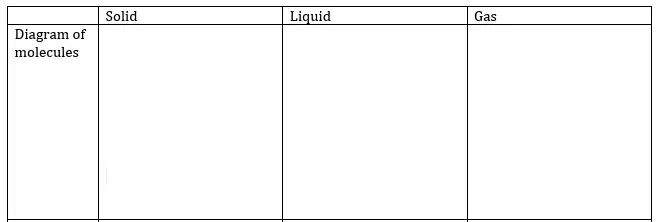
Pull the lever down to cool until the temperature reaches 0 K (-273 °C). Describe what happens to the particles.
Now, add heat until you reach an extremely high temperature. Observe what is happening to the particles as they heat up. What would happen if the container reached a maximum temperature?
The container would implode (collapse inward)
The container would explode.
The particles would be destroyed.
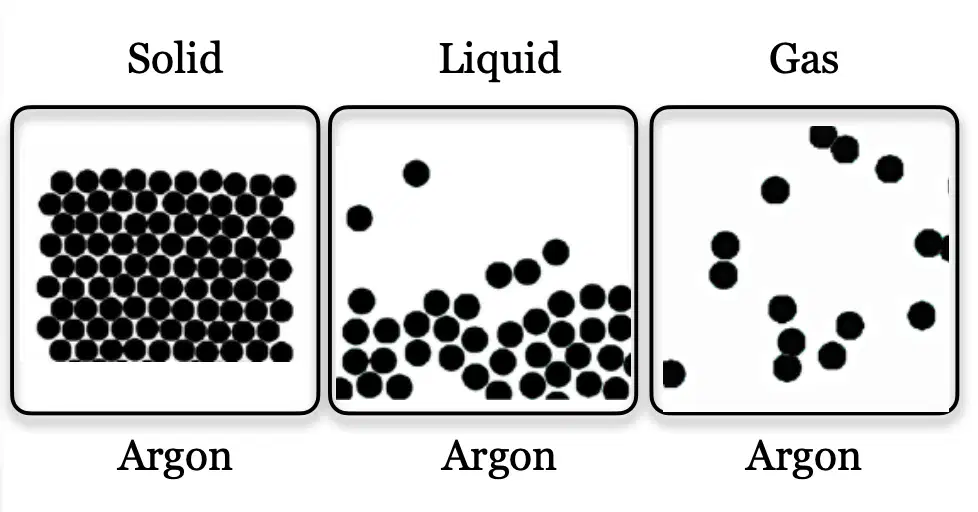
The state of matter in which the atoms are close together and slide past each other, but not held in place.
liquid
solid
gas
The state in which atoms are loosely packed and tend to completely fill the container. and take the shape of the container.
liquid
solid
gas
The state in which atoms are tightly packed and tend to keep their shape.
liquid
solid
gas

Look at the picture. Which state of matter is in beaker A?
Solid
Liquid
Gas
Blue thingys
Look at the picture. Which state of matter is in beaker C?
Solid
Liquid
Gas
Blue thingys

This is the element (a) , as shown in the PhET simulation, and the state of matter shown is a (b)
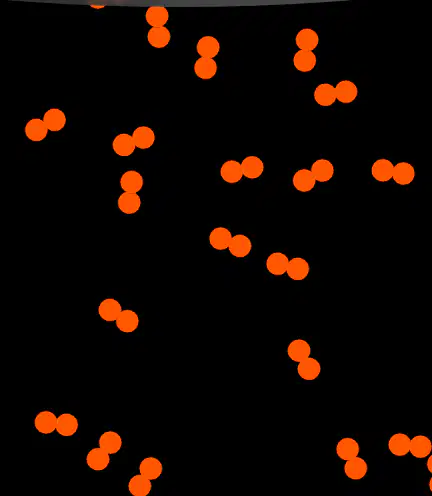
This is the element (a) , as shown in the PhET simulation, and the state of matter is a (b) .
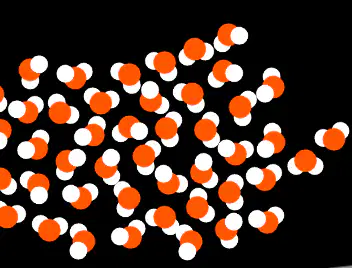
This is the molecule (a) , as shown in the PhET simulation, and the state of matter is a (b) .

This is the element (a) , as shown in the PhET simulation, and the state of matter is a (b) .

This is the molecule (a) , as shown in the PhET simulation, and the state of matter is a (b) .

This is the element (a) , as shown in the PhET simulation, and the state of matter is a (b) .
In the States section, observe how temperature and particle motion are related in different states of matter. What happens to the particles in a solid as the temperature increases?
A) The particles move more slowly and stay in place.
B) The particles move more quickly and stay in fixed positions.
C) The particles move more quickly and can break free from their fixed positions.
D) The particles do not move at all.
In the States section, observe how the temperature affects the particle motion in gases and liquids. Which state of matter has particles that are spaced far apart and move rapidly?
A) Solid
B) Liquid
C) Gas
D) Plasma
In the States section, experiment with different temperatures and observe the changes in the states of matter. What happens when a gas is cooled?
A) The particles move faster.
B) The gas expands.
C) The gas turns into a liquid.
D) The gas freezes into a solid.
In the States section, compare how the particles in solids, liquids, and gases behave at different temperatures. What happens to the particles of a liquid as it is heated?
A) The particles slow down and move closer together.
B) The particles speed up and move farther apart.
C) The particles stay the same and remain in place.
D) The particles freeze and turn into a solid.
In the States section, observe how increasing the temperature affects the volume of gases. What happens to the volume of a gas if the temperature increases and the pressure is kept constant?
A) The volume decreases.
B) The volume remains the same.
C) The volume increases.
D) The gas turns into a liquid.
In the States section, observe how particles in different states behave at various temperatures. Which state of matter is characterized by particles that are close together but able to move around each other?
A) Solid
B) Liquid
C) Gas
D) Plasma
In the Phase changes section, observe how matter changes between solid, liquid, and gas states. What occurs during the process of freezing?
A) A liquid turns into a gas.
B) A gas turns into a liquid.
C) A liquid turns into a solid.
D) A solid turns into a liquid.
In the Phase changes section, experiment with adding and removing heat to observe changes in states of matter. What happens when heat is added to a solid at its melting point?
A) The solid turns into a gas.
B) The solid turns into a liquid.
C) The solid stays frozen.
D) The solid evaporates into vapor.
In the Phase changes section, explore the process of condensation by cooling a gas. What happens when a gas cools and turns into a liquid?
A) The gas turns into a solid.
B) The gas condenses.
C) The gas evaporates.
D) The gas remains unchanged.
Explain how the behavior of particles in a solid, liquid, and gas is related to the changes in temperature and energy.
Describe the process of a substance changing from one state of matter to another, such as from a gas to a liquid. How does energy play a role in this process?
What happens to the particles of a substance during the phase change from liquid to gas (evaporation)? How does temperature affect this process?

The freezing point of water is ____ oC.
20
5
30
The boiling point of water is ____ oC.
20
100
250

