
 Worksheets
Week 3 Quiz: History of Project Management
Total questions: 30
Worksheet time: 3600secs
The origin of modern project management can be traced back to which period?
1900s industrial revolution
Post–World War II era
The 1980s information age
The 21st century digital era
The PERT (Program Evaluation and Review Technique) was first developed for:
NASA Apollo program
U.S. Navy Polaris project
Hoover Dam project
World Bank infrastructure program
Which of the following is NOT one of the 10 PMBOK knowledge areas?
Project Scope Management
Project Time Management
Project Innovation Management
Project Cost Management
According to PMBOK, Project Integration Management mainly deals with:
a) Coordinating project elements
b) Monitoring stakeholders
c) Managing procurement
d) Developing communication plans
Compared to previous project management, today's project management focuses more on:
Static planning
Soft skills such as leadership and communication
Rigid control mechanisms
Minimizing client involvement
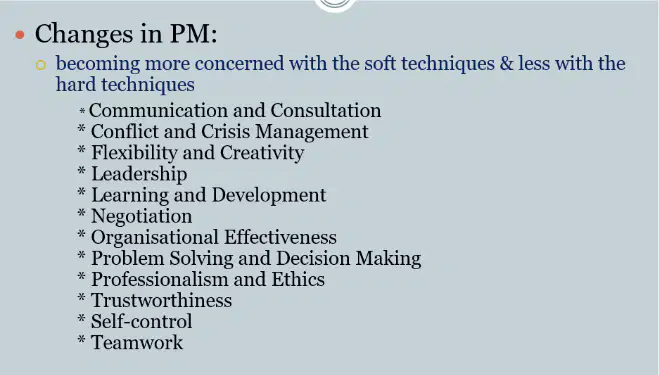
Which of the following is a soft technique?
Leadership
Negotiation
Flexibility and Creativity
Communication and Consultation
Conflict and Crisis Management
7. “Organisational Effectiveness” as mentioned in the slides relates most closely to:
Achieving organizational goals efficiently and effectively
Maximizing individual employee satisfaction
Focusing solely on profit generation
Implementing strict hierarchical structures
Based on the changes in project management (PM) from previous project management to today's project management, which of the following is becoming more important?
Hard technical skills
Leadership and culture within the team
Procurement planning
Risk identification
Previous project management assumed:
Clients frequently change scope
All risks are known
Client objectives and organization remain constant
Project scope is always flexible
The Project Life Cycle typically includes which of the following sequences?
Design → Execution → Procurement → Maintenance
Definition → Planning → Execution → Delivery
Planning → Tendering → Monitoring → Handover
Ideation → Development → Procurement → Review
During the Execution Phase, the primary activities include:
Defining goals and specifications
Creating schedules and budgets
Managing status reports and changes
Training customers
In the Delivery Phase, which activity is commonly performed?
Quality control
Forecasting performance
Transferring documents and lessons learned
Conducting feasibility study
The Technological dimension of project management includes:
Leadership and politics
Scope, WBS, and scheduling
Problem-solving and teamwork
Customer expectations
The Sociocultural dimension focuses primarily on:
Baseline budgets
Resource allocation
Teamwork and negotiation
Schedules
The three primary objectives of project management include:
Quality, Cost, and Scope
Meeting objectives, staying within schedule and budget, and monitoring progress
Staffing, Risk, and Quality
Procurement, Communication, and Integration
In the Project Management Triangle, improving scope usually impacts:
Quality only
Risk only
Time only
Which of the following is a technical dimension of project management?
b) Scope, WBS, and scheduling
c) Problem-solving and teamwork
d) Customer expectations
According to the Project Priority Matrix, a “Constrain” element means:
The factor can be sacrificed
The factor is fixed and must be met
The factor should be optimized
The factor is least important
In a matrix where Time is “Enhance” and Cost is “Accept,” the project manager should:
Delay completion to reduce expenses
Focus on completing earlier even if costs increase
Ignore performance
Maintain strict budget control
A project stakeholder can best be defined as:
Anyone involved in financing
Any individual or group impacted by project outcomes
Only the project sponsor
Only internal team members
Which of the following best defines a project?
Continuous operation with no end date
A temporary endeavor to create a unique product or service
A routine task repeated daily
A short-term maintenance job
One key benefit of project management is:
Quality only
Risk only
None of the above
Time and cost
During the initiation of a construction project, the project manager uses tools like Work Breakdown Structure (WBS) and Gantt charts to define deliverables and sequencing. Which dimension of project management is the manager applying?
Sociocultural Dimension – emphasizing leadership and communication
Technological Dimension – emphasizing planning tools and project control
Economic Dimension – emphasizing cost-benefit optimization
Organizational Dimension – emphasizing stakeholder hierarchy
A contractor is instructed to reduce the project duration by two weeks without changing the total project budget. Based on the Project Management Triangle, which factor will most likely be affected?
Quality – because reducing time often reduces work thoroughness
Cost – because faster work always increases expenses
Scope – because deliverables will automatically expand
Risk – because trade-offs are unrelated to time
To ensure a project meets its goals, it must be designed to meet its _______.
Objectives
Timeline
Contractual obligations
Quality standards
Monitoring and control provide a mechanism to track project _______.
Design
Cost overruns
Progress
Staffing
During the construction of a public infrastructure project, the local residents raise concerns about noise and dust, and the city council requests design modifications. Based on this situation, which statement best describes the role of stakeholders?
Stakeholders are limited to the project team and contractors.
Stakeholders include any individuals or groups who can influence or be influenced by the project's outcome.
Stakeholders only include those who provide project funding.
Stakeholders are external regulators who approve compliance documents.
To balance scope, schedule, and resources, a project manager must manage ______ and communication effectively.
Documentation
Performance
Risk
Procurement
Which of the following is a key benefit of stakeholder engagement in project management?
Increased project costs
Improved project alignment with organizational goals
Limited project scope changes
Reduced project timelines
In project management, what does the term 'scope creep' refer to?
Increased costs due to resource mismanagement
Uncontrolled changes or continuous growth in a project's scope
Reduction in project quality due to time constraints
Delays in project timelines due to unforeseen circumstances

